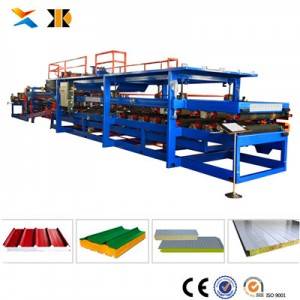


The Hebei Xinnuo Military Camp Modular Composite Panel Production Line is a specialized sandwich panel manufacturing system engineered to produce the flat-wall, modular-format insulated panels that form the building envelope of military accommodation camps, defense force housing, coalition base facilities, and UN peacekeeping compounds across the Middle East. Military camp panels occupy a distinct category within the insulated panel industry — they are neither commodity warehouse panels produced for lowest cost, nor architectural facade panels specified for visual appeal. They are logistics-driven, specification-governed, life-safety-critical building components whose performance requirements are defined not by building codes but by military engineering standards, defense procurement specifications, and the operational realities of deploying habitable structures to remote, hostile-environment locations on compressed timelines with supply chains that may be contested.
The defining characteristic of military camp construction is modularity — the principle that every building component must be transportable in standard ISO shipping containers, assemblable by military engineering units or contracted labor with minimal specialized tools, and, in many cases, disassemblable and relocatable as operational requirements shift. Sandwich panels for military camps are therefore produced to a fundamentally different dimensional and profile standard than commercial construction panels. The panels are typically flat-faced on both sides — no ribs, no corrugations, no exposed profiles — because the smooth surface is required for the standardized interior fit-out systems used in modular military accommodation: prefabricated electrical conduits that clip to flat walls, HVAC ducting that mounts flush against flat ceilings without bridging across rib valleys, and partition wall systems that butt against continuous flat surfaces without the detailing complexity that ribbed panels introduce at every junction. The panel edges are formed with a precision interlocking profile — typically a tongue-and-groove or flat lap-joint — that allows two soldiers or two contracted laborers to lift, position, and secure a panel section without powered lifting equipment, which may not be available at forward deployment sites. Panel dimensions are standardized to multiples of the ISO container footprint: 2.4–3.0 meters in width (matching the internal width of a 20ft or 40ft container for transport), and lengths in increments of 1.2 meters (the standard stud spacing for military modular framing systems) up to 6–9 meters for wall panels and 9–12 meters for roof panels.
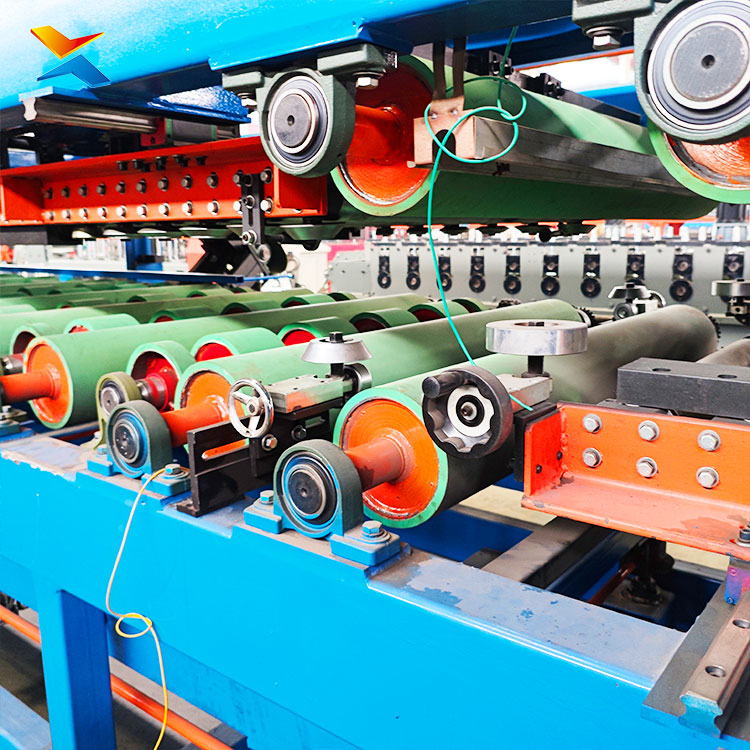
The machine configuration for military camp panel production is accordingly specialized. The forming units are configured for flat-face profiles on both the upper and lower skins — the top skin may incorporate a very shallow stiffening rib for roof panels destined for camps in high-wind desert environments, but wall panels are produced dead-flat on both faces. This requires a forming unit architecture that prioritizes flatness over profile complexity: fewer bending stations (10–14 for flat panels versus 14–18 for ribbed commercial panels), but with tighter roller alignment tolerances because any deviation from dead-flat on a panel that will form the interior wall of a service member’s living quarters is immediately visible and functionally problematic when modular furniture, equipment racks, and partition walls are mounted against it. The forming frame is 300H structural steel with 5.6-ton mass for vibration-damped stability. The roller shafts are Φ70mm for forming and Φ50mm for edge-folding, with hard chrome plating at 0.05–0.08mm for surface finish quality. The feed width is 1200mm, optimized for efficient nesting of standard ISO-container-compatible panel dimensions.
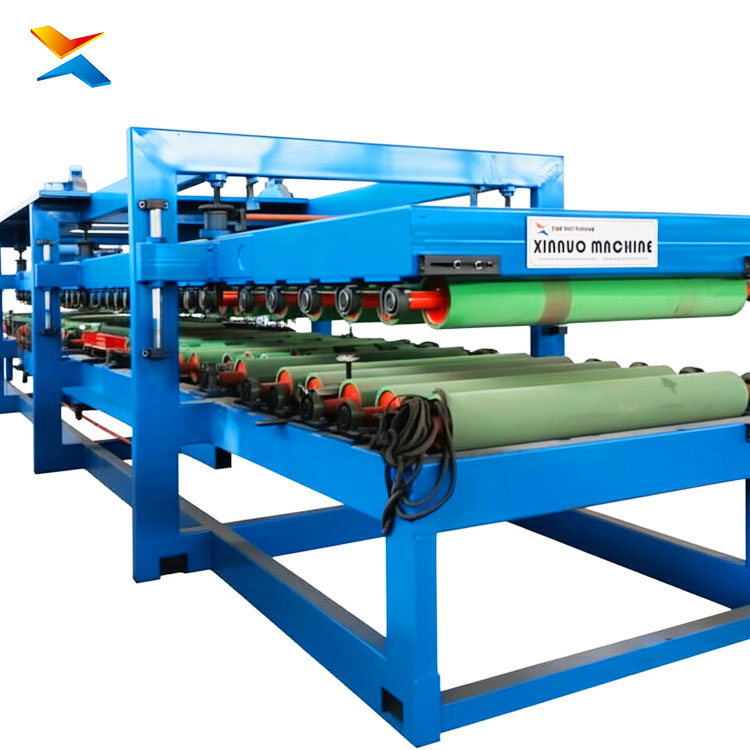
The core material selection for military panels is application-driven. EPS (expanded polystyrene) foam at 50–80mm is the dominant core for accommodation and administrative buildings in temperate and hot-dry climate zones, providing adequate insulation at the lowest weight and cost — critical when every kilogram of building material must be transported by military logistics chains where transport capacity is a zero-sum resource. Rock wool at 75–100mm is specified for buildings requiring fire-rated compartmentalization — ammunition storage annexes, fuel-handling facilities, kitchen and mess buildings, and medical facilities — where A-grade non-combustibility is a non-negotiable military engineering requirement. PU foam at 80–120mm is specified for camps in extreme climate zones (high-altitude or desert-winter locations) where the superior thermal performance (λ≈0.022) justifies the higher material cost through reduced HVAC energy consumption — a significant operational cost for camps relying on diesel-generated power. The 9-meter, 54-roller glue-lamination section with 0.05mm bed flatness handles all three core types with the same process reliability, bonded by the dual-motor dual-inverter quad-glue-pump system with black/white adhesive separation for consistent mix ratio across the long production runs that military panel framework contracts demand.
The ISO 9001 and 14-Year Gold Supplier credentials in the title are not marketing differentiators in the military procurement context — they are minimum qualification thresholds. Military and defense procurement organizations — whether national defense ministries (Saudi Ministry of Defense, UAE Armed Forces GHQ, Qatar Armed Forces), coalition logistics agencies (US Army Corps of Engineers Middle East District, NATO Support and Procurement Agency), or UN procurement bodies (UNPD, UNOPS) — operate under procurement regulations that mandate documented supplier quality management systems (ISO 9001 as the global minimum) and verified supplier stability (demonstrated manufacturing history, financial audit records, and export track record). The 14-year Gold Supplier verification — independently audited by SGS and TÜV — and the ISO 9001:2015 certification provide the documented qualification evidence that passes defense procurement pre-qualification review without the months of bespoke documentation that a non-certified supplier would need to assemble. For a panel producer bidding on a military camp framework contract — where the panel supply agreement may be worth USD 5–20 million over 3–5 years — the difference between pre-qualified and not pre-qualified is not a negotiation. It is a binary gate.
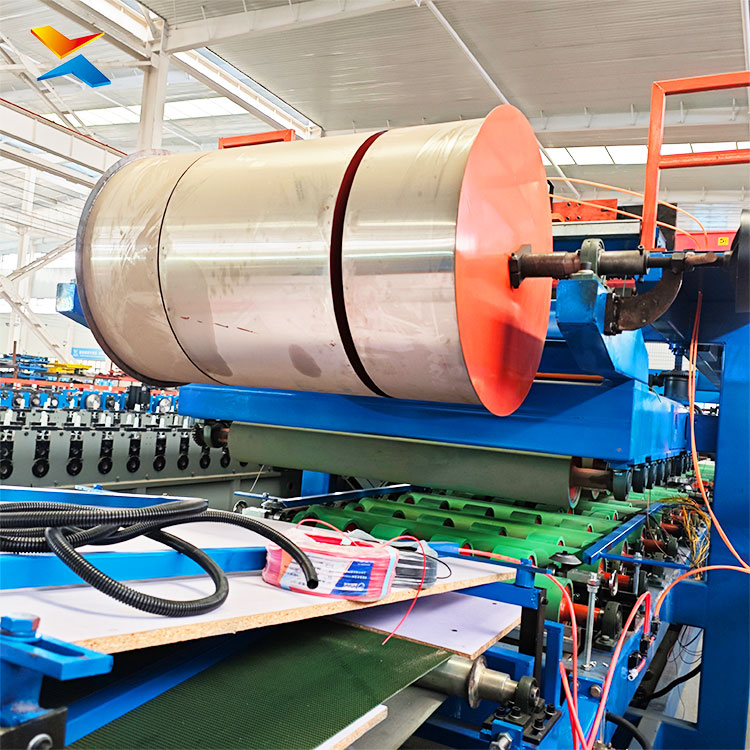
The machine carries the full Xinnuo technology suite within this military-application configuration: dual-blade fly-cut with enclosed dust collection, patented one-way steel belt with four-directional adjustment, 5.9-meter extended conveyor, dual cantilever or A-frame decoilers with brake, self-programmed Delta PLC with touchscreen HMI and SD-card batch logging, and 24/7 WeChat/WhatsApp remote diagnostics. Hebei Xinnuo’s 28-year continuous engineering history, 150+ machines annual output, and installed base across 30+ countries provide the supply chain depth that military panel producers require for multi-year framework contracts with penalty clauses for delivery failure. Standard after-sales includes on-site installation and commissioning by a senior engineer, comprehensive operator training covering military-specification panel quality inspection protocols, and ongoing remote support with spare parts shipped via DHL express to military logistics hubs across the Middle East.


♦ COMPANY PROFILE:
Hebei Xinnuo Roll Forming Machine Co., Ltd., not only produce different types of professional roll forming machines, but also develop intelligent automatic roll forming production lines, C&Z shape purline machines, highway guardrail roll forming machine lines, sandwich panel production lines, decking forming machines, light keel machines, shutter slat door forming machines, downpipe machines, gutter machines, etc.
Advantages of Roll Forming A Metal Part
There are several advantages of using roll forming for your projects:
- The roll forming process allows operations such as punching, notching, and welding to be performed in-line. Labor cost and time for secondary operations are reduced or eliminated, reducing part costs.
- Roll form tooling allows for a high degree of flexibility. A single set of roll form tools will make almost any length of the same cross-section. Multiple sets of tools for varying length parts are not required.
- It can provide better dimensional control than other competing metal forming processes.
- Repeatability is inherent in the process, allowing easier assembly of roll formed parts into your finished product, and minimizing problems due to “standard” tolerance build up.
- Roll forming is typically a higher speed process.
- Roll forming offers customers a superior surface finish. This makes roll forming an excellent option for decorative stainless steel parts or for parts requiring a finish such as anodizing or powder coating. Also, texture or pattern can be rolled into the surface during forming.
- Roll forming utilizes material more efficiently than other competing processes.
- Roll formed shapes can be developed with thinner walls than competing processes
Roll forming is a continuous process which converts sheet metal into an engineered shape using consecutive sets of mated rolls, each of which makes only incremental changes in the form. The sum of these small changes in form is a complex profile.