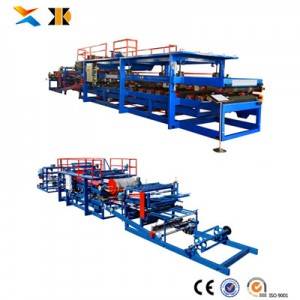


The Hebei Xinnuo Poultry Farm Insulated Sandwich Panel Machine is a purpose-configured composite panel production line engineered for the specific requirements of poultry housing construction across Egypt and the broader MENA region — a market that consumes an estimated 8–12 million square meters of insulated sandwich panels annually for new broiler houses, layer sheds, breeder farms, and hatchery buildings. Poultry farm panels are not a lower-specification variant of general construction panels — they are a functionally distinct product category driven by the biological imperatives of intensive livestock production. A chicken house must maintain an interior temperature of 21–24°C for broilers and 18–22°C for layers with minimal fluctuation, despite external temperatures that regularly reach 40–48°C in the Egyptian summer and drop below 10°C on winter nights in the Nile Delta. The building envelope must resist continuous exposure to internal relative humidity of 60–80% — generated by the respiration of tens of thousands of birds and the evaporative cooling pads that are standard equipment in MENA poultry houses — without delamination, rusting, or losing insulation performance. It must withstand daily exposure to ammonia gas concentrations of 10–25 ppm (parts per million) from decomposing litter, which attacks unprotected steel and standard paint coatings through chemical degradation. And it must present smooth, cleanable interior surfaces that can be washed down with high-pressure water and disinfectant between flock cycles — a biosecurity mandate in a region where avian influenza outbreaks have periodically devastated poultry production. These are not “nice-to-have” specifications. They are the minimum requirements for a panel that will function in a poultry house for its 15–20 year design life without becoming a vector for disease, a sink for energy costs, or a liability for the farm operator.
The machine is configured for the panel specification that dominates MENA poultry construction: EPS (expanded polystyrene) foam core at 50–80mm thickness for walls and 80–100mm for roofs, with white food-grade polyester-coated steel skins on both faces, lap-joint connection, and a smooth interior surface profile with no exposed ribs on the internal face. EPS is the dominant core material for poultry panels — not because it is the cheapest option, but because its closed-cell structure does not absorb moisture from the perpetually humid poultry house atmosphere, unlike open-cell foam alternatives that gradually saturate, lose insulation performance, and add dead weight to the building structure. The white interior skin serves a dual function: it maximizes light reflection to support bird growth (broilers under uniform lighting distribution gain weight more evenly), and it makes contamination immediately visible during the between-flock cleaning process, supporting biosecurity compliance. The lap-joint connection is specified because poultry houses are typically 12–15 meters wide by 80–150 meters long — long, repetitive structures where installation speed is the primary cost driver, and the 30–45 seconds per panel installation time of lap-joint systems directly reduces the construction cost per square meter. The smooth interior profile — achieved by running the panel through the forming unit with the flat face oriented inward — eliminates the dust-trapping rib valleys and screw-head crevices that harbor pathogens between cleaning cycles.
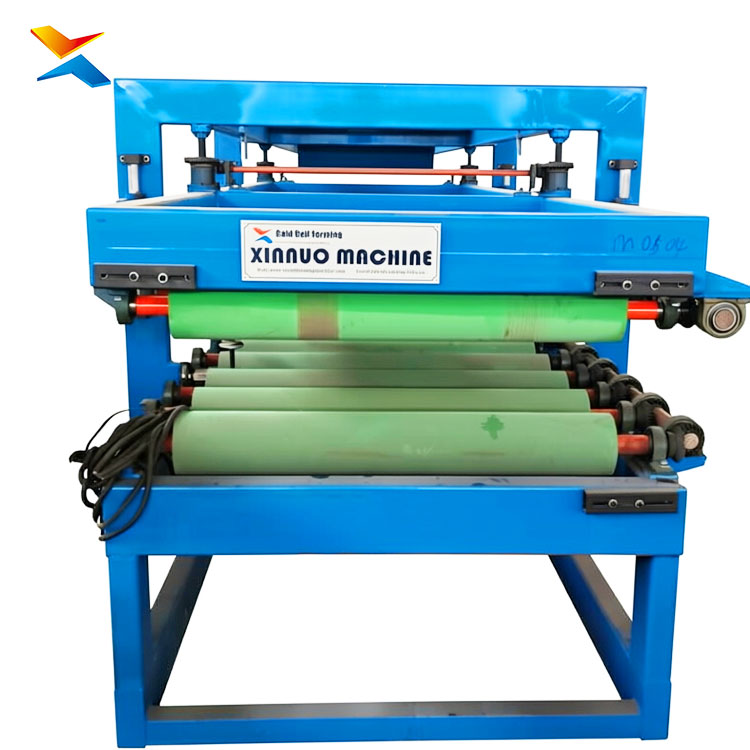
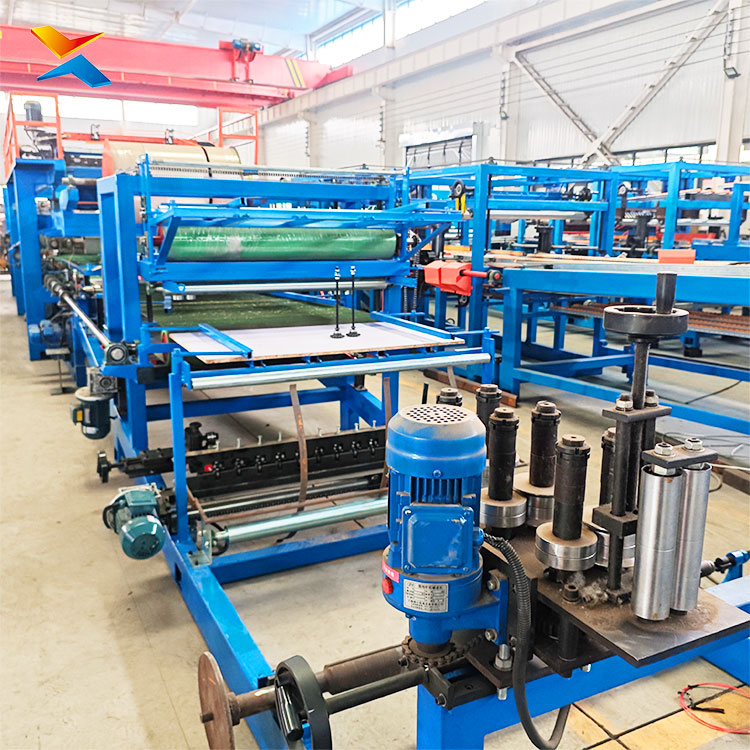
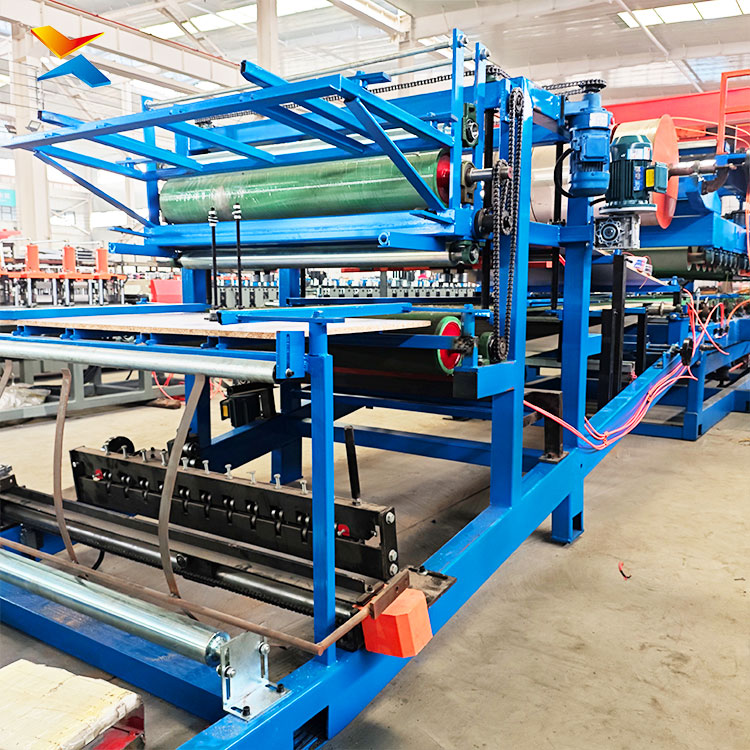
The machine integrates the full Xinnuo composite panel technology stack within a configuration optimized for poultry panel production economics. The 14-station forming units with 300H frame and 5.6-ton mass provide the precision and stability for consistent panel profile across the long, high-volume production runs that poultry farm panel orders demand — a single large-scale poultry project in Egypt typically requires 50,000–120,000 square meters of panels for 20–50 individual houses. The 9-meter 54-roller glue-lamination section on a 0.05mm flatness bed ensures void-free EPS bonding that maintains insulation integrity across the panel’s 15–20 year service life. The dual-motor dual-inverter quad-glue-pump system with black/white adhesive separation maintains consistent mix ratio across multi-shift production. The dual-blade fly-cut with enclosed dust collection keeps the production environment clean — important for a factory that may itself be audited by poultry integrators for biosecurity compliance. The patented one-way steel belt prevents the belt-jamming downtime that is particularly costly during the compressed pre-summer construction window when Egyptian poultry companies rush to complete new houses before the extreme heat arrives. The self-programmed Delta PLC with SD-card batch logging provides the production traceability that large poultry integrators — companies like Egypt’s Cairo Poultry Company, Dakahlia Poultry, and Wadi Group, or Morocco’s Zalar Holding — increasingly require in their supplier quality agreements.
The 14-Year Gold Supplier and CE certifications in the title address the two dimensions of buyer confidence that matter most in the MENA poultry equipment market. The 14-year Gold Supplier verification — independently audited by SGS and TÜV on Alibaba.com — provides documented evidence of Hebei Xinnuo’s manufacturing capability, financial stability, and export track record, addressing the “will this supplier still exist to support my machine in 10 years” concern that is paramount for capital equipment buyers. The CE certification — issued by an EU Notified Body under the Machinery Directive 2006/42/EC — provides third-party verification of machine safety and quality that supports the panel producer’s own qualification when supplying panels to poultry projects funded by international development banks (World Bank, EBRD, African Development Bank) or European development finance institutions, which routinely require CE-marked production equipment in their procurement specifications. With 28 years of continuous cold roll forming engineering, ISO 9001:2015 certified manufacturing, and an installed base spanning 30+ countries including multiple poultry industry customers in the MENA region, Hebei Xinnuo provides the supply chain depth and technical support that poultry panel production demands — from on-site installation and operator training to 24/7 WeChat/WhatsApp remote diagnostics and a spare parts logistics network that delivers to Cairo, Alexandria, Casablanca, and Algiers via DHL express.


♦ COMPANY PROFILE:
Hebei Xinnuo Roll Forming Machine Co., Ltd., not only produce different types of professional roll forming machines, but also develop intelligent automatic roll forming production lines, C&Z shape purline machines, highway guardrail roll forming machine lines, sandwich panel production lines, decking forming machines, light keel machines, shutter slat door forming machines, downpipe machines, gutter machines, etc.
Advantages of Roll Forming A Metal Part
There are several advantages of using roll forming for your projects:
- The roll forming process allows operations such as punching, notching, and welding to be performed in-line. Labor cost and time for secondary operations are reduced or eliminated, reducing part costs.
- Roll form tooling allows for a high degree of flexibility. A single set of roll form tools will make almost any length of the same cross-section. Multiple sets of tools for varying length parts are not required.
- It can provide better dimensional control than other competing metal forming processes.
- Repeatability is inherent in the process, allowing easier assembly of roll formed parts into your finished product, and minimizing problems due to “standard” tolerance build up.
- Roll forming is typically a higher speed process.
- Roll forming offers customers a superior surface finish. This makes roll forming an excellent option for decorative stainless steel parts or for parts requiring a finish such as anodizing or powder coating. Also, texture or pattern can be rolled into the surface during forming.
- Roll forming utilizes material more efficiently than other competing processes.
- Roll formed shapes can be developed with thinner walls than competing processes
Roll forming is a continuous process which converts sheet metal into an engineered shape using consecutive sets of mated rolls, each of which makes only incremental changes in the form. The sum of these small changes in form is a complex profile.