


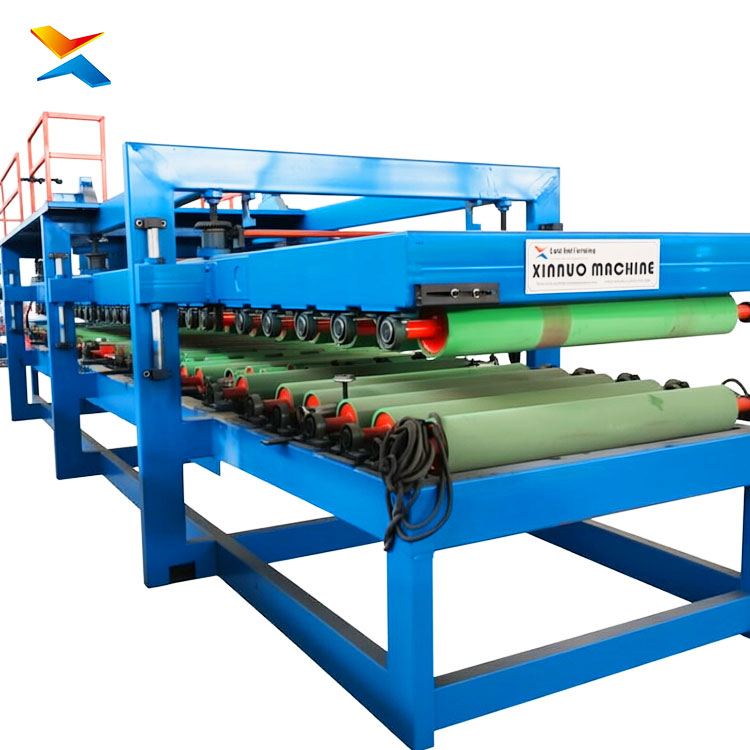
The Hebei Xinnuo Self-Locking Composite Panel Production Line is a precision roll forming system engineered to produce one of the most architecturally desirable — and mechanically demanding — sandwich panel joint profiles in the insulated panel industry: the self-locking concealed-fastener system. Unlike standard lap-joint panels where overlapping edges are secured with exposed screws penetrating through both panel faces, self-locking panels use a precision male-female snap-fit interlock that mechanically engages along the full panel edge without a single visible fastener on the finished building facade. The result is a perfectly clean, uninterrupted wall or roof surface — no screw heads, no plastic caps, no sealant beads breaking the visual plane — which is why self-locking panels are the specified product for premium commercial architecture, high-end retail facades, corporate headquarters, airport terminals, and any project where the building envelope is intended to be looked at, not just looked through.
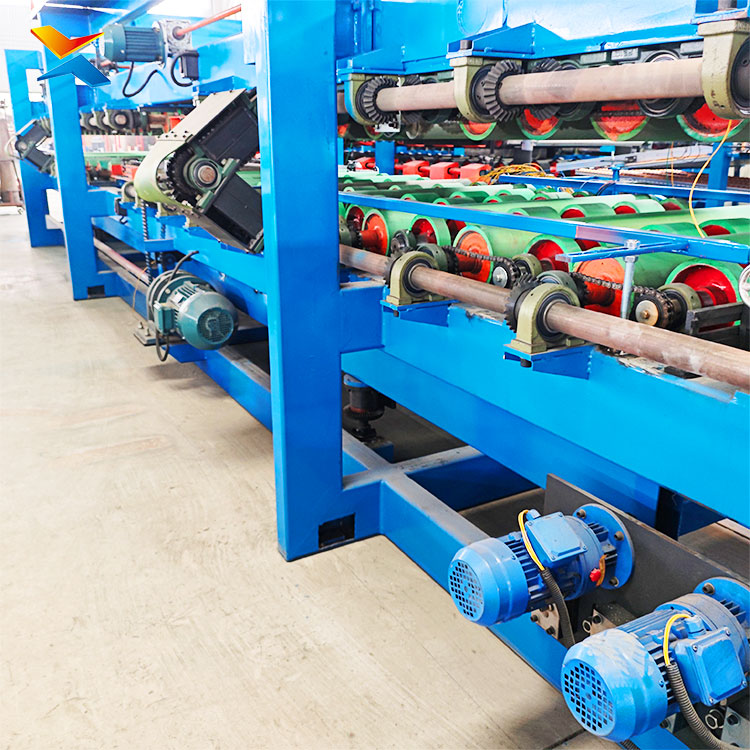
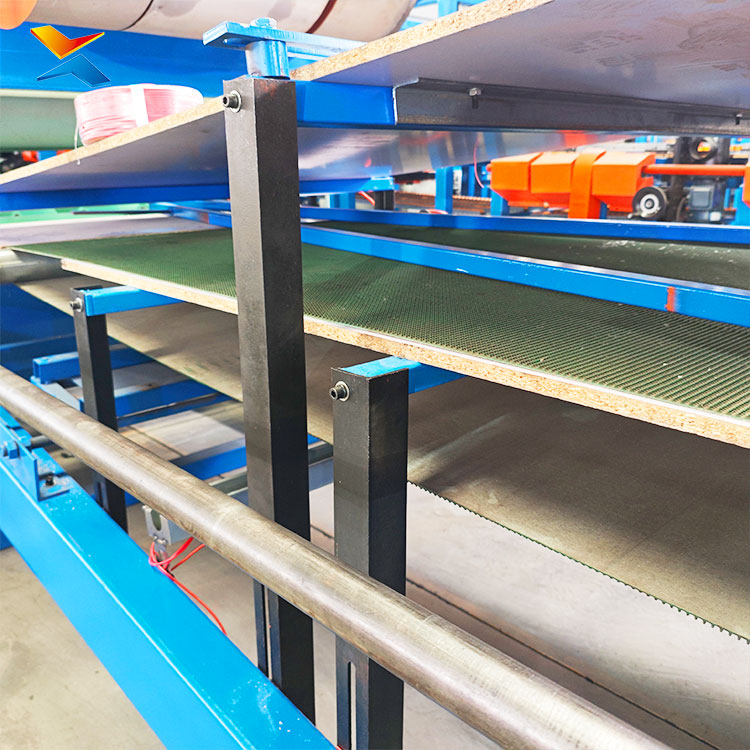
This visual purity comes at an engineering cost that separates capable manufacturers from pretenders. A lap-joint edge profile requires 2-4 simple forming bends — a 90° flange, perhaps a return fold, and a small interlock hook — distributed across 2-4 dedicated edge-forming stations within the standard 14-station forming train. A self-locking edge profile requires approximately 5-7 precision bends per edge: a male snap profile on one panel edge featuring a controlled-radius return fold with an undercut locking shoulder, and a complementary female receiving channel on the opposite edge with a spring-compensated retention lip that grips the male profile with sufficient mechanical interference to resist wind uplift without requiring screw fasteners. These compound edge profiles demand approximately 6-8 dedicated edge-forming roller stations — roughly double the edge-forming allocation of a lap-joint machine — each executing an incremental bend of 8-12° to preserve the zinc coating and paint layer integrity through the forming sequence. The mechanical interference between the male and female profiles must be engineered to a tolerance of ±0.2mm: too loose, and wind-driven rain penetrates the joint; too tight, and the panels cannot be snapped together by installers working on scaffolding at height. This ±0.2mm window, maintained across millions of linear meters of panel production over years of machine operation, is what defines a properly engineered self-locking panel machine — and it is what the Xinnuo system delivers through its 0.05mm glue-bed flatness, precision-ground GCr15 bearing steel rollers with hard chrome plating, and 300H structural frame rigidity that prevents the micron-scale roller alignment drift that gradually erodes edge profile accuracy over extended production runs.
The 1200mm feed width specified in the title is the industry-standard coil width for composite panel production — the dimension from which panels with effective widths of 950mm to 1050mm are formed, with the 200-250mm difference consumed by the edge profiles, joint overlaps, and trimming allowances. The 1200mm standard exists because steel mills worldwide produce color-coated coil in 1200mm and 1250mm widths as their primary stock dimensions for the construction panel industry, meaning 1200mm-compatible machines can source raw material from any supplier globally without requiring slit-to-width processing that adds cost and lead time. The Xinnuo self-locking line is configured to maximize material yield from 1200mm coils — the roller profiles are computationally optimized to position the male and female edge geometries such that trim waste is minimized and the effective panel width is maximized, producing 1000-1050mm effective coverage from a standard 1200mm coil. This yield optimization alone can save a Middle East panel producer 3-5% in annual raw material cost compared to a machine with suboptimal profile nesting.
The CE certification referenced in the title has been issued by an EU Notified Body following a full conformity assessment against the Machinery Directive 2006/42/EC, covering risk assessment (EN ISO 12100), safety-related control systems (EN ISO 13849), electrical safety (EN 60204-1), and guarding (EN ISO 14120). For Middle East panel producers supplying self-locking panels to projects designed by European architectural firms — which is the norm for the premium commercial and institutional buildings where self-locking panels are specified — CE certification on the production equipment provides documented, third-party-verified quality assurance that supports the panel producer’s own material submittal and supplier qualification documentation. The machine carries the full Xinnuo technology suite: 14-station forming units with 300H frame and 5.6-ton mass, 9-meter 54-roller glue-lamination section on a 0.05mm flatness bed, dual-motor dual-inverter quad-glue-pump adhesive system, patented one-way steel belt, dual-blade fly-cut with dust collection, and self-programmed Delta PLC with SD-card batch logging and 24/7 remote diagnostic capability. Standard after-sales includes on-site installation and commissioning by a senior engineer, comprehensive operator training covering self-locking edge profile quality inspection protocols, and ongoing WeChat/WhatsApp support. Hebei Xinnuo’s 28-year engineering track record, 14-year Alibaba Gold Supplier verification, and 150+ machines annual output ensure that the supply chain, technical support, and spare parts infrastructure behind your machine are as reliable as the machine itself.


♦ COMPANY PROFILE:
Hebei Xinnuo Roll Forming Machine Co., Ltd., not only produce different types of professional roll forming machines, but also develop intelligent automatic roll forming production lines, C&Z shape purline machines, highway guardrail roll forming machine lines, sandwich panel production lines, decking forming machines, light keel machines, shutter slat door forming machines, downpipe machines, gutter machines, etc.
Advantages of Roll Forming A Metal Part
There are several advantages of using roll forming for your projects:
- The roll forming process allows operations such as punching, notching, and welding to be performed in-line. Labor cost and time for secondary operations are reduced or eliminated, reducing part costs.
- Roll form tooling allows for a high degree of flexibility. A single set of roll form tools will make almost any length of the same cross-section. Multiple sets of tools for varying length parts are not required.
- It can provide better dimensional control than other competing metal forming processes.
- Repeatability is inherent in the process, allowing easier assembly of roll formed parts into your finished product, and minimizing problems due to “standard” tolerance build up.
- Roll forming is typically a higher speed process.
- Roll forming offers customers a superior surface finish. This makes roll forming an excellent option for decorative stainless steel parts or for parts requiring a finish such as anodizing or powder coating. Also, texture or pattern can be rolled into the surface during forming.
- Roll forming utilizes material more efficiently than other competing processes.
- Roll formed shapes can be developed with thinner walls than competing processes
Roll forming is a continuous process which converts sheet metal into an engineered shape using consecutive sets of mated rolls, each of which makes only incremental changes in the form. The sum of these small changes in form is a complex profile.


