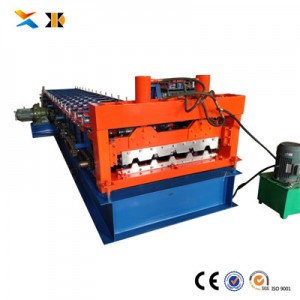


Double Layer Automatic Deck Sheet Former – Why Automation Matters More in Floor Deck Than Anywhere
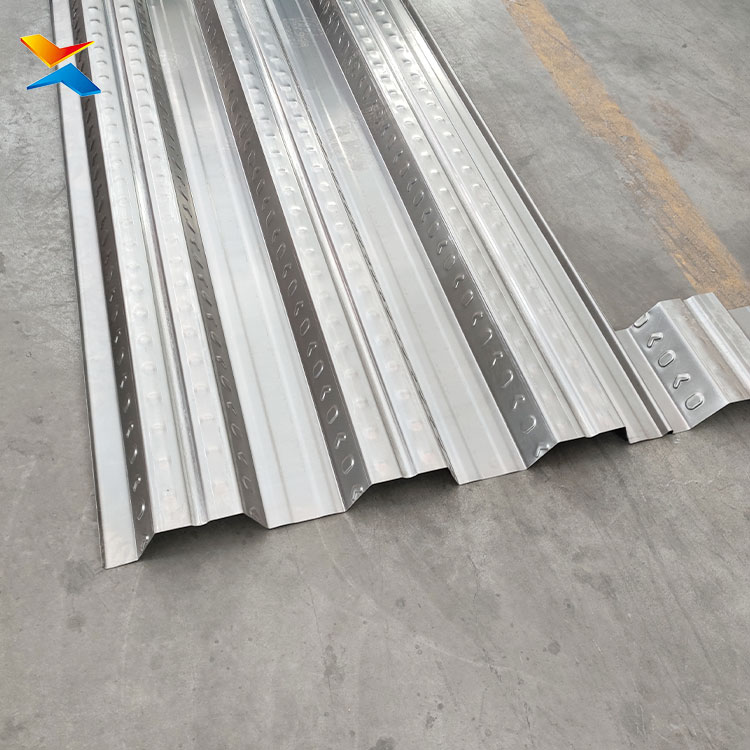
The floor deck sheet is the hardest product in the roll forming workshop: ribs 50–153 mm deep, steel 0.8–1.5 mm thick, forming rows up to 34, and friction inside the machine high enough to jam material if any station falls out of coordination. This is the product class where “automatic” is not a comfort feature — it is survival. A deck machine’s automatic systems do not simply save labor; they hold the deep-rib forming process in the narrow band where thick steel forms cleanly instead of jamming, scratching, or drifting out of tolerance.
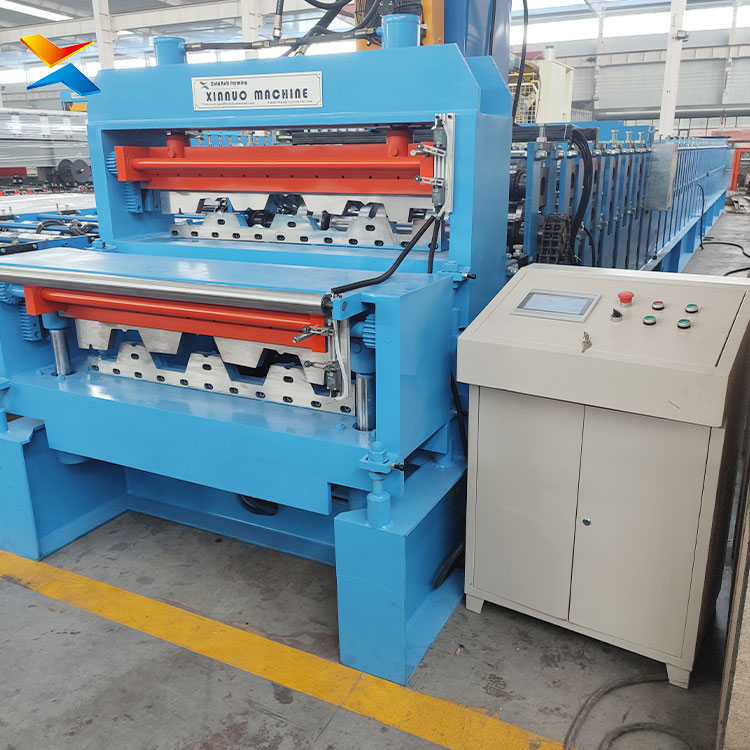
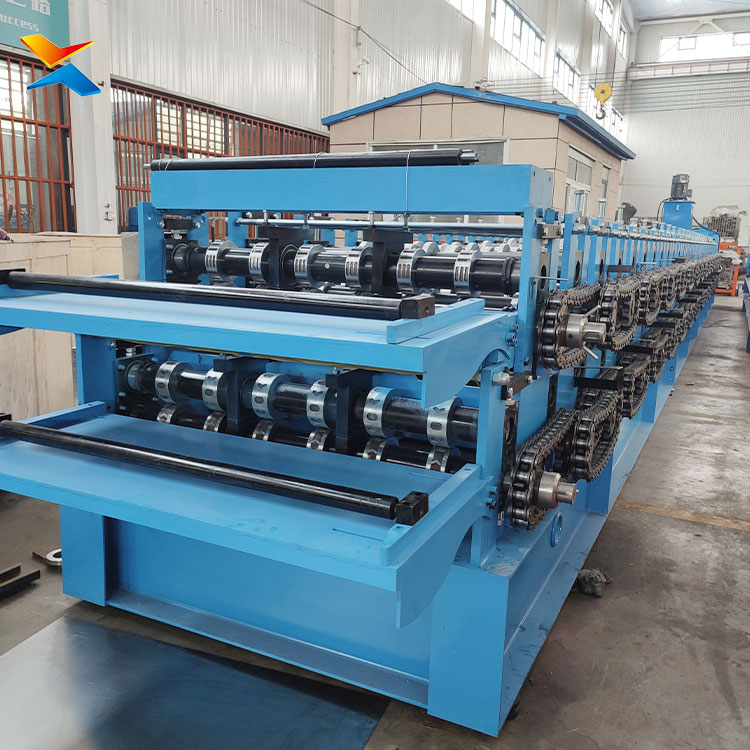
The Xinnuo double layer automatic deck sheet former puts two deck profiles on one frame with the automation engineered for this demanding class: automatic conveying, automatic coordination of the anti-pooling devices, automatic length-measured cutting by the dual-cylinder floor-standing shear, and gravity stacking — on both layers, switched by material path. It is built on 71 production-proven profiles (LB001–LB071, 2011–2025) — one of the factory’s highest-technical-requirement product lines.
What the Title Says, Decoded
- Steel Floor Decking Roll Forming Machine — the machine class that forms structural steel floor decks: deep-rib, thick-material, load-bearing permanent formwork for composite concrete floors.
- Double Layer — two deck profiles on one frame: two roller sets, switch the material path, run either profile on one footprint.
- Automatic Deck Sheet Former — the automatic system that turns coil into cut, stacked deck sheets without manual handling between stations.
Why “Automatic” Is Different Here
On a roof sheet machine, automation mainly saves labor — the forming task is gentle enough that manual operation still produces acceptable work. On a floor deck machine, automation holds the process together: the dimple wheels must be disconnected at the right moment (the clutch), the rear forming wheels must push rather than pull (bearing-mounted oversized wheels), the drive must deliver torque no operator can compensate for (dual motors through 2-inch chain), and the cut must be balanced across a full-width thick sheet (dual-cylinder shear). Automation in the deck class is the difference between a line that runs and a line that fights its operator — and the double layer machine doubles the system.



♦ COMPANY PROFILE:
Hebei Xinnuo Roll Forming Machine Co., Ltd., not only produce different types of professional roll forming machines, but also develop intelligent automatic roll forming production lines, C&Z shape purline machines, highway guardrail roll forming machine lines, sandwich panel production lines, decking forming machines, light keel machines, shutter slat door forming machines, downpipe machines, gutter machines, etc.
Advantages of Roll Forming A Metal Part
There are several advantages of using roll forming for your projects:
- The roll forming process allows operations such as punching, notching, and welding to be performed in-line. Labor cost and time for secondary operations are reduced or eliminated, reducing part costs.
- Roll form tooling allows for a high degree of flexibility. A single set of roll form tools will make almost any length of the same cross-section. Multiple sets of tools for varying length parts are not required.
- It can provide better dimensional control than other competing metal forming processes.
- Repeatability is inherent in the process, allowing easier assembly of roll formed parts into your finished product, and minimizing problems due to “standard” tolerance build up.
- Roll forming is typically a higher speed process.
- Roll forming offers customers a superior surface finish. This makes roll forming an excellent option for decorative stainless steel parts or for parts requiring a finish such as anodizing or powder coating. Also, texture or pattern can be rolled into the surface during forming.
- Roll forming utilizes material more efficiently than other competing processes.
- Roll formed shapes can be developed with thinner walls than competing processes
Roll forming is a continuous process which converts sheet metal into an engineered shape using consecutive sets of mated rolls, each of which makes only incremental changes in the form. The sum of these small changes in form is a complex profile.
-
Customizable Floor Deck Roll Forming Machine | ...
-
Floor Decking Panels Roll Forming Machine iron ...
-
Galvanized Steel Floor Deck Machine | Hydraulic...
-
Heavy-Duty Floor Deck Machine | High-Strength S...
-
High Efficiency Floor Deck Making Machine | Ene...
-
Double Layer Floor Deck Roll Forming Machine St...