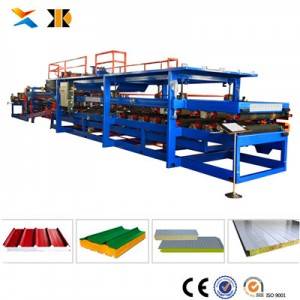


The Hebei Xinnuo Livestock Building Insulated Panel Machine is a composite panel production line purpose-configured for the agricultural construction sector of the GCC — a market driven by the region’s strategic investment in domestic food production capacity under national food security programs that have accelerated since 2020. Livestock buildings — dairy cow housing, cattle feedlots, sheep and goat sheds, camel barns, and poultry houses — represent a distinct category of insulated panel application that is neither commercial warehouse construction nor industrial cold storage, and the panels they require are correspondingly specialized. A livestock building in the GCC must reconcile three seemingly contradictory requirements: it must maintain interior temperatures below 28°C for dairy cattle (above which milk yield drops measurably) despite external temperatures that routinely reach 48–50°C in Saudi Arabia’s Central Province and the UAE interior; it must withstand continuous internal relative humidity of 70–90% generated by animal respiration, evaporative cooling systems, and daily high-pressure washdown of manure alleys, without panel delamination or insulation degradation over a 15–20 year service life; and it must be cost-competitive on a per-square-meter-installed basis because livestock farming operates on commodity margins where every riyal of construction cost per cow place directly impacts the investment’s return period. These three requirements — extreme thermal performance, extreme moisture resistance, and extreme cost discipline — define the panel specification and the machine configuration that produces it.
The 5-peak roof profile highlighted in the title is the panel industry’s optimal solution for livestock building roofs across the GCC. The “5-peak” designation refers to the number of longitudinal stiffening ribs formed into the panel’s exterior face — five raised trapezoidal ribs distributed across the panel width that serve a dual structural function. First, the ribs increase the panel’s section modulus (bending stiffness) by approximately 40–60% compared to a flat panel of equivalent steel thickness and core material, enabling the panel to span 3–4 meters between roof purlins without excessive deflection under the combined loads of its own weight, wind uplift (a significant factor in GCC open-terrain locations), and the occasional maintenance worker accessing the roof. Livestock buildings are typically clear-span structures 20–40 meters wide with purlin spacing driven by structural steel economics; a panel that can span wider purlin spacing reduces the number of purlins required, directly lowering the building’s steel frame cost. Second, the 5-rib geometry creates channels between the ribs that act as drainage paths, directing rainfall and condensation toward the eaves — an important detail for livestock buildings where roof condensation dripping onto animals or feed is both a welfare issue and a feed-spoilage concern. The 5-peak configuration is favored over 3-peak (deeper ribs, fewer of them, more drainage capacity but less uniform support) and 6-peak (shallower ribs, more of them, less structural stiffness) because it provides the best balance of span capability, drainage performance, and material efficiency for the 20–40 meter clear spans typical of GCC livestock housing.
The wall panels for livestock buildings use a different profile logic: the interior face is flat and smooth for cleanability — daily washdown of walls in milking parlors, holding areas, and calving pens is a biosecurity and hygiene protocol mandated by GCC dairy regulations aligned with international animal welfare standards — while the exterior face carries a shallow rib profile for wind-load stiffness. The panels are typically specified with EPS (expanded polystyrene) foam core at 50–80mm for walls and 80–120mm for roofs, with white food-grade polyester-coated steel skins on the interior face and PVDF or high-durability polyester-coated steel in light colors on the exterior. EPS is preferred over PU for livestock buildings — despite PU’s superior thermal performance — because EPS has a true closed-cell structure that does not absorb moisture from the high-humidity interior environment, whereas PU foam’s hygroscopic behavior in sustained 70–90% RH can gradually degrade its insulation value. Rock wool is specified only for fire-rated applications (maternity wards, veterinary pharmacies, feed mills attached to the livestock complex) where A-grade non-combustibility is required. The lap-joint connection is standard across walls and roofs — the fastest installation system, critical when a single dairy expansion project may require 80,000–150,000 square meters of panels for multiple cow housing structures built during the narrow winter construction window before summer heat makes outdoor installation work impossible.
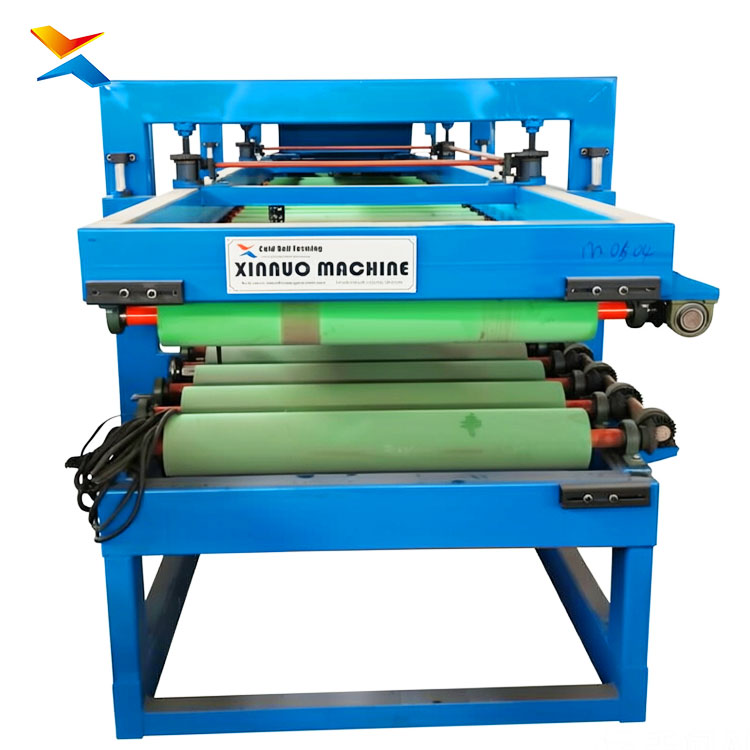
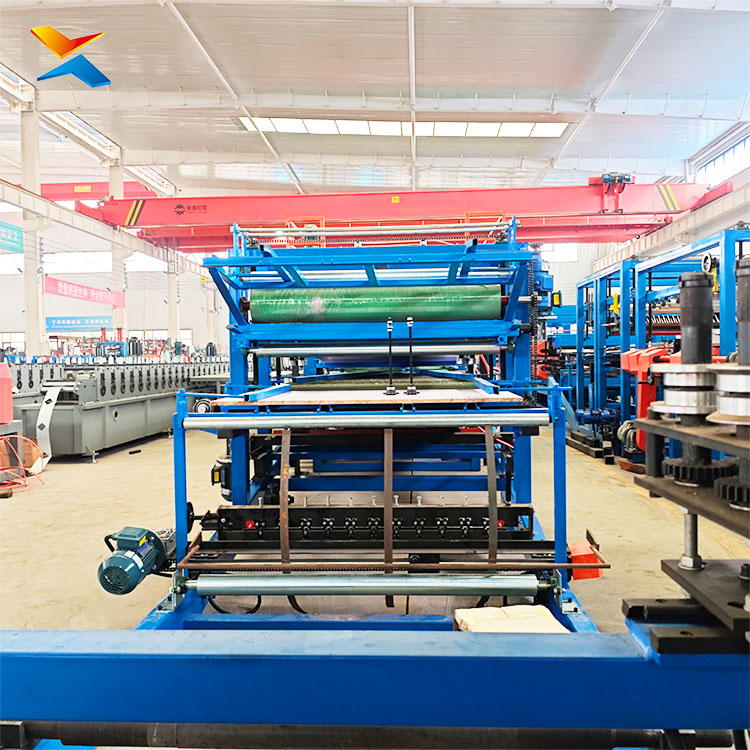
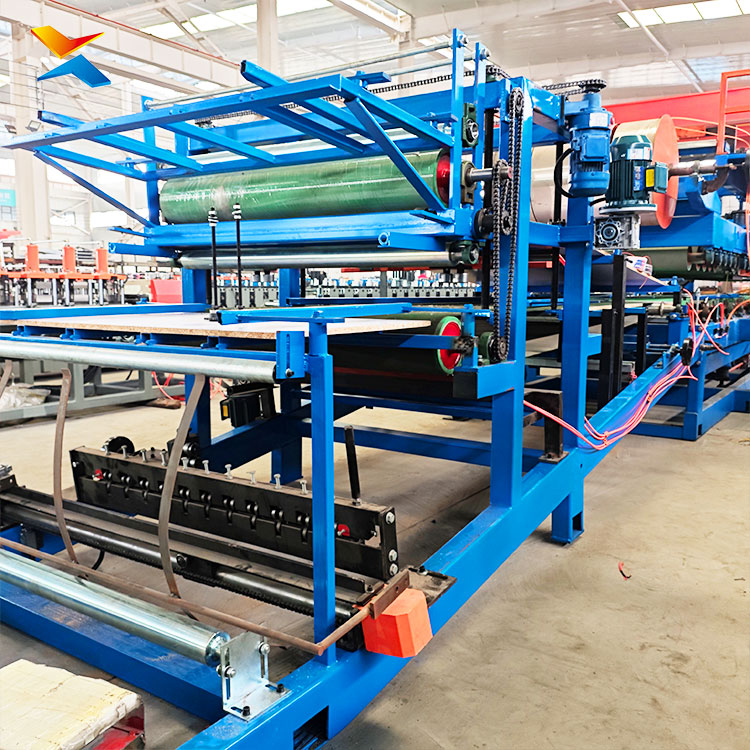
The machine is configured for this dual-profile production requirement — 5-peak roof panels and flat-interior wall panels — on a single line. The upper forming unit produces the 5-peak roof profile with its deep rib geometry spread across the full 14 forming stations for progressive, coating-preserving bending. The lower forming unit produces the flat interior wall profile with 10–12 stations optimized for flatness rather than rib complexity. The 14-station × 2 architecture, 300H frame, 5.6-ton mass, Φ70mm forming shafts, and 14mm mid-plates provide the rigidity for consistent profile accuracy across the high-volume production runs that livestock building projects demand. The 9-meter 54-roller glue-lamination section (0.05mm bed flatness) ensures void-free EPS bonding, critical because any void in the core-to-skin bond in a high-humidity livestock house becomes a condensation trap that initiates progressive delamination. The dual-motor dual-inverter quad-glue-pump system with black/white adhesive separation maintains consistent mix ratio across multi-shift production. The dual-blade fly-cut with enclosed dust collection keeps the production environment clean. The patented one-way steel belt prevents downtime from belt jamming during the rapid size changeovers between wall and roof panel runs. The self-programmed Delta PLC with SD-card batch logging provides production traceability.
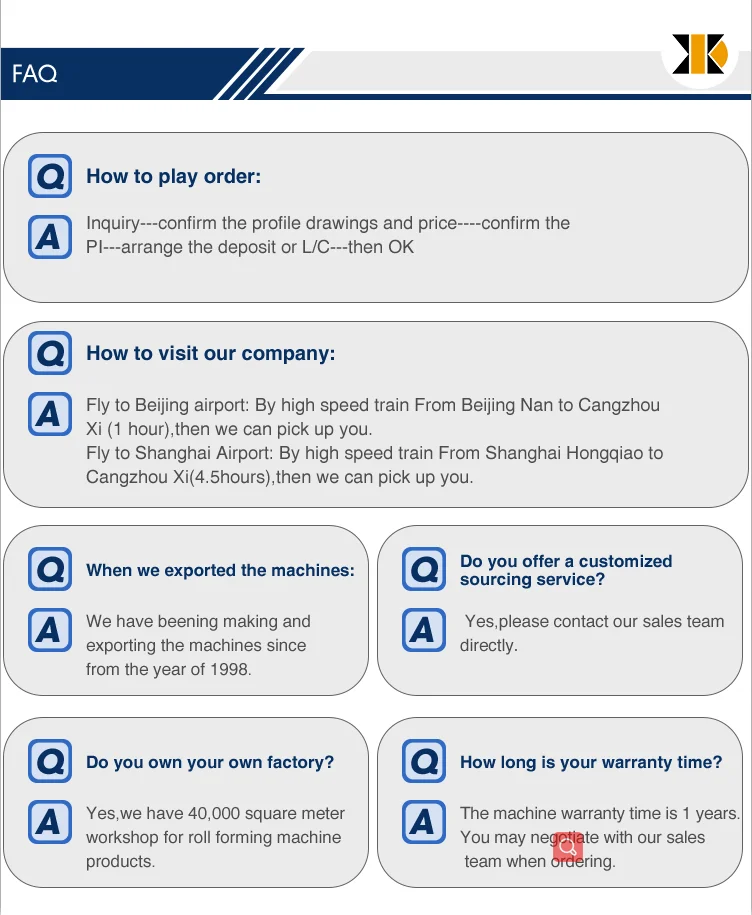
The 14-Year Gold and CE certifications provide the documented supplier qualification that GCC livestock industry procurement demands. Large dairy and livestock companies — Almarai (the world’s largest vertically integrated dairy company, headquartered in Saudi Arabia), Nadec, Al Safi Danone, National Food Products Company (UAE), Al Rawabi (UAE), and Baladna (Qatar) — operate supplier pre-qualification systems modeled on the ISO 9001 framework that their own operations are certified to. When these companies tender for new livestock housing construction, the panel supplier’s production equipment certification forms part of the technical submission. Hebei Xinnuo’s 14-year Gold Supplier verification (independently audited by SGS and TÜV), ISO 9001:2015 certification, and CE certification (Notified Body audited) provide the three-legged qualification stool that passes these reviews. With 28 years of continuous cold roll forming engineering, 150+ machines annual output, and an installed base across 30+ countries, Xinnuo provides the supply chain depth that livestock building panel producers require. Standard after-sales includes on-site installation and commissioning, operator training covering agricultural panel quality inspection, and 24/7 remote support with DHL express spare parts delivery to GCC logistics hubs.


♦ COMPANY PROFILE:
Hebei Xinnuo Roll Forming Machine Co., Ltd., not only produce different types of professional roll forming machines, but also develop intelligent automatic roll forming production lines, C&Z shape purline machines, highway guardrail roll forming machine lines, sandwich panel production lines, decking forming machines, light keel machines, shutter slat door forming machines, downpipe machines, gutter machines, etc.
Advantages of Roll Forming A Metal Part
There are several advantages of using roll forming for your projects:
- The roll forming process allows operations such as punching, notching, and welding to be performed in-line. Labor cost and time for secondary operations are reduced or eliminated, reducing part costs.
- Roll form tooling allows for a high degree of flexibility. A single set of roll form tools will make almost any length of the same cross-section. Multiple sets of tools for varying length parts are not required.
- It can provide better dimensional control than other competing metal forming processes.
- Repeatability is inherent in the process, allowing easier assembly of roll formed parts into your finished product, and minimizing problems due to “standard” tolerance build up.
- Roll forming is typically a higher speed process.
- Roll forming offers customers a superior surface finish. This makes roll forming an excellent option for decorative stainless steel parts or for parts requiring a finish such as anodizing or powder coating. Also, texture or pattern can be rolled into the surface during forming.
- Roll forming utilizes material more efficiently than other competing processes.
- Roll formed shapes can be developed with thinner walls than competing processes
Roll forming is a continuous process which converts sheet metal into an engineered shape using consecutive sets of mated rolls, each of which makes only incremental changes in the form. The sum of these small changes in form is a complex profile.