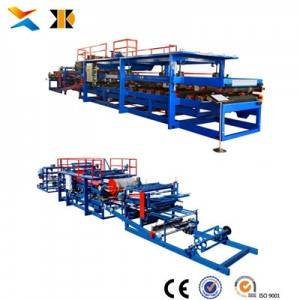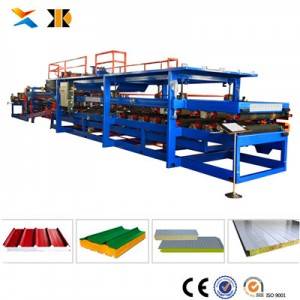


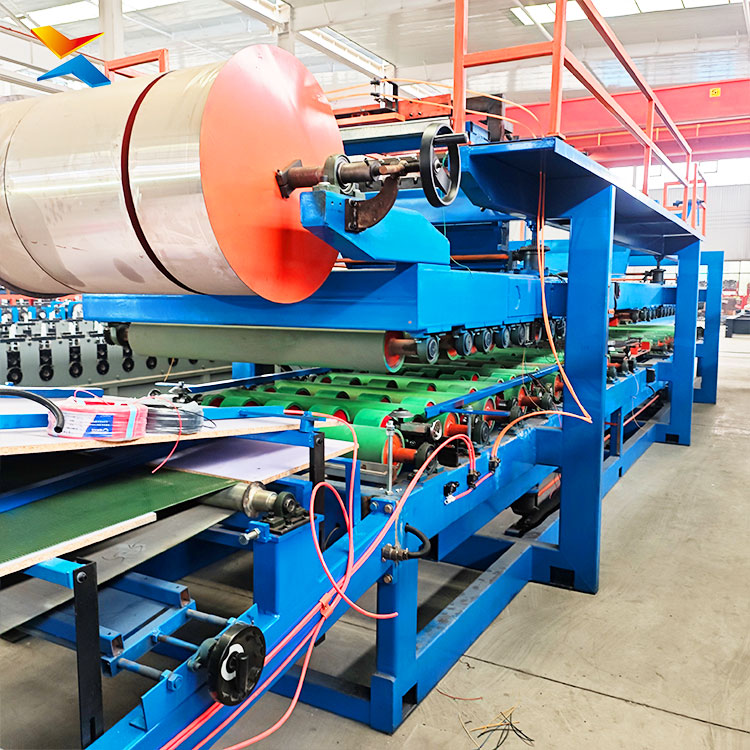
The Hebei Xinnuo Gearbox-Drive Sandwich Panel Roll Former is a precision composite panel production line engineered specifically for the manufacturing environment and market requirements of Algeria and Morocco — two of North Africa’s largest and fastest-growing insulated panel markets. This machine is distinguished from the chain-drive configurations that dominate the composite panel machine market by its gearbox drive system, a mechanical architecture in which each pair of forming roller stations is driven through a dedicated, oil-bath-lubricated, sealed helical gearbox rather than through an open roller-chain and sprocket system. The gearbox drive represents a fundamentally different engineering philosophy about how forming torque should be transmitted across a multi-station roll forming train, and the choice between gearbox and chain drive is one of the most consequential decisions a panel producer makes about the long-term operating characteristics of their production line.
In a chain-drive system — which is the industry standard on the majority of composite panel machines globally — a continuous roller chain runs along the side of the forming unit, engaging sprockets mounted on each roller shaft to transmit torque from the main drive motor through the entire forming train in series. This system has two inherent characteristics that define its operational profile. First, it is an open system: the chain, sprockets, and lubrication points are exposed to the ambient factory environment, meaning that dust, moisture, and airborne contaminants — all of which are present in a sandwich panel factory where EPS foam cutting generates fine particulate, adhesive overspray creates sticky residue, and rock wool processing releases mineral fiber dust — accumulate on the drive components and accelerate wear. Chain drives in panel factories require weekly cleaning and lubrication, and chain replacement every 2–3 years under normal production volumes. Second, it is a series system: torque is transmitted from station to station along the chain, meaning that chain wear, stretch, and sprocket tooth erosion at the early stations progressively degrades the speed synchronization of the later stations. A chain with 0.5% accumulated stretch over its service life causes the outfeed-end rollers to rotate approximately 0.5% slower than the infeed-end rollers for a given motor speed, introducing a subtle longitudinal compression in the panel between the mid-forming and final stations that can produce surface buckling — a particularly damaging defect on panels destined for visible architectural facades.
The gearbox drive system eliminates both characteristics. Each roller station pair — or, in the Xinnuo configuration, each group of two adjacent station pairs — is driven through its own sealed helical gearbox containing precision-ground, hardened steel gears running in an oil bath. The gearboxes are connected in series by a common driveshaft with flexible couplings, but the gear mesh inside each sealed housing is protected from the factory environment by oil seals and gaskets. This architecture delivers three operational advantages that are particularly relevant to the Algeria and Morocco markets. First, maintenance reduction: the sealed gearboxes require only an annual oil-level check and oil change every 3–5 years depending on operating hours — no weekly chain cleaning, no periodic chain tensioning, no sprocket wear inspection. In the Algerian and Moroccan industrial context, where skilled roll forming maintenance technicians may not be as readily available as in established manufacturing hubs, the reduced maintenance burden directly translates to higher machine availability and lower dependence on specialized labor. Second, speed synchronization precision: helical gears transmit torque with near-zero backlash and no cumulative stretch, meaning that the roller speed at station 14 is identical to the roller speed at station 1 within 0.1% over the machine’s service life — no chain-stretch-induced speed drift, no progressive forming misalignment. This precision directly benefits panel profile consistency and surface quality across long production runs. Third, operational quietness: enclosed helical gears operating in an oil bath produce approximately 3–5 dB(A) less noise than an open chain drive of equivalent power transmission capacity, contributing to a better factory working environment — a factor that is increasingly weighted in Algeria and Morocco as industrial workplace regulations align with European standards.
The machine is configured for the panel specifications that dominate the Algerian and Moroccan markets. Both countries have construction sectors heavily influenced by European building standards — a legacy of French and Spanish colonial-era building traditions reinforced by contemporary trade relationships with the EU — which favors panel profiles and quality standards aligned with European norms. The forming units are 14-station configurations with 300H frame and 5.6-ton mass, producing lap-joint wall and roof panels with 950–1050mm effective width from 1200mm feed coils. The panels support EPS, PU, and rock wool cores at 50–200mm thickness, with food-grade or PVDF-coated steel skins. The glue-lamination section is the proven 9-meter, 54-roller configuration on a 0.05mm flatness bed, with the dual-motor dual-inverter quad-glue-pump adhesive delivery system. The patented one-way steel belt, dual-blade fly-cut with enclosed dust collection, and self-programmed Delta PLC with SD-card batch logging complete the technology suite.
The 14-Year Gold Supplier credential carries particular weight in the Algeria-Morocco market context. Both countries have procurement cultures — shaped by decades of trade with European suppliers who emphasize supplier longevity and audited quality systems — where a supplier’s documented history is a primary evaluation criterion, not a secondary consideration. The Alibaba Gold Supplier verification, with its annual SGS/TÜV factory audits spanning 14 consecutive years, provides the independently verified, annually refreshed evidence of manufacturing stability that Algerian and Moroccan panel producers need when presenting their supply chain credentials to their own customers — particularly when those customers are European-owned industrial facilities, government infrastructure projects, or international development bank-funded construction programs that require documented supplier qualification as a condition of material acceptance. The machine also carries ISO 9001:2015 certification and CE certification issued by an EU Notified Body under the Machinery Directive 2006/42/EC — the CE mark being particularly relevant for panel producers supplying projects in Morocco’s Tangier Med and Casablanca industrial zones, where European automotive and aerospace manufacturers operate facilities and specify CE-marked production equipment in their supplier quality requirements. Hebei Xinnuo’s 28-year engineering history, 150+ machines annual output, and installed base across 30+ countries provide the supply chain depth that North African panel producers require for sustained, high-volume production. Standard after-sales includes on-site installation and commissioning by a senior engineer, comprehensive operator training, and 24/7 remote support — with French and Arabic language capability available for technical communication.


♦ COMPANY PROFILE:
Hebei Xinnuo Roll Forming Machine Co., Ltd., not only produce different types of professional roll forming machines, but also develop intelligent automatic roll forming production lines, C&Z shape purline machines, highway guardrail roll forming machine lines, sandwich panel production lines, decking forming machines, light keel machines, shutter slat door forming machines, downpipe machines, gutter machines, etc.
Advantages of Roll Forming A Metal Part
There are several advantages of using roll forming for your projects:
- The roll forming process allows operations such as punching, notching, and welding to be performed in-line. Labor cost and time for secondary operations are reduced or eliminated, reducing part costs.
- Roll form tooling allows for a high degree of flexibility. A single set of roll form tools will make almost any length of the same cross-section. Multiple sets of tools for varying length parts are not required.
- It can provide better dimensional control than other competing metal forming processes.
- Repeatability is inherent in the process, allowing easier assembly of roll formed parts into your finished product, and minimizing problems due to “standard” tolerance build up.
- Roll forming is typically a higher speed process.
- Roll forming offers customers a superior surface finish. This makes roll forming an excellent option for decorative stainless steel parts or for parts requiring a finish such as anodizing or powder coating. Also, texture or pattern can be rolled into the surface during forming.
- Roll forming utilizes material more efficiently than other competing processes.
- Roll formed shapes can be developed with thinner walls than competing processes
Roll forming is a continuous process which converts sheet metal into an engineered shape using consecutive sets of mated rolls, each of which makes only incremental changes in the form. The sum of these small changes in form is a complex profile.
-
Pharma Cleanroom Sandwich Panel Line for GCC | ...
-
eps and rock wool sandwich panel production lin...
-
Flat Bottom Panel Machine for Saudi Container C...
-
Poultry Farm Insulated Sandwich Panel Machine f...
-
sandwich panels production machine line iron sh...
-
Coastal Anti-Corrosion Composite Panel Line for...