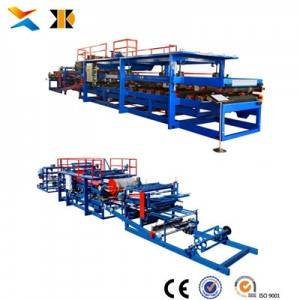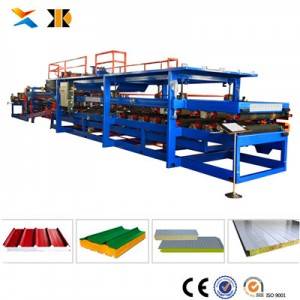


The Xinnuo XN-SP-950 is a dedicated insulated sandwich panel roll forming machine purpose-built for the Middle East’s food processing and cold chain infrastructure sector. The model designation encodes its key production capability: XN for Xinnuo’s engineering lineage, SP for sandwich panel, and 950 for the 950mm effective panel width — the most widely specified dimension for food industry wall and ceiling panels across the region, from cold storage warehouses to commercial kitchen partition systems. Unlike general-purpose composite panel machines that are designed to cover every possible application from warehouse roofing to high-rise cladding, the XN-SP-950 is deliberately optimized for the specific panel profiles, material combinations, and production economics that define food-grade panel manufacturing. This focus is what makes it a workhorse rather than a compromise: every component — from the 6分单排 chain drive to the Delta PLC automation architecture — has been selected to deliver reliable, repeatable quality at the production volumes and cost structures that food industry panel suppliers operate within.
The food processing built environment in the Middle East — spanning the GCC, Levant, and North African markets served through regional distribution — is shaped by three intersecting forces that define panel requirements. First, the region imports approximately 85% of its food, driving massive investment in temperature-controlled logistics infrastructure: cold storage warehouses, blast freezers, refrigerated distribution centers, and portside chillers. These facilities demand insulated panels with high thermal performance (typically PU or high-density EPS cores at 75–150mm thickness) and moisture-resistant surfaces that withstand the condensation cycles inherent to cold environments in hot, humid ambient conditions — a cold store interior at -25°C separated from 45°C/80% RH exterior air by a 100mm panel creates a vapor pressure differential that will drive moisture through any microscopic breach in the panel face unless the skin material and lamination bond are properly specified. Second, food safety regulations aligned with GCC Standardization Organization (GSO) and national food authority codes (Dubai Municipality, Saudi SFDA, Qatar MOPH) increasingly require food processing and storage facilities to use wall and ceiling surfaces that are smooth, non-porous, cleanable, and resistant to food acids and commercial cleaning chemicals — requirements that rule out standard ribbed-profile panels with their dust-trapping valleys and exposed screw fasteners. Third, the rapid expansion of commercial food service — hotel central kitchens, catering facilities, restaurant chain commissaries — across the region’s hospitality and tourism sector creates sustained demand for cost-effective, quickly installable modular panel systems that balance hygiene compliance with construction speed.
The XN-SP-950 addresses all three forces with a machine configuration that prioritizes versatility within the food-grade panel envelope. The forming units are qualified to run 304 stainless steel skins (0.4–0.6mm) for direct food-contact zones and wet-processing areas where daily high-pressure washdown with chlorinated cleaning solutions is standard practice, as well as food-grade polyester or PVDF-coated color steel for general cold storage and dry-processing areas where chemical exposure is less aggressive. The 950mm effective width is engineered to maximize material yield from standard 1200mm-wide steel coils while producing a panel module that is easily handled by two installers — an important ergonomic consideration in the fast-paced installation timelines of food facility construction. The panel face can be produced as a completely flat profile for interior partition walls where flush mounting of stainless steel shelving, electrical conduits, and drainage systems is required, or with a shallow 3-rib profile for ceiling and exterior wall applications where additional structural stiffness is beneficial.
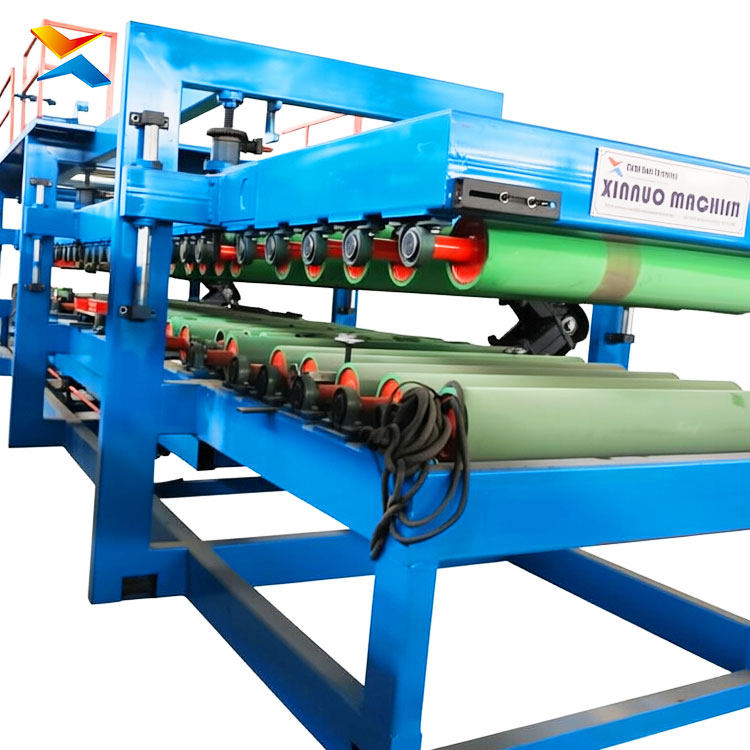
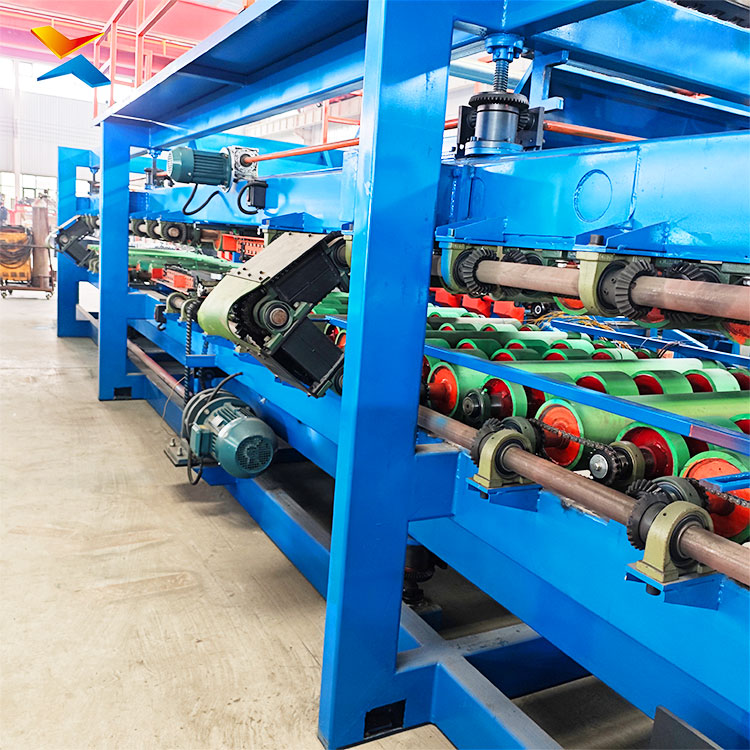
The 6分单排 chain drive highlighted in the title is a deliberate engineering choice that reflects this machine’s positioning as a reliable, cost-efficient production workhorse. In composite panel forming, chain size selection is a balance between torque capacity, running smoothness, and maintenance practicality. The 6分 (6-fen, approximately 3/4-inch pitch) single-row chain is the most widely proven drive system in the composite panel machine industry: it provides adequate torque transmission for the relatively low forming forces involved in thin-gauge panel skin forming (0.3–0.8mm steel does not require the heavy chain torque of structural purlin machines), it runs quieter and with less vibration than heavier double-row chains — which matters for panel surface quality because chain vibration transmits directly through the roller shafts into the panel skin — and it is universally available for replacement anywhere in the Middle East through industrial supply distributors, eliminating the extended downtime that occurs when a factory in Dammam or Sohar must wait two weeks for a specialized chain link to be air-freighted from China. The PLC Auto designation refers to the machine’s fully automated Delta PLC control architecture: the operator sets the desired panel length, production quantity, and line speed on the touchscreen HMI, and the PLC manages the decoiler feed synchronization, glue pump metering ratio, core material feeder timing, fly-cut length positioning, and finished panel counting without further manual intervention. Batch production data — including run time, panel count, material consumption estimates, and any alarm events — is logged to the PLC’s SD card for production management and quality traceability.
The XN-SP-950 carries Hebei Xinnuo’s full quality credentials: 28 years of cold roll forming engineering, 14-year Alibaba Gold Supplier verification with SGS/TÜV on-site factory audit, ISO 9001:2015 certified manufacturing processes, and CE certification issued by an EU Notified Body under the Machinery Directive 2006/42/EC. Standard after-sales includes on-site installation and commissioning by a senior engineer, comprehensive operator training covering food-grade panel quality inspection protocols, and 24/7 WeChat/WhatsApp remote technical support. For Middle East customers, we configure the electrical system at the factory to match the specific grid parameters — 380V/50Hz or 400V/60Hz — and provide documentation packages that support food safety auditor requirements for production equipment qualification.



♦ COMPANY PROFILE:
Hebei Xinnuo Roll Forming Machine Co., Ltd., not only produce different types of professional roll forming machines, but also develop intelligent automatic roll forming production lines, C&Z shape purline machines, highway guardrail roll forming machine lines, sandwich panel production lines, decking forming machines, light keel machines, shutter slat door forming machines, downpipe machines, gutter machines, etc.
Advantages of Roll Forming A Metal Part
There are several advantages of using roll forming for your projects:
- The roll forming process allows operations such as punching, notching, and welding to be performed in-line. Labor cost and time for secondary operations are reduced or eliminated, reducing part costs.
- Roll form tooling allows for a high degree of flexibility. A single set of roll form tools will make almost any length of the same cross-section. Multiple sets of tools for varying length parts are not required.
- It can provide better dimensional control than other competing metal forming processes.
- Repeatability is inherent in the process, allowing easier assembly of roll formed parts into your finished product, and minimizing problems due to “standard” tolerance build up.
- Roll forming is typically a higher speed process.
- Roll forming offers customers a superior surface finish. This makes roll forming an excellent option for decorative stainless steel parts or for parts requiring a finish such as anodizing or powder coating. Also, texture or pattern can be rolled into the surface during forming.
- Roll forming utilizes material more efficiently than other competing processes.
- Roll formed shapes can be developed with thinner walls than competing processes
Roll forming is a continuous process which converts sheet metal into an engineered shape using consecutive sets of mated rolls, each of which makes only incremental changes in the form. The sum of these small changes in form is a complex profile.