
On that comparison, honestly: the section areas above are nominal areas calculated from the documented section designations, and the 1.4× figure is an arithmetic consequence of them — not a rated hydraulic capacity, and not a sizing rule. Actual discharge depends on the section’s internal geometry, wall thickness, the downspout’s length and bend count, and the project’s design criteria. A buyer choosing between the two documented bores should take the project engineer’s sizing and then confirm the machine can form that section.
No pairing rule is recorded — and that is the correct position (档案未记录配对规则——这是正确立场) It would be convenient to publish a table saying “YX010 pairs with one YX130 per X metres of eave”. The archive contains no such rule, and inventing one would be a disservice: pairing depends on roof area, storm intensity, run length, and drop positions — all project-specific. The machine’s job is to deliver the sections the design calls for; the pairing belongs to the engineer.
The consequence buyers discover late: the pair needs two coil widths (买家最后才发现的后果) The two parts of the pair are formed from different coil widths. The V-section gutter (YX010) is documented at a 350 mm feed width; the rectangular downspout (YX130) at 335 mm; the square downspout (YX131) at 405 mm. A fabricator forming both parts of the pair must therefore stock two different slit-coil widths, and both must be obtainable in the local market. This is the practical reason to settle coil supply before choosing sections — and it is the single most common mismatch in this product family.
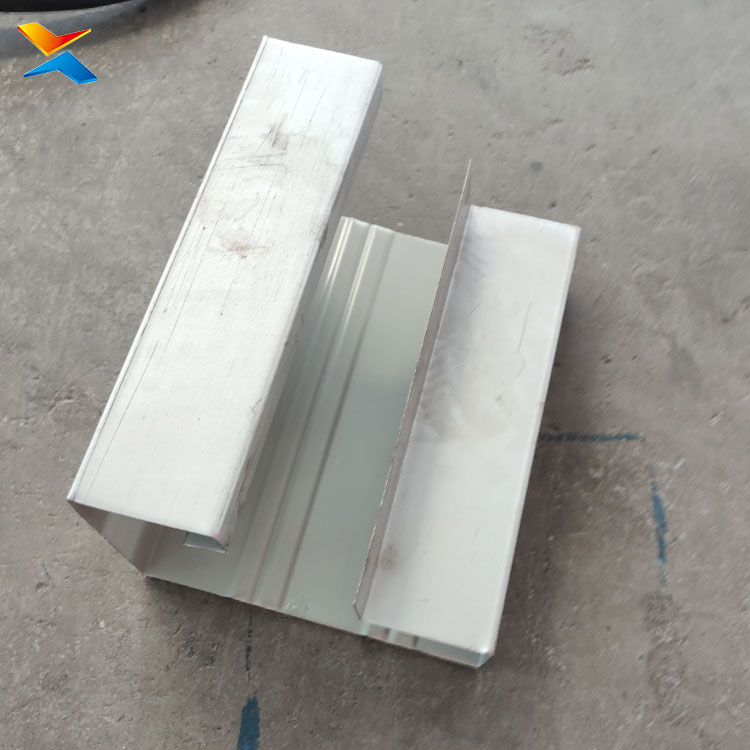
A note on section types the archive does and does not document (关于档案记录与未记录截面类型的说明) The documented roof rainwater sections are the V-section gutter (YX010), the U-section flashing channel (YX042, three width steps 55/80/105 mm), the half-round channel (YX106), and the two downspouts (YX130, YX131). If a project specifies a different gutter form — a box gutter, for example — that section is not among the documented blueprints; supply the section drawing and the engineers will confirm whether a proven blueprint is a close match or whether new tooling is required. That confirmation is a written answer, not an assumption.

♦ COMPANY PROFILE:
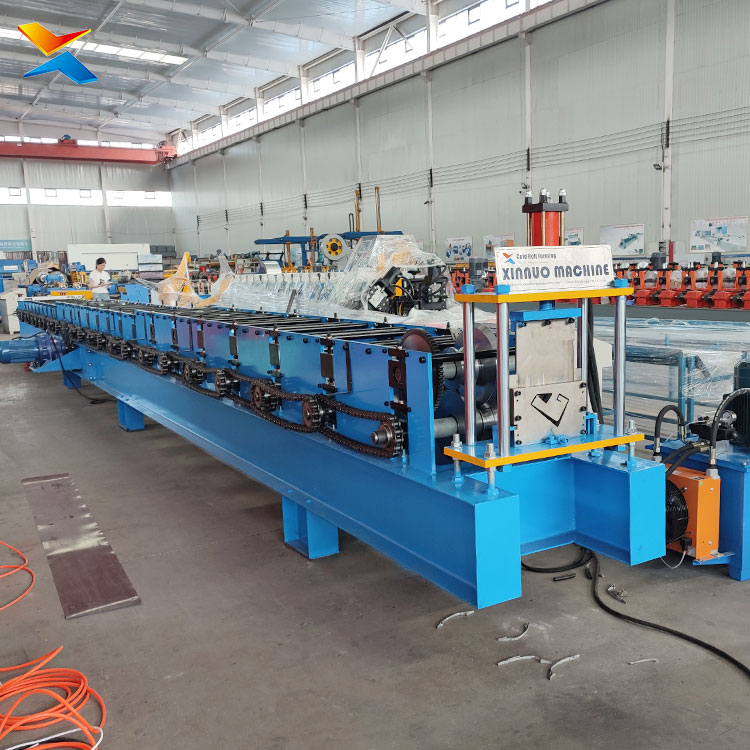
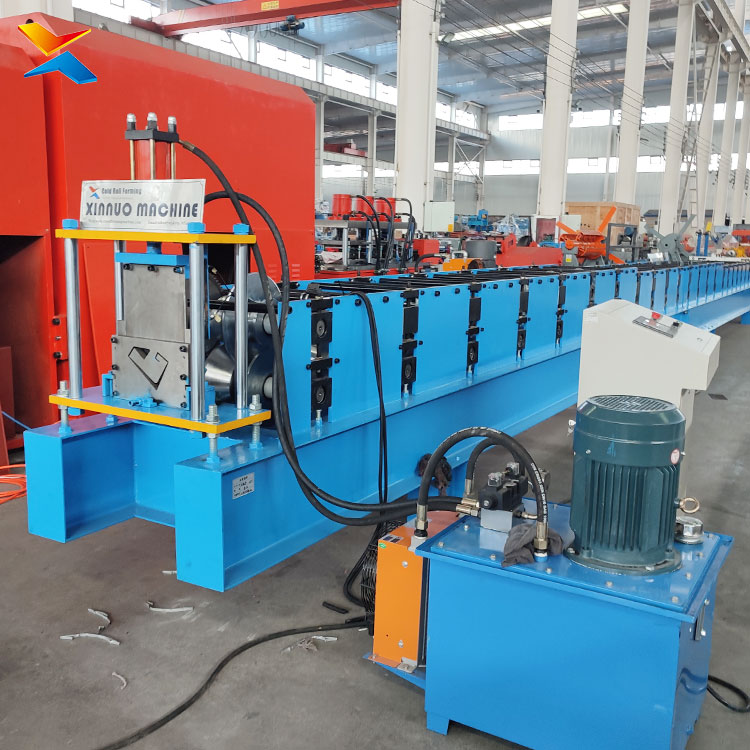
Hebei Xinnuo Roll Forming Machine Co., Ltd., not only produce different types of professional roll forming machines, but also develop intelligent automatic roll forming production lines, C&Z shape purline machines, highway guardrail roll forming machine lines, sandwich panel production lines, decking forming machines, light keel machines, shutter slat door forming machines, downpipe machines, gutter machines, etc.
Advantages of Roll Forming A Metal Part
There are several advantages of using roll forming for your projects:
- The roll forming process allows operations such as punching, notching, and welding to be performed in-line. Labor cost and time for secondary operations are reduced or eliminated, reducing part costs.
- Roll form tooling allows for a high degree of flexibility. A single set of roll form tools will make almost any length of the same cross-section. Multiple sets of tools for varying length parts are not required.
- It can provide better dimensional control than other competing metal forming processes.
- Repeatability is inherent in the process, allowing easier assembly of roll formed parts into your finished product, and minimizing problems due to “standard” tolerance build up.
- Roll forming is typically a higher speed process.
- Roll forming offers customers a superior surface finish. This makes roll forming an excellent option for decorative stainless steel parts or for parts requiring a finish such as anodizing or powder coating. Also, texture or pattern can be rolled into the surface during forming.
- Roll forming utilizes material more efficiently than other competing processes.
- Roll formed shapes can be developed with thinner walls than competing processes
Roll forming is a continuous process which converts sheet metal into an engineered shape using consecutive sets of mated rolls, each of which makes only incremental changes in the form. The sum of these small changes in form is a complex profile.