
Double Layer Roll Forming Machine Manufacturer | Double Layer Roofing Sheet Making Machine Supplier
Product Description
Double layer roll forming machine, factory-direct from the manufacturer — one machine body, two roofing sheet profiles, for steel building projects in the Middle East.
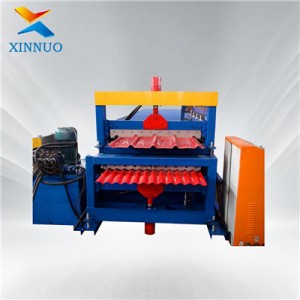
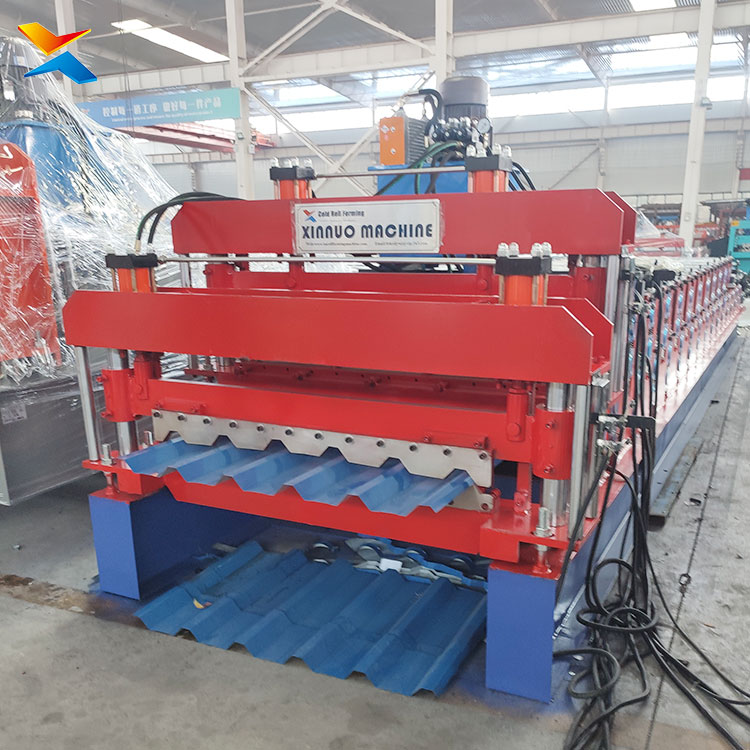
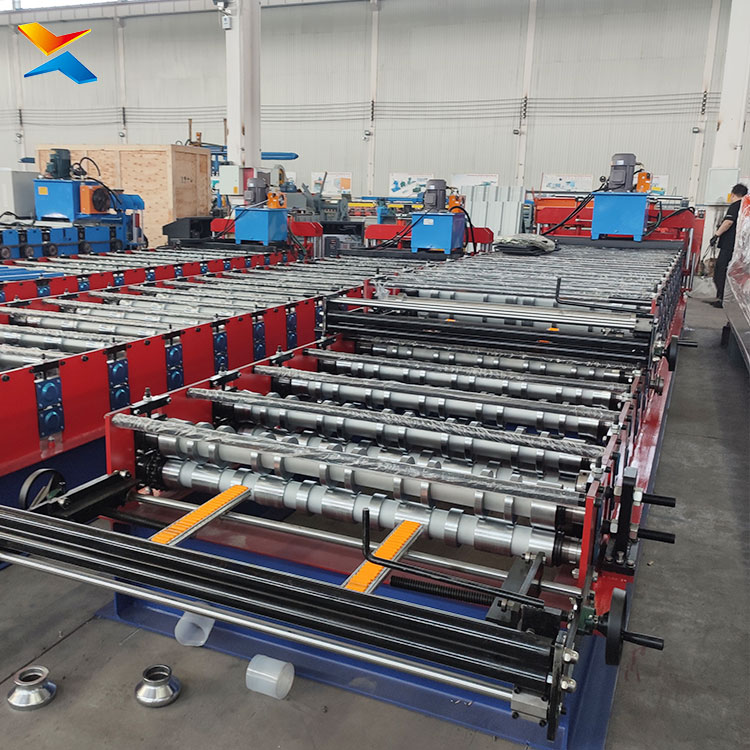
A double layer roll forming machine carries two independent sets of forming rollers stacked one above the other inside a single machine frame, running from one shared drive. The two roller sets are tooled for two different profiles. By changing the material path — repositioning the guide plates and baffles that lead the coil into the machine — the operator directs the strip into the upper roller set or the lower one, and the same machine then produces the other panel. It is a two-profile machine from one body, and for a fabricator who needs both profiles but cannot justify or house two separate lines, it is usually the most sensible way to buy them.
The important thing to state plainly at the start is that a double layer machine produces one panel at a time. It carries two tooling sets, not two production lines. Changing over is a matter of minutes of guide adjustment, not a machine swap, but the two profiles cannot be run simultaneously from one drive. Buyers who genuinely run both profiles in high volume, side by side, are better served by two single-layer machines, and any supplier who tells them otherwise is selling the wrong product.
What the double layer buys you — and what it asks of you.
The advantages are space and capital. A double layer machine occupies a single footprint instead of two, and it costs noticeably less than buying the two corresponding single-layer machines separately, because the frame, the drive, the decoiler and the control system are shared rather than duplicated. For a workshop where floor space is tight, or where capital is better spent on stock and marketing than on a second line, that is a real gain.
The costs are in commissioning and flexibility. Two tooling sets must be aligned inside one frame, so the rollers of both layers have to be centred and gapped together, and the machine takes longer to install and bring into production than a single-layer machine. The frame also has to be stiffer, and taller, because it is carrying two roller stacks. This is not a reason to avoid the product — it is a reason to plan the installation properly, with suppliers who attend site, provide illustrated commissioning manuals and video guidance, and stay reachable while your team learns the machine. The honest summary is that a double layer machine is a capital-efficiency decision, and it should be chosen for that reason, not as a throughput decision.
The combination types, and which ones fit a Gulf fabricator.
Double layer machines are built around combination families, and the family decides how difficult the machine is to build, to commission, and to price.
The simplest and least expensive combination is trapezoidal plus trapezoidal — two conventional trapezoidal sheeting profiles, both formed by straightforward continuous rolling, which is why this family costs less than combinations that involve curved or textured tooling. It suits a fabricator who needs two different widths or peak counts of conventional roof and wall sheet, for example a wall profile alongside a roof profile.
The most common sales combination is trapezoidal plus glazed tile: one layer producing a conventional trapezoidal panel for structural roofing, and the other producing an antique glazed tile panel for decorative roofing. It suits dealers and factories that serve both the ordinary customer and the higher-value traditional project from one machine. The glazed tile layer carries a pitch-stamping device, so it is more involved to commission than a pure trapezoidal layer.
The most widely exported combination is arc plus trapezoid: one layer forming a curved wave panel for industrial roofing, the other a trapezoidal panel for structural roofing and cladding. It covers the two most frequently ordered panel types in emerging markets from one body, which is exactly why it travels well.
The most demanding of the common combinations is arc plus glazed tile. One layer needs curved forming tooling and the other needs pitch-stamped tooling, and the two processes differ substantially. It is built for markets that carry both industrial construction and traditional-architecture demand at the same time — which is precisely the profile of the Gulf market, where warehouses and villas, logistics buildings and mosques, stand in the same district. Buyers choosing this combination should expect a longer commissioning period and should ask for a factory commissioning technician, not just documentation.
Two curved layers with different wave heights and pitches is a further family, and it is less common. It works, but the two roller stacks must not differ too much in wave height, because a large height difference makes the frame design and the material path difficult. A triple-layer machine, stacking three tooling sets, is the most complex product in this range and is effectively a custom build: it is taller, its commissioning is substantially longer again, and it exists for showrooms, for demonstration, and for exporters whose market is unusually diversified.
The rules that decide whether a combination works.
Three engineering rules decide whether a proposed pair of profiles belongs on one double layer body, and a buyer can use them to check any quotation.
The first is row-count balance between the two layers. If one layer carries many more forming stages than the other, the lightly formed layer is prone to panel defects, and because both layers run at one speed from a shared drive, unequal roller diameters make the strip travel less steadily. A pair of profiles requiring a similar number of forming stages is the cleanest design; a modest difference is acceptable; a large difference needs compensating design work, and an extreme difference should be treated as an engineering question rather than a catalogue choice.
The second is feed width. Where both layers accept the same strip width, the machine can share a single decoiler and feed frame, which is the best and simplest arrangement. Where the widths are close, guide blocks can bridge the difference. Where they are far apart, the machine needs two guide systems and manual adjustment at changeover, which is workable but erodes the convenience the double layer was bought for.
The third is frame and drive specification. The frame of a double layer machine is determined by the heavier of the two layers, and it steps up a grade from the single-layer frame that the same profile would need, because it is carrying the weight and absorbing the vibration of both stacks. The chain is specified for the layer with the greatest torque demand. This is why a double layer machine quotes higher than the heavier of its two single-layer equivalents — and why a quotation that matches single-layer frame and chain specifications for a double-layer body should be questioned.
The hardest case, and how it is handled.
Two glazed tile layers on one body is the most difficult combination in this family. Each layer stamps its own pitch, so the two pitch systems must be controlled independently, and unless at least one layer is driven by a servo system, pitch error accumulates across the panel. Both pitch tooling sets must be levelled together during commissioning, which takes an experienced technician and considerably longer than a standard double layer build. The practical transmission solution is to keep the main drive shared while giving the pitch control of one layer its own servo motor, so the pattern of each layer is set independently while the forming load stays on one drive. Buyers who need two different antique tile profiles should raise this as a specific requirement rather than assume it from a generic double-layer quotation.
Machine height, weight, and the workshop around it.
Stacking two roller sets makes a double layer machine noticeably taller and heavier than the single-layer machine for either profile. That has three practical consequences for the buyer, and all three belong in the pre-order checklist. The workshop must have clear height for the machine and for lifting the top roller set during commissioning and maintenance. The floor and the installation plan must handle a heavier machine. And the machine’s overall height should be compared against the building’s own structure — roof trusses, crane rails, doors and access routes — before it is ordered, not after it lands. Where the profiles are very wide or very heavy, a double layer body is not the natural answer, and the conversation should move back to two single-layer machines.
Putting a double layer to work in the Gulf.
The Gulf market fits the double layer argument unusually well. Demand is genuinely mixed: industrial and logistics buildings call for conventional trapezoidal and curved metal roofing, while villas, mosques, religious buildings, heritage developments, boutique hospitality and new-Chinese-style elevations call for antique glazed tile panels. A fabricator serving both, with limited floor space and a preference for putting capital into stock and marketing, can cover both demand streams from one machine body rather than two lines. The arc-plus-trapezoid and arc-plus-glazed-tile combinations in this range were built for exactly that market pattern.
Two climate points belong with the specification. Near-coast humidity and salt-laden air on projects in the UAE, and intense solar loading with strong thermal cycling inland in Saudi Arabia, both place the emphasis on the coil and coating system the buyer chooses, because the machine forms the geometry while the coating decides how long the appearance lasts. And a double layer machine stacks tooling in one frame, so surface protection and lubrication practice on the machine itself matter more, not less, in a hot workshop — the maintenance routine should be part of the purchase conversation.
As a manufacturer and supplier.
This range is built and supplied directly by the factory, not resold. It is the same production line that has built the factory’s double layer archive — a body of production-proven blueprints covering all of the combination families described above, some of which have been built repeatedly for different export markets. When a buyer sends two panel requirements, the factory identifies the closest proven blueprint, checks the two selection rules that matter most — row-count balance and feed width — and tells the buyer in writing whether the pair matches an existing build or requires new tooling. Frame class, chain specification and commissioning plan follow from the heavier layer. Documentation, electrical configuration for the destination market, installation and commissioning support, operator training, illustrated manuals, video guidance and spare parts supply are all part of the supply relationship, and the specific scope should be written into the order rather than assumed.
To quote a double layer machine, send these items. The two panel types you want, with a cross-section drawing or sample for each — peak count, pitch, peak and trough detail, and effective width. The material and the gauge you will actually run. The coil widths you can buy locally, because the machine’s feed width must match a strip you can actually source. Whether both profiles run in high volume simultaneously, because that single answer decides between a double layer machine and two single-layer machines. Your workshop’s clear height, floor space and handling arrangements. The panel lengths and daily output you need for each profile. Your site’s voltage and frequency. And whether you also need to slit coil to width, since a forming and slitting combination exists as a separate family in this range. With those answers, the factory can propose a combination, state the frame and drive specification the pair requires, confirm whether the profiles match proven tooling or need new tooling, and return an itemised quotation with the line layout drawing for the configuration.

♦ COMPANY PROFILE:
Hebei Xinnuo Roll Forming Machine Co., Ltd., not only produce different types of professional roll forming machines, but also develop intelligent automatic roll forming production lines, C&Z shape purline machines, highway guardrail roll forming machine lines, sandwich panel production lines, decking forming machines, light keel machines, shutter slat door forming machines, downpipe machines, gutter machines, etc.
Advantages of Roll Forming A Metal Part
There are several advantages of using roll forming for your projects:
- The roll forming process allows operations such as punching, notching, and welding to be performed in-line. Labor cost and time for secondary operations are reduced or eliminated, reducing part costs.
- Roll form tooling allows for a high degree of flexibility. A single set of roll form tools will make almost any length of the same cross-section. Multiple sets of tools for varying length parts are not required.
- It can provide better dimensional control than other competing metal forming processes.
- Repeatability is inherent in the process, allowing easier assembly of roll formed parts into your finished product, and minimizing problems due to “standard” tolerance build up.
- Roll forming is typically a higher speed process.
- Roll forming offers customers a superior surface finish. This makes roll forming an excellent option for decorative stainless steel parts or for parts requiring a finish such as anodizing or powder coating. Also, texture or pattern can be rolled into the surface during forming.
- Roll forming utilizes material more efficiently than other competing processes.
- Roll formed shapes can be developed with thinner walls than competing processes
Roll forming is a continuous process which converts sheet metal into an engineered shape using consecutive sets of mated rolls, each of which makes only incremental changes in the form. The sum of these small changes in form is a complex profile.
-
Double Layer Trapezoidal Roll Forming Machine |...
-
Double Layer Single Profile Roll Forming Machine
-
Energy Saving Double Layer Steel Sheet Cold Rol...
-
High Precision Double Layer Single Plate Roll F...
-
roling machine double layer machine double laye...
-
Portable Trapezoidal Roof Sheet Machine | On-Si...