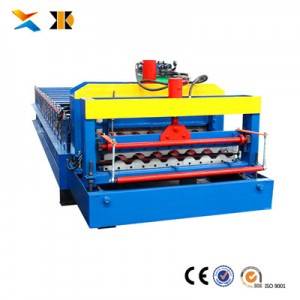

Glazed Tile Roll Forming Machine | Curved Glazed Roof Tile Making Machine Supplier for Steel Building
Product Description
Curved glazed roof tile making machine for steel buildings — a metal panel with the look of antique ceramic tile.
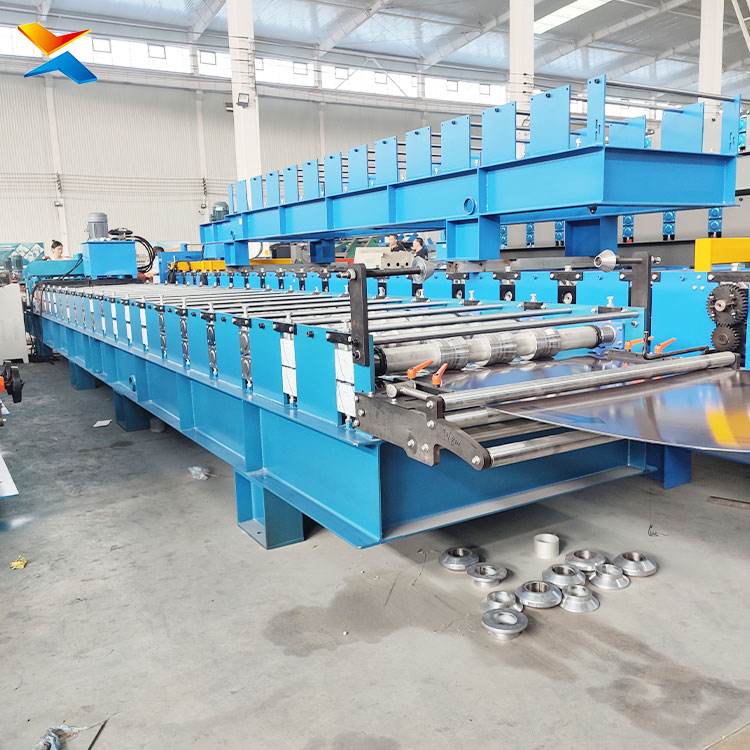
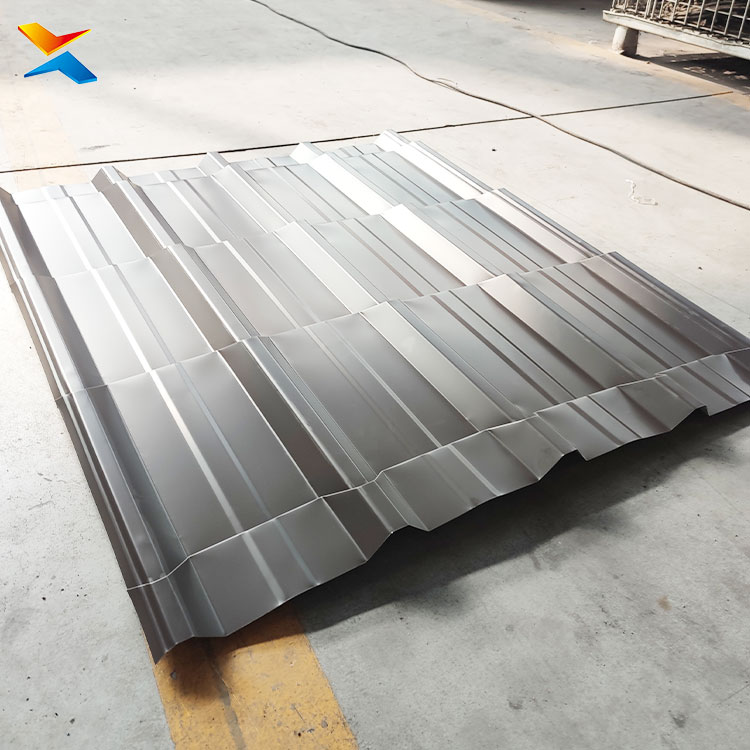
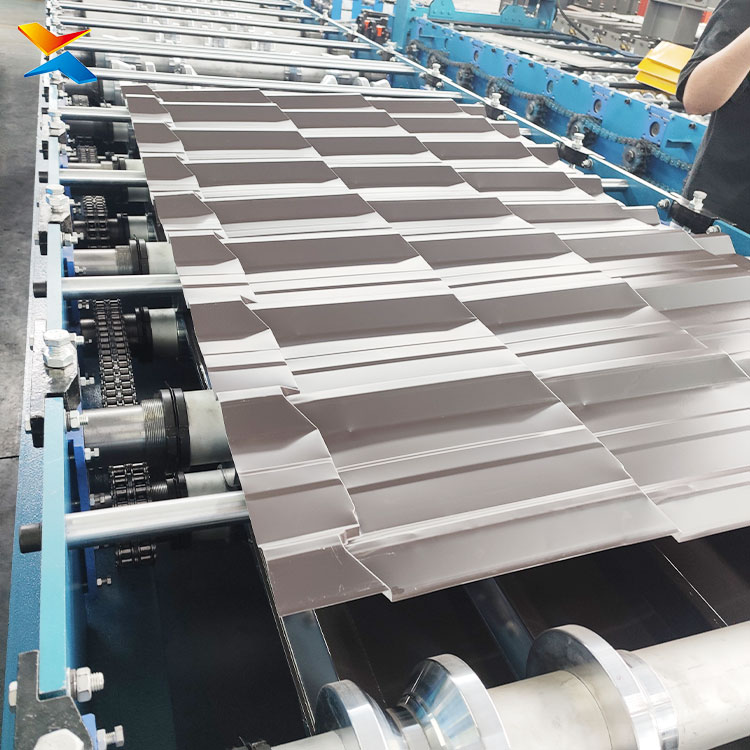
This curved glazed roof tile making machine forms coated steel coil into curved roofing and façade panels carrying the appearance of antique ceramic tile. It works in two rhythms: continuous rolling forms the arc, and a pitch-stamping device presses a segment line into every peak, so the finished panel reads as rows of individual antique tiles rather than a plain wave. Everything that separates a glazed tile machine from an ordinary arc machine comes from that one addition, and it is what puts the glazed tile machine in a higher price band than a comparable arc machine.
The panel that leaves the line is metal. It is lightweight colour-coated steel coil, not fired clay, not ceramic, and not PVC or resin. That is the whole commercial point on a steel building: the appearance of traditional roof tile without the structural penalty of real tile, so a roof, a façade or an entire elevation can carry an antique idiom on a light steel structure. One build in the range is recorded as switchable between colour-coated steel glazed tile and resin tile by adjusting the pitch, for buyers who serve both material markets from one machine.
“Curved” describes different products, and confusing them is the expensive mistake.
A continuous curved wave with no tile pattern is produced on an arc roll forming machine. A curved tile with antique texture — the segment lines on every peak — is produced on a glazed tile machine, which carries the additional pitch-stamping device. A curved tile with stronger relief sits inside the glazed tile family: an asymmetric arc, in which one flank is steeper than the other so the relief reads deeper, and a bamboo-joint profile, which carries the deepest relief in the range with a wide pitch.
The naming convention makes the distinction readable at a glance in any quotation. If the machine name contains “峰” (peak), it is a glazed tile machine. If it contains only “波” (wave), it is an arc machine. A glazed tile machine sits above a comparable arc machine in price, and a servo-driven version sits above the standard version — which makes this distinction the largest single commercial decision in the purchase, not a cosmetic one.
Peak height governs the rest of the build.
The deeper the peak, the more forming rows the machine needs to produce a flat, consistent panel — a rule that generates most of the rest of the specification. Row count drives the frame class, the shaft diameter and the motor power. Economy builds run on channel-steel or light frame sections; standard builds step up to heavier frames; medium-heavy and deep-arc work moves to heavy frames; and the heaviest builds in the range use a portal-style heavy frame, which is described in the factory’s records as an industry-heavy specification rather than a common one.
For a buyer, the practical check is to compare four items as a set — forming rows, frame class, shaft diameter and motor power — against the peak height required by the section. Where a quotation offers a light row count for a deep peak, it is a different class of machine. Mass belongs to the same argument on large-arc work: these machines are built heavy, and the mass is what keeps the forming stations from deflecting under a deep peak.
The material this family forms is thin-gauge colour-coated steel coil. A deep peak deforms material heavily and is not suited to thick plate, while the heaviest builds extend to a somewhat thicker gauge because their frames and drives are built to move that material. Confirm the gauge you will actually run for the specific model, rather than inferring it from a general figure.
Pitch decides how the tile looks.
Small pitches give a fine, dense antique look suited to high-end façades and roofs with a Tang or Song idiom. Medium pitches are the mainstream specification — the volume seller of the range, and the specification that best balances architectural detail with coverage. Large pitches give broad, high-relief peaks in a Qing-style idiom for temples, villas and garden buildings.
A pitch is not a free variable that a buyer can simply name. Each pitch corresponds to a designed stamping mould, and the factory’s own record here covers long-standing pitch design experience across a wide span of values. A pitch that is not already in the archive is new tooling — a separate engineering step, which should be answered in writing rather than assumed.
For buyers whose product must look regular across an entire roof, the drive decides the result. A servo motor with bevel-gear drive positions the pitch far more precisely than a clutch-and-brake arrangement, and the difference shows over the many repetitions required across one elevation. The bevel gear train is also documented as quieter and smoother in service than chain drive. For buyers intent on throughput, newer builds in the range move to higher-power drives for faster speed and slightly thicker material, and the most recent addition uses an SEW-compatible helical gear reducer for better efficiency and a quieter, longer-lived drive.
Curved variants for specific briefs.
The range also holds curved variants that answer particular architectural requirements. An asymmetric arc, where one flank is steeper than the other, gives a stronger sense of depth and is recorded for high-end commercial and residential work. A bamboo-joint profile carries the deepest relief in the range with a wide pitch, for gardens, temples and boutique hospitality. A “with A” version presses an A-shaped reinforcing rib across the flat between peaks, raising panel stiffness without increasing peak height. A half-peak design fits a partial peak at each edge so that adjoining panels join into complete peaks and coverage improves. And a dual-width build produces two panel widths from one machine by changing part of the tooling, which avoids a second machine where a project specifies more than one width.
Where the curve belongs on a steel building.
A small arc with a dense wave suits integrated housing and light-steel roofs, and this family competes directly with single-layer trapezoidal panels — its advantage being the more attractive arc. The factory’s records note this dense-wave work as common in the Middle East market. A medium arc is the mainstream balance of stiffness and weight for plants, warehouses and agricultural buildings. A deep arc carries more for a given material thickness, which is why it is the range’s answer for wide-span buildings. The glazed tile panel then serves the projects that specify a traditional idiom: villas, mosques and religious buildings, tourist developments, boutique hospitality and new-Chinese-style elevations, where the panel is formed to the building’s own lengths, closes the roof or elevation quickly, and takes its colour from the coil coating system rather than from tiles laid piece by piece.
Supplied to the Gulf and neighbouring markets.
Products from this family have been supplied to the Gulf region and its neighbourhood, including Dubai in the United Arab Emirates, Azerbaijan and Syria, and asymmetric-arc glazed tile work has gone to Dubai alongside other export markets. This is a lightweight metal panel made from coated steel coil, offered as a supplier for steel building projects in the UAE and Saudi Arabia — the appearance of antique roof tile, formed on a steel building rather than laid as ceramic tile.
Two exposure conditions shape the specification in this region. Near-coast humidity and salt-laden air on UAE projects, and intense solar loading with strong thermal cycling inland in Saudi Arabia, both put the emphasis on the coil and coating system the buyer chooses. The machine forms the geometry; the coating decides how long the appearance lasts. A lifespan question answered with a number rather than with a coil specification is an answer to a different question.
The process behind the profile.
The manufacturing standard is the same one used for the factory’s single-layer panel machines. Forming dies are forged from carbon steel and carried through a multi-step process of rough turning, hardening, finish turning, keyway cutting, polishing and electroplating. Shafts are alloy steel, finish-turned and externally ground for roundness and straightness under load. Frames are machined on CNC gantry mills so that every forming station measures from a flat reference. Welding is shielded and slag-free, and surfaces are shot blasted, then electrostatically sprayed and baked for protection.
To quote a machine, send these items. The appearance type you want — antique tile texture or a plain curve — because that decides the category. A cross-section drawing or sample, or the closest reference: peak count, pitch, peak height and effective width. The material and the gauge you will actually run. The coil width obtainable in your local market, since the machine’s feed width must match a coil you can actually buy. Your drive preference — standard chain, or servo with gear. The panel lengths required and your daily output. Your workshop’s voltage and frequency. And any dual-purpose requirement, whether two widths, two wave scales, or metal and resin tile. The engineers will identify the closest production-proven blueprint and confirm in writing whether your section matches the archive or needs new pitch tooling, then return an itemised factory-direct quotation with the line layout drawing for your configuration.

♦ COMPANY PROFILE:
Hebei Xinnuo Roll Forming Machine Co., Ltd., not only produce different types of professional roll forming machines, but also develop intelligent automatic roll forming production lines, C&Z shape purline machines, highway guardrail roll forming machine lines, sandwich panel production lines, decking forming machines, light keel machines, shutter slat door forming machines, downpipe machines, gutter machines, etc.
Advantages of Roll Forming A Metal Part
There are several advantages of using roll forming for your projects:
- The roll forming process allows operations such as punching, notching, and welding to be performed in-line. Labor cost and time for secondary operations are reduced or eliminated, reducing part costs.
- Roll form tooling allows for a high degree of flexibility. A single set of roll form tools will make almost any length of the same cross-section. Multiple sets of tools for varying length parts are not required.
- It can provide better dimensional control than other competing metal forming processes.
- Repeatability is inherent in the process, allowing easier assembly of roll formed parts into your finished product, and minimizing problems due to “standard” tolerance build up.
- Roll forming is typically a higher speed process.
- Roll forming offers customers a superior surface finish. This makes roll forming an excellent option for decorative stainless steel parts or for parts requiring a finish such as anodizing or powder coating. Also, texture or pattern can be rolled into the surface during forming.
- Roll forming utilizes material more efficiently than other competing processes.
- Roll formed shapes can be developed with thinner walls than competing processes
Roll forming is a continuous process which converts sheet metal into an engineered shape using consecutive sets of mated rolls, each of which makes only incremental changes in the form. The sum of these small changes in form is a complex profile.