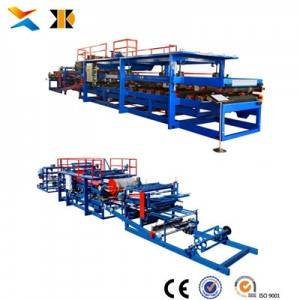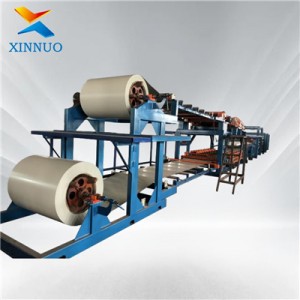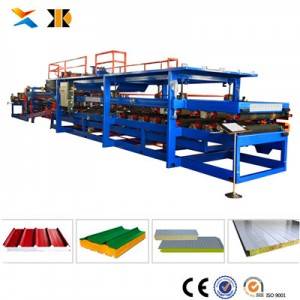


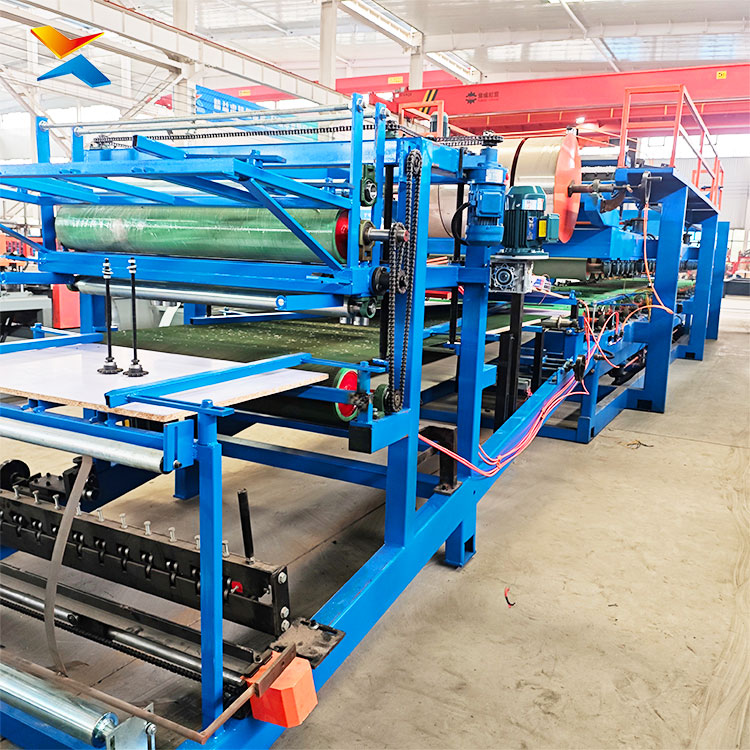
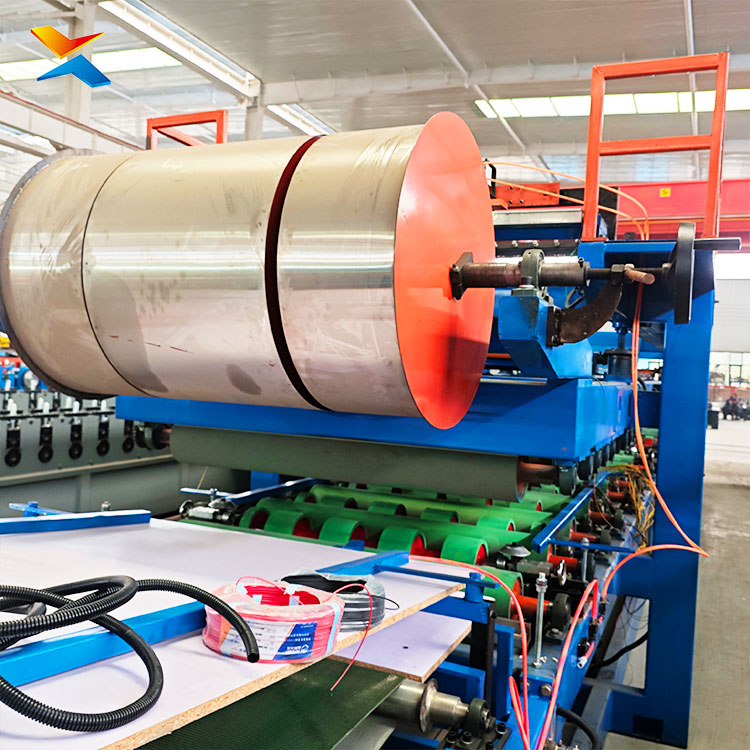
The Hebei Xinnuo Salt Spray Tested Sandwich Panel Production Line is a fully instrumented, corrosion-validated composite panel manufacturing system engineered for the single most aggressive environmental challenge facing industrial machinery in the Middle East: the relentless combination of extreme heat, persistent humidity, and airborne salinity that defines the Arabian Gulf, Red Sea, and eastern Mediterranean coastlines. What distinguishes this machine from every other composite panel line in our portfolio — and from any machine sold with generic “anti-corrosion” marketing claims — is that its corrosion resistance is not a promise. It is a measured, certified, and independently verifiable performance characteristic, validated through ISO 9227 Neutral Salt Spray (NSS) testing conducted on production-representative coated steel coupons and documented in test reports available to qualified buyers.
The headline performance figures are unambiguous. Our marine-grade coating system — comprising SA 2.5-grade shot-blast surface preparation (near-white metal, per ISO 8501-1), a 60–80μm zinc-rich epoxy primer with 80%+ metallic zinc content by dry film weight, and an 80–100μm marine-grade polyester powder topcoat oven-cured at 200°C — achieves 1,500+ hours to first rust at scribe under continuous ISO 9227 NSS exposure, with 3,000+ hours to significant scribe creep (defined as creep from scribe <3mm). By comparison, a standard single-coat polyester powder system at 60–80μm — which is the industry default on the vast majority of composite panel machines sold globally — typically shows first rust at 300–500 hours in the same test, with scribe creep exceeding 3mm by 800–1,000 hours. The performance gap is not marginal. It is a factor of 3× to 5× in time-to-failure, and it is the difference between a machine whose structural frame begins rusting within the first two years of coastal operation and a machine whose frame remains structurally intact through a decade of salt-laden factory air.
The shot-blast coating process highlighted in the title is the foundation upon which this corrosion performance is built — and it is the step that the majority of roll forming machine manufacturers skip or under-invest in. Shot blasting to SA 2.5 is not merely cleaning; it is surface engineering. The process propels angular steel grit at high velocity against every structural steel surface, simultaneously removing all mill scale, rust, welding slag, and surface contaminants while creating a uniform 50–75μm anchor profile — a microscopic mountain range of peaks and valleys in the steel surface that provides mechanical keying for the primer coat. Without this anchor profile, even the highest-quality primer adheres only through weak chemical bonding that fails within months under the thermal cycling and chloride exposure of a coastal factory. With it, the zinc-rich epoxy primer achieves adhesion strengths exceeding 5 MPa in pull-off testing (ISO 4624), creating a bond that resists under-film corrosion creep — the mechanism by which rust propagates beneath apparently intact paint, peeling the coating from the inside. The entire structural assembly — 300H main frame, 200×100mm rectangular tube sub-frame, decoiler arms, conveyor supports — undergoes this process as integrated units, ensuring complete coverage of every weld seam, bolt hole, and structural junction where corrosion typically initiates on machines that are painted (not blasted) before coating.
The PLC designation in the title refers specifically to the process-control dimension of corrosion resistance. A coating system is only as good as the consistency with which it is applied, and consistency in industrial coating is a function of process control — pretreatment dwell time, primer thickness uniformity, oven cure temperature profile, and post-cure inspection. The Xinnuo coating line is governed by a dedicated process-control PLC that monitors and logs every parameter: shot-blast cabinet pressure and media flow rate (ensuring consistent SA 2.5 anchor profile across every structural component), electrostatic spray booth voltage and powder flow rate (ensuring consistent primer and topcoat DFT across complex geometries), and oven zone temperatures with PID-controlled gas burner modulation (ensuring complete epoxy cross-linking and polyester cure without under-bake or over-bake conditions that compromise coating performance). This process data is stored on the PLC’s SD card alongside the machine’s production batch records, creating a traceable coating quality record for every machine shipped — a level of process documentation that pharmaceutical and aerospace coating operations require and that is essentially unknown in the roll forming machinery industry. For a Middle East panel producer whose end customers — particularly in the oil and gas, food processing, and cold chain sectors — increasingly demand documented evidence of production equipment quality as part of their supplier audit programs, this coating process traceability is not a nice-to-have. It is the documentation that passes the audit.
The machine integrates the full Xinnuo composite panel technology stack within its corrosion-hardened architecture: 14-station upper and lower forming units with GCr15 bearing steel rollers hard-chrome plated to 0.05–0.08mm with post-plating micro-pore sealing treatment; 9-meter 54-roller glue-lamination section on a 0.05mm flatness bed; dual-motor dual-inverter quad-glue-pump adhesive delivery with black/white separation; patented one-way steel belt with four-directional adjustment; dual-blade fly-cut system with enclosed dust collection; and the self-programmed Delta PLC with touchscreen HMI, SD-card batch logging, and 24/7 WeChat/WhatsApp remote diagnostics. All external fasteners are A2-70 (304) stainless steel. All electrical enclosures are IP65-rated with neoprene gaskets and positive-pressure purge ventilation. Hebei Xinnuo’s 28-year engineering track record, 14-year Alibaba Gold Supplier verification, ISO 9001:2015 certified manufacturing, and CE certification issued by an EU Notified Body complete the quality assurance framework. The salt spray test reports — the quantified, verifiable evidence that this machine will survive where standard machines fail — are available to qualified buyers under NDA.
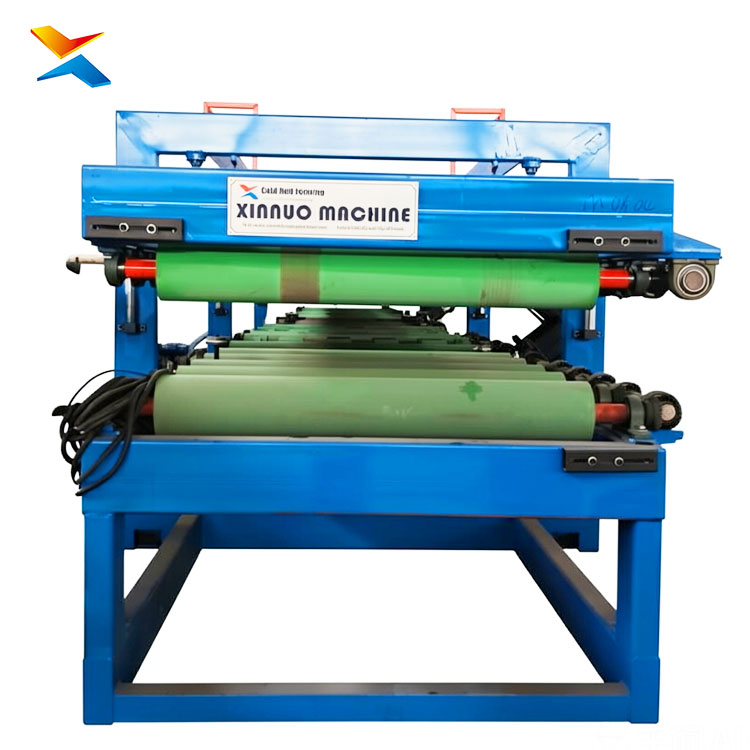



♦ COMPANY PROFILE:
Hebei Xinnuo Roll Forming Machine Co., Ltd., not only produce different types of professional roll forming machines, but also develop intelligent automatic roll forming production lines, C&Z shape purline machines, highway guardrail roll forming machine lines, sandwich panel production lines, decking forming machines, light keel machines, shutter slat door forming machines, downpipe machines, gutter machines, etc.
Advantages of Roll Forming A Metal Part
There are several advantages of using roll forming for your projects:
- The roll forming process allows operations such as punching, notching, and welding to be performed in-line. Labor cost and time for secondary operations are reduced or eliminated, reducing part costs.
- Roll form tooling allows for a high degree of flexibility. A single set of roll form tools will make almost any length of the same cross-section. Multiple sets of tools for varying length parts are not required.
- It can provide better dimensional control than other competing metal forming processes.
- Repeatability is inherent in the process, allowing easier assembly of roll formed parts into your finished product, and minimizing problems due to “standard” tolerance build up.
- Roll forming is typically a higher speed process.
- Roll forming offers customers a superior surface finish. This makes roll forming an excellent option for decorative stainless steel parts or for parts requiring a finish such as anodizing or powder coating. Also, texture or pattern can be rolled into the surface during forming.
- Roll forming utilizes material more efficiently than other competing processes.
- Roll formed shapes can be developed with thinner walls than competing processes
Roll forming is a continuous process which converts sheet metal into an engineered shape using consecutive sets of mated rolls, each of which makes only incremental changes in the form. The sum of these small changes in form is a complex profile.