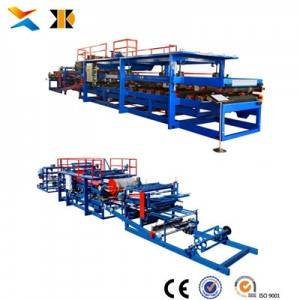


The Xinnuo Flat Bottom Insulated Panel Roll Forming Machine is a specialized variant of our composite panel production line, engineered exclusively for producing flat-face sandwich panels used in container houses, modular prefabricated buildings, portable cabins, and rapid-deployment housing — applications where the interior and exterior wall surfaces must be completely flat, without ribs, peaks, or corrugations. Standard sandwich panel machines produce panels with 3 to 6 longitudinal ribs on both faces, which provide structural stiffness for large-span roofing but are functionally problematic for container house walls: the ribs create uneven surfaces that complicate interior finishing, prevent flush mounting of electrical fixtures and plumbing, waste interior space by 20–30mm per wall, and trap dust and moisture in the rib valleys — a significant concern in Iraq’s arid, dust-prone environment.
The flat bottom panel — also called a flat-wall or container panel — eliminates all surface profiling on the bottom skin, producing a completely smooth panel face that serves as a finished interior wall without additional drywall, plaster, or cladding. The top skin may retain a shallow rib profile for structural stiffness, or be produced flat as well depending on the end-use application. This profile is the global standard for ISO shipping container conversions, modular workforce accommodation, site offices, guard houses, and rapid-deployment relief housing — all of which are high-demand categories in Iraq’s ongoing reconstruction and infrastructure development cycle. Iraq’s modular housing market has expanded significantly since 2018, driven by post-conflict reconstruction programs, oil field worker camps in Basra and Kirkuk, and government-led affordable housing initiatives that favor prefabricated construction for its speed, cost efficiency, and quality control compared to traditional on-site masonry.
What fundamentally distinguishes a flat bottom panel machine from a standard composite panel machine is the forming unit design. Standard machines form ribbed profiles with 12–18 forming stations per unit, with relatively gentle, progressive bends distributed across many roller passes. A flat bottom panel requires fewer forming stations — typically 10 — because the bottom skin undergoes minimal deformation: the steel strip is essentially straightened, edged, and lightly profiled for joint formation, with no peaks to shape. However, this apparent simplicity masks a more demanding engineering requirement: because the panel face must be perfectly flat, any roller misalignment, shaft deflection, or frame flex creates visible waviness or “oil-canning” on the finished panel surface that is unacceptable in a visible interior wall application. The machine must be stiffer, not more complex, than its ribbed-profile counterpart.
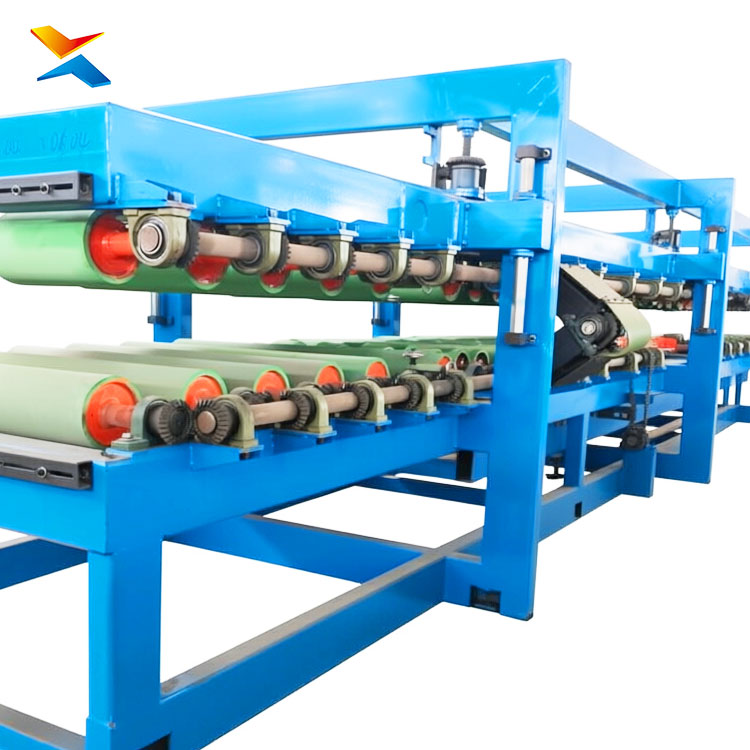
Xinnuo addresses this with a purpose-designed bottom panel forming unit built on a 250H heavy structural steel frame with a 12mm mid-plate and Φ72mm main roller shafts — the specification highlighted in the product title. This shaft diameter is approximately 10–15% larger than the Φ60–65mm shafts used in budget flat-panel machines, and the incremental diameter provides a substantial gain in bending stiffness — shaft deflection under load scales inversely with the fourth power of diameter, meaning a Φ72mm shaft is roughly 40% stiffer than a Φ65mm shaft of the same material and span. This stiffness directly translates to panel flatness: a shaft that does not deflect under forming load maintains uniform roller gap across the full 1100mm feeding width, producing panels that are dead-flat rather than subtly bowed. The 10-station roller configuration, while fewer in number than ribbed-profile machines, uses GCr15 bearing steel rollers with hard chrome plating and precision-ground profiles matched to the specific flat-panel joint geometry — typically a tongue-and-groove or lap-joint edge profile for modular assembly.
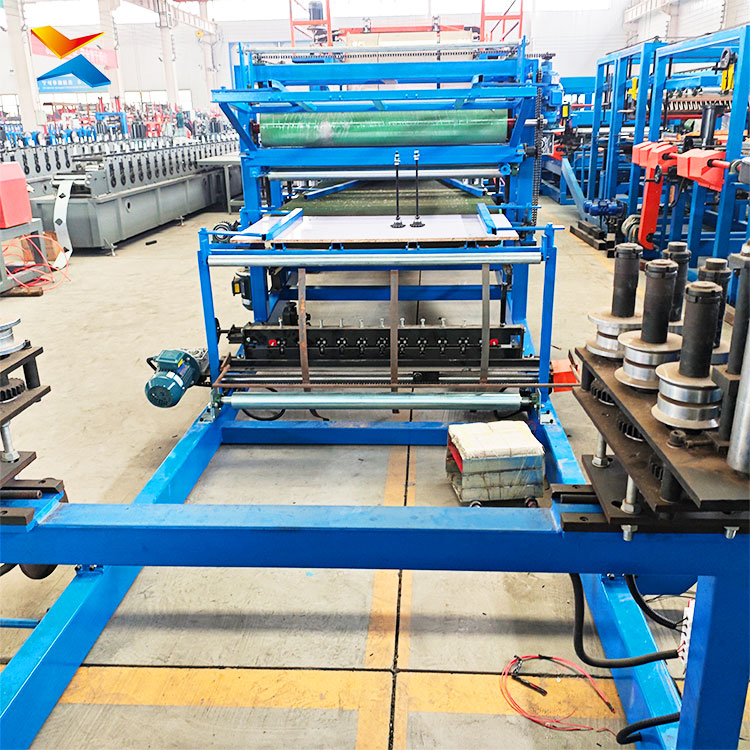
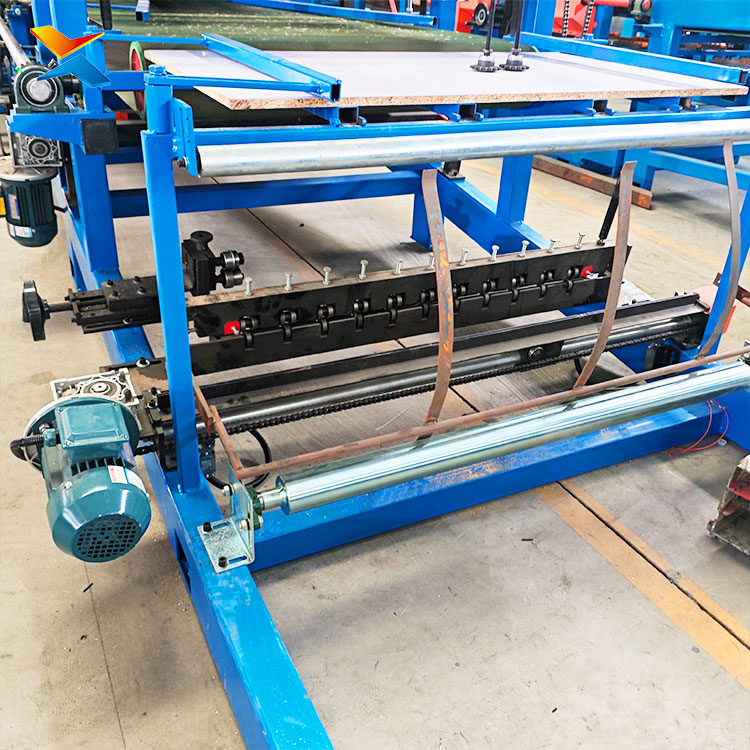
The machine integrates seamlessly into our standard composite panel line architecture: dual decoilers feed upper and lower steel coils (0.3–0.8mm top, 0.3–0.6mm bottom), the upper forming unit produces the desired top skin profile (flat or shallow-ribbed), the lower unit produces the flat bottom skin, and both skins meet in the 9-meter, 54-roller glue-lamination section where the insulation core — EPS foam for general container housing, rock wool for fire-rated applications, or PU for cold-climate or refrigerated container units — is bonded between them. The dual-blade fly-cut system maintains continuous production without stopping, essential for the high-volume, standardized-panel production that container house manufacturing demands. The patented one-way steel belt system prevents belt jamming during the frequent panel-width changeovers that occur when a container house factory switches between wall panels, roof panels, and partition panels across different container sizes (10ft, 20ft, 40ft).
The CE certification referenced in the title has been issued by an EU Notified Body following a full conformity assessment against the Machinery Directive 2006/42/EC, covering risk assessment (EN ISO 12100), safety-related controls (EN ISO 13849), and electrical safety (EN 60204-1). For Iraq-based manufacturers supplying container housing to UN agencies, international NGOs, oil field service companies, or government procurement programs — all of which routinely require CE or equivalent certification on production equipment as part of their supplier qualification — this third-party-audited certification is a critical commercial enabler. Hebei Xinnuo’s 28-year engineering track record, 14-year Alibaba Gold Supplier status, and annual output of 150+ composite panel machines ensure that the machine you receive is supported by a supply chain and technical team that understands the Iraqi market’s logistics, power infrastructure, and after-sales support requirements.



♦ COMPANY PROFILE:
Hebei Xinnuo Roll Forming Machine Co., Ltd., not only produce different types of professional roll forming machines, but also develop intelligent automatic roll forming production lines, C&Z shape purline machines, highway guardrail roll forming machine lines, sandwich panel production lines, decking forming machines, light keel machines, shutter slat door forming machines, downpipe machines, gutter machines, etc.
Advantages of Roll Forming A Metal Part
There are several advantages of using roll forming for your projects:
- The roll forming process allows operations such as punching, notching, and welding to be performed in-line. Labor cost and time for secondary operations are reduced or eliminated, reducing part costs.
- Roll form tooling allows for a high degree of flexibility. A single set of roll form tools will make almost any length of the same cross-section. Multiple sets of tools for varying length parts are not required.
- It can provide better dimensional control than other competing metal forming processes.
- Repeatability is inherent in the process, allowing easier assembly of roll formed parts into your finished product, and minimizing problems due to “standard” tolerance build up.
- Roll forming is typically a higher speed process.
- Roll forming offers customers a superior surface finish. This makes roll forming an excellent option for decorative stainless steel parts or for parts requiring a finish such as anodizing or powder coating. Also, texture or pattern can be rolled into the surface during forming.
- Roll forming utilizes material more efficiently than other competing processes.
- Roll formed shapes can be developed with thinner walls than competing processes
Roll forming is a continuous process which converts sheet metal into an engineered shape using consecutive sets of mated rolls, each of which makes only incremental changes in the form. The sum of these small changes in form is a complex profile.