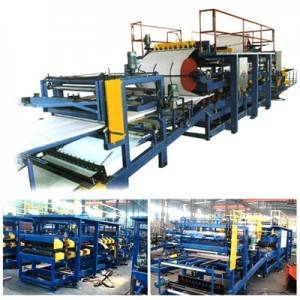


The Hebei Xinnuo Data Center Insulated Panel Production Line is a precision-engineered composite panel manufacturing system purpose-configured for the most thermally demanding, quality-intolerant building type in the GCC construction market: the hyperscale and colocation data center. Data center panels are not warehouse panels manufactured to a tighter tolerance — they are a fundamentally different product category defined by performance requirements that general-purpose sandwich panel machines cannot reliably meet. A data center building envelope must maintain an interior environment at 18–27°C with ±1°C stability and 40–60% relative humidity despite external ambient temperatures that routinely exceed 48°C in GCC summer conditions, while simultaneously providing fire-rated compartmentalization between server halls and supporting a roof-mounted cooling infrastructure weighing hundreds of tons. Every panel joint that leaks conditioned air, every square meter of panel surface that develops a thermal bridge from uneven core bonding, and every panel that fails to meet its specified fire-resistance rating represents not just an energy cost but a direct threat to server uptime — the single metric by which data center operators are measured and the basis upon which their SLA (Service Level Agreement) revenue depends.
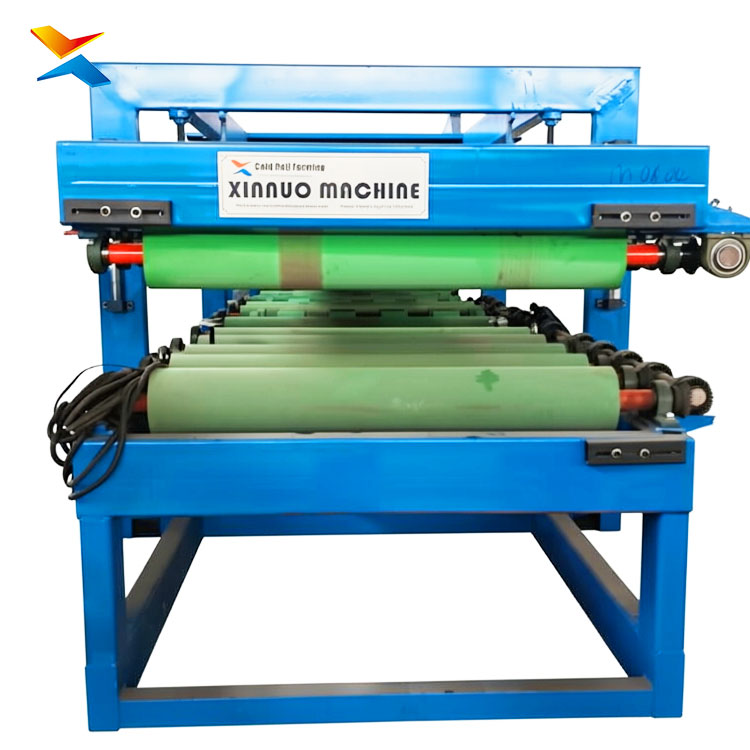
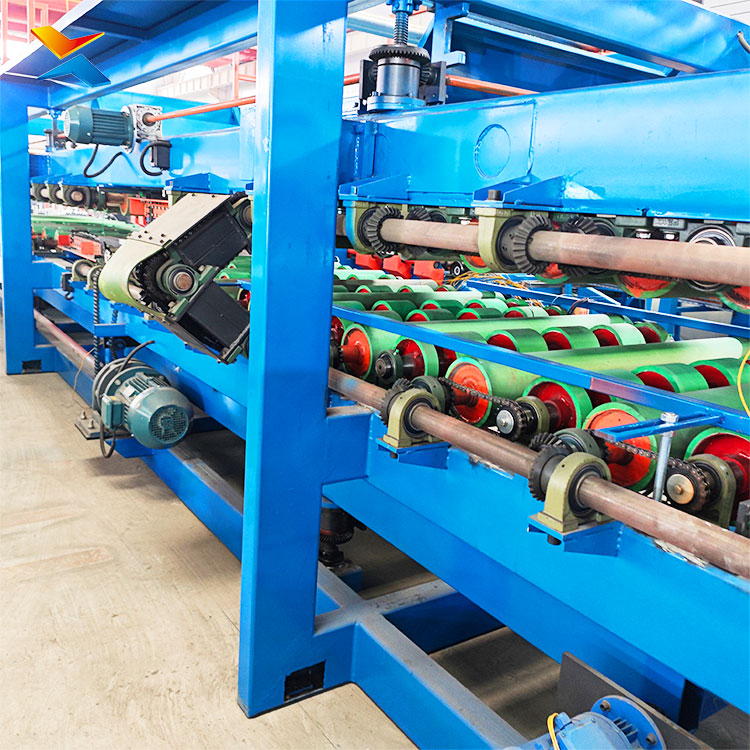
The dual glue pumps highlighted in the title are not an incidental specification elevated for marketing — they are the component that most directly governs the thermal integrity and long-term durability of the panels that enclose mission-critical IT infrastructure. In sandwich panel manufacturing, the adhesive that bonds the insulation core to the upper and lower steel skins is a two-component polyurethane system: a base resin (the “black” component) and a hardener/catalyst (the “white” component). The ratio at which these two components are mixed determines the adhesive’s cured strength, flexibility, and resistance to thermal degradation. A deviation of as little as 3–5% from the optimal mix ratio — which is common on single-pump systems that premix the components in a shared reservoir where settling, temperature stratification, and pump-wear asymmetry progressively alter the delivered ratio over a production shift — produces adhesive bonds that are measurably weaker and more susceptible to delamination under the thermal cycling that data center panels experience daily (hot exterior sun exposure cycling with cold interior air conditioning). Xinnuo’s dual-motor, dual-inverter, quad-pump architecture physically separates the black and white adhesive circuits from reservoir to injection nozzle, with each circuit independently metered by its own motor-inverter pair. The mix ratio is set digitally on the PLC touchscreen and maintained within ±1% accuracy across the full production run, regardless of reservoir levels, ambient temperature, or pump runtime. For a data center panel producer, this means that Panel 1 and Panel 10,000 in a production order — which may be installed on opposite sides of a 50-megawatt server hall — have identical adhesive bond strength and identical thermal resistance. There are no “Monday morning panels” with off-ratio adhesive from a pump that settled over the weekend, and no “end-of-shift panels” with degraded bonds from a pump that drifted as it heated up over eight hours of continuous operation.
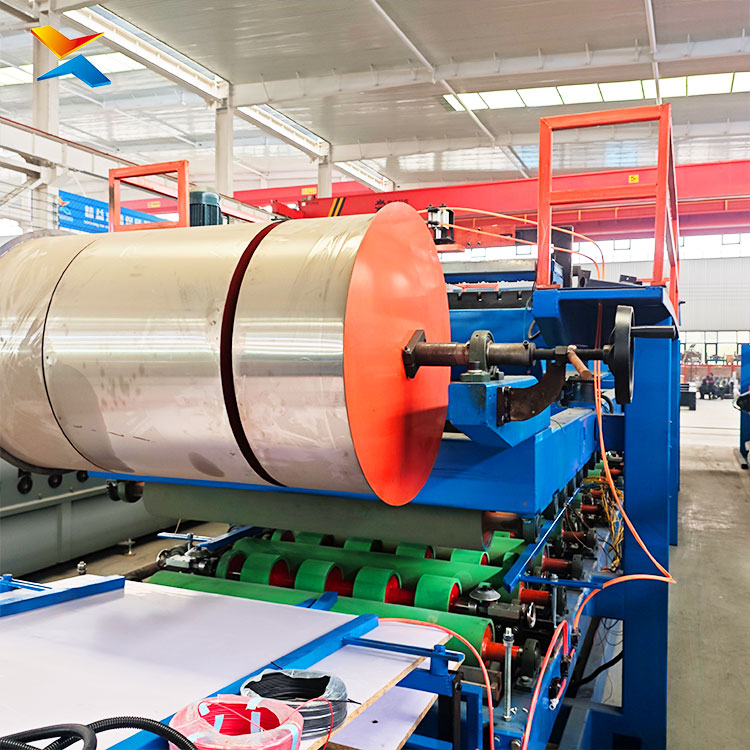
The data center panel profile is typically an S-joint (S口) hermetic interlock — the same continuous male-female edge geometry used in pharmaceutical clean rooms, specified for data centers because the positive-pressure air management systems that prevent dust ingress into server halls require a near-zero-leakage building envelope. The S-joint profile demands additional forming stations and tighter roller tolerances compared to standard lap-joint profiles, which is why the S-joint machine is the longest configuration in our composite panel lineup at up to 65 meters. The panels themselves are specified with PU (polyurethane) foam cores at 100–150mm thickness for the highest thermal resistance per millimeter (λ≈0.022) — critical for minimizing the thickness of walls that consume valuable white-space floor area — or rock wool cores at 100–200mm where A-grade fire compartmentalization between server halls or between the data hall and supporting MEP (mechanical, electrical, plumbing) galleries is required by GCC fire codes. The steel skins are typically food-grade or PVDF-coated color steel in light colors to maximize solar reflectance and reduce the building’s cooling load. The entire production process — from decoiler tension control through forming, lamination, and fly-cut — is governed by a self-programmed Delta PLC with SD-card batch logging that provides the production traceability documentation that data center operators increasingly require as part of their supplier quality audit programs.
The 14-Year Gold Supplier credential in the title is not an abstract badge — it represents 14 consecutive years of independently verified factory audits by SGS and TÜV on Alibaba.com, providing documented third-party evidence of Hebei Xinnuo’s manufacturing capability, financial stability, and export compliance. For a GCC data center panel buyer — who is likely supplying panels to projects designed by international engineering firms (Arup, Jacobs, AECOM), built by tier-one contractors, and ultimately owned by hyperscale cloud operators (AWS, Microsoft, Google) or colocation providers (Equinix, Khazna, Gulf Data Hub) — supplier qualification is not a formality. It is a multi-stage process in which the panel producer must demonstrate, with documented evidence, that their production equipment, quality management system, and manufacturing processes meet the standards required to supply materials for mission-critical infrastructure. The 14-year Gold Supplier verification, combined with ISO 9001:2015 certification, CE certification issued by an EU Notified Body, and Xinnuo’s 28-year engineering track record, provides the documented qualification package that passes these audits. The machine is supported by full on-site installation and commissioning by a senior engineer, comprehensive operator training, and 24/7 WeChat/WhatsApp remote technical support — essential for GCC data center panel producers operating against the compressed construction timelines that characterize the region’s cloud infrastructure build-out.


♦ COMPANY PROFILE:
Hebei Xinnuo Roll Forming Machine Co., Ltd., not only produce different types of professional roll forming machines, but also develop intelligent automatic roll forming production lines, C&Z shape purline machines, highway guardrail roll forming machine lines, sandwich panel production lines, decking forming machines, light keel machines, shutter slat door forming machines, downpipe machines, gutter machines, etc.
Advantages of Roll Forming A Metal Part
There are several advantages of using roll forming for your projects:
- The roll forming process allows operations such as punching, notching, and welding to be performed in-line. Labor cost and time for secondary operations are reduced or eliminated, reducing part costs.
- Roll form tooling allows for a high degree of flexibility. A single set of roll form tools will make almost any length of the same cross-section. Multiple sets of tools for varying length parts are not required.
- It can provide better dimensional control than other competing metal forming processes.
- Repeatability is inherent in the process, allowing easier assembly of roll formed parts into your finished product, and minimizing problems due to “standard” tolerance build up.
- Roll forming is typically a higher speed process.
- Roll forming offers customers a superior surface finish. This makes roll forming an excellent option for decorative stainless steel parts or for parts requiring a finish such as anodizing or powder coating. Also, texture or pattern can be rolled into the surface during forming.
- Roll forming utilizes material more efficiently than other competing processes.
- Roll formed shapes can be developed with thinner walls than competing processes
Roll forming is a continuous process which converts sheet metal into an engineered shape using consecutive sets of mated rolls, each of which makes only incremental changes in the form. The sum of these small changes in form is a complex profile.