


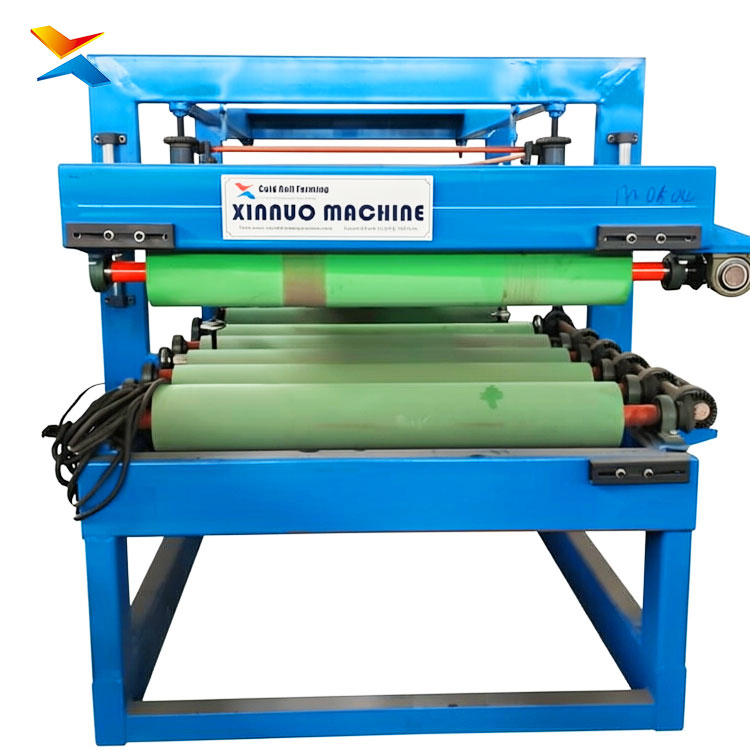
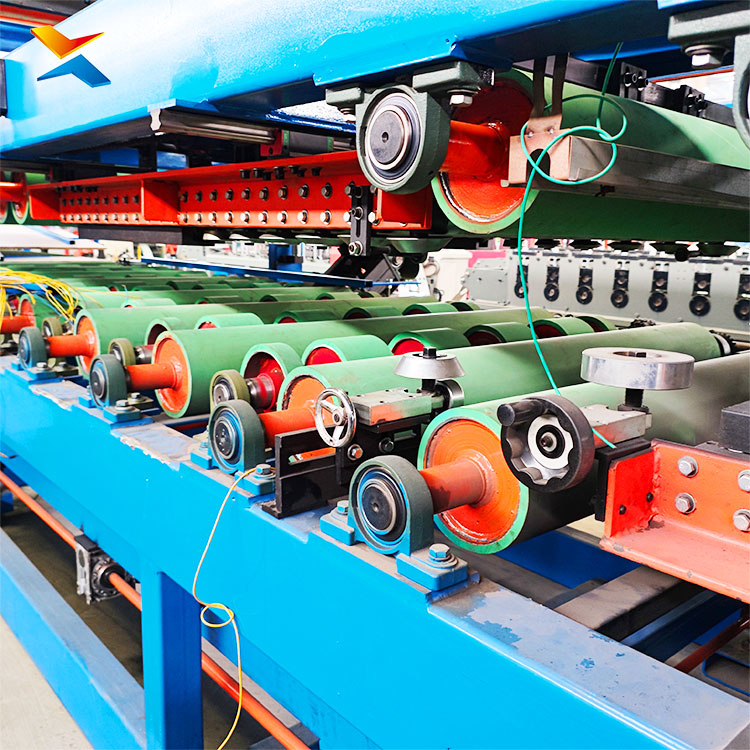
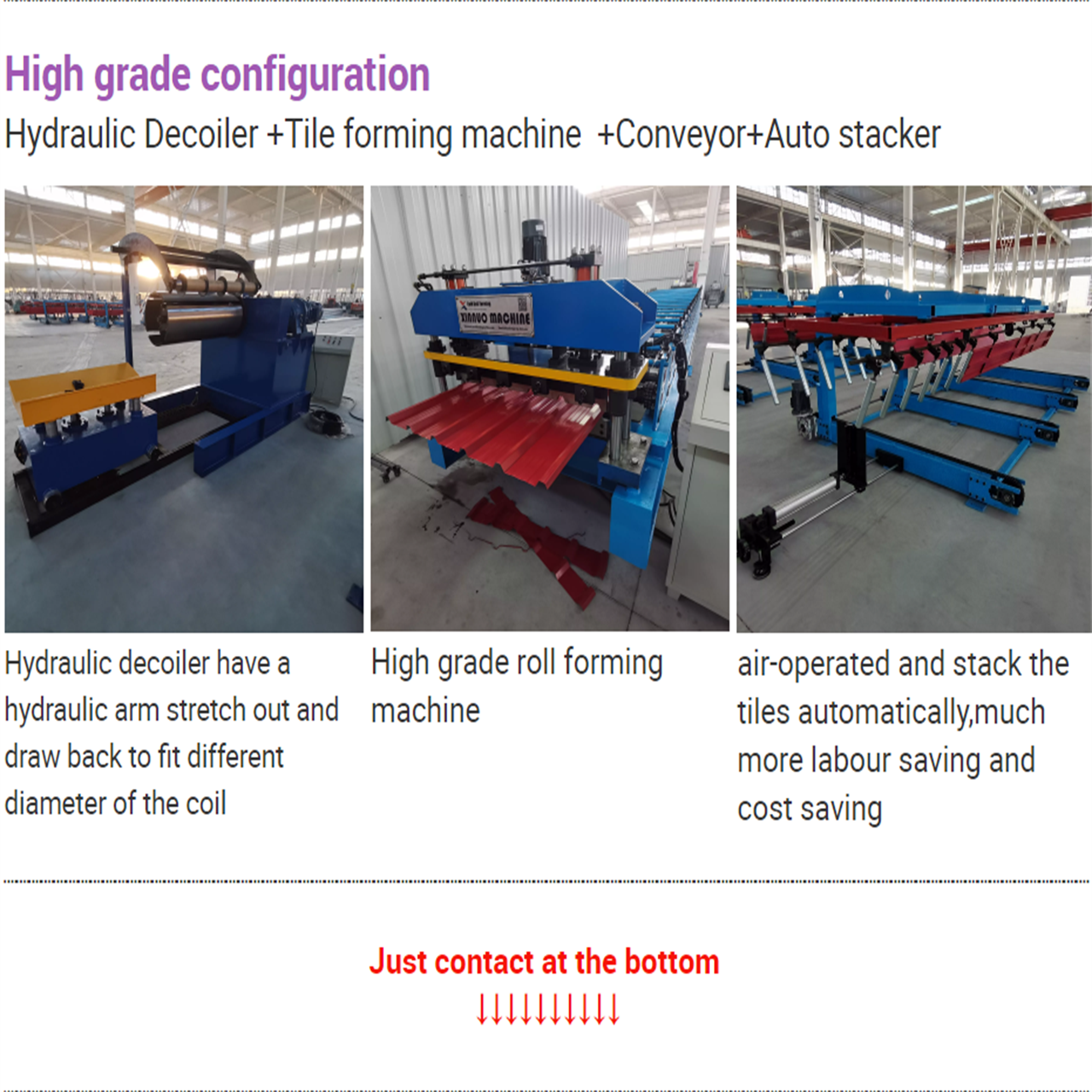
The Hebei Xinnuo Auto Stacker Sandwich Panel Production Line is a fully integrated, end-to-end automated manufacturing system that takes color-coated steel coil and insulation core material as raw material inputs and delivers stacked, counted, ready-to-ship finished sandwich panels as its output — without a single manual panel-handling operation between decoiling and forklift pickup. This is the fundamental distinction between the Auto Stacker line and a conventional composite panel machine: a conventional machine produces panels to an output table where a crew of 2–3 workers manually lifts, carries, and stacks each panel as it exits the fly-cut station. On a line producing 1,500–2,500 square meters of panels per shift, this manual handling represents 3–5 tons of panel weight lifted, carried, and positioned by human labor every day — a process that is physically demanding, injury-prone, speed-limiting, and the single most common source of panel surface damage (scratching during stacking, edge dents from misaligned placement, corner damage from drops). The Auto Stacker line eliminates this bottleneck entirely with an integrated pneumatic stacking system synchronized to the production PLC: panels exit the fly-cut station onto a 12-meter accumulating output table that provides buffering between the continuous production flow and the batch stacking operation, then a pneumatic lift-and-place stacker with vacuum or mechanical grippers picks each panel and positions it precisely onto the finished-panel pallet, building stacks of 10–30 panels per pallet with edge-to-edge alignment within ±2mm. When a pallet reaches its programmed stack count, the PLC signals the operator via the HMI, the full pallet is removed by forklift, an empty pallet is positioned, and stacking resumes — all without stopping the production line.
The value of this automation for the Saudi Arabian market is amplified by three structural factors in the Kingdom’s construction labor environment. First, Saudi Arabia’s Vision 2030 Saudization (Nitaqat) program imposes escalating quotas for Saudi national employment and increasing levies on expatriate worker visas, driving up the cost and reducing the availability of the manual labor that conventional panel factories depend on for panel handling, stacking, and packing. A conventional line requiring 5–6 workers (2 for decoiling and machine operation, 2–3 for panel stacking, 1 for forklift) can reduce to 2–3 workers with the Auto Stacker (1 machine operator, 1 forklift driver, 1 quality inspector) — a 40–50% labor reduction that directly improves Nitaqat compliance and reduces long-term operating cost exposure to rising expatriate levies. Second, Saudi Arabia’s construction sector operates on compressed project timelines, with peak demand concentrated in the October–April window when ambient temperatures allow outdoor installation work. Panel factories must maximize throughput during these months to build inventory for the peak season and fulfill just-in-time orders during it. The Auto Stacker’s elimination of manual stacking — which on a conventional line limits effective throughput to the speed at which a fatigued stacking crew can work by the eighth hour of a shift — enables the production line to operate at its mechanical speed limit throughout a 10–12 hour shift, increasing effective daily output by 20–30% compared to a manually stacked line of identical forming and lamination specification. Third, the quality consistency of auto-stacked panels — identical stack alignment, zero handling scratches, uniform pallet presentation — directly impacts the customer’s perception of the panel supplier’s professionalism when pallets arrive on a Saudi construction site. A pallet of perfectly aligned, unscratched panels with machine-printed batch labels communicates industrial capability; a pallet of manually stacked panels with offset edges, visible handling marks, and handwritten labels communicates a workshop. In a market where panel suppliers compete for EPC contractor framework agreements, this quality perception difference translates into won and lost contracts.
The auto stacker subsystem itself is Xinnuo-designed and Xinnuo-built, integrated into the production line’s Delta PLC architecture rather than being a third-party add-on with a separate control interface. This integration is operationally significant: the stacker’s lift and place timing, pallet stack count, and stacking pattern (flat stack or alternating-face stack for different panel profiles) are set on the same touchscreen HMI that controls the entire production line, eliminating the need for a separate stacker operator and preventing the synchronization errors that occur when independently controlled stackers fall out of phase with the production flow. The pneumatic actuation system — chosen over hydraulic for clean operation in the panel factory environment — uses 6-bar compressed air with a 1,000-liter buffer tank to ensure consistent actuation speed regardless of stacking frequency. The gripper system is configurable for vacuum cups (for smooth, flat panel surfaces) or mechanical edge clamps (for ribbed or textured surfaces), and the gripper pressure is PLC-adjustable to prevent panel surface marking on sensitive coated finishes.
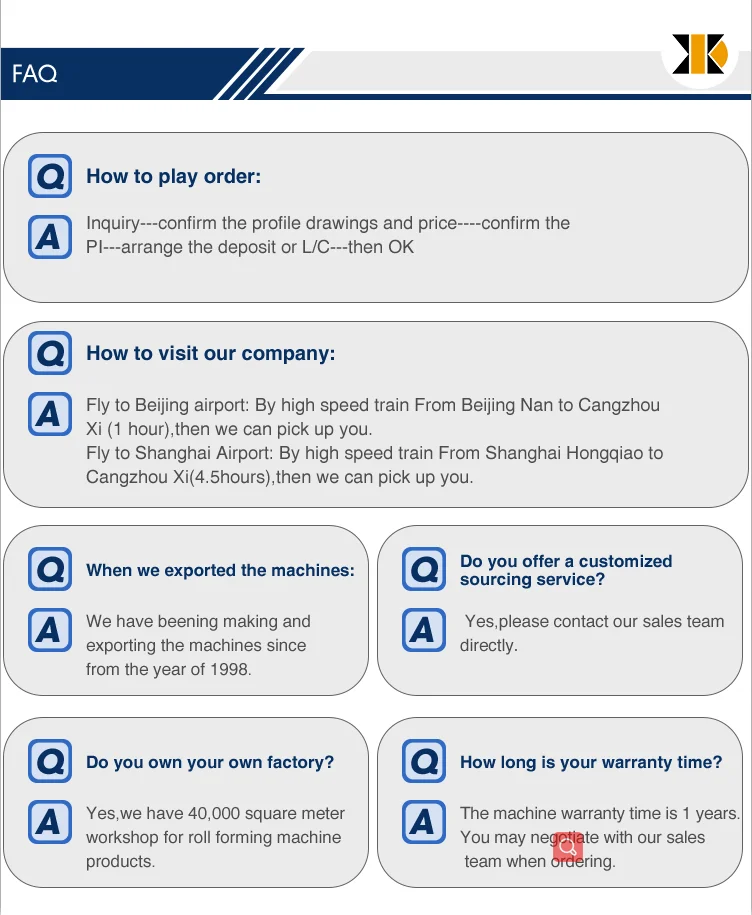
The machine carries Hebei Xinnuo’s full credentials, with the title emphasizing two that carry particular weight in the Saudi market. The 28-Year Manufacturer designation is not just a longevity claim — in the Saudi industrial procurement environment, where government and semi-government entities (MODON, SAGO, Saudi Ports Authority, Royal Commission projects) routinely require minimum 10–15 years of manufacturing history in their equipment supplier pre-qualification criteria, 28 years is a hard qualification metric that opens doors that would be closed to newer entrants regardless of their machine specifications. The High-Tech Cert (国家高新技术企业) is a certification issued by the Chinese government’s Ministry of Science and Technology following an audit of the company’s R&D investment, patent portfolio, and innovation outputs — it is not a self-declared claim but a government-verified technical capability credential. For Saudi buyers familiar with Chinese industrial supplier qualification, the High-Tech Enterprise certificate provides independent verification of Xinnuo’s engineering capability beyond the standard ISO/CE commercial certifications. The machine also carries ISO 9001:2015 certification, CE certification issued by an EU Notified Body, and the patented one-way steel belt, 0.05mm bed flatness 54-roller glue-lamination section, dual-motor quad-glue-pump adhesive delivery, dual-blade fly-cut with enclosed dust collection, and self-programmed Delta PLC with SD-card batch logging and 24/7 WeChat/WhatsApp remote diagnostics. Standard after-sales includes on-site installation and commissioning by a senior engineer — covering both the production line and the auto stacker subsystem — comprehensive operator training, and ongoing remote support.


♦ COMPANY PROFILE:
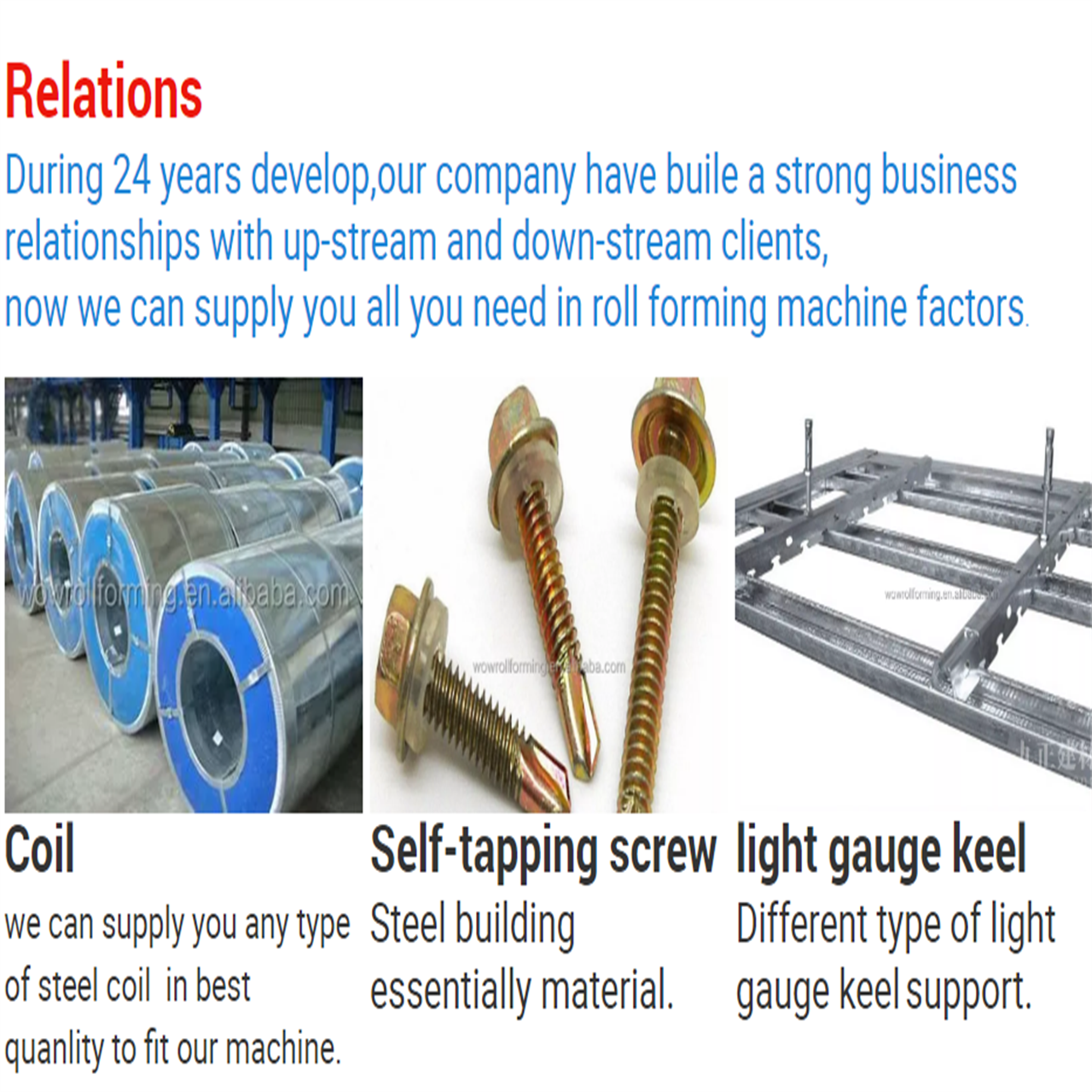
Hebei Xinnuo Roll Forming Machine Co., Ltd., not only produce different types of professional roll forming machines, but also develop intelligent automatic roll forming production lines, C&Z shape purline machines, highway guardrail roll forming machine lines, sandwich panel production lines, decking forming machines, light keel machines, shutter slat door forming machines, downpipe machines, gutter machines, etc.
Advantages of Roll Forming A Metal Part
There are several advantages of using roll forming for your projects:
- The roll forming process allows operations such as punching, notching, and welding to be performed in-line. Labor cost and time for secondary operations are reduced or eliminated, reducing part costs.
- Roll form tooling allows for a high degree of flexibility. A single set of roll form tools will make almost any length of the same cross-section. Multiple sets of tools for varying length parts are not required.
- It can provide better dimensional control than other competing metal forming processes.
- Repeatability is inherent in the process, allowing easier assembly of roll formed parts into your finished product, and minimizing problems due to “standard” tolerance build up.
- Roll forming is typically a higher speed process.
- Roll forming offers customers a superior surface finish. This makes roll forming an excellent option for decorative stainless steel parts or for parts requiring a finish such as anodizing or powder coating. Also, texture or pattern can be rolled into the surface during forming.
- Roll forming utilizes material more efficiently than other competing processes.
- Roll formed shapes can be developed with thinner walls than competing processes
Roll forming is a continuous process which converts sheet metal into an engineered shape using consecutive sets of mated rolls, each of which makes only incremental changes in the form. The sum of these small changes in form is a complex profile.


