

English
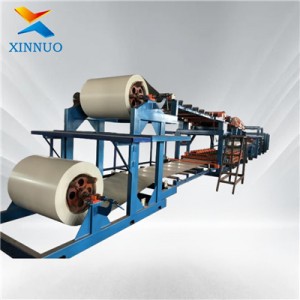
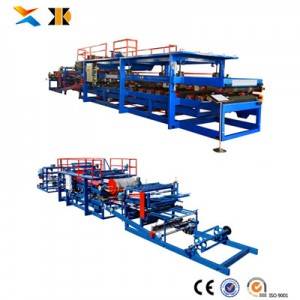
The Xinnuo Coastal Anti-Corrosion Composite Panel Production Line is a purpose-built continuous roll forming system engineered specifically for the corrosive marine environments of Dubai and Dammam. The Arabian Gulf coastline — where summer air temperatures exceed 45°C, relative humidity stays above 80%, and airborne salinity reaches 39–42 PSU — constitutes one of the world’s most aggressive corrosion zones for industrial machinery. Standard composite panel machines, designed for inland factories, experience frame rust-through within 3–5 years, roller surface pitting that degrades panel quality, and electrical system failures caused by conductive chloride films forming on unprotected circuits. Each of these failure modes not only increases maintenance cost and unplanned downtime, but also contaminates the panels being produced — microscopic rust particles and chloride residues transfer from the degraded machine to the steel panel skins during forming, becoming hidden corrosion initiators that compromise the building envelope’s service life from day one.
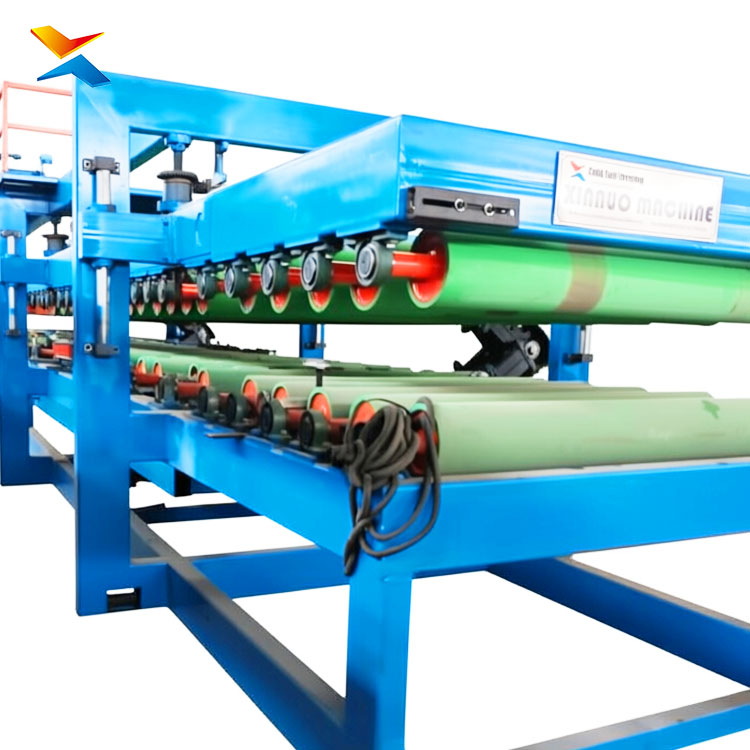
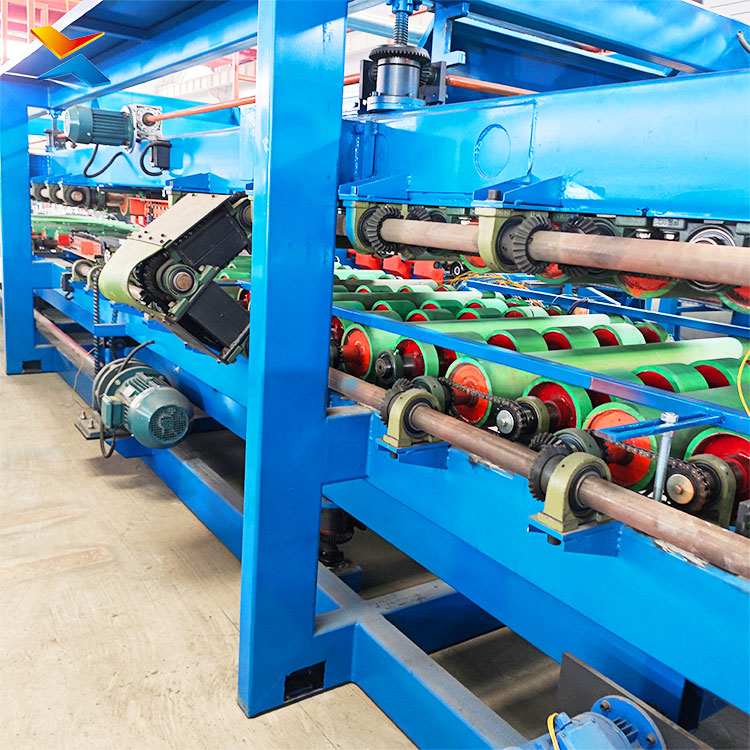
Our Coastal Anti-Corrosion variant addresses this systematically. Every structural steel component receives a two-coat marine-grade finish: shot-blast descaling to SA 2.5 (near-white metal), a 60–80μm zinc-rich epoxy primer that provides sacrificial cathodic protection even if the topcoat is scratched, and an 80–100μm marine-grade polyester powder topcoat oven-cured at 200°C. This dual-coat system, adapted from offshore platform fabrication standards, extends the structural repainting cycle from 3–5 years to beyond 10 years. All external fasteners, tensioners, and adjustment mechanisms are specified in A2-70 (304) stainless steel as standard, with A4-70 (316L) molybdenum-bearing stainless available for facilities within 500 meters of the shoreline — the zone where chloride deposition rates are highest and where 304 alone can still pit over extended exposure. The forming rollers receive hard chrome plating at 0.05–0.08mm thickness — 2× to 2.5× the industry standard — with a post-plating micro-pore sealing treatment that blocks chloride ion migration to the bearing steel substrate. For customers producing panels for direct seafront installations, an optional upgrade to 440C martensitic stainless steel rollers (58–60 HRC, intrinsically corrosion-resistant without plating) is available. The entire electrical control system is housed in IP65-rated 304 stainless steel enclosures with neoprene compression gaskets and positive-pressure purge ventilation that prevents humid, salt-laden factory air from entering during maintenance. All PCBs receive acrylic conformal coating, all internal wiring uses tinned copper conductors with XLPE insulation, and every screw terminal is protected with dielectric anti-corrosion grease after commissioning.
The CE certification referenced in our title is not a self-declaration — it has been issued following a full Notified Body audit against the EU Machinery Directive 2006/42/EC, covering risk assessment (EN ISO 12100), safety-related control systems (EN ISO 13849), electrical safety (EN 60204-1), and guarding (EN ISO 14120). For Dubai and Dammam buyers supplying panels to projects designed by European engineering consultants or financed by international development banks, this third-party-verified CE certification is a documented competitive advantage in supplier pre-qualification. The machine supports all four major insulation core materials — EPS foam, PU polyurethane, rock wool, and glass wool — with dual-blade fly-cut technology that maintains continuous production without stopping for each cut, eliminating the material waste and visible seam defects associated with stop-cut systems. The 54-roller glue-lamination section (9 meters, Φ180mm A-grade eco-certified rubber rollers) is built on a 12-meter CNC single-pass gantry-milled bed with 0.05mm flatness tolerance, ensuring void-free adhesive bonding across the full panel width. Total line length ranges from 50 to 65 meters depending on configuration, with panel effective widths from 950 to 1120mm and thickness from 50 to 200mm. Hebei Xinnuo brings 28 years of continuous cold roll forming engineering to every machine, backed by a 14-year unbroken Alibaba Gold Supplier track record, annual output of 150+ composite panel machines, and an installed base spanning over 30 countries including Israel, Russia, Turkey, Uzbekistan, India, Vietnam, Algeria, Brazil, and multiple GCC states. On-site installation, operator training, and 24/7 remote support via WeChat/WhatsApp are included as standard.


♦ COMPANY PROFILE:
Hebei Xinnuo Roll Forming Machine Co., Ltd., not only produce different types of professional roll forming machines, but also develop intelligent automatic roll forming production lines, C&Z shape purline machines, highway guardrail roll forming machine lines, sandwich panel production lines, decking forming machines, light keel machines, shutter slat door forming machines, downpipe machines, gutter machines, etc.
Advantages of Roll Forming A Metal Part
There are several advantages of using roll forming for your projects:
- The roll forming process allows operations such as punching, notching, and welding to be performed in-line. Labor cost and time for secondary operations are reduced or eliminated, reducing part costs.
- Roll form tooling allows for a high degree of flexibility. A single set of roll form tools will make almost any length of the same cross-section. Multiple sets of tools for varying length parts are not required.
- It can provide better dimensional control than other competing metal forming processes.
- Repeatability is inherent in the process, allowing easier assembly of roll formed parts into your finished product, and minimizing problems due to “standard” tolerance build up.
- Roll forming is typically a higher speed process.
- Roll forming offers customers a superior surface finish. This makes roll forming an excellent option for decorative stainless steel parts or for parts requiring a finish such as anodizing or powder coating. Also, texture or pattern can be rolled into the surface during forming.
- Roll forming utilizes material more efficiently than other competing processes.
- Roll formed shapes can be developed with thinner walls than competing processes
Roll forming is a continuous process which converts sheet metal into an engineered shape using consecutive sets of mated rolls, each of which makes only incremental changes in the form. The sum of these small changes in form is a complex profile.