

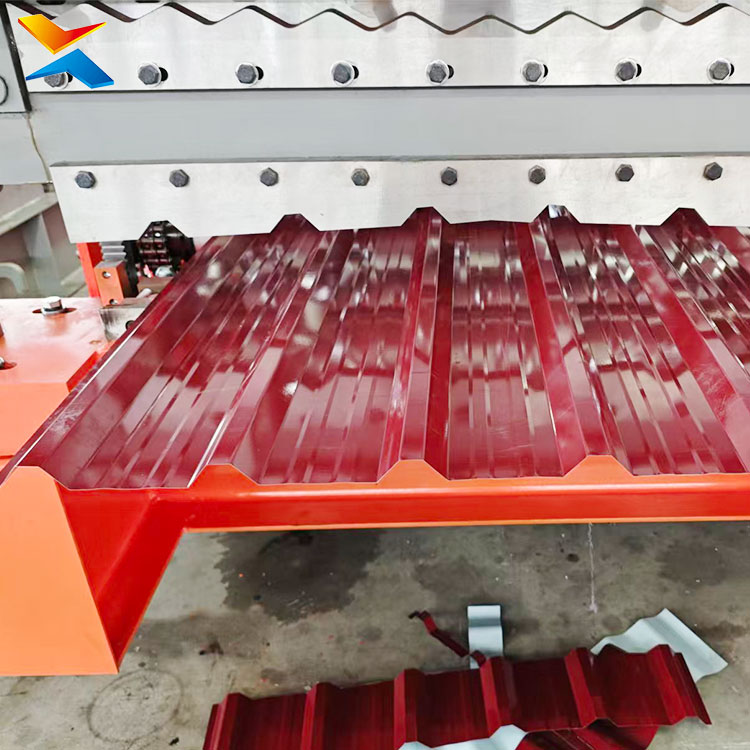
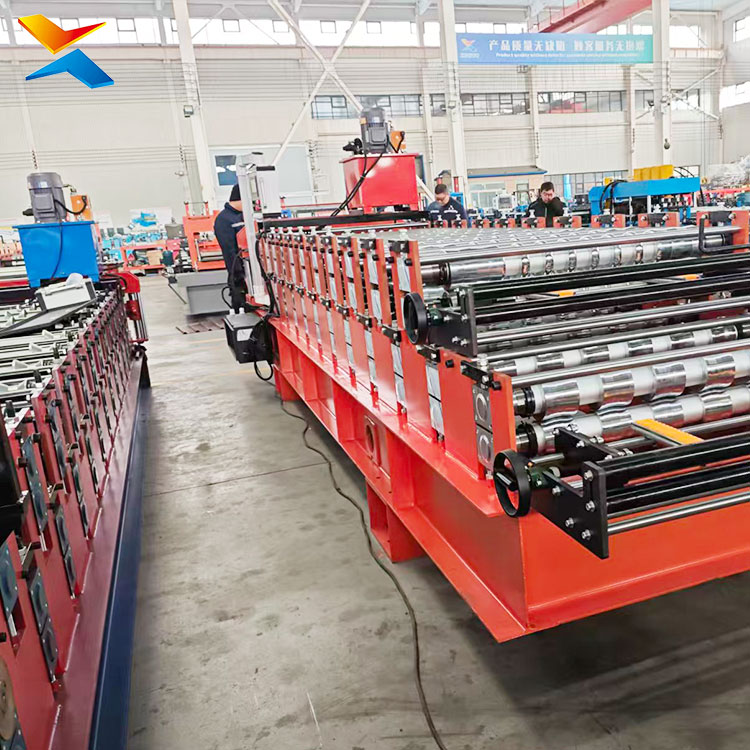
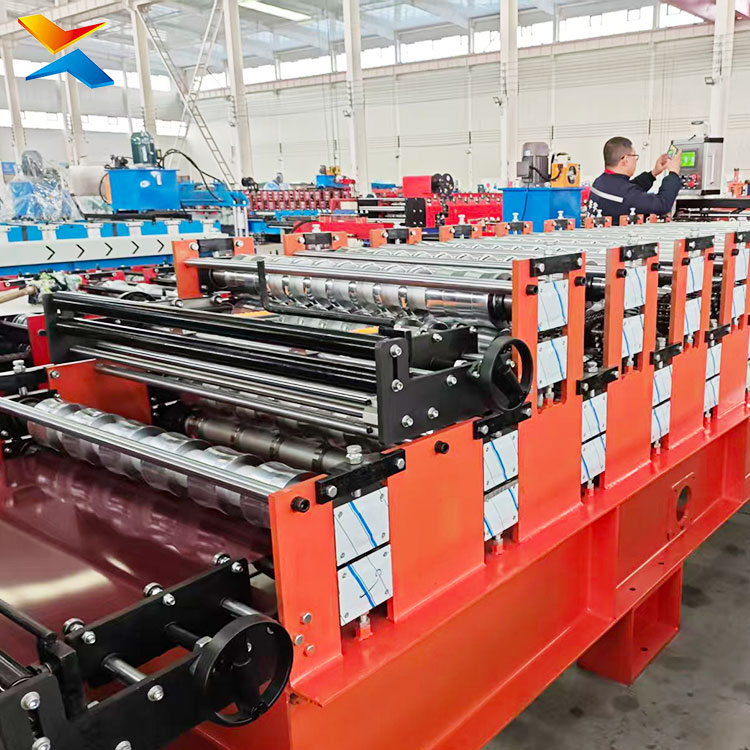
The Hebei Xinnuo Double Layer Roll Forming Machine is the space-saving, capital-efficient answer to a question every roofing sheet factory faces: how to produce two different roof panel profiles without buying, installing, and operating two separate machines. The answer is a single machine body carrying two complete forming roller sets stacked vertically — one set for each profile — sharing a single frame, a single drive system, and a single operator. To switch between the two profiles, the operator redirects the material path through a changeover gate: the strip enters the upper roller set for profile A, or the lower roller set for profile B. The changeover takes 5–15 minutes and requires no tooling changes, no roller removal, and no re-installation. This architecture — known in the industry as a double layer, double deck, or two-in-one roll forming machine — is engineered for the production reality of a roofing sheet factory that serves multiple market segments: a machine that produces the corrugated arc wave profile favored for industrial and agricultural roofing on one deck, and the trapezoidal profile favored for structural roofing and wall cladding on the other, covers the two most widely specified steel roof profiles in the Middle East market with a single investment.
The ”two profile” capability is the machine’s defining commercial logic. A single-layer machine produces one profile, and a factory needing two profiles historically bought two machines — two frames, two drive systems, two foundations, two installations, two maintenance regimes, and roughly double the floor space. The double layer machine collapses this into one machine with a vertical stack of rollers: the total investment is approximately 65–75% of the cost of two equivalent single-layer machines (70% is the typical figure for the arc + trapezoid combination), and the floor space requirement drops by approximately 40–60% — from the 44–88 square meters that two single machines typically occupy to roughly 20–35 square meters for the double layer unit. For a Middle East roofing sheet producer operating in an industrial zone where floor space is a direct cost — rent per square meter, concrete foundation per square meter, overhead crane coverage per square meter — this space saving is a measurable capital and operating cost reduction, not a convenience.
The corrugated tile designation in the title refers to the arc wave profile — the continuous sine-wave roof panel that dominates industrial roofing in hot-climate markets. The arc profile’s characteristic wave shape provides drainage capacity and spanning stiffness for large industrial roofs while remaining economical in material use. The second deck’s trapezoidal profile — with its flat crown and steep sidewalls — provides the structural rigidity that makes it the standard for structural roofing and wall cladding in steel-frame construction. The Xinnuo double layer platform supports this arc + trapezoid combination across production-proven blueprint configurations — from the entry-level DB001 (16-row 836mm arc / 14-row 840mm trapezoid with A-wheel, 350H frame) through the heavier DB024 (13-row 6-peak 1000mm trapezoid / 16-row 9-wave 960mm arc, 400H frame) to the standard DB043 (13-row 12-wave 836mm arc / 11-row 5-peak 840mm trapezoid) — with 234 production-proven blueprints across seven combination families covering trapezoid+trapezoid, arc+trapezoid, arc+glazed tile, trapezoid+glazed tile, arc+arc, triple-layer, and press+slitting combinations. For the Middle East market specifically, the arc + glazed tile combination (DB057: 14-row 988mm arc / 18-row 6-peak 1000mm glazed tile, 1220mm feed, 350H) serves the region’s combined demand for industrial roofing and decorative glazed tile roofing on prestige and heritage-influenced buildings.
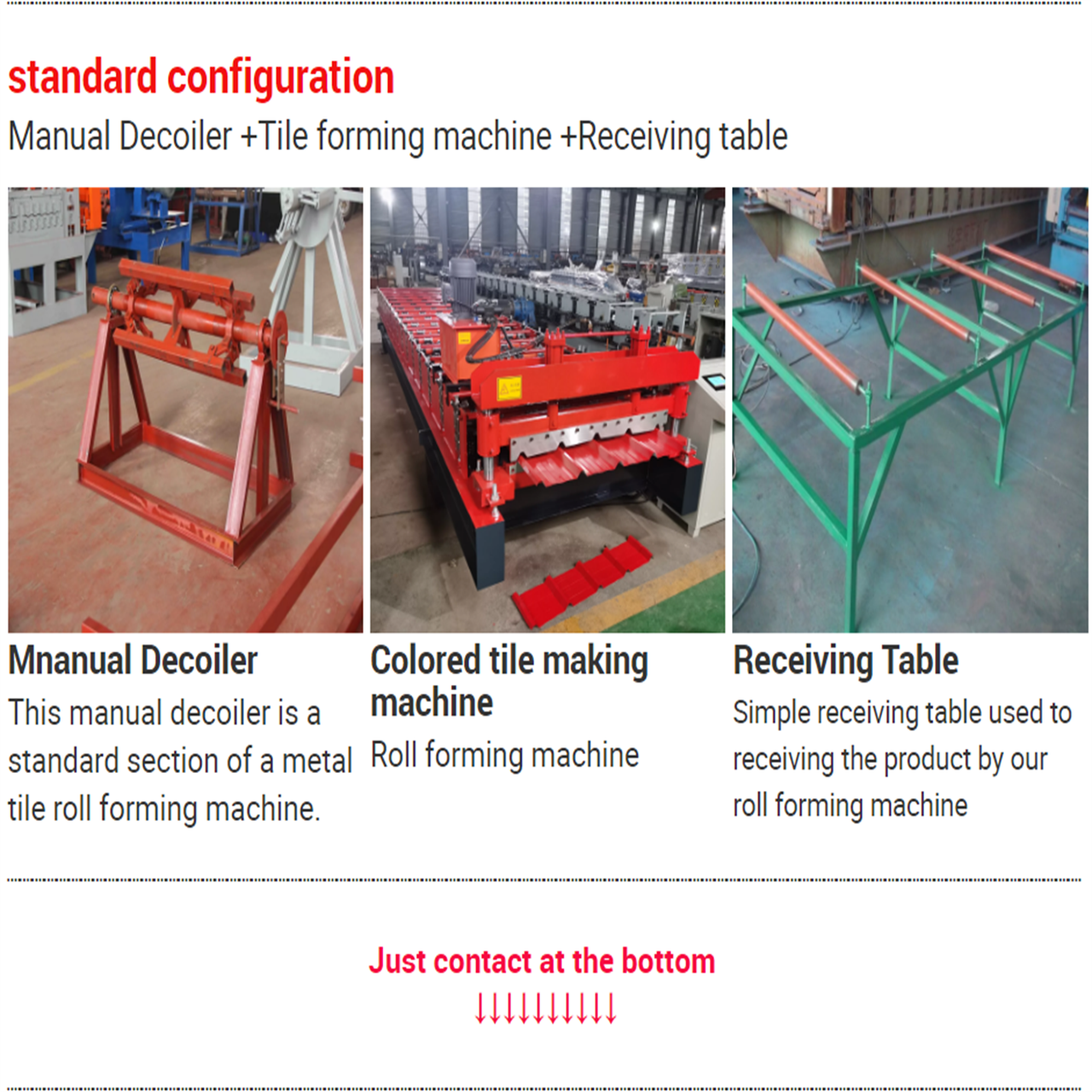
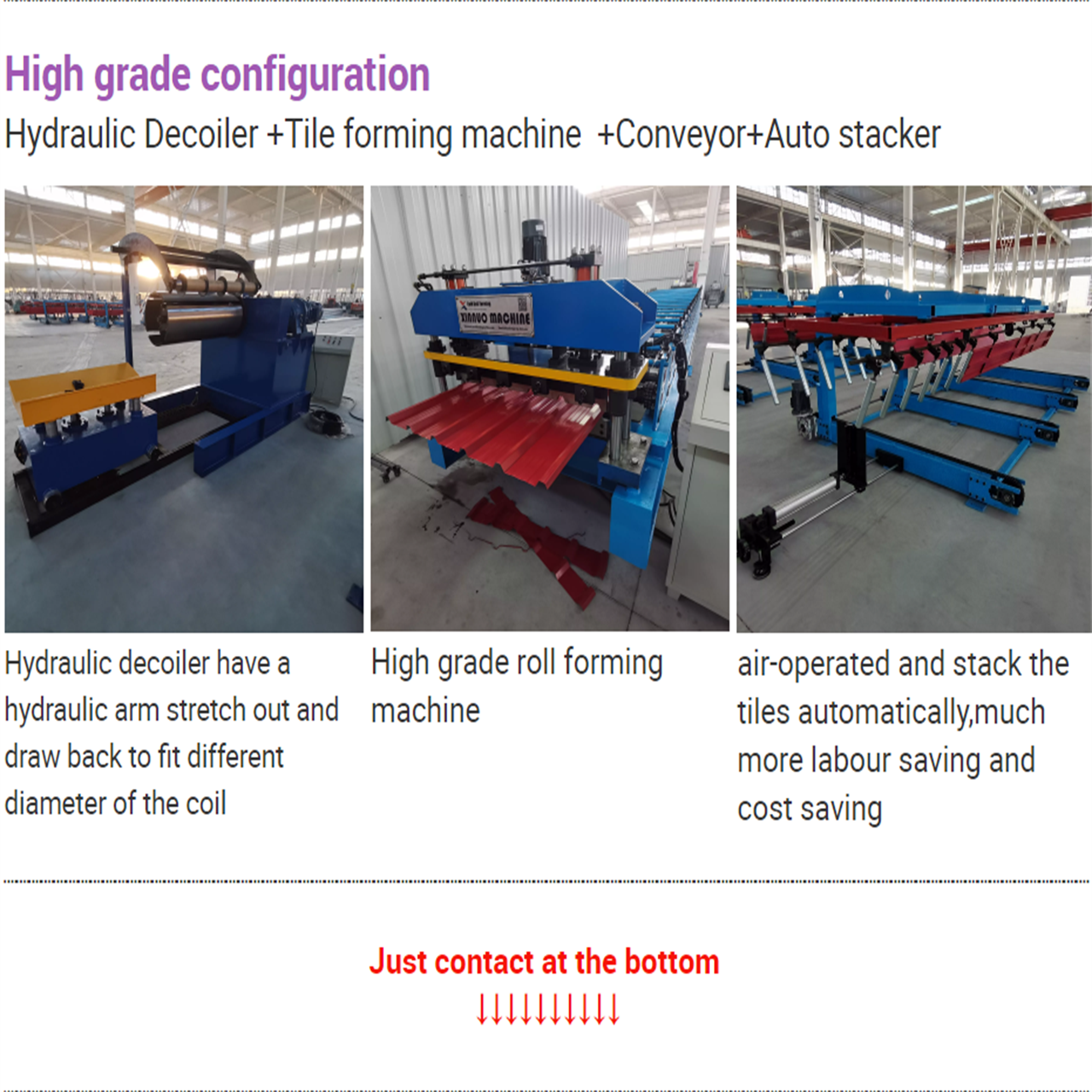
The standard configuration across the double layer family follows proven engineering rules. 12 or 14 forming rows per deck is the standard — the 900/840 double layer being the highest-frequency configuration in our production history — with 350H structural steel frame as the standard frame class (the frame is always specified one class above the equivalent single-layer machine, because the stacked decks multiply the frame loading; a single-layer 300H machine becomes a 350H double layer, and heavy combinations step up to 400H or 450H). The drive system uses 5.5KW motors with 6分双排 (double-row) chain as the standard — the double-row chain being required because it transmits torque to two stacked decks, and its specification is set by the deck with the higher torque demand. The two decks share the same feeding width where possible — a shared decoiler and feeding table serve both decks, simplifying the factory layout — and the row-count difference between the two decks is kept within reasonable limits (typically ≤6 rows) to maintain balanced forming quality and stable strip travel between decks. The changeover gate — the mechanical detail that makes the dual-profile capability practical — is designed for operator-friendly 5–15 minute switches between decks, with the material path redirected by a pivoting guide plate.
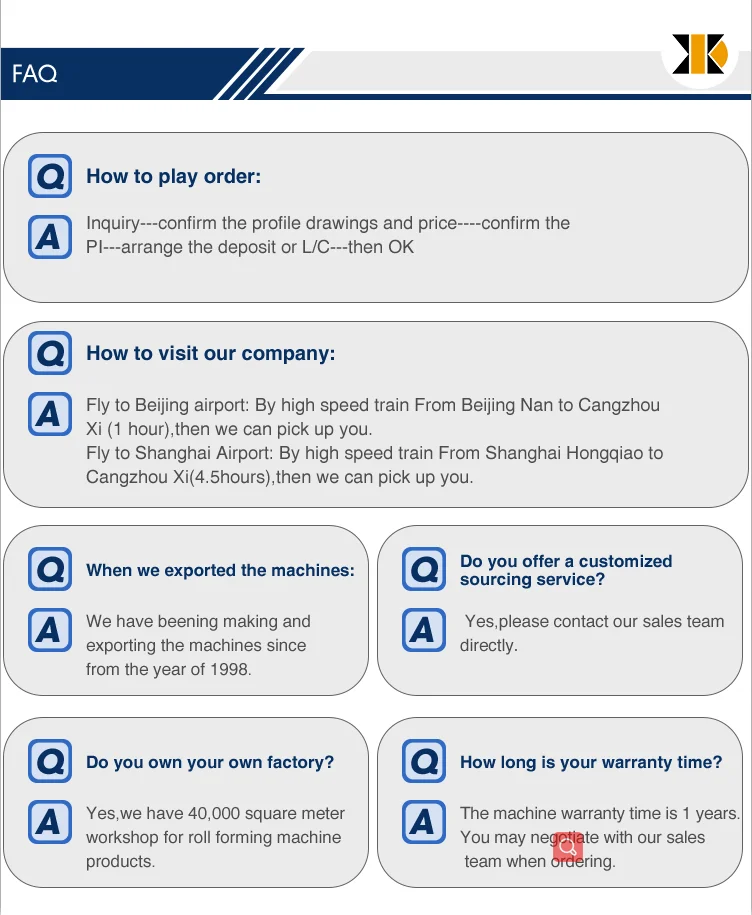
For the Middle East steel roof market — driven by the region’s steel structure construction programs spanning logistics warehouses, industrial plants, agricultural buildings, and commercial developments — the double layer machine delivers the production flexibility that matches the market’s profile mix. The same factory serves industrial projects specifying corrugated arc roofing and structural projects specifying trapezoidal profiles, switching between decks between orders without re-tooling. The machine carries Hebei Xinnuo’s complete credentials: 28-year manufacturing history, ISO 9001:2015 certified processes, CE certification issued by an EU Notified Body under the Machinery Directive 2006/42/EC, 14-year Alibaba Gold Supplier verification with SGS/TÜV factory audits, and National High-Tech Enterprise certification. On-site installation and commissioning by senior engineers, operator training, and 24/7 WeChat/WhatsApp remote support are included as standard — with the double layer machine’s commissioning taking approximately 2–3 days for standard combinations (versus 1 day for a single-layer machine) and 3–5 days for complex arc + glazed tile combinations, with detailed illustrated commissioning manuals and video guides provided with every machine.


♦ COMPANY PROFILE:
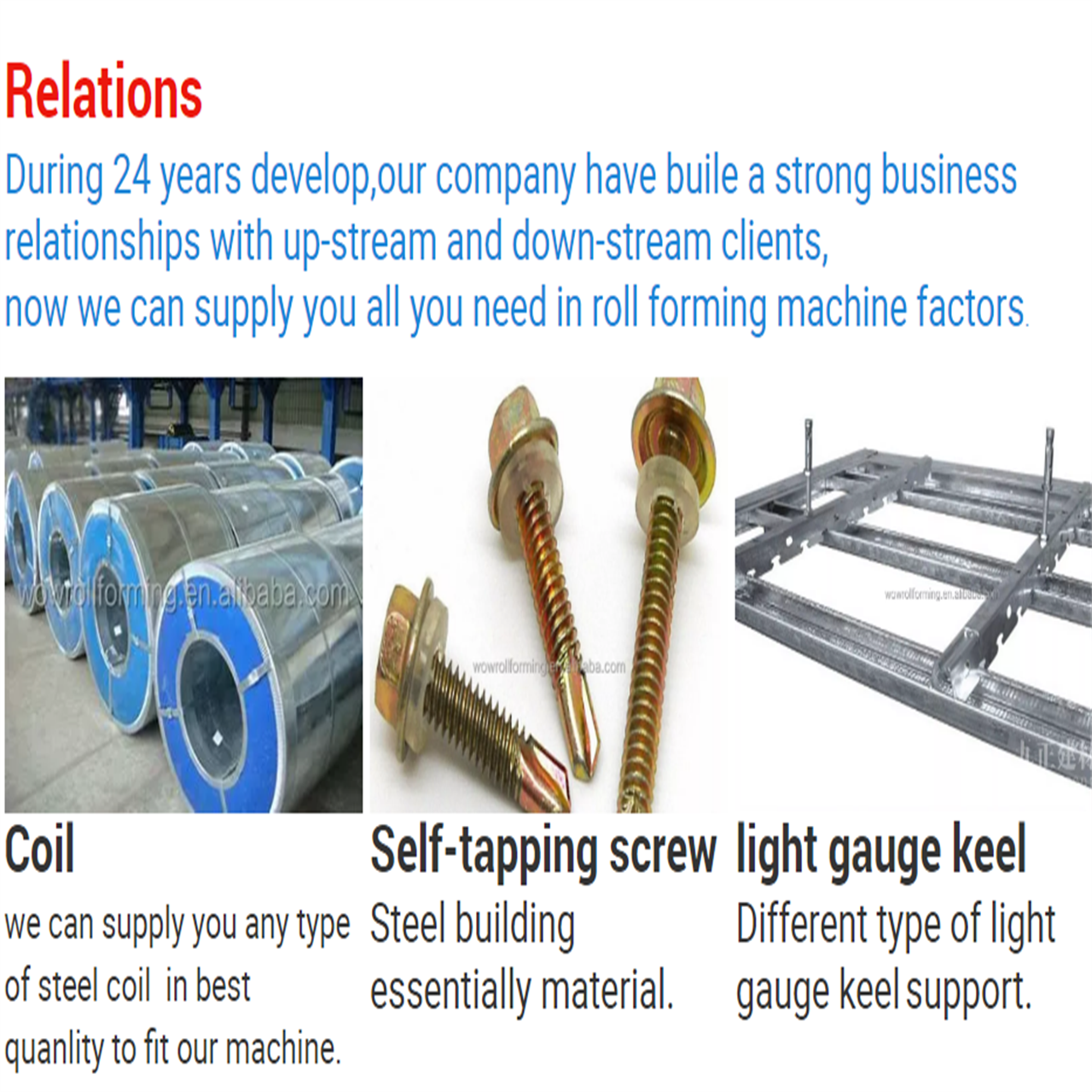
Hebei Xinnuo Roll Forming Machine Co., Ltd., not only produce different types of professional roll forming machines, but also develop intelligent automatic roll forming production lines, C&Z shape purline machines, highway guardrail roll forming machine lines, sandwich panel production lines, decking forming machines, light keel machines, shutter slat door forming machines, downpipe machines, gutter machines, etc.
Advantages of Roll Forming A Metal Part
There are several advantages of using roll forming for your projects:
- The roll forming process allows operations such as punching, notching, and welding to be performed in-line. Labor cost and time for secondary operations are reduced or eliminated, reducing part costs.
- Roll form tooling allows for a high degree of flexibility. A single set of roll form tools will make almost any length of the same cross-section. Multiple sets of tools for varying length parts are not required.
- It can provide better dimensional control than other competing metal forming processes.
- Repeatability is inherent in the process, allowing easier assembly of roll formed parts into your finished product, and minimizing problems due to “standard” tolerance build up.
- Roll forming is typically a higher speed process.
- Roll forming offers customers a superior surface finish. This makes roll forming an excellent option for decorative stainless steel parts or for parts requiring a finish such as anodizing or powder coating. Also, texture or pattern can be rolled into the surface during forming.
- Roll forming utilizes material more efficiently than other competing processes.
- Roll formed shapes can be developed with thinner walls than competing processes
Roll forming is a continuous process which converts sheet metal into an engineered shape using consecutive sets of mated rolls, each of which makes only incremental changes in the form. The sum of these small changes in form is a complex profile.
-
Automatic Double Layer Roll Forming Machine Cor...
-
Double Layer Roll Forming Machine Manufacturer ...
-
Stable Performance Double Layer Profile Roll Fo...
-
Custom Design Double Layer Metal Sheet Forming ...
-
Double layer IBR and corrugated roofing sheet r...
-
Double Layer Trapezoidal Roll Forming Machine |...


