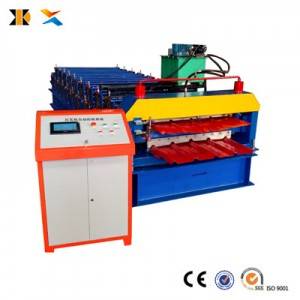


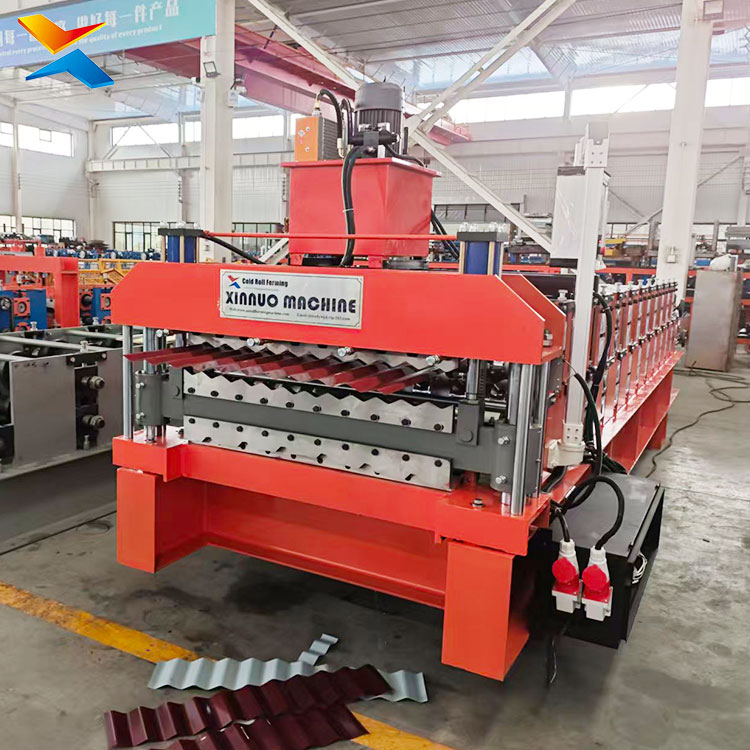
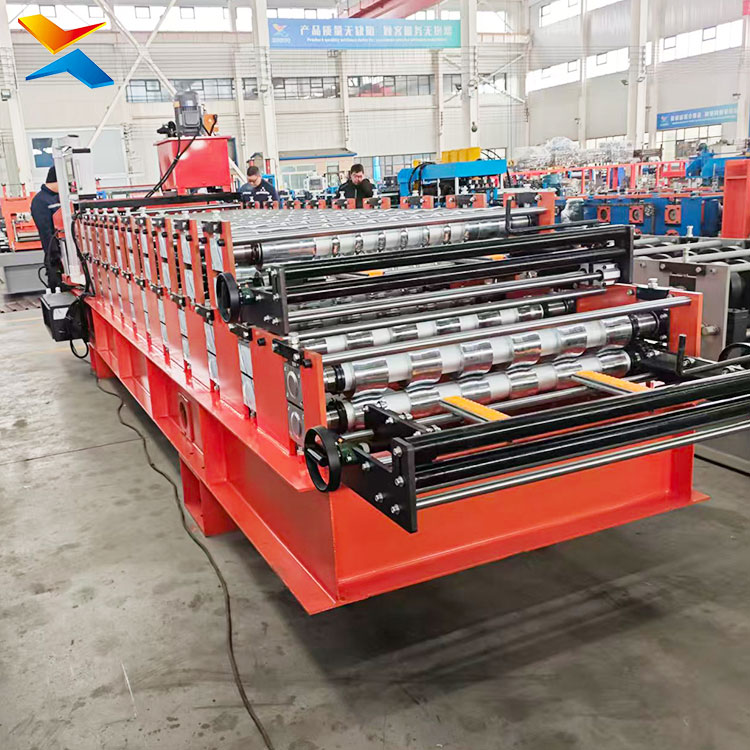
The Xinnuo Double Layer Roofing Sheet Roll Forming Machine is the “two in one” solution for the Middle East roofing sheet industry — one machine body that produces the two most widely specified steel roof profiles in the region: the corrugated arc wave profile that dominates industrial roofing, and the trapezoidal profile that dominates structural roofing and wall cladding. The “two in one” concept is literal: two complete forming decks — each a full set of rollers for its profile — are stacked vertically inside a single 350H frame, sharing one drive system, one electrical cabinet, one decoiler, and one operator. To change the production profile, the operator redirects the strip through a pivoting changeover gate into either the upper deck (one profile) or the lower deck (the other). The switch takes 5–15 minutes, requires no tooling change, and produces no setup scrap — the first sheet after a changeover is a finished product. This is the production machine equivalent of owning two machines with the capital and footprint of one: approximately 65–75% of the cost of two equivalent single-layer machines (the corrugated + trapezoidal combination at approximately 70%), in roughly 40–60% less floor space (approximately 20–35 m² versus the 44–88 m² that two singles typically occupy).
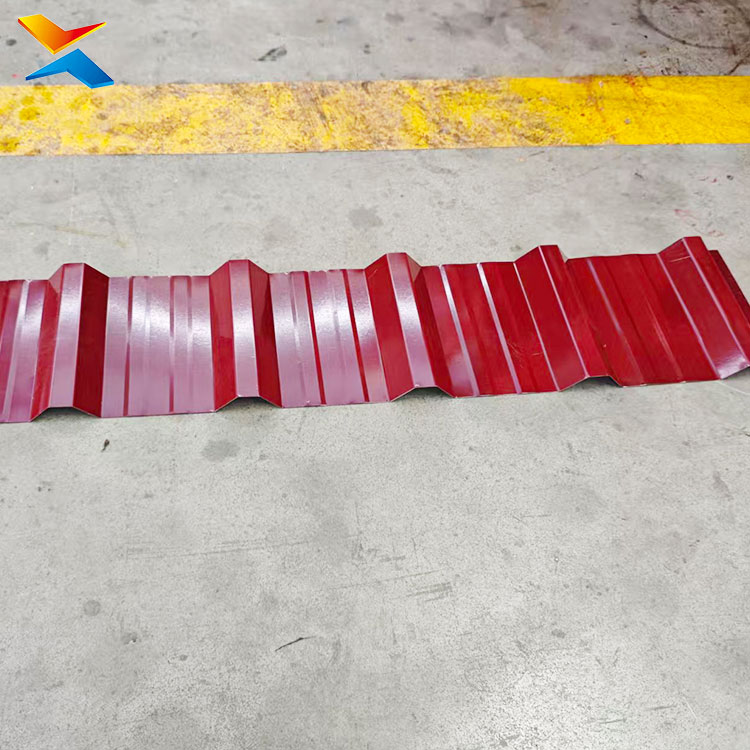
The two profiles carried by this machine are complementary in the Middle East market rather than competitive — they serve different project types that flow through the same factory’s order book. The corrugated arc profile — a continuous sine wave with a smooth, sweeping cross-section — is specified for large industrial roofs where its wave geometry provides efficient drainage (rapid shedding of the brief but intense rainfall events characteristic of Gulf winters) and spanning stiffness at economical material weight. Warehouses, factories, logistics centers, and agricultural buildings across the GCC specify corrugated roofing as their standard envelope. The trapezoidal profile — with its flat crowns and steep, vertical sidewalls — is specified where structural rigidity is the governing requirement: purlin-supported structural roofing, wall cladding panels, and buildings where the roof sheet is a structural element in the assembly. The two profiles appear together in many projects — a warehouse with a corrugated roof and trapezoidal wall cladding is a typical steel structure building across the region — which means a single factory serving the full local market needs both profiles, and the two-in-one machine delivers both.
The machine’s engineering follows the production-proven Xinnuo double layer architecture. Each deck carries 12–14 forming rows as the standard — the 900/840 double layer configuration being the highest-frequency profile pair in our 234-blueprint production history (2014–2025, 80+ countries) — mounted in a 350H structural steel frame. The frame class is always specified one level above the equivalent single-layer machine (a single-layer 300H machine becomes a 350H double layer) because the vertically stacked decks multiply the frame loading, and heavy combinations step up to 400H or 450H. The drive is 5.5KW motors with 6分双排 (double-row) chain as standard — the double-row chain being required to transmit torque to both stacked decks, with its specification set by the deck having the higher torque demand. The two decks share a common feeding width and a shared decoiler and feeding table where possible, simplifying the factory layout to a single coil-handling path. The row-count difference between the two decks is held within approximately 6 rows to maintain balanced forming quality and stable strip travel across both decks. Production-proven blueprint references anchor every configuration: DB001 (16-row 836mm corrugated arc / 14-row 840mm trapezoidal with A-wheel, 350H) as the entry configuration; DB024 (13-row 6-peak 1000mm trapezoidal / 16-row 9-wave 960mm corrugated arc, 400H) as the heavy configuration; and DB043 (13-row 12-wave 836mm corrugated arc / 11-row 5-peak 840mm trapezoidal) as the standard configuration.
For the Middle East market, the two-in-one machine addresses the region’s characteristic demand pattern: project-based, seasonally concentrated, and profile-mixed. GCC construction activity concentrates in the October–April window when temperatures permit outdoor work, and within that window a single factory may receive industrial orders (corrugated roofing) and structural orders (trapezoidal roofing) in alternating sequence. The two-in-one machine absorbs this mixed order flow without a second machine: decks are switched between orders in minutes, and the same operator, the same coil inventory, and the same production planning cover both profiles. The machine also serves the region’s dealer and distributor segment — roofing sheet dealers who stock multiple profiles to serve walk-in customers and small contractors, for whom the two-in-one machine provides both profiles in a single-floor-space, single-operator footprint that fits a dealer-scale workshop. Commissioning is supported by Xinnuo’s senior engineers on-site (2–3 days for standard combinations, 3–5 days for complex combinations), with illustrated manuals and video guides included, and the 24/7 WeChat/WhatsApp channel provides ongoing remote support. The machine carries ISO 9001:2015, CE (Notified Body audited), 14-year Alibaba Gold Supplier verification, and National High-Tech Enterprise certification — the qualification framework that Middle East factory owners and dealers apply when selecting production equipment.


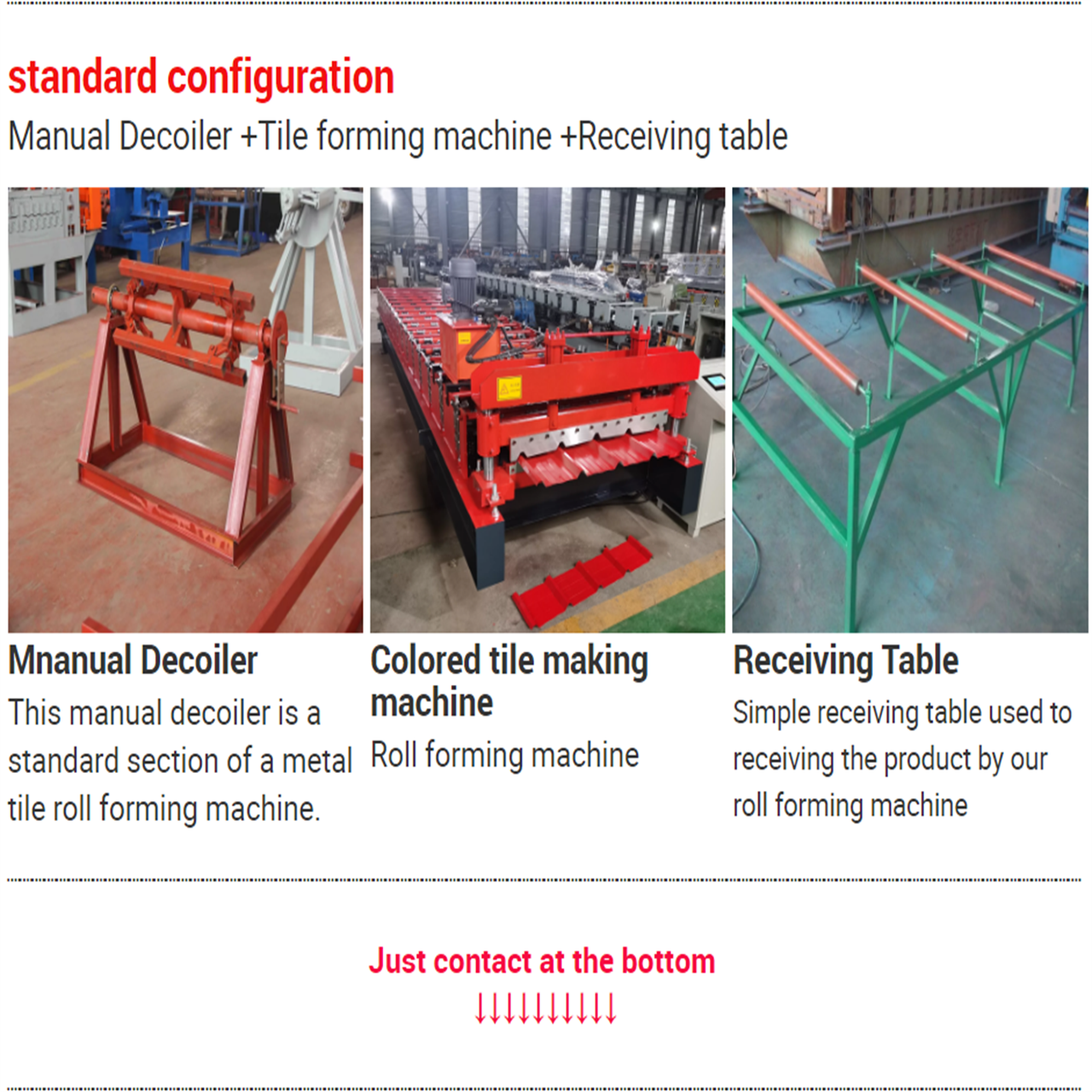
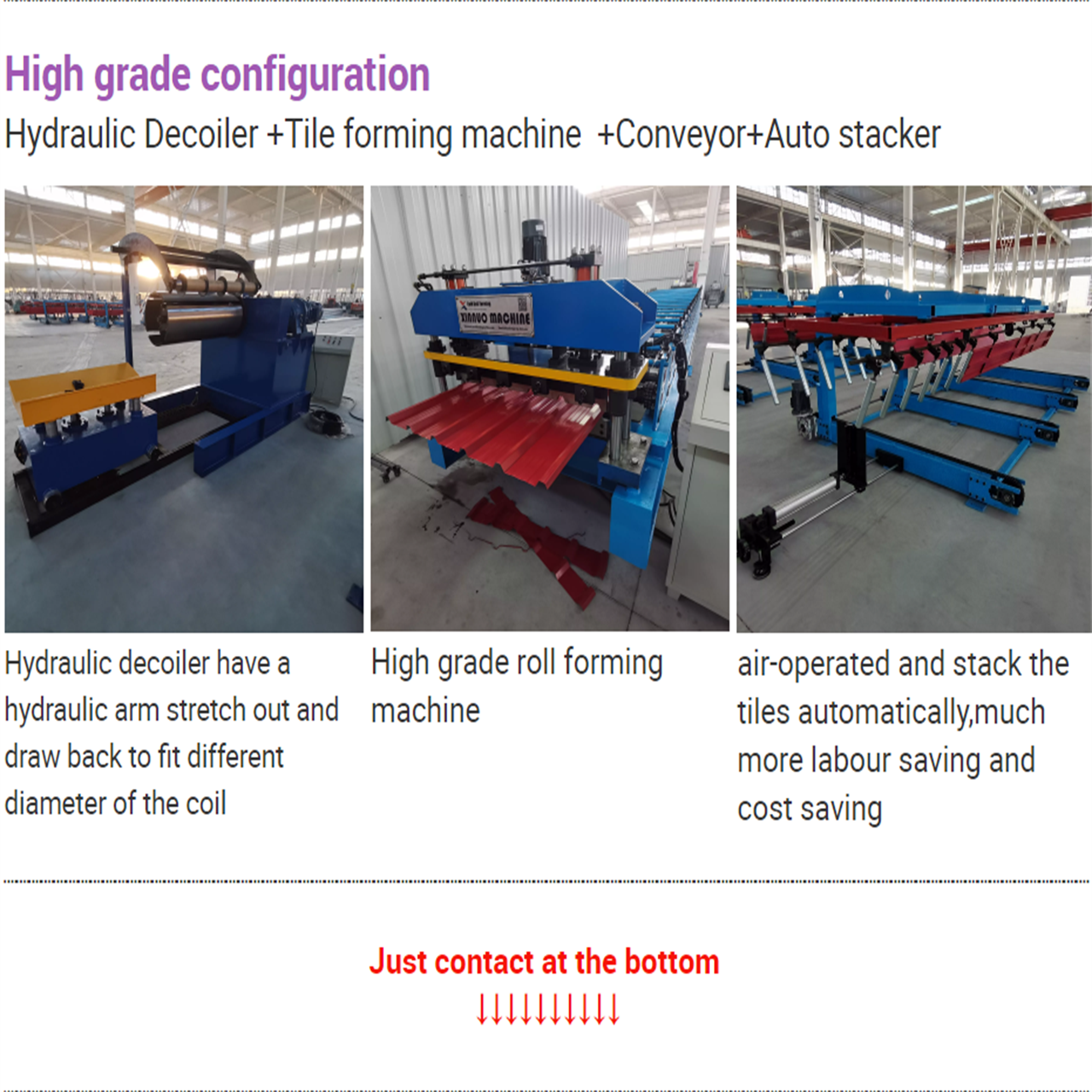
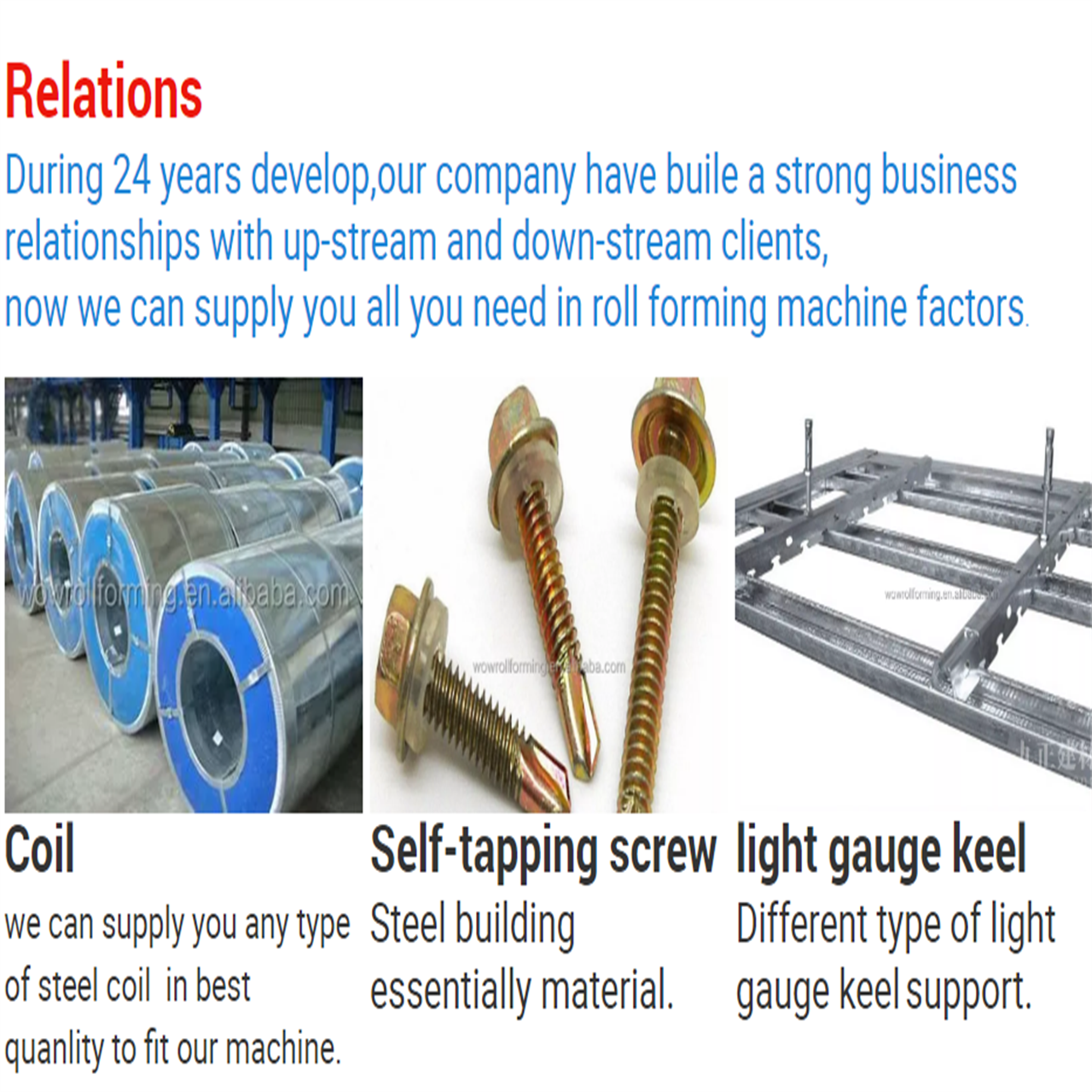
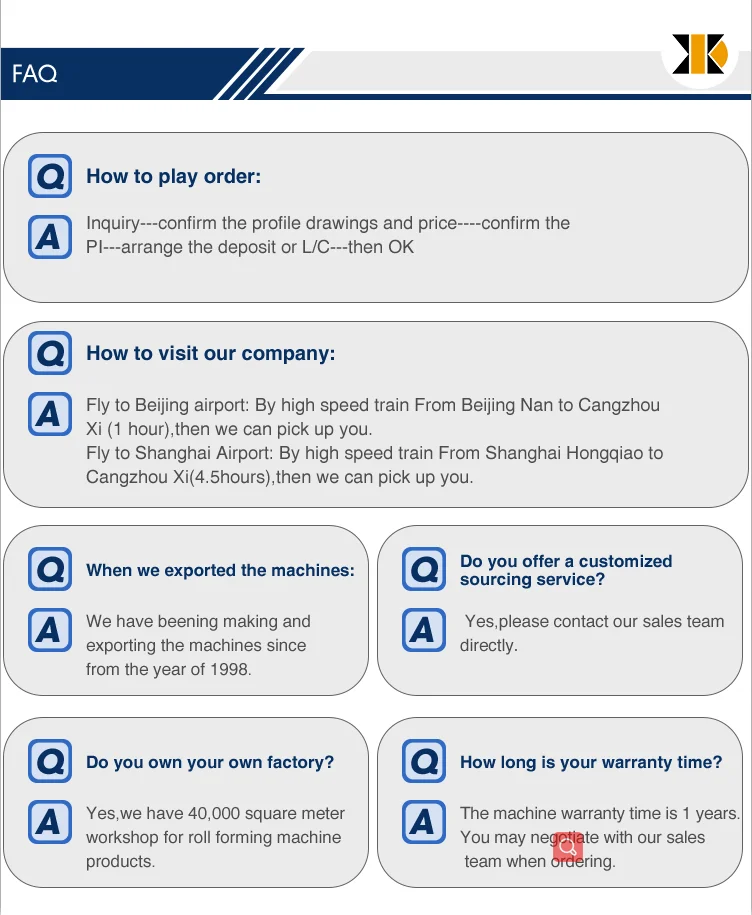
♦ COMPANY PROFILE:
Hebei Xinnuo Roll Forming Machine Co., Ltd., not only produce different types of professional roll forming machines, but also develop intelligent automatic roll forming production lines, C&Z shape purline machines, highway guardrail roll forming machine lines, sandwich panel production lines, decking forming machines, light keel machines, shutter slat door forming machines, downpipe machines, gutter machines, etc.
Advantages of Roll Forming A Metal Part
There are several advantages of using roll forming for your projects:
- The roll forming process allows operations such as punching, notching, and welding to be performed in-line. Labor cost and time for secondary operations are reduced or eliminated, reducing part costs.
- Roll form tooling allows for a high degree of flexibility. A single set of roll form tools will make almost any length of the same cross-section. Multiple sets of tools for varying length parts are not required.
- It can provide better dimensional control than other competing metal forming processes.
- Repeatability is inherent in the process, allowing easier assembly of roll formed parts into your finished product, and minimizing problems due to “standard” tolerance build up.
- Roll forming is typically a higher speed process.
- Roll forming offers customers a superior surface finish. This makes roll forming an excellent option for decorative stainless steel parts or for parts requiring a finish such as anodizing or powder coating. Also, texture or pattern can be rolled into the surface during forming.
- Roll forming utilizes material more efficiently than other competing processes.
- Roll formed shapes can be developed with thinner walls than competing processes
Roll forming is a continuous process which converts sheet metal into an engineered shape using consecutive sets of mated rolls, each of which makes only incremental changes in the form. The sum of these small changes in form is a complex profile.