


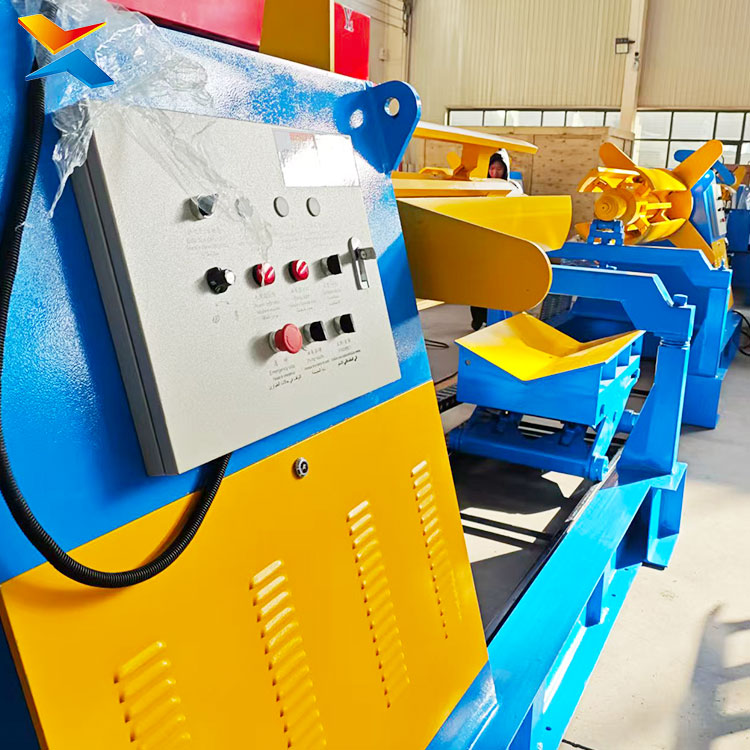
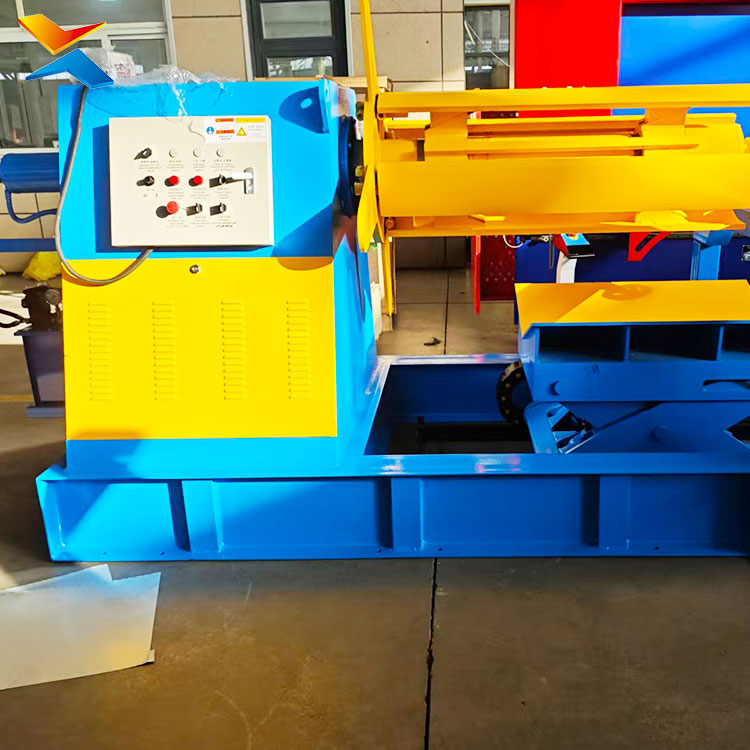
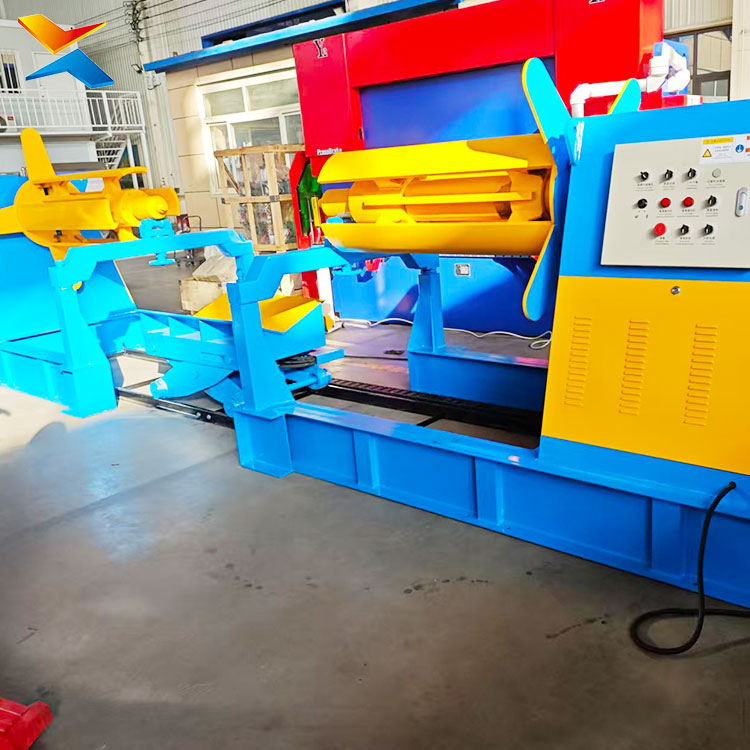
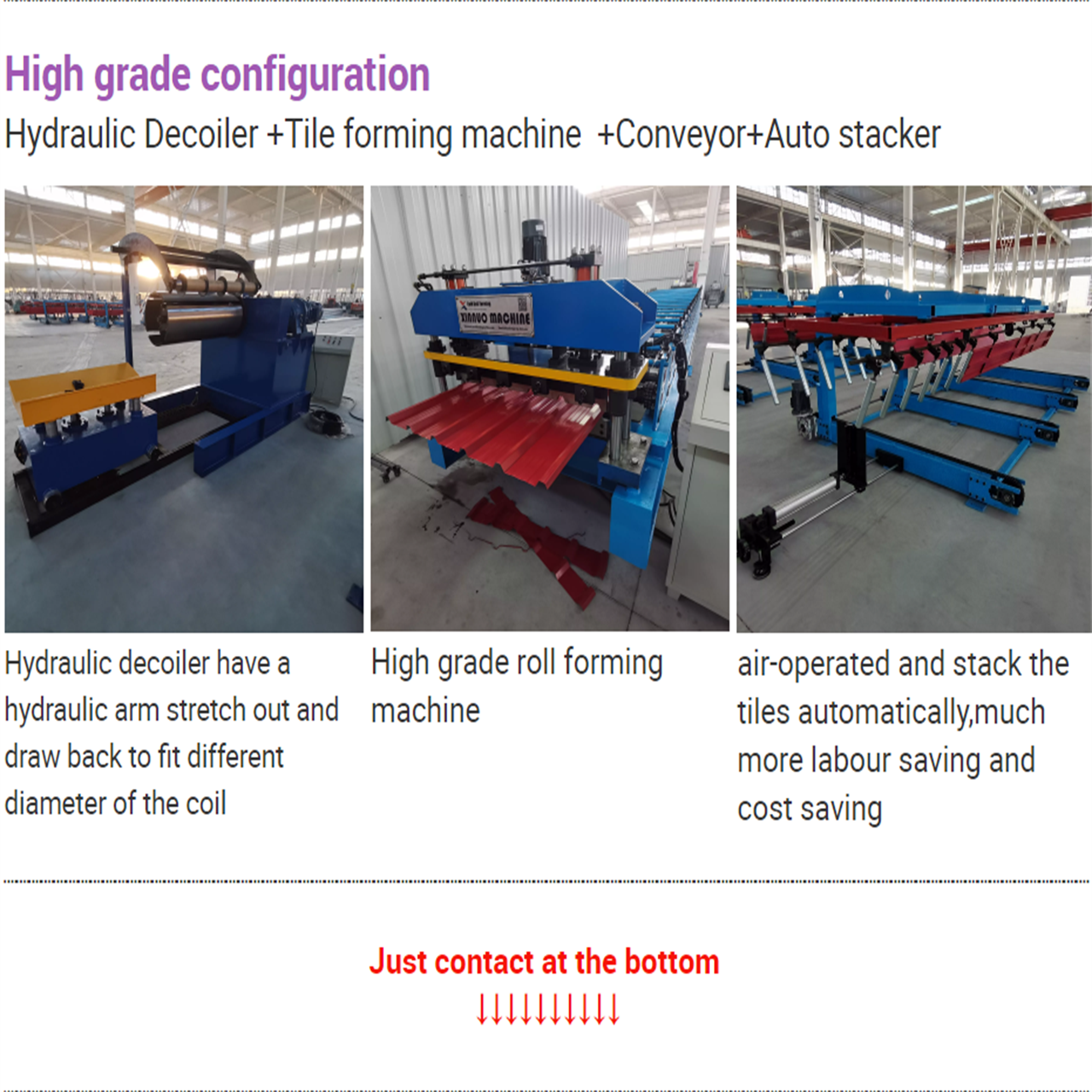
The Hebei Xinnuo Hydraulic Decoiler — also known as the automatic steel coil uncoiler or coil feeding stand — is the first station of every cold roll forming production line and the foundation of consistent product quality. Its function is deceptively simple: hold a steel coil securely, release it under controlled tension, and feed the strip continuously and straight into the forming machine at a rate synchronized with the line speed. But the mechanical reality of this function is far from simple. A 3-to-5-ton steel coil represents a significant rotating mass with substantial inertia; if the decoiler fails to hold the coil securely during loading, fails to release it smoothly under tension, or allows the strip to wander laterally as it feeds, the consequences cascade through the entire production line: strip misalignment entering the forming stations produces twisted or wavy profiles, uneven tension causes thickness stretching or buckling defects, and a coil that shifts on its mandrel during uncoiling can damage the strip edges — turning an entire coil into scrap in minutes. The decoiler is therefore not an accessory to the roll forming line; it is the first quality gate, and its engineering quality determines whether the material entering the forming machine is in the condition the forming machine’s precision was designed to process.
The Xinnuo decoiler range is built around two proven configurations, each matched to a specific capacity class, both manufactured to the same quality standard as our complete production lines. The cantilever decoiler (悬臂式开卷机) supports standard coils up to 3 tons — the most widely deployed configuration across the industry, serving C/Z purlin lines, single-layer roof panel lines, and lighter composite panel configurations. The A-frame decoiler (三角架/A型架开卷机) supports heavy-duty coils of 5 tons and above — specified for high-volume production lines where larger coils mean fewer coil-change stoppages, for the heavy-duty CZ and CZU flagship purlin lines, for composite panel lines requiring dual decoilers (one for the upper skin coil, one for the lower), and for the S-joint panel line’s A-frame configuration with 5-ton capacity per unit. The A-frame design — with its three-point tripod geometry and inclined loading arms — handles the larger coil mass with a wider support base, and its loading arms accept coils by crane or coil car with guided positioning, reducing loading time and the risk of coil-to-machine impact damage that is common with lighter cantilever designs when handling heavy coils.
The hydraulic designation in the title refers to the coil-gripping mechanism — the most safety-critical and quality-critical function of the machine. The decoiler mandrel carries a hydraulically actuated expansion mechanism that grips the coil’s inner diameter with controlled radial force. When a coil is loaded, the operator or the PLC-controlled sequence activates the hydraulic system; the mandrel segments expand outward, pressing against the coil’s inner surface with a clamping force that holds the coil concentric and prevents any rotational slip or axial shift during uncoiling. The hydraulic system maintains this grip force continuously throughout the uncoiling run — it does not relax as the coil diameter decreases, ensuring the coil remains perfectly centered on the mandrel from the first wrap to the last. The expansion range is configured at the factory to match the customer’s coil inner diameter specification — please provide your coil ID and coil OD at inquiry so we can match the mandrel configuration precisely. The hydraulic power unit also drives or assists the coil-loading functions on the A-frame design, and the entire hydraulic circuit is protected against the high-ambient-temperature and dusty conditions of Middle East steel processing facilities, with sealed components and a cooling circuit specified for the regional climate.
Tension control is the second critical function. As the strip exits the decoiler toward the forming machine, it must be maintained under consistent back-tension — enough to keep the strip straight and prevent loop accumulation, but not so much that it stretches the material between the decoiler and the first forming station. The Xinnuo decoiler achieves this with a brake system integrated into the mandrel drive: the brake applies adjustable resistance to the coil rotation, and the operator or PLC sets the tension level according to the material thickness and line speed. For the highest-demand applications — non-stop flying-cut lines where the line never pauses and tension must be maintained continuously — the brake system provides the steady, adjustable back-tension that prevents the strip wander and loop instability that would otherwise degrade cut length accuracy and profile consistency. The decoiler’s output guides and entry rollers center the strip laterally before it enters the leveling unit (where fitted) or directly into the first forming station, completing the controlled material path from coil to profile.
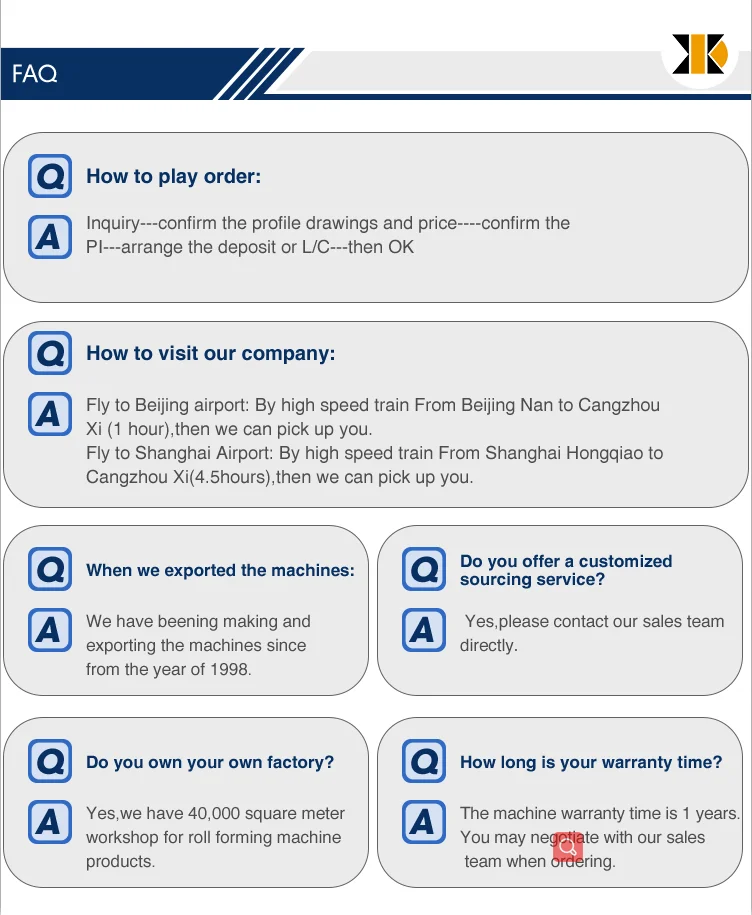
For Middle East customers, the Xinnuo decoiler is delivered with the same integration and support framework as our complete lines: the decoiler’s PLC interface (where fitted) connects to the line’s Delta PLC control architecture for synchronized start/stop and tension adjustments; on-site installation and commissioning are performed by our senior engineers; and the 24/7 WeChat/WhatsApp support channel provides remote troubleshooting, with spare parts shipped via DHL express to ports and industrial hubs across the GCC and wider Middle East. Hebei Xinnuo’s 28-year manufacturing history, ISO 9001:2015 certified processes, CE certification issued by an EU Notified Body, and 14-year Alibaba Gold Supplier verification provide the documented quality assurance that Middle East steel fabricators and panel producers require when adding or upgrading their coil feeding infrastructure.


♦ COMPANY PROFILE:
Hebei Xinnuo Roll Forming Machine Co., Ltd., not only produce different types of professional roll forming machines, but also develop intelligent automatic roll forming production lines, C&Z shape purline machines, highway guardrail roll forming machine lines, sandwich panel production lines, decking forming machines, light keel machines, shutter slat door forming machines, downpipe machines, gutter machines, etc.
Advantages of Roll Forming A Metal Part
There are several advantages of using roll forming for your projects:
- The roll forming process allows operations such as punching, notching, and welding to be performed in-line. Labor cost and time for secondary operations are reduced or eliminated, reducing part costs.
- Roll form tooling allows for a high degree of flexibility. A single set of roll form tools will make almost any length of the same cross-section. Multiple sets of tools for varying length parts are not required.
- It can provide better dimensional control than other competing metal forming processes.
- Repeatability is inherent in the process, allowing easier assembly of roll formed parts into your finished product, and minimizing problems due to “standard” tolerance build up.
- Roll forming is typically a higher speed process.
- Roll forming offers customers a superior surface finish. This makes roll forming an excellent option for decorative stainless steel parts or for parts requiring a finish such as anodizing or powder coating. Also, texture or pattern can be rolled into the surface during forming.
- Roll forming utilizes material more efficiently than other competing processes.
- Roll formed shapes can be developed with thinner walls than competing processes
Roll forming is a continuous process which converts sheet metal into an engineered shape using consecutive sets of mated rolls, each of which makes only incremental changes in the form. The sum of these small changes in form is a complex profile.


