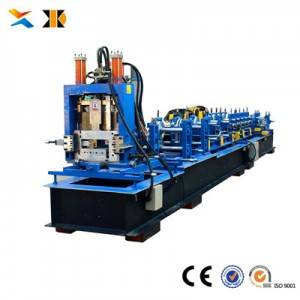


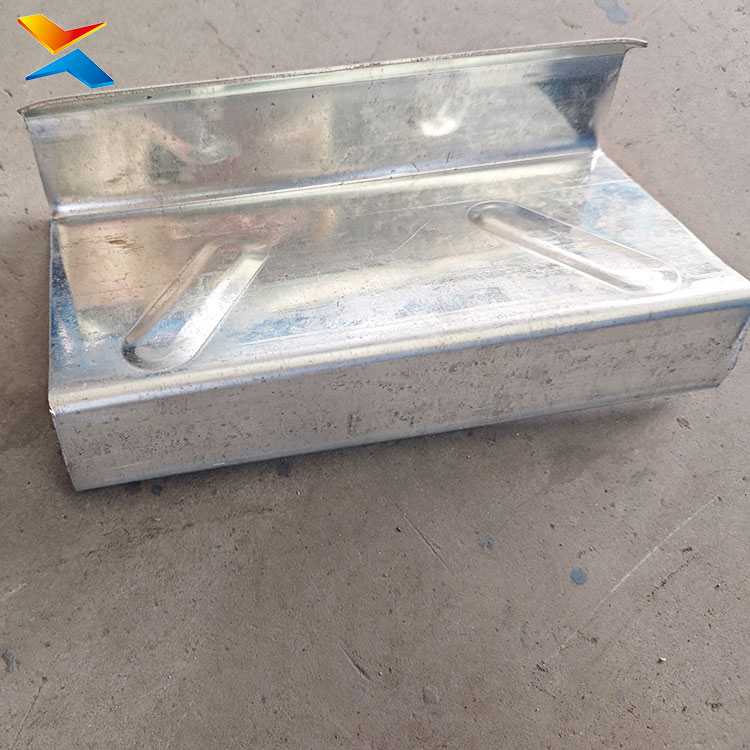
The Hebei Xinnuo Automatic C Purlin Roll Forming Machine is a fully automated cold roll forming production line engineered to manufacture C-shaped steel purlins — the lightweight structural channels that form the secondary framing system of steel structure buildings worldwide. C purlins are the horizontal members that span between primary steel frames — columns and rafters — supporting the roof sheeting and wall cladding panels of every steel-frame warehouse, factory, aircraft hangar, logistics center, agricultural building, and solar mounting structure. They are ubiquitous in modern steel construction because they combine structural efficiency (a C-channel provides high bending strength per kilogram of steel through its optimized cross-section geometry) with manufacturing economy (a flat steel coil can be progressively cold-formed into finished purlins at 15–40 meters per minute with zero material waste). The machine that produces these purlins is therefore not a peripheral piece of equipment — it is the production heart of a steel structure supply chain, and its accuracy, speed, and reliability directly determine the quality, cost, and delivery schedule of every building that depends on its output.
The Automatic designation in the title refers to three levels of automation that distinguish the Xinnuo machine from manual and semi-automatic purlin machines. First, automatic profile changeover: the machine’s four motors — each equipped with a high-resolution encoder producing pulse feedback signals — drive the four adjustment axes (bottom width W, side height H, lip length L, and the forming stations’ vertical position) to precisely reposition for a new profile in approximately one minute, with no manual calibration and no trial runs. The operator enters the target dimensions on the touchscreen HMI — 150mm bottom width, 60mm side height, 20mm lip, 2.0mm thickness, for example — presses confirm, and the machine reconfigures itself with the pulse-counted precision of servo-like positioning. On a manual machine, the same changeover requires 30–60 minutes of spanner work on twelve or more adjustment points, each affecting the others in a time-consuming iterative sequence. Second, automatic punching: the in-line punching unit — controlled by the same PLC — positions and fires the punch dies according to the customer’s hole pattern program, whether standard slotted purlin holes for bolted connections or custom patterns for specific project requirements, with the punch cycle synchronized to the forming speed. Third, automatic cutting: the shear operates in sync with the forming line, cutting each purlin to the exact programmed length (±2–3mm with the standard hydraulic stop-cut shear, ±0.5–1mm with the optional flying-cut tracking shear) with the cut count managed by the PLC’s counter — including the rear-mounted counter feature that automatically punches the last piece of each batch before cutting, reducing end-piece waste.
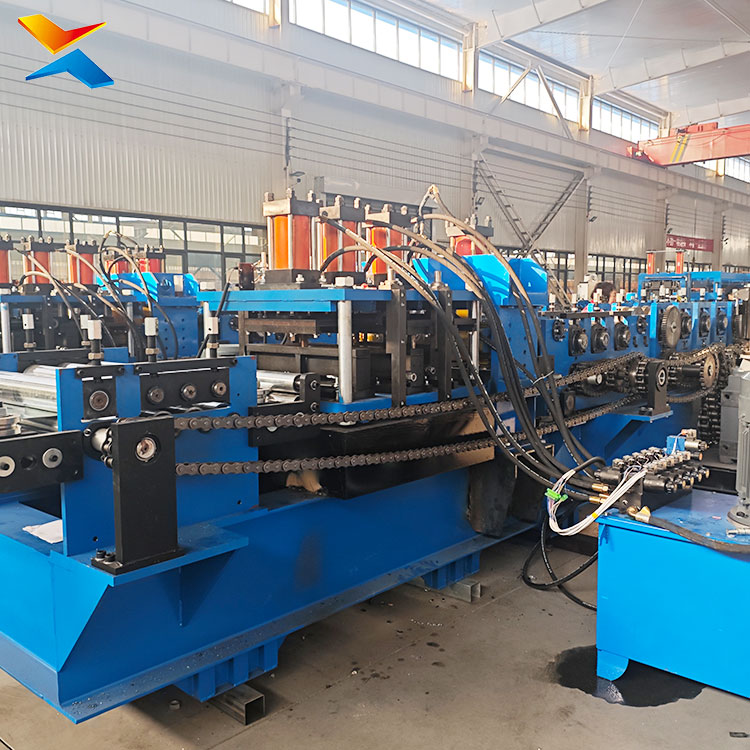
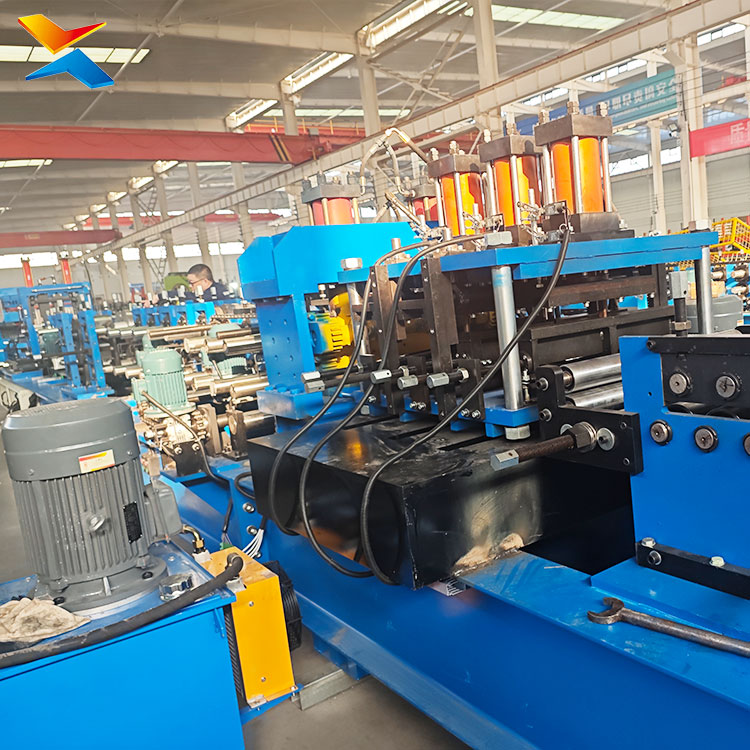
The machine’s forming accuracy is built on an engineering foundation that matches its automation sophistication. The main frame is machined on a 12-meter Taiwan CNC milling machine in a single setup, achieving a 0.05mm flatness tolerance across the full frame length — this is the platform on which all 15–18 forming stations are mounted, and it is the reason the machine can hold profile dimensional accuracy within ±0.5mm across thousands of consecutive pieces. The forming molds are manufactured from forged bearing steel (GCr15) through a six-stage process — forging, rough turning, quenching to HRC 58–62, finish turning, keyway cutting, and hard chrome plating — which is the same process lineage used for automotive crankshaft journals and is what delivers the combination of dimensional accuracy and wear resistance that keeps the machine producing consistent profiles for years without mold re-grinding. The critical high-wear wheels — the side wheels, diagonal wheels, and straightening wheels that contact the strip edges during forming — are manufactured from Cr12MoV tool steel, a material with substantially higher wear resistance than standard bearing steel, extending the service interval of the highest-wear components by a factor of 2–3×. The roller shafts are 40Cr alloy steel, rough-turned, precision-ground, and chrome-plated for hardness and surface smoothness. Every structural component is shot-blasted before electrostatic powder coating — the same surface preparation process used on the C purlin machine’s heavier cousins — ensuring the machine itself resists the corrosive environment of a metal-forming factory.
The C purlin machine family covers profile ranges from 50mm to 406mm bottom width, 10mm to 127mm side height, 7mm to 30mm lip, and material thickness from 0.7mm to 5.0mm — a range that spans every standard C purlin specification used in global steel construction, from the 100×50×20×2.0 purlins that support lightweight roof sheeting in warehouse construction to the heavy 300×80×30×3.0 and larger sections used in aircraft hangars and industrial plants. The machine is configured at the factory for the specific profile range and thickness capacity the customer requires — a lightweight-configuration machine (15 rows, 350H frame, Φ80mm shafts, 11KW power) for thin-gauge, small-profile production, or a heavy-duty configuration (18 rows, 400H frame, Φ95mm shafts, 22KW power) for thick material up to 5.0mm — ensuring the buyer pays for the capability they need and no more. The complete production line — decoiler, leveling unit, forming unit, punching unit, shear, output tables, control cabinet, and hydraulic pump station — occupies approximately 19.6 meters by 3 meters for the standard configuration, with the non-stop flying-cut version extending to approximately 20.9 meters. An optional automatic bundling/stacking section adds approximately 2.5 meters, converting the line into a fully hands-off production cell that receives coils at one end and delivers stacked, counted, strapped bundles of finished purlins at the other.
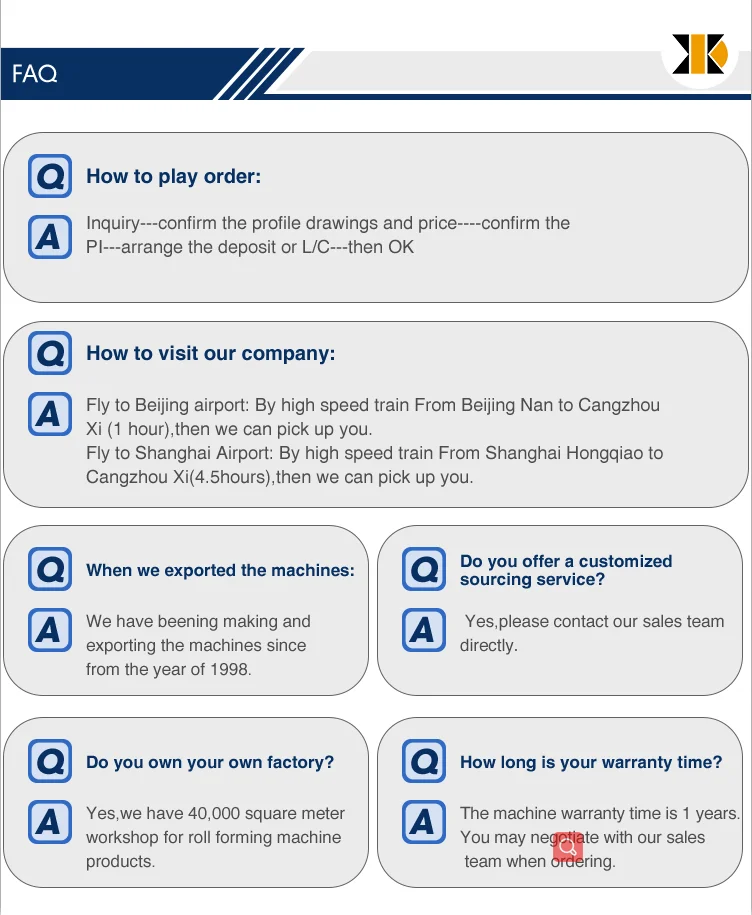
The machine is backed by Hebei Xinnuo’s complete quality and service infrastructure: ISO 9001:2015 certified manufacturing, CE certification issued by an EU Notified Body under the Machinery Directive 2006/42/EC, National High-Tech Enterprise certification, dozens of national patents, and the President Unit designation of the Machinery Industry Association. The PLC system is self-programmed by Xinnuo’s own electrical engineering team — meaning that when an electrical issue arises, a single WeChat or WhatsApp video call connects the customer’s operator to the engineer who wrote the machine’s program, resolving the majority of electrical issues remotely without waiting for a third-party service technician. Professional after-sales includes on-site installation, commissioning, and operator training, plus 24/7 remote support and detailed video operation guides. With 20+ years of specialization in purlin machines, an annual output of 200+ units, and exports to 30+ countries including the United States, the United Kingdom, Mexico, Turkey, India, Pakistan, Russia, the Philippines, Peru, Brazil, and Indonesia, Hebei Xinnuo provides the engineering depth and supply chain reliability that steel structure fabricators require from their production equipment.


♦ COMPANY PROFILE:
Hebei Xinnuo Roll Forming Machine Co., Ltd., not only produce different types of professional roll forming machines, but also develop intelligent automatic roll forming production lines, C&Z shape purline machines, highway guardrail roll forming machine lines, sandwich panel production lines, decking forming machines, light keel machines, shutter slat door forming machines, downpipe machines, gutter machines, etc.
Advantages of Roll Forming A Metal Part
There are several advantages of using roll forming for your projects:
- The roll forming process allows operations such as punching, notching, and welding to be performed in-line. Labor cost and time for secondary operations are reduced or eliminated, reducing part costs.
- Roll form tooling allows for a high degree of flexibility. A single set of roll form tools will make almost any length of the same cross-section. Multiple sets of tools for varying length parts are not required.
- It can provide better dimensional control than other competing metal forming processes.
- Repeatability is inherent in the process, allowing easier assembly of roll formed parts into your finished product, and minimizing problems due to “standard” tolerance build up.
- Roll forming is typically a higher speed process.
- Roll forming offers customers a superior surface finish. This makes roll forming an excellent option for decorative stainless steel parts or for parts requiring a finish such as anodizing or powder coating. Also, texture or pattern can be rolled into the surface during forming.
- Roll forming utilizes material more efficiently than other competing processes.
- Roll formed shapes can be developed with thinner walls than competing processes
Roll forming is a continuous process which converts sheet metal into an engineered shape using consecutive sets of mated rolls, each of which makes only incremental changes in the form. The sum of these small changes in form is a complex profile.