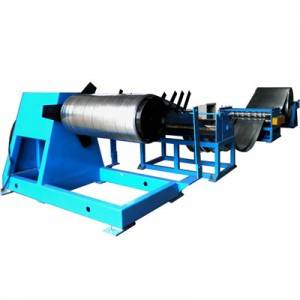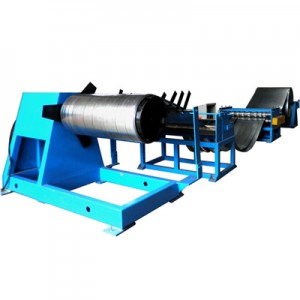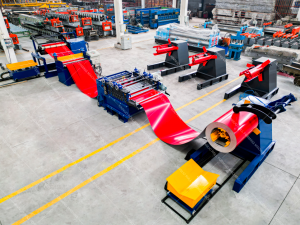


Heavy Duty Steel Coil Slitting Line – The Industrial-Grade Metal Sheet Slitting & Rewinding Machine for Coil Processing Factories
There is a difference between a workshop machine and a factory machine. A workshop machine processes a few coils a day, in the hands of its owner-operator. A factory machine processes coils by the shift, around the calendar, feeding a steel service center that supplies processed narrow coil and sheet to an entire market. The heavy duty steel coil slitting line from Hebei Xinnuo is built for the second world — the world of the coil processing factory.
This is the class of equipment that steel service centers in Dammam, Jeddah, Dubai, and Abu Dhabi run: a heavy line that takes wide, heavy coil — up to the 8 mm × 1800 mm class — and processes it into slit narrow coils and cut sheets with industrial precision and industrial uptime. It is the machine behind the coil processing factory business model: buy wide coil, process to order, and sell narrow coil and flat sheet by the ton to the construction and manufacturing industries.
Xinnuo’s heavy duty capability is not theoretical. The factory has engineered and delivered heavy leveling and slitting systems for export — including the 8×1800 heavy line with 24-axis servo control supplied to the Brazilian export project in 2024, with total line lengths of 30–60 m and main drives of 37–110 kW. When a Middle East buyer orders a heavy duty slitting line from Xinnuo, they order equipment whose heavy-grade engineering has already been proven in export delivery.
This page is written for steel service center owners, coil processing factory investors, and industrial procurement teams across the Middle East. It explains the engineering depth of an industrial-grade slitting line — the process stations that separate factory-grade processing from workshop-grade processing — presents the heavy line configuration built on Xinnuo’s export-proven design, maps the coil processing factory business model to the Middle East market, and covers the site engineering (foundations, power, handling) that a heavy line requires.
What Defines “Heavy Duty” in Coil Processing
A heavy duty slitting line is defined by four engineering characteristics that a light or standard line does not have:
- Heavy coil handling — the uncoiler handles coils by the tens of tons, with hydraulic expansion, coil cars, and powered pay-off. The frame and mandrels are engineered for heavy coil mass and inertia.
- Thick plate capability — the line processes plate up to the 8 mm class (and beyond on the heaviest configurations), which demands far higher slitting forces, heavier blade drives, and rigid leveling.
- Industrial drive and control — main drives in the 37–110 kW class, with servo control on the precision stations (leveling, flying shear, stacking), and process automation that runs the line shift after shift.
- Continuous process architecture — the heavy line is a full process system: heavy uncoiling → pinch leveling → loop (looper) → precision servo leveling → servo flying shear → conveyor → precision stacking. Each station is engineered for the next, as one continuous flow.
These four characteristics are what make the difference between “a slitting machine” and “a coil processing factory capability.” The rest of this page details how Xinnuo builds that capability.


♦ COMPANY PROFILE:
Hebei Xinnuo Roll Forming Machine Co., Ltd., not only produce different types of professional roll forming machines, but also develop intelligent automatic roll forming production lines, C&Z shape purline machines, highway guardrail roll forming machine lines, sandwich panel production lines, decking forming machines, light keel machines, shutter slat door forming machines, downpipe machines, gutter machines, etc.
Advantages of Roll Forming A Metal Part
There are several advantages of using roll forming for your projects:
- The roll forming process allows operations such as punching, notching, and welding to be performed in-line. Labor cost and time for secondary operations are reduced or eliminated, reducing part costs.
- Roll form tooling allows for a high degree of flexibility. A single set of roll form tools will make almost any length of the same cross-section. Multiple sets of tools for varying length parts are not required.
- It can provide better dimensional control than other competing metal forming processes.
- Repeatability is inherent in the process, allowing easier assembly of roll formed parts into your finished product, and minimizing problems due to “standard” tolerance build up.
- Roll forming is typically a higher speed process.
- Roll forming offers customers a superior surface finish. This makes roll forming an excellent option for decorative stainless steel parts or for parts requiring a finish such as anodizing or powder coating. Also, texture or pattern can be rolled into the surface during forming.
- Roll forming utilizes material more efficiently than other competing processes.
- Roll formed shapes can be developed with thinner walls than competing processes
Roll forming is a continuous process which converts sheet metal into an engineered shape using consecutive sets of mated rolls, each of which makes only incremental changes in the form. The sum of these small changes in form is a complex profile.