


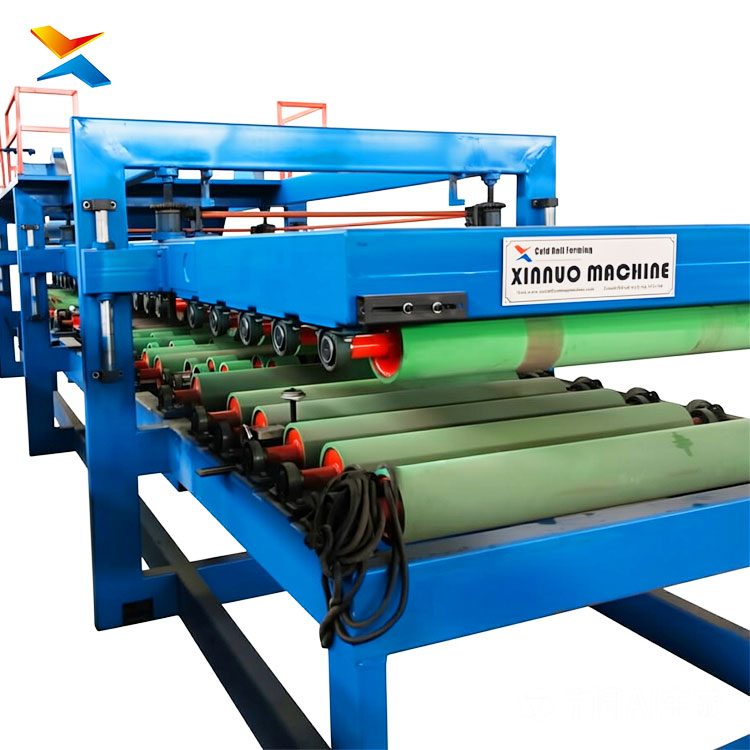
The Xinnuo XN-SP-DB061 is the most mechanically sophisticated machine in our composite panel portfolio — a dedicated garage door sandwich panel production line that holds a unique position in the industry as the composite panel machine with the highest forming station count: 24 rows. The model designation encodes this exceptional capability: XN for Xinnuo engineering, SP for sandwich panel, and DB061 as the blueprint reference from our production-proven catalog of 76 composite panel profiles. While a standard wall or roof panel machine uses 14 forming stations to produce simple trapezoidal rib profiles from thin-gauge steel, the DB061 requires 24 stations because a garage door panel is not a simple ribbed sheet — it is a precision-engineered structural component that must simultaneously satisfy thermal insulation performance, inter-panel hinge articulation, wind-load structural rigidity, weather-sealing integrity, and architectural facade aesthetics. No other panel type in the composite panel industry demands this many simultaneous performance criteria, and no other machine in our catalog demands 24 forming stations to meet them.
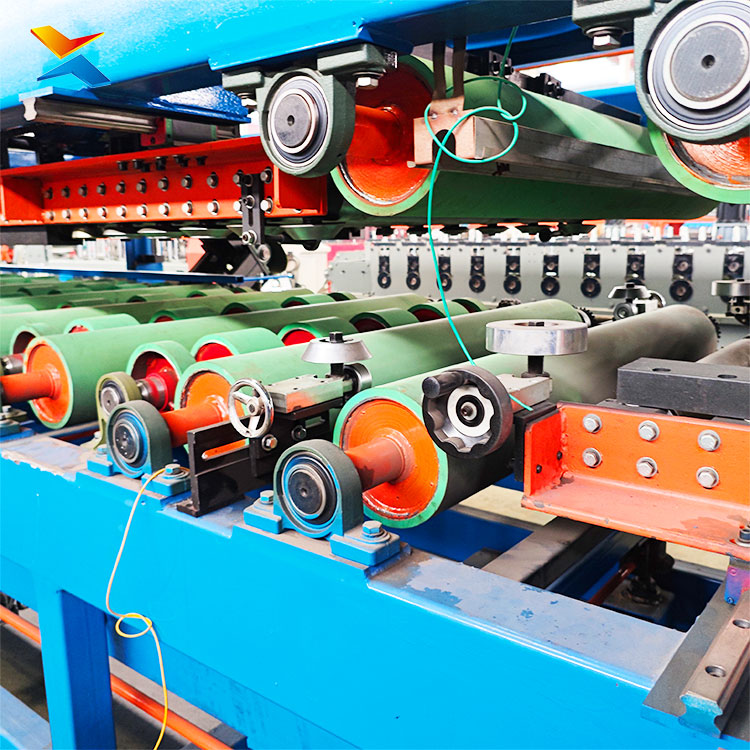
The key to understanding the DB061′s engineering is the garage door panel’s functional geometry. Unlike a wall or roof panel that simply overlaps or interlocks with its neighbor in a static, permanently fixed installation, a garage door panel section articulates — it hinges relative to the panels above and below it, rolling up along curved tracks as the door opens and closes, typically 4–6 times per day for residential doors and 20–50 times per day for commercial and industrial doors. Each panel section’s top and bottom edges must therefore be formed not as flat overlaps but as precision interlocking hinge profiles that accept the roller-and-hinge hardware connecting adjacent sections, while maintaining a continuous thermal break and weather seal across the articulated joint. Forming these compound-edge profiles — which combine a hinge-accepting groove, a weather-seal retention channel, and a thermal-break geometry — requires approximately 10 additional forming stations beyond the 14 used for standard panel edge profiles. The extra stations distribute the complex bending sequence across more incremental passes, preventing the work-hardening and micro-cracking that would occur if the same geometry were formed in fewer, more aggressive bends. This is why the DB061′s 24-row configuration is not a marketing claim about “more is better” — it is the minimum forming architecture required to produce a structurally sound, dimensionally accurate garage door panel edge profile at production speeds of 2–4 meters per minute.
The 350H frame specified in the title is the heaviest frame section in our composite panel machine range. Standard composite panel machines use 300H structural steel frames, which provide adequate rigidity for the modest forming forces involved in thin-gauge (0.3–0.8mm) panel skin forming. The DB061 upgrades to 350H because the garage door panel forming process generates three distinct force components that standard frames are not designed to handle simultaneously: (1) vertical bending forces from the 24 roller stations forming both the top and bottom panel faces, (2) lateral forces from the hinge-edge forming stations that bend the panel edge outward and then back inward in a compound S-curve, and (3) torsional forces distributed across the full 350H beam length as the dual-motor drive system transmits torque from both ends of the forming unit. A 300H frame under these combined loads would exhibit measurable twist over a production shift, producing panels that are dimensionally correct at the start of a batch but progressively deviate as the frame settles under sustained load. The 350H section — with its wider flange, thicker web, and higher section modulus — maintains dimensional stability across continuous multi-shift production, which is the operational reality for GCC garage door panel manufacturers supplying the region’s high-volume residential and commercial construction pipeline.
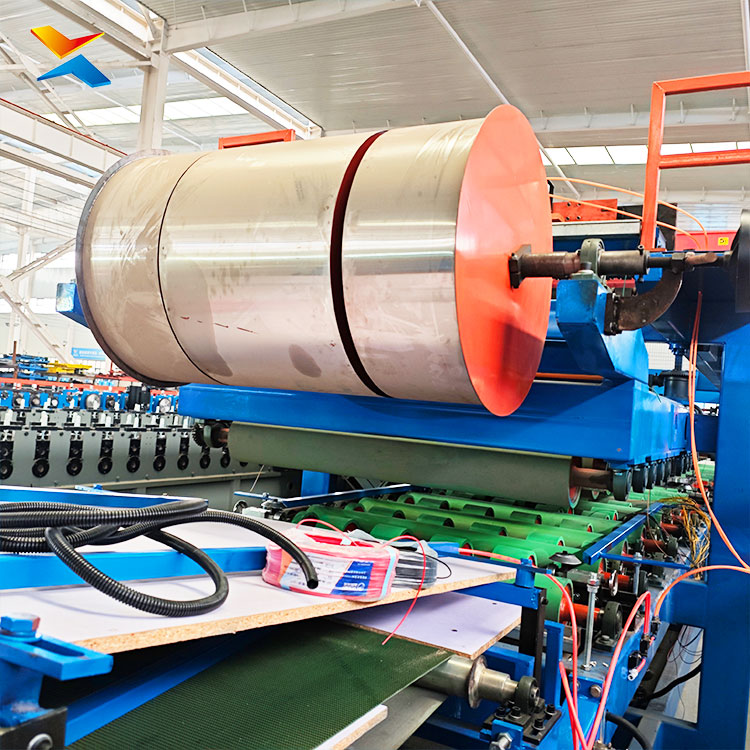
The dual motor drive configuration — 4KW to 5KW per motor, compared to the single 3–4KW motor on standard composite panel machines — serves two purposes. First, the 24-station forming train presents higher cumulative frictional resistance than a 14-station train, simply because more roller-bearing contact points exist between the drive motor and the panel. Dual motors — one driving from the infeed end and one from the outfeed end — distribute the drive torque across the forming train, reducing chain tension at any single point and equalizing roller speed from the first station to the last. Unequal roller speed across a 24-station train produces a subtle but damaging effect: if the outfeed-end rollers rotate marginally slower than the infeed-end rollers due to chain stretch, the panel experiences longitudinal compression between station 12 and station 24 that manifests as surface buckling — visually unacceptable on a garage door panel that is a prominent architectural element on the building facade. Second, the dual-motor configuration provides operational redundancy. In a high-volume GCC garage door panel factory — where a single day of unplanned downtime during peak construction season can delay door installation across multiple villa or commercial projects — the ability to continue production at reduced speed on one motor while the other is serviced is a commercially significant insurance policy. The machine is also equipped with our patented one-way steel belt system, the 9-meter 54-roller glue-lamination section on a 0.05mm flatness bed, dual-blade fly-cut with dust collection, and a self-programmed Delta PLC with remote diagnostics — the full Xinnuo composite panel technology stack configured specifically for garage door panel geometry and production volumes.
The GCC market for garage door sandwich panels is structurally distinct from general insulated panel demand. It is driven not by warehousing and cold storage (where standard wall/roof panels dominate) but by the residential villa and commercial building sectors where every structure has at least one — and typically multiple — garage door openings. In Saudi Arabia, the UAE, Qatar, and Kuwait, the prevalence of attached garages in villa construction, underground parking entrance enclosures in commercial towers, and industrial sectional doors in logistics facilities creates a sustained, non-cyclical demand for insulated garage door panels that does not track the boom-bust patterns of large-scale industrial construction. A garage door panel manufacturer in the GCC selling into the replacement and renovation market — aging doors, upgrading from non-insulated to insulated panels, switching from steel-only to sandwich panel doors — operates in a demand environment that is closer to the automotive aftermarket than to construction materials: steady, recurring, and price-resilient. The DB061 is the production tool for this market.



♦ COMPANY PROFILE:
Hebei Xinnuo Roll Forming Machine Co., Ltd., not only produce different types of professional roll forming machines, but also develop intelligent automatic roll forming production lines, C&Z shape purline machines, highway guardrail roll forming machine lines, sandwich panel production lines, decking forming machines, light keel machines, shutter slat door forming machines, downpipe machines, gutter machines, etc.
Advantages of Roll Forming A Metal Part
There are several advantages of using roll forming for your projects:
- The roll forming process allows operations such as punching, notching, and welding to be performed in-line. Labor cost and time for secondary operations are reduced or eliminated, reducing part costs.
- Roll form tooling allows for a high degree of flexibility. A single set of roll form tools will make almost any length of the same cross-section. Multiple sets of tools for varying length parts are not required.
- It can provide better dimensional control than other competing metal forming processes.
- Repeatability is inherent in the process, allowing easier assembly of roll formed parts into your finished product, and minimizing problems due to “standard” tolerance build up.
- Roll forming is typically a higher speed process.
- Roll forming offers customers a superior surface finish. This makes roll forming an excellent option for decorative stainless steel parts or for parts requiring a finish such as anodizing or powder coating. Also, texture or pattern can be rolled into the surface during forming.
- Roll forming utilizes material more efficiently than other competing processes.
- Roll formed shapes can be developed with thinner walls than competing processes
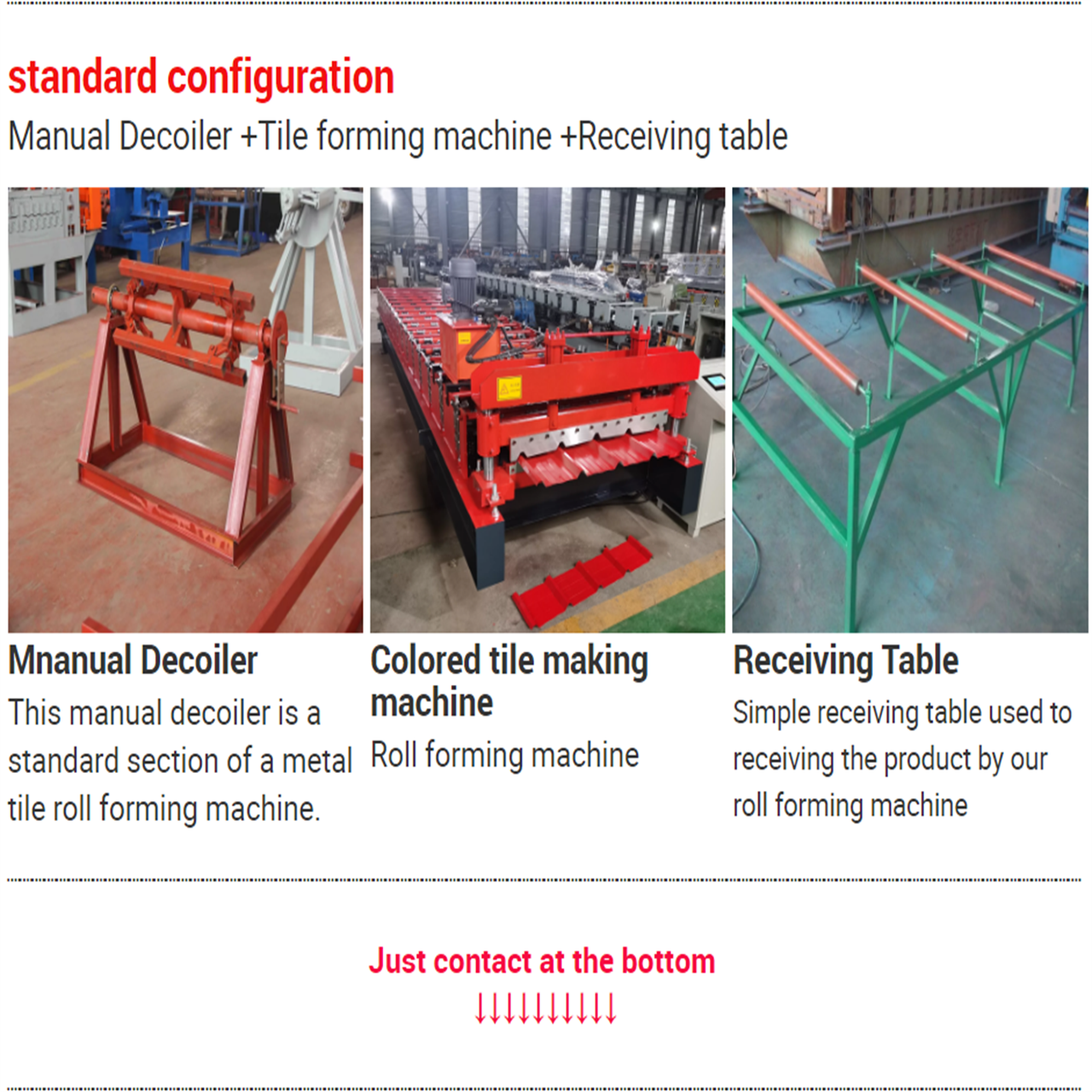
Roll forming is a continuous process which converts sheet metal into an engineered shape using consecutive sets of mated rolls, each of which makes only incremental changes in the form. The sum of these small changes in form is a complex profile.


