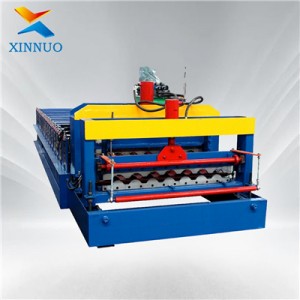

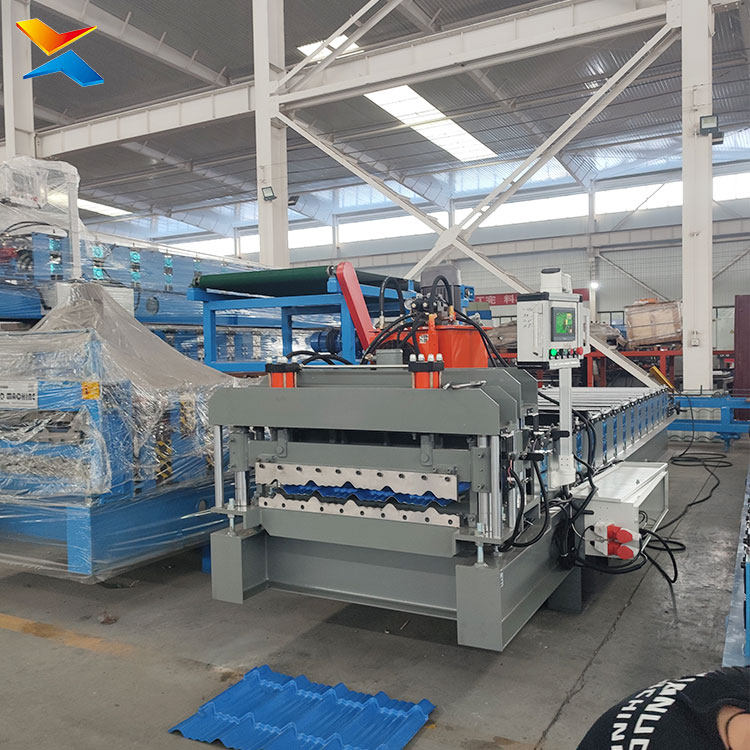
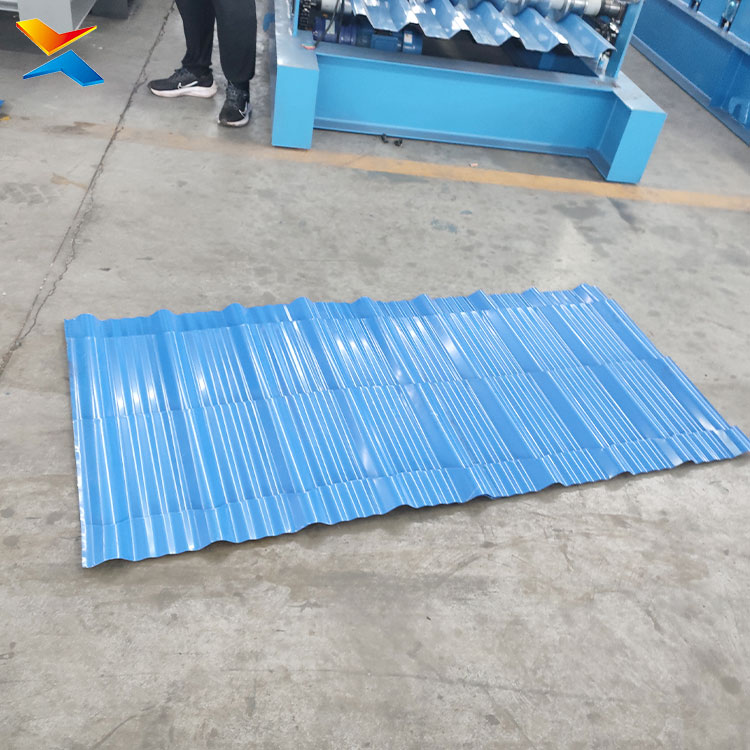
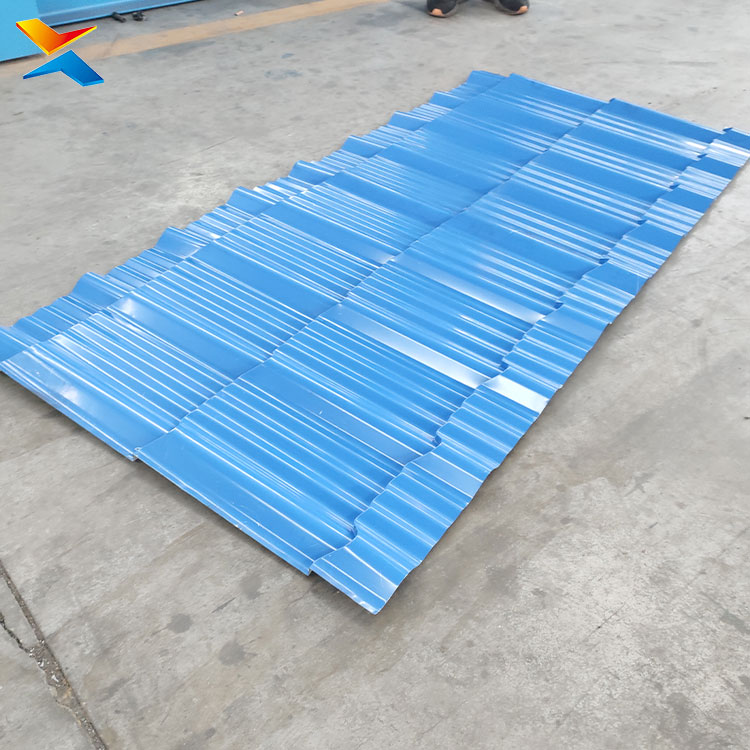
Metal tile roof roll forming machine — supplied by the manufacturer to the UAE for villa and resort roofing. The machine forms flat coated steel coil into a metal roof tile panel: a panel carrying the curve of a tile, divided along its length into tile-like courses, with interlocking edges formed at both sides, cut to the length the roof requires.
The panel leaves the machine as a finished tile profile ready to be lifted and fixed as a roof covering. What the machine makes is the panel; the roof it becomes is built by the roofing contractor on a roof structure designed for it, with the fixing and flashing details the project’s engineer specifies.
This machine serves two kinds of work, and they are not the same job.
It is worth separating them at the start, because the two are bought from the same description and compared on the same figures, and yet they ask different things of the machine and of the workshop.
Villa roofing is one building at a time. A villa roof is a small roof: a handful of planes meeting at ridges, hips and valleys, interrupted by dormers, chimneys and changes of level, closed at the eaves and verges, and consuming panels in short lengths. Its production is measured in a few roofs at a time, and the profile is changed as the project’s houses differ. What matters most is that each small plane is covered properly, that the tile pattern reads correctly when seen up close, and that the workshop can reset lengths and change profiles without a long interruption.
Resort roofing is one architectural language across a site. A resort is not one roof. It is a collection of buildings of quite different types — guest accommodation blocks, detached and semi-detached units, chalets, the main building, restaurants and bars, arrival and entrance structures, service and staff buildings, plant screens, gatehouses, pavilions, shade structures, pool buildings — and the roofs of all of them are seen together, from the ground, from terraces and pools, from upper floors, and in the images the property uses to present itself. The roofs are therefore judged as a group. A resort whose buildings each wear a slightly different tile reads as several unrelated projects, however good each roof is on its own.
That is the difference that decides machine specification in this application, and it is not a matter of quantity. A villa workshop buys a machine that produces a good roof. A resort buys a machine whose output is repeatable across the whole site, across every building type, and across the accessory profiles that close each of them.
A single tile language, held across every building and every accessory.
For a resort, the tile reading has to be held constant. Three things carry it.
The tile pitch. The pitch is the height of one tile course. Every profile on the site must be set to the same pitch, or the buildings will not read as one. This is a machine-setting question and a tooling question at once: the pitch device’s tooling is made for the pitch, so a site worked in one pitch uses one pitch tooling across all its profiles.
The arc depth and the divisions per panel. Together these set how large the tile reads and how fine the surface is. Buildings of different widths on the same site will use panels of different widths, and the profile of each has to be worked out so that the tile reads at the same size across them — a narrower building’s panel and a wider building’s panel, both carrying the same tile reading, are not simply the same profile at different widths.
The accessory profiles. A roof is closed by its accessories: ridge and hip caps, verge and eave trims, valley sections, apron and change-of-slope flashings, and the terminations at parapets and abutments. On a resort these are multiplied, because there are more ridges, more hips, more valleys, more changes of level and more junctions between buildings than on any single villa, and because the accessory profiles themselves have to read as the same tile family as the field of the roof. An accessory set that is visually unrelated to the panel — a plain folded trim against a tiled field — is the commonest way a tiled roof ends up looking like a metal roof.
Reproducibility — the resort will be built in phases.
A resort is rarely built in one go, and it is regularly extended afterwards. Wings are added, buildings are repeated, structures are replaced. Every one of those additions has to match the original tile reading, and the addition is often made years after the first phase, when the original shift has gone and the original file may not be at hand.
This makes the machine’s record matter as much as its accuracy. Where the profile, the pitch, the panel width and the tooling set are documented and held — so that the same profile can be produced again later and the same panel produced from the same tooling — an expansion matches. Where they are not, an extension is an approximation of the original tile, and the difference is visible on the finished building. A resort buyer is therefore buying not only the panels for this phase but the ability to reproduce them for the next one, and it is worth settling that with the machine builder at the outset rather than discovering it at the second phase.
The panel is a formed metal roof panel, and it should be judged as one.
The appeal of a metal tile roof is that it gives the appearance of a tiled roof with the properties of a formed metal panel: lighter than tile, fixed in fewer operations, carried on a lighter roof structure, and formed from a coil that is flat, uniform and available in the coating the project wants. What it is not is a tile in the clay sense. The panel is formed from coated steel coil, and the coating — not the forming — is what protects it in service. The performance of the roof is therefore partly a machine matter (the arc formed, the divisions pressed, the edges set) and partly a coating matter, which is a conversation to have with the coil supplier as well as with the machine builder.
The machine forms the tiles. It does not fire them, it does not cast them, and it does not install the roof. Where a project’s design calls for a fired or cast tile, or for a tile with a granule or ceramic surface applied over the metal, that requirement has to be stated at the outset and confirmed against what the machine produces, because those are different production routes.
Machine construction — the main assemblies.
The frame. A heavy fabricated steel structure carrying the roll stands and the pitch device, machined so that the stands sit in line and the shaft centres hold their position. The frame is the machine’s accuracy: if the stands are not aligned and held, no care in the tooling will produce a panel whose curve is consistent along its length — and a curve that varies along the length is a tile pattern that varies along the roof.
The roll stands and shafts. The stands carry the forming rolls. The shafts are carried in bearings at both ends, hardened and ground so the rolls turn true. The spacing of the stands and the support given to the shafts decide how the panel is formed and how tightly its dimensions are held. Forming a curved tile panel is demanding work: the strip is being drawn into a curve across its full width at every stand, so the working load on the shafts is considerably greater than on a shallow fluted profile.
The forming rollers. The rolls carry the profile, machined in matched pairs and hardened, and their sequence forms the flat strip stage by stage — first breaking it into the curve, then deepening and refining it, then setting the edges, and finally the tile divisions. The number of forming stages and the arrangement of the rolls decide whether the finished panel’s curve is smooth, whether the surface is marked, and whether the panel’s width holds to the tolerance the covering requires.
The pitch-stamping device. The unit that presses the tile division across the panel at each pitch. Its tooling is made for the pitch and the panel width of the profile being produced, and it is the assembly that has to hold its positioning accuracy across long runs — which is what a resort asks of it, because the same tile reading has to repeat across every building on the site.
The drive. The machine is driven either by a standard gearbox and chain transmission or by a servo motor driving through a bevel gear arrangement. Both drive the forming stands; the difference lies in how precisely the strip’s advance is controlled and therefore in how accurately each tile division is positioned. A servo drive with bevel gears runs more quietly than a chain transmission, holds its setting without the stretch a chain develops, and does not lose its accuracy progressively as the transmission wears.
The cutting arrangement. The finished panel is cut to the length the roof requires, so a project’s mix of lengths is produced directly rather than cut down afterwards. The control can be set to cut at a chosen length, and — where the profile allows it — at a chosen point in the tile pattern, so that a panel’s end falls where the roof’s termination wants it. On a resort, where a great many panels terminate against ridges, hips and abutments, this is the setting that keeps the terminations tidy.
The control arrangement. The control sets the panel length, the number of divisions to be formed, the run rate, and the coordination between the forming stands, the pitch device and the cutting arrangement. It is also where the operations that recur in villa and resort work live: setting a new panel length, and setting up for a different profile or pitch. A control arrangement that makes these quick and repeatable is worth more here than a higher forming speed, because both recur far more often per unit of roof area than on a single large roof.
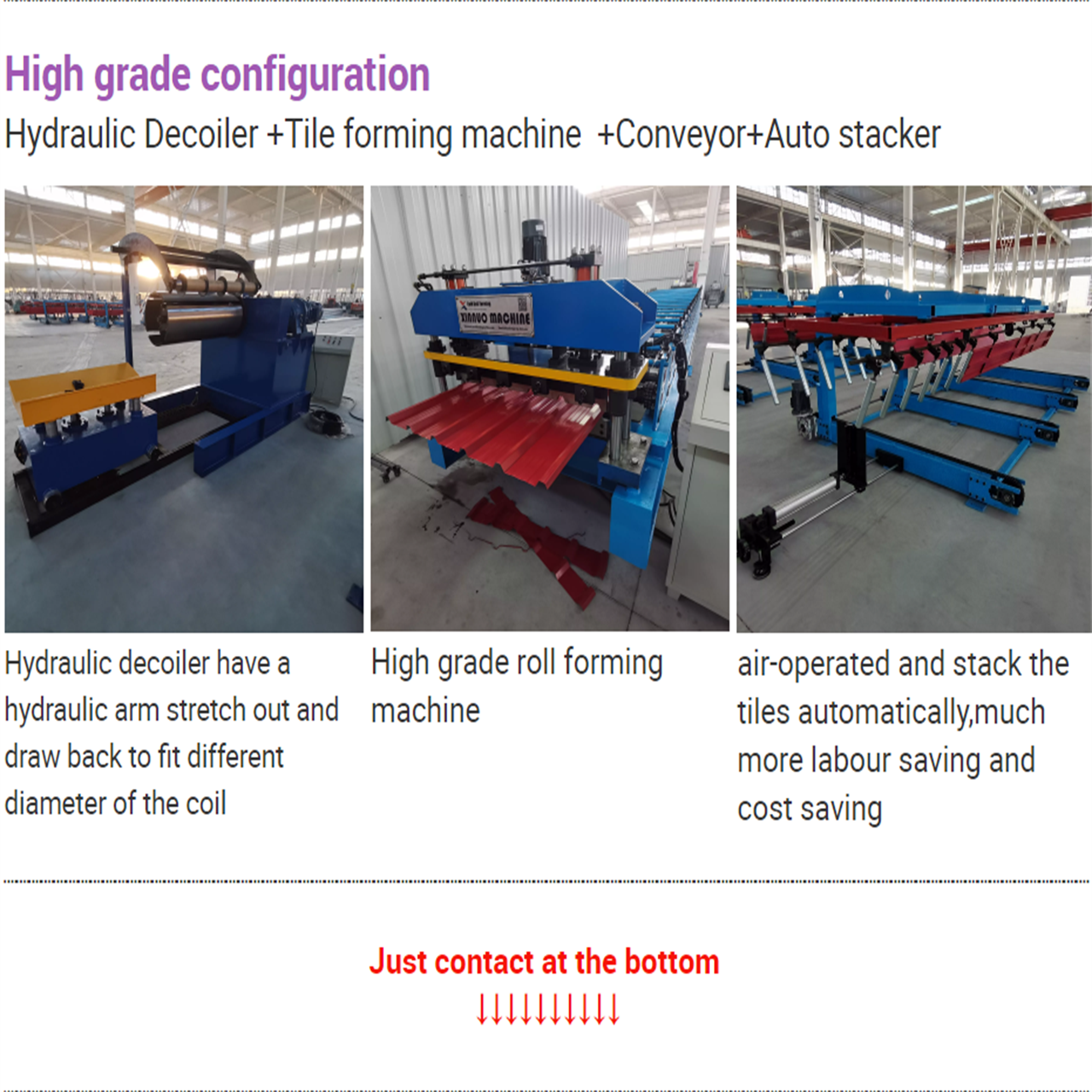
The hydraulic arrangement. Where the machine uses hydraulic functions, a power unit supplies them, built with standard-specification components so that they can be sourced and serviced in the UAE as readily as anywhere else.
The profiles this machine is built in.
The profiles fall into families, and the family names describe how the roof reads rather than a rank of quality. A villa project chooses one for its houses; a resort project chooses one for the whole site and then has the accessory profiles made to match it.
Fine pitch, closely divided. Closely spaced divisions and a relatively shallow curve, reading as a fine, detailed tile surface. Used where a roof should look restrained and worked rather than bold — high-end residential and hospitality buildings — and suited to wall cladding and screens as well as roofing, which is an advantage on a resort where the same tile is often wanted on a feature wall or a screen.
Medium pitch, the mainstream. The middle of the range: a panel divided into a small number of tile courses, with a curve deep enough to read as tile from the ground. This is the family most villa and most resort accommodation buildings are built on, because it balances appearance against the amount of material the roofs consume.
Deep pitch, bold divisions. Wider divisions and a deeper curve, so each tile reads as a large, strongly modelled tile and the roof has pronounced relief. Suited to buildings whose architecture is emphatic — feature entrances, main buildings, and the elements a resort uses to make an impression.
Bamboo-joint profile. The most strongly modelled of the family, with the deepest curve combined with the widest division, so the panel reads in pronounced segments. Used where a traditional and richly modelled roof is wanted — gardens, pavilions, heritage-styled buildings and resort architecture with a strong regional reference.
Asymmetric profile. A curve whose two sides are not mirror images, one side steeper than the other, which gives the panel a stronger three-dimensional reading than a symmetrical curve of the same depth. Used where the roof is a deliberate architectural statement rather than a neutral cover.
Profiles with additional stiffening ribs. Where a profile carries extra ribs pressed into its flatter areas in addition to the curve and the tile divisions, the panel is stiffer across its width. On a resort this is worth considering for two reasons that do not arise in the same way on a villa: the roofs are larger, so a panel spanning between supports with less support than usual is more likely; and the roofs are serviced in service, so a panel that holds up better when it is walked on over the life of the building is worth having.
Two-width versions. Some machines in this family produce two panel widths from the same machine by changing part of the tooling. On a resort site, where buildings differ considerably in width, a single machine covering two widths saves setting up for a second.
Two-material versions. Some machines are built to run both coated steel and resin tile material, the tooling being changed between them. Where a project uses one material on the roofs and the other on a screened or sheltered area, this is worth settling at the outset.
Materials.
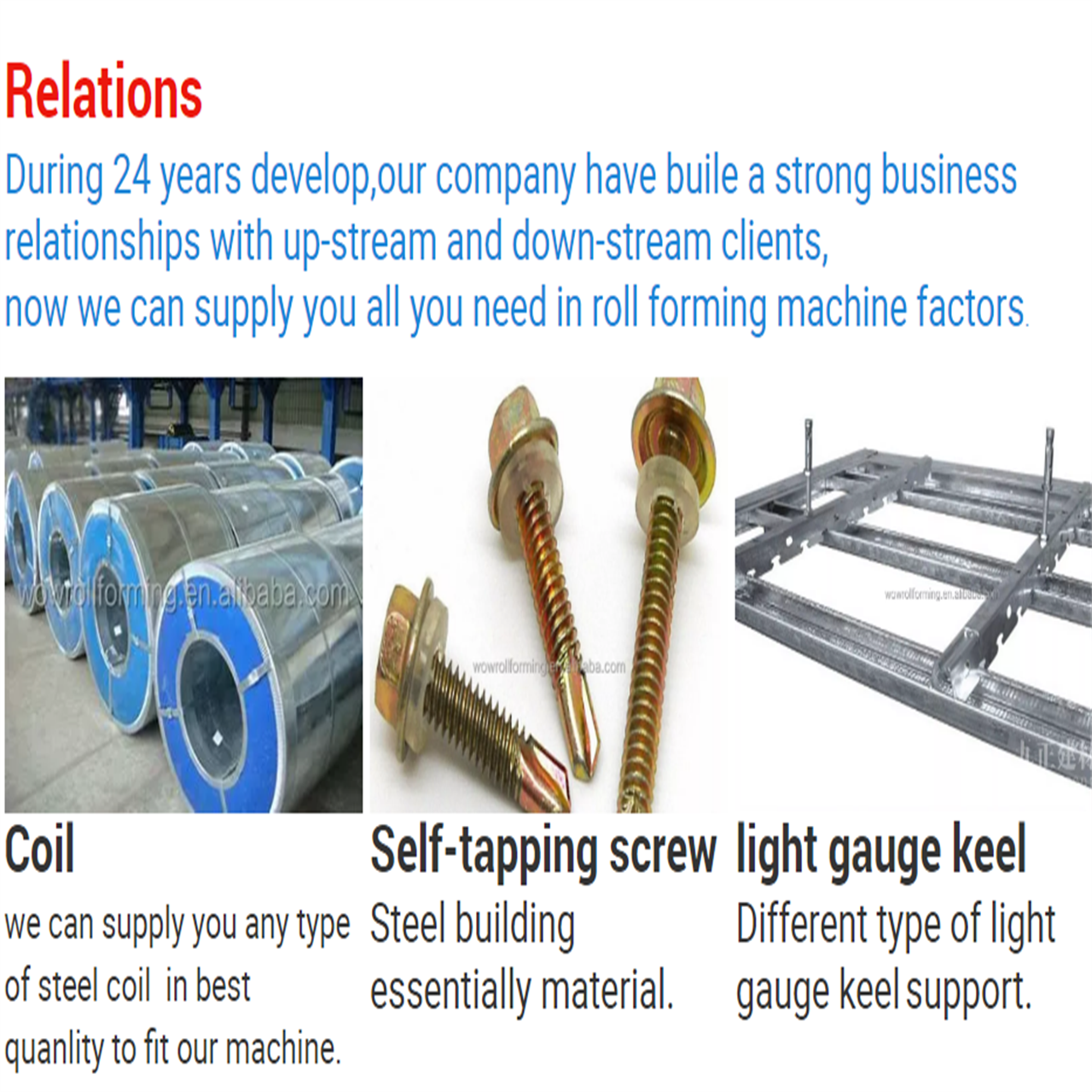
The machine forms coated steel coil — steel with a metallic coating and a paint system applied to it, which is what gives the roof its surface and colour. The coating, not the forming, is what protects the panel in service, and it is asked to survive the forming as well: a coating that cracks or flakes at the curves and divisions leaves bare steel at precisely the places a roof weathers first, and on a coastal resort those are the places where the roof will begin to fail.
Coil thickness is a range and the right part of it depends on the curve depth of the profile, because a panel being drawn into a deep curve is worked harder in forming than one being drawn into a shallow curve, and a thickness that forms cleanly at one curve depth is not automatically the thickness that forms cleanly at another. Thickness and profile are therefore considered together rather than chosen separately — and on a resort, where one profile runs across many buildings, it is worth confirming once, properly, rather than repeating the decision building by building.
Configurations.
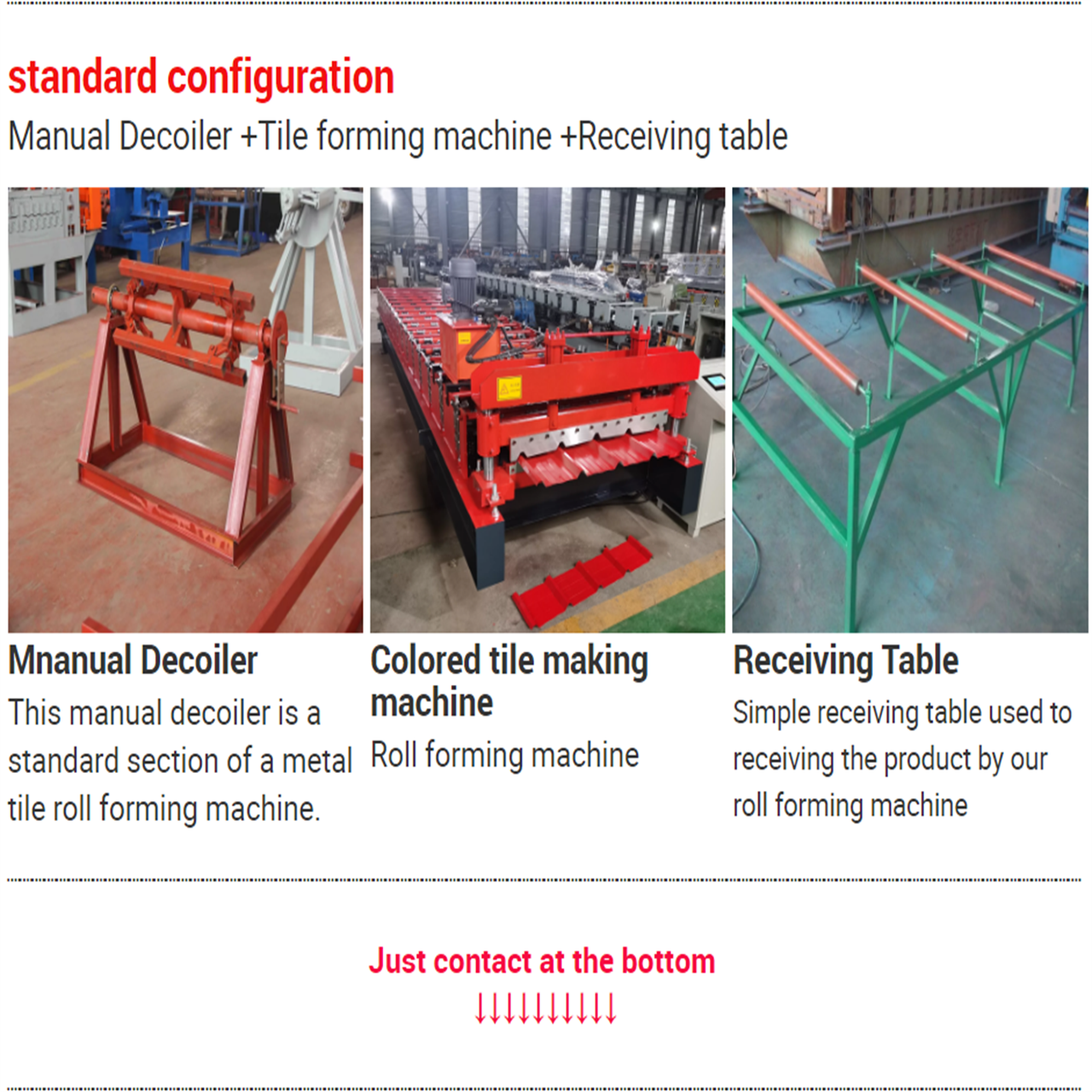
Forming and pitch stamping in one machine. The standard arrangement: the curve is formed and the tile division pressed in the same pass, the panel emerging with both and cut to length at the end.
Standard drive or servo drive. A standard gearbox and chain transmission, or a servo motor through a bevel gear arrangement. The second is chosen where the regularity of the tile pattern matters — which, where a whole site is judged as one roofscape, it does.
Tooling for one profile, or for a set of profiles. Machines are built for a specific profile; where the workshop intends to produce more than one — a second tile profile, or the accessory profiles that close a roof such as ridge and hip caps, verge trims and eave sections — the tooling set is planned for that from the beginning, because the stands and the pitch device are configured around the profiles the machine is intended to produce. On villa and resort work generally, and on resort work especially, the accessories are part of the requirement and not an afterthought.
One panel width or two. Where the machine is built for two widths, part of the tooling is changed between them.
Coated steel only, or coated steel and resin tile. Where the machine is built for both materials, the tooling is changed between them.
With documentation of the profile and the tooling. Where the profile, pitch, panel width and tooling set are recorded and held, a later phase of the same project can be produced to match. This is a configuration choice, not merely a document, and it is the item most often left out of a first phase and most missed in the second.
Product features and advantages.
Built around the tile reading rather than only the panel. The machine is specified by what the finished roof reads as — the pitch, the divisions per panel and the curve depth — because those are what a villa or a resort is buying.
Positively controlled pitch positioning. Where the drive is servo with bevel gear transmission, the strip advance is controlled rather than released, so tile divisions hold their spacing along a panel and from panel to panel — which is what allows a whole site to read as one roof.
Transmission that holds its accuracy. A bevel gear arrangement runs more quietly than a chain, does not stretch, and does not lose accuracy progressively with wear.
Forming tooling made for the profile being produced. The roll sequence is planned for the curve depth and panel width of the profile, so a deep curve is formed with the number of stages and the support it needs rather than being pulled into shape in too few passes.
Pitch tooling made for the tile pitch. The pitch device’s tooling is made for the pitch the profile is designed around, so the tile reading is produced rather than approximated — and the same pitch tooling can be held for the accessory profiles so the whole roof matches.
Cutting to length within the production run. Panels are produced to the lengths the roofs actually need, which keeps the waste of a roof cut into many small planes within reason instead of creating it by cutting long panels down on site.
Profiles for the appearance the project wants. Fine, medium and deep pitch, bamboo-joint, asymmetric and ribbed profiles, so the roof’s reading can be chosen rather than accepted.
Stiffening-rib profiles for larger and serviced roofs. Where a panel must span with less support, or will be walked on during maintenance, a ribbed profile holds up better than a plain one.
Two-width and two-material versions. For sites whose buildings differ in width, or projects working in both coated steel and resin tile.
Heavy frame and adequately supported shafts. To hold the stands in line and carry the load of drawing a full-width panel into a curve.
Built for the destination electrical supply. Machines are configured for the voltage, frequency and phase of the installation site.
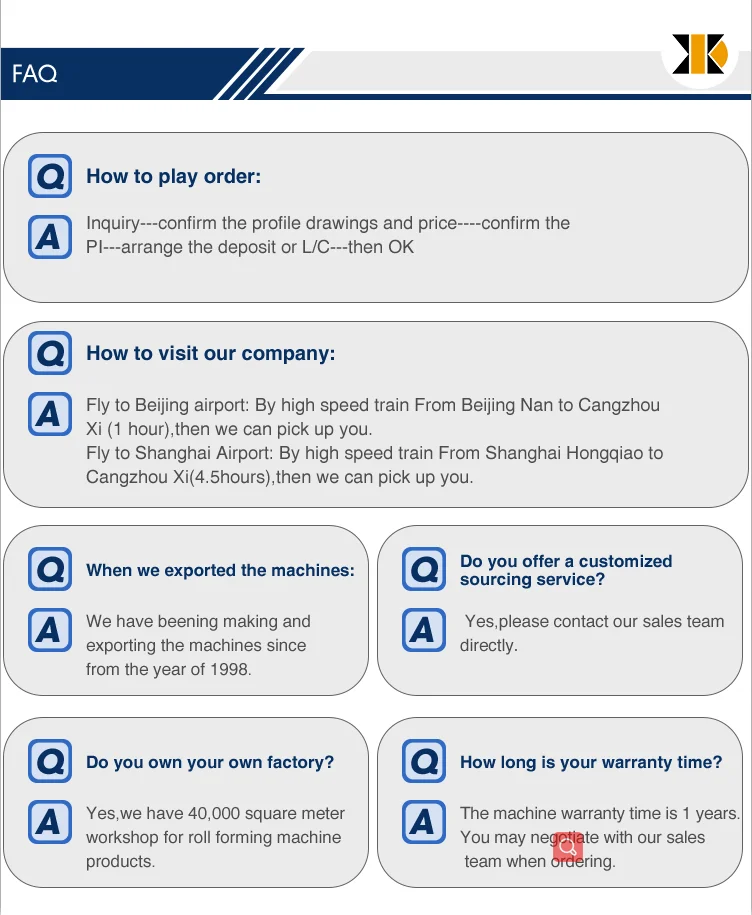
Factory direct. The machine is built by the manufacturer and supplied direct, so the profile, the pitch, the panel width, the tooling set and the drive arrangement are settled with the people who build the machine rather than selected from a fixed list — and the accessory profiles that close the roof can be planned as part of the same tooling set.
Where the panel is used in villa and resort work.
In villa work it is the roof of the house and its immediate structures: main roof slopes, entrance porches and canopies, towers and feature elements, gate and guard structures, poolside and majlis structures, and garden pavilions.
In resort work the range is wider, and this is where the machine’s repeatability earns its place: guest accommodation blocks and detached units, chalets, the main building, restaurants, bars and dining pavilions, arrival and entrance structures, lobby and porte-cochere roofs, spa, fitness and recreational buildings, pool buildings and poolside shade structures, retail and gallery pavilions, prayer rooms, service, staff and utility buildings, plant screens, and the gatehouses and boundary structures of the site. On the same project the same tile is often wanted on feature walls, screens and soffits as well as on the roofs, which the panel can be used for where the profile was planned for it.
The machine in UAE conditions.
High ambient temperature and intense sun. The UAE works at high temperatures for long periods, and the roofs of villas and resorts are exposed all day. A metal panel moves with the temperature over the course of a day, and although a small villa plane keeps that movement short, a long resort roof does not: the movement has to be provided for at the fixings and at the terminations, in the way the roof details specify rather than at the roofer’s discretion.
Ultraviolet exposure and colour stability. The panel’s coating carries the weather in this market, and the roof is visible on the buildings that present the property to guests. Colour stability, gloss retention and resistance to chalking are properties of the coil’s coating system rather than of the machine, and they deserve the same care in specification as the curve and the tile pitch — because a roof whose colour has moved is a very visible change on a building whose roof was chosen for its appearance.
Coastal humidity and salt air. Much of the Emirates’ villa and resort building is coastal. The panel field is protected by its coating; corrosion begins at the details — a cut edge, a fixing point, a scratch, a drilled hole, a place where two dissimilar metals meet. On a resort this matters twice over, because there are more details than on a villa and because the building cannot easily be closed for remedial work during a season.
Blowing sand and dust. Dust and sand are carried onto the roofs constantly, and a tile profile holds them: the divisions and the curves give the dust a place to settle in a way a smooth roof does not. Over time this changes the roof’s appearance and holds material on the surface, so the roofs are cleaned rather than left — and on a resort, where cleaning is done around guests and around other finishes, access and the panel’s ability to be walked on are practical matters rather than theoretical ones.
Intense rain in a short season. The Emirates’ rainfall is concentrated, and when it comes it comes hard. The roof has to pass an intense event quickly; on a tile roof the water’s route off the plane follows the curves and divisions, and the overlapping edges do the sealing. The laps and the pitch relationship between them are set by the profile rather than by the installation, which is a reason to settle the profile properly at the start of a project.
Reflected heat and glare. A pale, coated metal roof on a low-rise building is surrounded by its own reflection in a way a matte tile roof is not, and on a resort with glazed elevations and water features nearby this is worth considering when the coating and its finish are chosen.
Where the roof is designed rather than inherited. It is worth stating plainly that this machine makes panels for a roof designed as a pitched, tiled roof. Not every villa or resort building in the Emirates is designed that way — a great deal of the region’s building is on flat roofs, and where the design is flat, a tiled roof machine has no part to play. The projects this machine serves are the ones whose design already calls for a pitched tiled roof, whether on a single villa or across a resort site.
Machine build quality.
The machine is built as a heavy fabricated machine rather than assembled from light components. The frame is welded from steel plate and sections, stress-relieved and machined so that the roll stands sit in line and hold the shaft centres the profile needs. The shafts are hardened and ground and carried in bearings at both ends. The forming rollers are machined in matched pairs and hardened, and the roll sequence is planned for the profile rather than adapted from another. The pitch-stamping device is made as a unit of the machine, its tooling made for the profile’s pitch. Where the drive is servo with bevel gears, the gear arrangement is machined and set so that the transmission holds its accuracy rather than drifting with use. The electrical arrangement is wired and tested as a complete unit, and the machine is run before shipment so that the forming sequence, the pitch device’s positioning and repeatability, the cut length and the control settings are verified as a complete machine.
Service and support.
Machines are supplied with documentation covering the machine, including the operating manual, the electrical drawings and the arrangement of the forming sequence, and — where the tooling set is documented — the profile, pitch and panel width records that allow the same panel to be produced again later. Installation and commissioning are carried out with technicians attending site, and operator training is provided so that a profile is set up correctly, the pitch device is set and checked, the panel lengths a project needs are set in the control, and panels are produced and inspected to the standard the roof’s appearance demands. Illustrated manuals and video guidance cover the settings used most often, including changing a profile and checking the regularity of the tile divisions, and the routine attention the machine needs where heat and dust are constant. Engineering support is available for technical questions through the working life of the machine, and spare parts are supplied, with the pitch device’s tooling, the forming rollers and the transmission components given particular attention.
Supplying the UAE.
The machine is supplied factory direct, configured for the voltage, frequency and phase of the installation site and built around the profile, pitch and panel width the project’s roof calls for. The manufacturer’s archive of tile and arc machine drawings and customer records covers the family this machine belongs to, and the Middle East is among the markets recorded in it. A project’s roof profile, tile pitch, panel width, panel lengths and material are the right starting point for a quotation, together with the list of accessory profiles the roof needs in order to be closed — which on a villa or resort project is where the covering is actually settled.
♦ COMPANY PROFILE:
Hebei Xinnuo Roll Forming Machine Co., Ltd., not only produce different types of professional roll forming machines, but also develop intelligent automatic roll forming production lines, C&Z shape purline machines, highway guardrail roll forming machine lines, sandwich panel production lines, decking forming machines, light keel machines, shutter slat door forming machines, downpipe machines, gutter machines, etc.
There are several advantages of using roll forming for your projects:
- The roll forming process allows operations such as punching, notching, and welding to be performed in-line. Labor cost and time for secondary operations are reduced or eliminated, reducing part costs.
- Roll form tooling allows for a high degree of flexibility. A single set of roll form tools will make almost any length of the same cross-section. Multiple sets of tools for varying length parts are not required.
- It can provide better dimensional control than other competing metal forming processes.
- Repeatability is inherent in the process, allowing easier assembly of roll formed parts into your finished product, and minimizing problems due to “standard” tolerance build up.
- Roll forming is typically a higher speed process.
- Roll forming offers customers a superior surface finish. This makes roll forming an excellent option for decorative stainless steel parts or for parts requiring a finish such as anodizing or powder coating. Also, texture or pattern can be rolled into the surface during forming.
- Roll forming utilizes material more efficiently than other competing processes.
- Roll formed shapes can be developed with thinner walls than competing processes
In modern construction and manufacturing, the roll forming machine (commonly known as a roof tile or sheet metal roll former) has revolutionized profile fabrication. By replacing labor-intensive traditional press brake methods, advanced roll forming technology offers unmatched efficiency, quality, and cost savings for metal roofing and wall panel production.
Here are the key advantages of implementing a modern roll forming machine in your operations:
1. Unmatched High Efficiency and Output Speed
High-speed roll forming lines operate continuously, producing custom metal panels at speeds up to 20–40 meters per minute. This automated process significantly shortens lead times and accelerates project delivery cycles.
2. High Precision and Consistent Quality
Engineered with heavy-duty steel frames, high-precision roller dies, and PLC automated control systems, roll formers deliver pinpoint dimensional accuracy. Every panel exhibits uniform thickness, sharp profiles, and precise hole punching, ensuring seamless job-site installation.
3. Material Efficiency and Reduced Waste
Continuous roll forming minimizes scrap metal generation compared to conventional stamping. Precise coil feeding and automated hydraulic flying shears ensure optimal material utilization and reduced raw material costs.
4. Low Maintenance and Extended Durability
Constructed with heat-treated chrome-plated rollers and robust drive systems, industrial roll forming machines require minimal downtime while delivering a long service life under heavy daily operation.
Conclusion
Investing in a reliable roll forming machine boosts productivity, lowers labor costs, and guarantees consistent product quality—delivering maximum long-term return on investment (ROI) for metal fabrication businesses.
Metal roll forming is a continuous, automated metal fabrication process used to shape long strips of sheet metal (usually coiled steel or aluminum) into specific, uniform cross-sectional profiles.
Unlike traditional metal bending techniques like press braking—which shapes sheets batch by batch—roll forming operates as a continuous production line, making it one of the most efficient manufacturing methods for structural profiles, roofing panels, and automotive components.
How the Metal Roll Forming Process Works
The process passes coil stock through a series of consecutive roller dies to incrementally shape the metal into a finished cross-section:
-
Uncoiling: A heavy coil of sheet metal (often pre-painted, galvanized, or stainless steel) is mounted onto a decoiler and fed continuously into the line.
-
Progressive Forming: The strip passes through a sequence of mating roller stations (known as flower patterns). Each set of rollers gradually bends the metal by a few degrees. By making incremental bends, the process avoids overstressing the material or cracking protective coatings.
-
In-Line Processing (Optional): Pre-punching, post-punching, slitting, or embossing can be integrated directly into the automated line before or after forming.
-
Cutting to Length: Once the final profile is shaped, an automated flying shear or hydraulic cutter cuts the continuous panel into precise custom lengths without interrupting the line speed.
Key Advantages of Metal Roll Forming
-
Continuous High Output: Roll forming lines operate at high speeds (typically 20–50 meters per minute), significantly outperforming press brakes for mass production.
-
Tight Dimensional Tolerances: Advanced PLC automation and precision-machined rollers ensure strict dimensional consistency across every piece produced.
-
Material & Cost Efficiency: Minimizes scrap metal waste and eliminates extra handling steps by integrating punching, bending, and cutting into a single automated line.
-
Design Flexibility & Surface Protection: Capable of producing complex, multi-bend profiles while preserving surface finishes, galvanization, and paint coats.
Common Applications
Metal roll forming is widely used across multiple heavy-duty industries:
| Industry | Common Roll-Formed Products |
| Building & Construction | Trapezoidal roof tiles, standing seam panels, C/Z purlins, drywall studs, rain gutters |
| **Automotive &# What is Metal Roll Forming? |
Metal roll forming is a continuous, high-volume manufacturing process that bends long strips of sheet metal—usually coiled steel or aluminum—into custom cross-sectional profiles.
Unlike traditional press braking or stamping, which processes metal in single discrete batches, roll forming shapes metal incrementally at room temperature (cold forming) through a series of consecutive roller dies.
How Metal Roll Forming Works
The roll forming process relies on a line of paired roller stations that gradually shape the metal in steps:
-
Coil Unloading & Uncoiling: A heavy coil of flat metal strip is loaded onto an uncoiler and fed continuously into the machine.
-
In-Line Pre-Punching: Automatic presses notch, punch holes, or create slots in the flat strip prior to shaping.
-
Progressive Roll Shaping: The strip passes through multiple sets of upper and lower rollers (called roll stations). Each station bends the metal slightly more than the previous one, preventing stress fractures and material strain.
-
Cutting & Shearing: A flying hydraulic shear cuts the finished profile to exact target lengths without stopping the continuous line.
Key Benefits of Roll Forming
-
High Speed & Efficiency: Lines operate at speeds up to 20–50 meters per minute with minimal manual labor required.
-
Consistent Quality & Precision: Heavy-duty tool steel rollers controlled by PLC automation ensure exact tolerances across thousands of identical panels.
-
Material Waste Reduction: Continuous coil processing generates virtually zero scrap compared to conventional sheet stamping or trimming.
-
Complex Profiles: Produces intricate shapes—such as standing seam panels, hat channels, C/Z purlins, and tubular sections—in a single continuous pass.
Common Applications
-
Building & Construction: Roof tiles, wall cladding panels, gutters, structural purlins, and steel framing studs.
-
Automotive: Bumper beams, door impact bars, and chassis structural rails.
-
Solar & Energy: Solar panel mounting racks and support structures.
-
Storage & Industrial: Warehouse racking systems, shelving, and heavy-duty tracks.