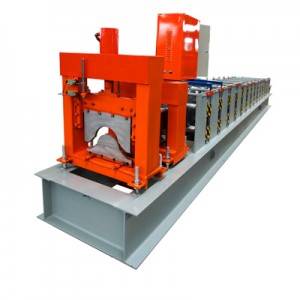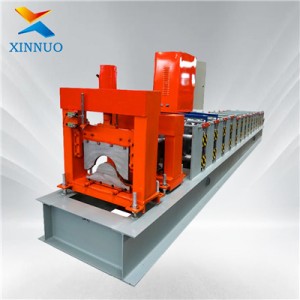

Ridge cap roll forming machine, built and supplied factory-direct — the machine that forms the closure capping the ridge line of a profiled metal roof, where the two slopes meet.
A ridge cap machine forms flat coated coil into the narrow section that sits along the top of a roof, covering the joint where the two slopes meet and closing the roof against rain, dust and wind. It is a small machine compared with a roof panel line, and it is bought for a small part of the roof — but it is present on every roof that uses it, and it is the part that decides whether the top of the building is watertight or is forever the place a leak starts.
This page is written around one idea, because one idea governs whether the machine you receive is the right one: a ridge cap is a matched component, not a standard one. It has to be formed to suit the roof panel it caps — its coverage has to span the panel’s ribs on both slopes, and its section has to nest down onto them. A ridge cap that is the wrong shape for the roof it sits on does not fail gracefully; it either perches on the ribs without sealing, or it leaves the panel’s high points exposed at the ridge. That is why the first question in any enquiry for this machine is not about the machine at all. It is about the roof panel.
First clarification: this is a closure accessory, not a roofing panel machine.
The two are routinely confused in enquiries, so it is worth separating them plainly. A roof panel machine forms the wide trapezoidal sheet that covers the slopes of the roof: a long, wide, asymmetric profile, formed from a wide coil, with many forming stages and a substantial drive, because it is the primary weather surface of the building. A ridge cap machine forms the narrow closure that caps the ridge: a short, narrow section, usually symmetric about its centre line, formed from a much narrower coil, with fewer forming stages and a smaller drive, because its job is to close a line rather than to cover a roof.
The practical consequences of that difference are worth knowing before you compare quotations. The ridge cap machine is a considerably smaller and less costly machine than the panel machine it serves — not because it is built to a lower standard, but because there is less metal to form and the forming force involved is much lower. It follows that judging a ridge cap machine against a panel machine’s price is a comparison between two different jobs rather than between two suppliers. It also follows that a ridge cap machine is not the right purchase for a fabricator who needs roof sheets: the coil widths, the section geometry and the duty are all different, and no specification of a panel machine makes a ridge cap.
What the ridge cap machine is genuinely for is this: it lets the fabricator who already produces roof panels complete the roof package in-house instead of buying the closures in. That is the commercial argument for the machine, and it is examined further below.
The core clarification: the ridge cap has to match the roof panel, and here is what “match” means.
Two requirements have to be satisfied together, and a supplier who addresses only one of them has not understood the job.
The first is coverage. The cap has to be wide enough to reach across onto the panel on both sides of the ridge, far enough to clear at least a full rib or peak of the panel on each slope. The reason is straightforward: the fasteners and the watertightness both depend on the cap bearing on the panel beyond the last rib, not stopping on or before it. A cap that is too narrow leaves the high points of the panel exposed exactly where water runs toward the ridge, and the resulting leak is at the highest and least accessible point of the roof. A cap that is much too wide looks heavy on the building and wastes material, and on a shallow roof it may not lie down properly at all.
The second is nesting. The underside of the cap has to sit down onto the panel’s profile rather than perching on top of it. The cap’s section therefore has to complement the panel’s rib spacing and rib shape, so that the two come together and seal along the length of the ridge instead of leaving a gap that admits wind-driven rain and dust — and in the Gulf, wind-driven dust is as much a reason to get this right as rain is.
There is a third factor that is easy to overlook and matters more on some buildings than others: the pitch of the roof. On a shallow roof the cap sits in a comparatively flat position across the ridge; on a steep roof the angle between the two slopes is much sharper, and the cap has to suit that geometry. This is why the profile range includes a dedicated V-shaped section intended for roofs of considerable slope, alongside the arc and multi-fold sections used elsewhere. A buyer who specifies a ridge cap without mentioning the roof pitch has left a specification decision unmade.
The consequence of all three is the same instruction, and it is the single most useful thing a buyer can act on: send the roof panel’s cross-section drawing and its effective width first, and tell the supplier the roof pitch and the coverage you need. With those three items, a supplier with a genuine design archive can identify a ridge cap that suits your panel — and this factory’s archive exists precisely for that purpose, holding a large body of proven ridge cap profiles built to suit the standard roof panel families from narrow panels up to the widest, together with the special sections used for steep roofs and for wide-span ridges. Where a buyer’s panel is not one of the standard families, the correct answer is a ridge cap designed to suit that panel, and the buyer should require that answer in writing rather than accept a catalogue profile that is close.
This is also why the factory offers a multi-width version of the machine, and why that version is worth particular attention from a fabricator serving several markets: it accepts more than one coil width and can be switched between them, so one machine covers several roof panel types instead of one dedicated machine per panel type. For a fabricator whose order book mixes roof systems — or who expects it to — that flexibility is the difference between one capital purchase and several.
Ridge or hip: two different lines on the same roof.
The ridge is the horizontal line at the top of the roof where two slopes meet. A hip is the inclined line at a corner, where two slopes meet as they run down the building. Both need closing, and both are closures of the same family, but they are not the same component: a hip runs down a slope rather than sitting level along the top, and its section may consequently differ.
So a buyer should state which of the two they need, or whether they need both, and should not assume that a machine configured for one is automatically configured for the other. In practice many fabricators need ridge caps as the volume item and hip closures for particular building shapes, and the sensible way to buy is to say so at the enquiry stage, so the sections can be considered together rather than added later.
And the roof system itself decides whether this is the right machine at all.
A formed metal ridge cap of the kind described here suits a profiled sheet roof — the trapezoidal and corrugated metal roofing that covers industrial, commercial and residential buildings throughout the Gulf. That is the roof type this machine is built for, and it is the great majority of the market.
But there are other roof systems whose ridge treatment is not this component. A standing seam roof closes its ridge in a manner specific to its seam; an antique glazed tile roof closes its ridge as part of that tile system rather than with a plain formed metal cap. A buyer whose roof is one of those systems should say so at the enquiry stage rather than ordering a cap machine and discovering the mismatch afterwards — and equally, a buyer whose enquiry is about capping a profiled sheet roof is in exactly the right place. Stating the roof system costs one line in an email and prevents a wrong purchase.
The section shapes, and the configuration tiers.
The ridge cap profiles in this factory’s archive fall into a few recognisable groups, and knowing which one you need is most of the specification.
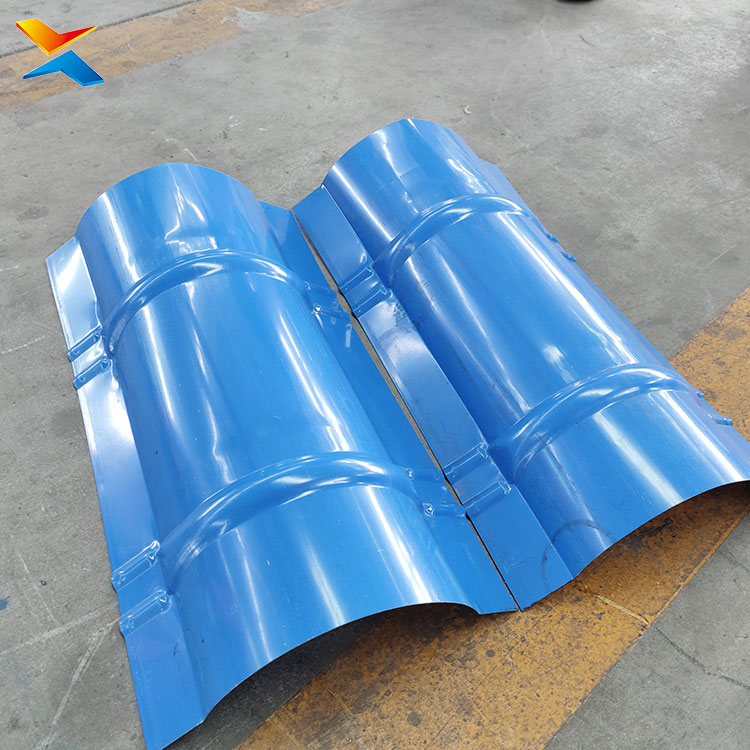
The symmetric V section is the everyday answer and the majority of the archive: a simple, clean ridge line for the ordinary profiled roof. The arc section gives a softer, curved ridge line, and the archive includes a high-precision version of it built with a heavier frame plate and a servo drive, for buyers whose application demands tighter consistency than the standard arrangement. The triangular section exists for special architectural work where the ridge is intended to read as a deliberate feature. And the range also covers a narrow V section for roofs of substantial slope, an unextended range of widths to suit panels from the narrowest standard family up to the widest, and an ultra-wide cap for wide-span ridges where the ridge has to be closed across a broader distance.
The configuration tiers run from the lightest machine in the range — the fewest forming stages and the smallest drive, intended for decorative ridge work and small panels — through the standard configuration, which is the most universal and the sensible starting point for most buyers, to the heavy configuration, which carries more forming stages and a larger drive and is described in the factory’s own records as the export mainstay of the range. Above that sits the precision flagship described above. Alongside them sit the two specials: the multi-width switchable machine, and the widest-coverage machine.
Choosing between them is not a matter of buying the most capable machine available. The right questions are how wide the panel is that the cap must match, what the ridge has to look like on the finished building, how thick the material is, and how many roof systems the machine must cover. A buyer producing decorative ridges on small panels does not need, and should not pay for, the export configuration; a buyer capping wide-span roofs of heavier material does need it, and would be badly served by the light machine.
The commercial argument: turning a bought-in item into an in-house product.
Fabricators who run a roof panel line almost always need ridge caps, and until they make their own they buy them in from a third party. That arrangement has three costs that are easy to live with and easy to stop noticing. The first is the margin — someone else earns it on a component that is on every roof. The second is the dependency: the cap has to match the panel, so a bought-in cap either matches or is a compromise, and the fabricator has limited control over which. The third is the schedule: a roof cannot be completed without its closures, so a late delivery of ridge caps holds up work that the panel line has already finished.
Putting a ridge cap machine behind the panel line removes all three, and it does so for a fraction of what the panel line itself cost, because the machine is a narrower, lighter and simpler machine. That combination — a comparatively modest purchase that closes a gap on every job and takes a purchased item in-house — is the reason this machine is often bought as an addition to an existing panel line rather than as a first purchase.
It is worth being honest about where the machine does not pay, so that buyers can judge for themselves. A fabricator whose roof work is occasional and who has a reliable local supplier of matching caps at a good price may be better served by continuing to buy them in: the machine needs to run to justify itself, and a machine that sits idle while caps are bought from elsewhere is worse than no machine. Similarly, a fabricator who works in one roof system only, in low volume, may find a dedicated cap machine entirely adequate and should not be talked into a multi-width machine on the general principle that flexibility is good. Flexibility is worth paying for when the order book actually varies.
About the production line, briefly.
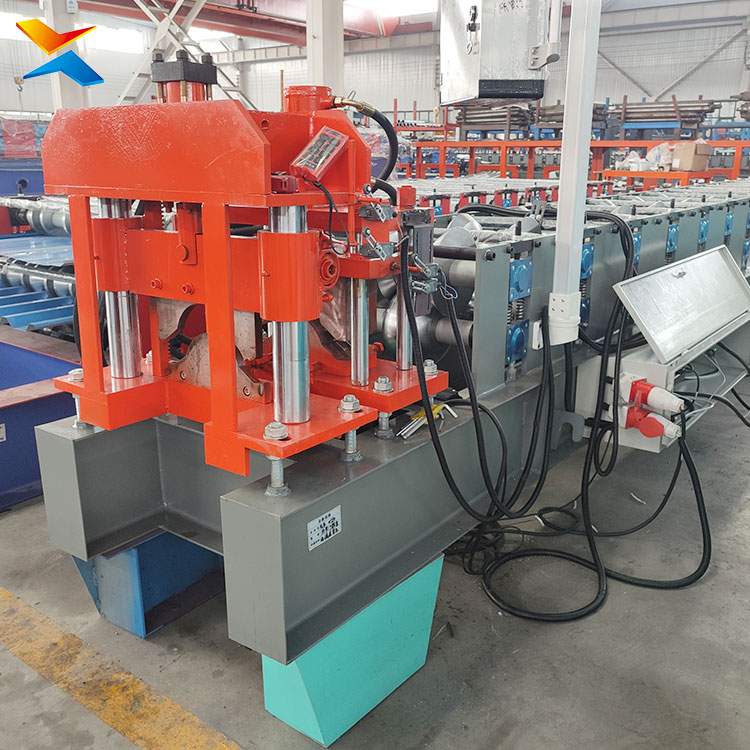
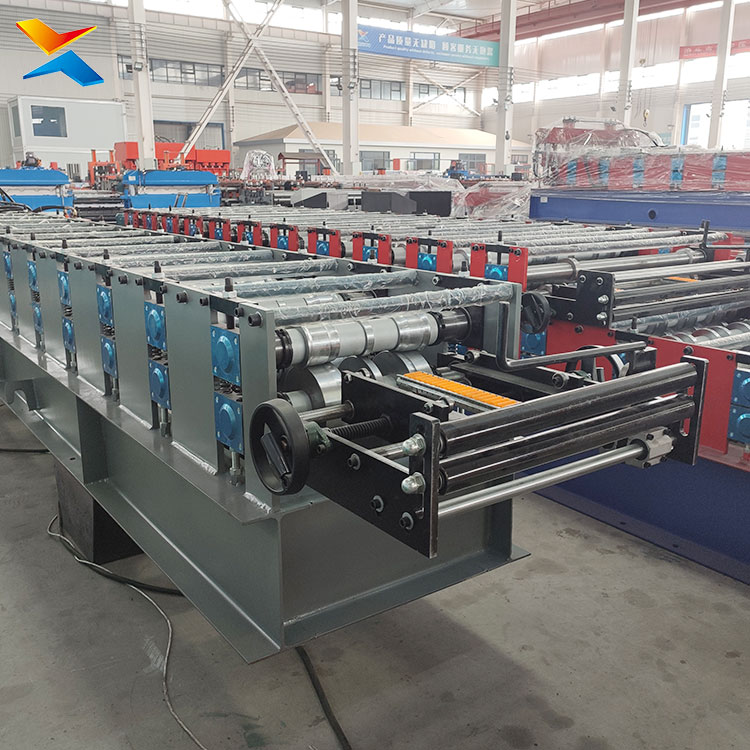
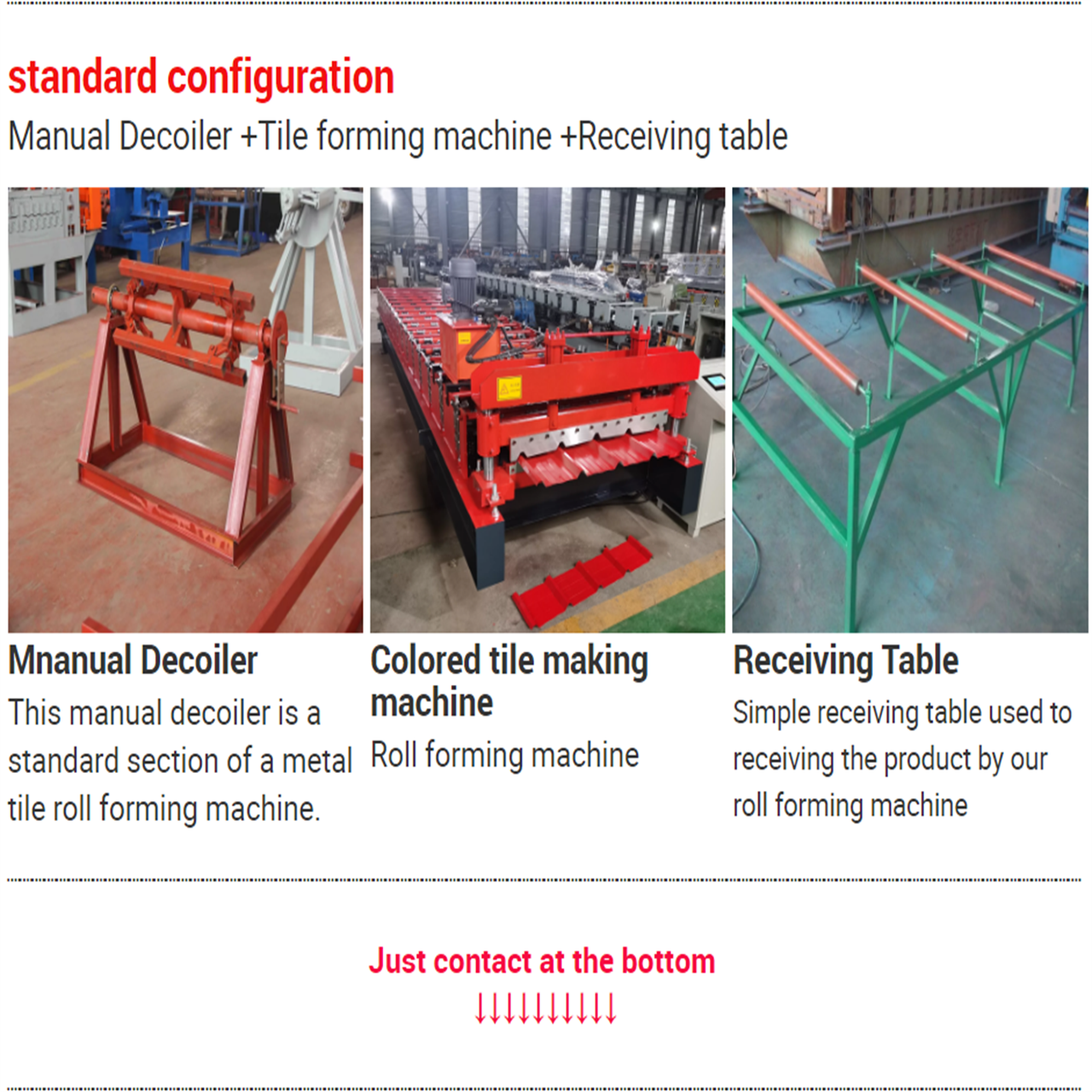
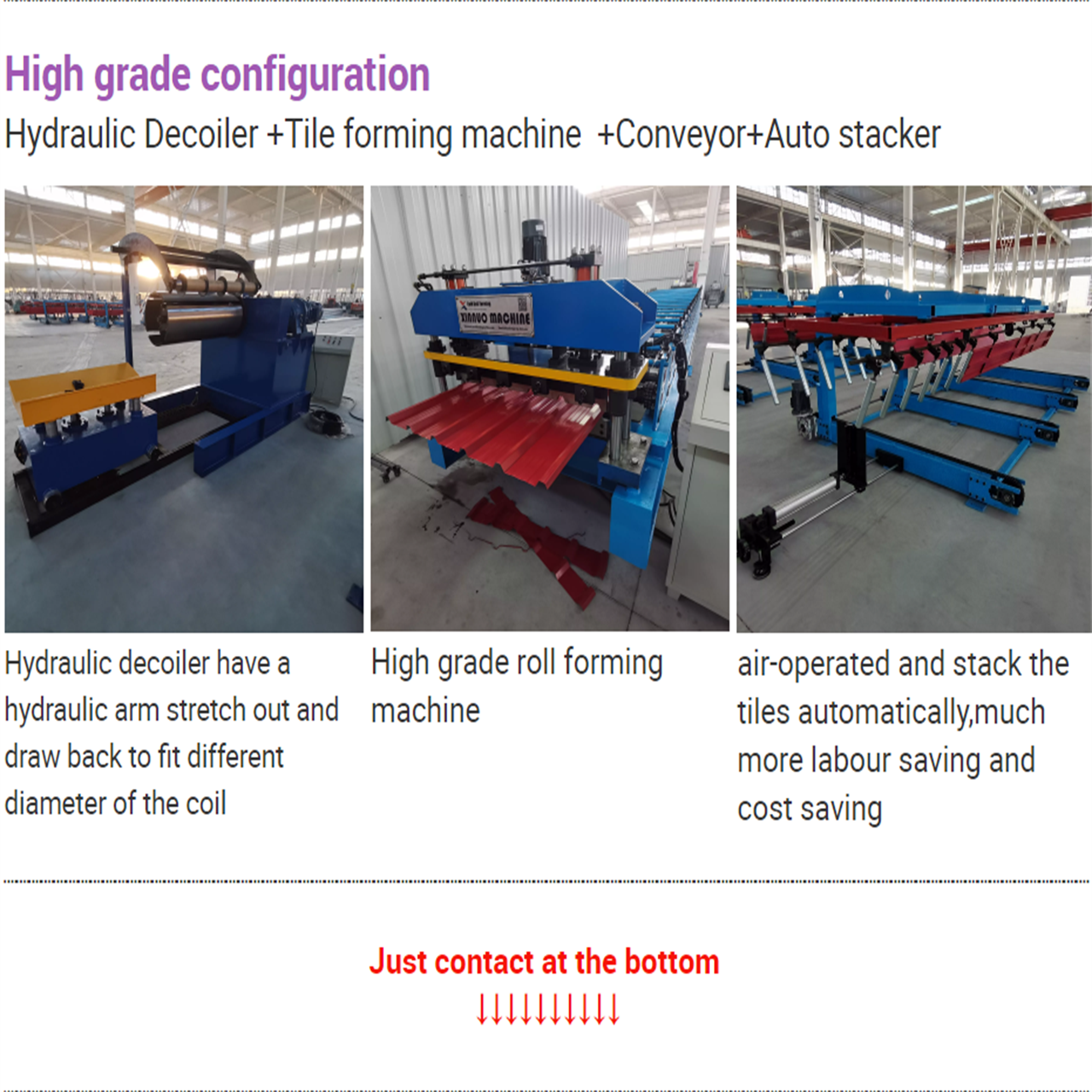
Ridge cap machines are supplied as a working line rather than as a bare forming unit, and the scope is worth confirming item by item in the same way as any other line in this range: a decoiler to carry and pay off the coil, the forming unit itself, a cutting arrangement to separate the finished cap to length, output handling to receive it, and the control panel with its drive and hydraulic arrangements where applicable.
Two practical points follow from what this machine is. Because the finished parts are short compared with roof panels, the handling requirements at the output end are simpler and the line as a whole is short — a point worth confirming against your own workshop, but not the constraint it is on a panel line. And because the run lengths are short and the profile is narrow, the machine is typically supplied in a straightforward configuration; a buyer who wants the same degree of automation as a panel line should ask for it explicitly rather than assume it, and a supplier should be able to state plainly what is automated and what is done by hand. As always, ask for the itemised scope of supply and the layout drawing to go with it, and compare against the shop before comparing prices.
Where this machine earns its keep in the Gulf.
The region’s building stock is overwhelmingly roofed in profiled metal sheet, and that is the roof type this machine serves. The demand follows the panel, and the panel is on nearly everything.
The industrial, logistics and commercial market — factories, warehouses, logistics facilities, workshops, cold stores and commercial units — runs on profiled sheet roofs in volume, and every one of those roofs needs its ridge closed. For a fabricator supplying the contractors building them, the ridge cap is not an occasional item but a routine line on every order, which is exactly the volume pattern that justifies making it in-house.
Villas, residential compounds and smaller buildings are where the appearance argument applies most directly. On a domestic roof the ridge line is highly visible, and a cap that sits down onto the panel and follows it cleanly is what makes the roof look finished rather than assembled. Buyers serving that market have a reason to care about the section shape beyond the technical requirement.
Mosques, heritage and tourism buildings, and architecturally deliberate projects are where the less common sections come into their own: the arc section for a softer ridge, the triangular section where the ridge is meant to be a feature, and the steep-slope V section for roofs pitched more sharply than the industrial norm. These are lower-volume but higher-margin jobs, and a fabricator who can supply the closure as well as the sheet keeps the whole package rather than handing part of it away.
And there is the re-roofing and repair market, which is easy to overlook and steady in a region with a large existing building stock. Re-roofing and repairs need caps matched to panels that may have been installed years ago, often of a profile the fabricator did not supply originally. A cap machine with more than one width available, or with a supplier able to match a section to an existing panel, is worth more in that situation than in new-build work.
On the material side, the Gulf climate puts the emphasis where it belongs: on the coil and its coating rather than on the machine, because a ridge cap is the most exposed part of the roof and the most likely place for corrosion to start. The exposure is worse than on the roof field, because the cap sits at the highest point, on a change of direction, and against the fixings. Buyers should specify their coil and coating accordingly, and should not assume that the material specified for the roof field is automatically adequate at the ridge.
The export record, stated plainly.
It is worth being straightforward about what this product line’s records show, because buyers in a region do ask, and because not all of this factory’s product lines have the same pattern of documented deliveries.
The ridge cap archive records a documented export build for a West African market, together with trade-orders, and the factory’s own records describe the heavy configuration as the export mainstay of the range. The archive for this product line does not, as it stands, carry a Middle East delivery record. So a Gulf buyer should ask for the specific record relevant to the roof panel they need capped, rather than accept a general claim about the region — and a supplier with a genuine archive should be able to answer that question specifically. Where a buyer’s roof panel falls outside the standard families, the honest answer is that the required ridge cap section would be designed to suit that panel, and that answer should arrive before the order rather than during commissioning.
One further point belongs here, and it is a reason to require written confirmation rather than quoting from a catalogue. The factory’s own profile documentation notes that some of the earlier profile entries carry estimated parameters and that the actual drawings govern. That is a normal and honest state of affairs in an archive accumulated over many years — but it means that a buyer should treat any ridge cap specification as confirmed in writing against the drawing for the section being offered, not as fixed by a table. Ask for the section drawing with the quotation.
As the manufacturer and supplier.
These machines are built and supplied directly by the factory rather than resold, and they are configured against a drawing archive rather than designed from scratch for each order. The archive holds a substantial body of proven ridge cap profiles covering the standard roof panel families, the arc and triangular sections, the steep-slope section, the widest-coverage cap and the multi-width machine — so the most likely outcome for a standard enquiry is that the requirement matches a section the factory has already built.
That is the answer worth extracting from any supplier, and it is worth demanding in writing: does my ridge cap correspond to a section you have built before, and if so, which one? A supplier with a real archive can answer; one without will answer with adjectives. Where the buyer’s panel requires a new section, the honest answer is that new tooling is needed, and that should be stated before the order.
Beyond the machine, the supply relationship covers documentation, electrical configuration matched to your site, installation and commissioning with factory technicians on site, operator training, illustrated manuals, video guidance for the settings used most often, round-the-clock engineering support, and spare parts supply. The company’s credentials in this product line can be requested as documents rather than accepted as adjectives. The specific scope of supply, service and training belongs in the order.
To quote a ridge cap machine, send these items. The cross-section drawing of the roof panel you are capping, together with its effective width — because the ridge cap is matched to the panel and nothing else about the enquiry can substitute for this. The coverage width you need the cap to span, and the ridge height you want the finished ridge to have. The roof pitch, since a shallow roof and a steep roof call for different cap geometry. Whether you need ridge caps only, hip closures as well, or both. The section shape you want — symmetric V, arc, triangular, or a multi-fold profile. The material thickness you will run. The coil width and coil weight you can buy locally, which set the decoiler specification. How many different roof panel types the machine must cover, since serving several panel families is the case for the multi-width version. The lengths you cut the caps to, and your expected output. Your workshop’s usable dimensions and the route the machine takes into the building. And your site’s voltage, frequency and phase. With those answers the factory can confirm whether your requirement matches a proven section or needs new tooling, propose the correct configuration, specify the scope of supply item by item, and return an itemised factory-direct quotation with the section drawing and the layout drawing.
In one sentence, the honest summary. A ridge cap machine is a small machine doing a small job that appears on every roof, so buy it the way the job demands — by first sending the roof panel it has to match, because a ridge cap is a matched component rather than a standard one, and the cost of getting that wrong lands at the highest and hardest-to-reach point of the building.

♦ COMPANY PROFILE:
Hebei Xinnuo Roll Forming Machine Co., Ltd., not only produce different types of professional roll forming machines, but also develop intelligent automatic roll forming production lines, C&Z shape purline machines, highway guardrail roll forming machine lines, sandwich panel production lines, decking forming machines, light keel machines, shutter slat door forming machines, downpipe machines, gutter machines, etc.
Advantages of Roll Forming A Metal Part
There are several advantages of using roll forming for your projects:
- The roll forming process allows operations such as punching, notching, and welding to be performed in-line. Labor cost and time for secondary operations are reduced or eliminated, reducing part costs.
- Roll form tooling allows for a high degree of flexibility. A single set of roll form tools will make almost any length of the same cross-section. Multiple sets of tools for varying length parts are not required.
- It can provide better dimensional control than other competing metal forming processes.
- Repeatability is inherent in the process, allowing easier assembly of roll formed parts into your finished product, and minimizing problems due to “standard” tolerance build up.
- Roll forming is typically a higher speed process.
- Roll forming offers customers a superior surface finish. This makes roll forming an excellent option for decorative stainless steel parts or for parts requiring a finish such as anodizing or powder coating. Also, texture or pattern can be rolled into the surface during forming.
- Roll forming utilizes material more efficiently than other competing processes.
- Roll formed shapes can be developed with thinner walls than competing processes
Roll forming is a continuous process which converts sheet metal into an engineered shape using consecutive sets of mated rolls, each of which makes only incremental changes in the form. The sum of these small changes in form is a complex profile.