

Product Description
U purlin and U channel roll forming machine, built and supplied factory-direct — the open channel section, formed from flat steel coil, for steel building work, racking, liner, cable management and solar mounting.
A U section machine takes flat steel coil and progressively forms it into an open channel: a flat base with two sides turned up. It is the simplest structural section this factory produces, and that simplicity is the single most useful thing a buyer can understand about it, because it explains the price, the size of the machine, the amount of floor space the line needs, and — just as importantly — the jobs the section is and is not suited to.
This page is written to help a buyer choose correctly rather than to sell the machine as a substitute for every other section. That matters here more than in most product lines, because the words buyers use around U sections overlap heavily, and the section is frequently ordered for one job when a different one is what the drawing actually shows.
First, the difference that defines everything: a U section has no lips, and a C purlin does.
This is the distinction worth understanding before anything else, because it explains both the price and the performance of the two families, and because the two names are used loosely enough in the trade to cause real purchasing mistakes.
A C purlin is formed from a flat strip into a base, two sides, and then two inward lips folded back at the top of each side — five bends in total. Those lips are what give a C section its stiffness: they turn the open channel into a shape that resists twisting and buckling, which is why C sections are the standard secondary framing for roof purlins and wall girts in steel buildings, and why they can carry load over a span.
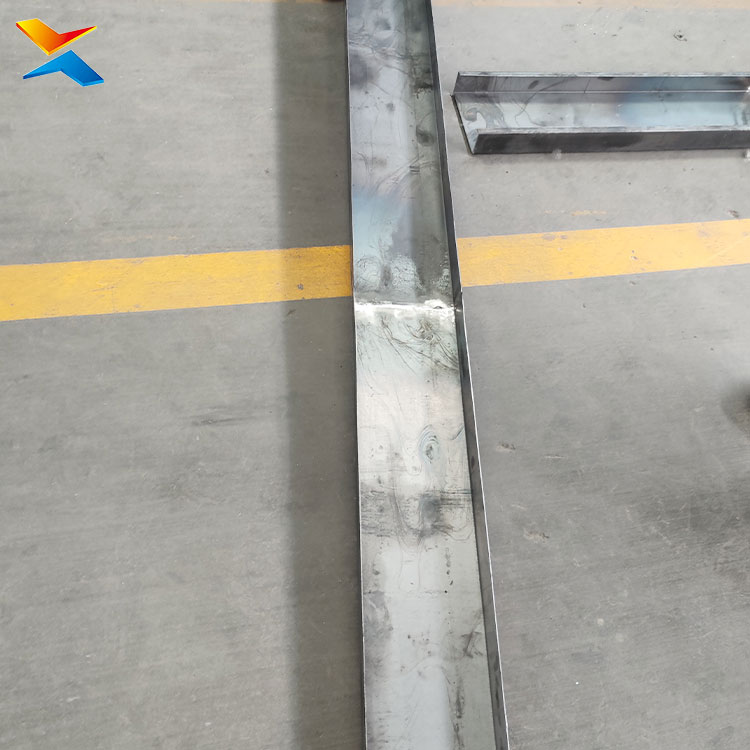
A U section is formed from a flat strip into a base and two sides — two bends, and no lips (or, on a few profiles, only a very small inward micro-lip). That is the whole cross-section. It is simpler to form, and because there is less bending to do, a U machine needs fewer forming stages, a lighter frame, smaller shafts, less power, and a shorter line than a C machine of comparable range. A U machine also uses a considerably lighter and less costly frame construction, because the forming force involved is lower.
Two consequences follow, and both are things a buyer should hear plainly.
The first is that a U machine is less expensive, and the reason is the section, not the build quality. The price difference between a U machine and a C machine of comparable range is a real consequence of the geometry. A supplier who presents a U machine as simply a cheaper version of a C machine is skipping the reason.
The second is the one that protects a buyer from a costly error: for the same material weight, an open U section is less rigid than a C section, because it has no lips to resist twisting. So if the member is going to carry load across a span as a roof purlin or a wall girt, the C section — or the Z section, where lapped continuous runs suit the roof — is usually the right section. U sections earn their place where the section’s job is different: as a liner or edge member, a rack or shelving section, cable tray and cable management, guide rails, light steel framing, trim and closure pieces, and as mounting rails. If you are about to buy a U machine because it is the cheaper option for a purlin that has to carry a roof, that is the one mistake this page most wants to prevent.
Second, “U channel” is not one product — it is a family of jobs.
The trade uses “U channel”, “U purlin”, “U beam” and “channel” almost interchangeably, and they cover sections that differ in width, in height, in whether a micro-lip is present, in material, and in what they are for. The factory’s own archive organises U sections by what they do, and the buyer’s most useful move is to say which of these is their case.
At the small end sit the miniature U sections — narrow channels used as liner, cable management and decorative trim. They are formed on very light, compact machines.
Above them sit the standard U channels, the everyday mid-size section used for light structural framing, furring, and shelving systems.
Then the medium U sections, which are the sizes used as structural purlins and for racking columns and beams.
Then the large U sections, which reach the widest channels the range covers, used for heavier structural work and for solar mounting rails.
And alongside these sit a group of special U profiles with no equivalent in the C family, which are worth knowing about because they are the reason a buyer should not assume any channel machine can make any channel:
- A high-speed liner machine, built with gear drive and a heavy archway frame for continuous liner production — a configuration that does not appear in the ordinary U range.
- A waterstop machine, producing the multi-level stepped profile used in concrete construction joints to prevent water infiltration. This is not a simple channel at all; it is a specialty product for concrete work, and it is routinely enquired about together with structural channels by mistake.
- A twist-break cut machine, where the section is separated by a hydraulic twist rather than by a shear, giving a cleaner cut end on thin material where a shear would deform the profile.
- A wide U machine designed for stainless steel, a material capability that the standard C machines in this range are not designed to handle.
The practical instruction that follows: send the cross-section drawing and the application, not a width alone. Whether the section needs lips, what the section will do, and what material it will be made from each change the machine, and none of them is visible in the phrase “U channel”.
Third, if you need both C and U sections, that is a different purchase again.
There is a further option worth knowing about before you specify, because it can change the machine you buy: integrated C-plus-U machines exist in this range, where one machine body produces C sections and U sections. The archive documents machines of this type running in three modes — C channel, equal-leg U, and unequal-leg U — and others covering a C range and a U range on one body.
So the choice is not only “which section” but “how many sections, on one machine or two”. If your order book genuinely calls for both, and you are already paying for an adjustable machine, the integrated option can be the better purchase than two separate machines. If it calls for one section, the dedicated machine is simpler, cheaper and stiffer for that job. This is the same decision that runs through the whole purlin range, and it should be settled with the supplier using your own order history rather than a preference for flexibility in the abstract.
The line is short, and for a workshop paying rent, that is a real advantage.
Because a U section needs fewer forming stages than a lipped section, the whole production line is shorter — and in this factory’s range the U line is the most compact of all, standing well inside the floor space a comparable C or Z line would occupy. For a fabricator in a market where industrial space is expensive and every square metre is paid for monthly, that difference turns directly into money, and it is worth asking for the line length and layout drawing as a specific item rather than assuming the machine alone is the footprint.
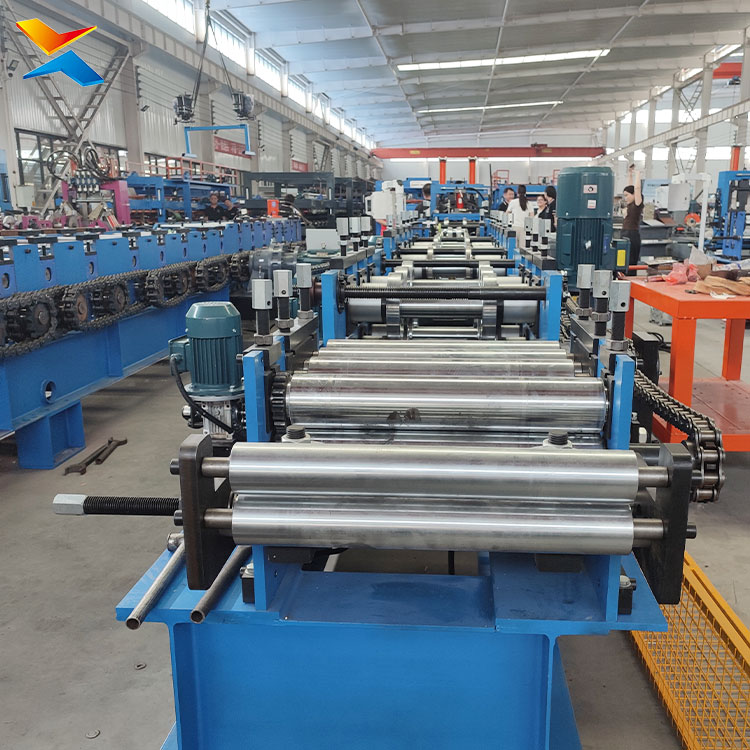
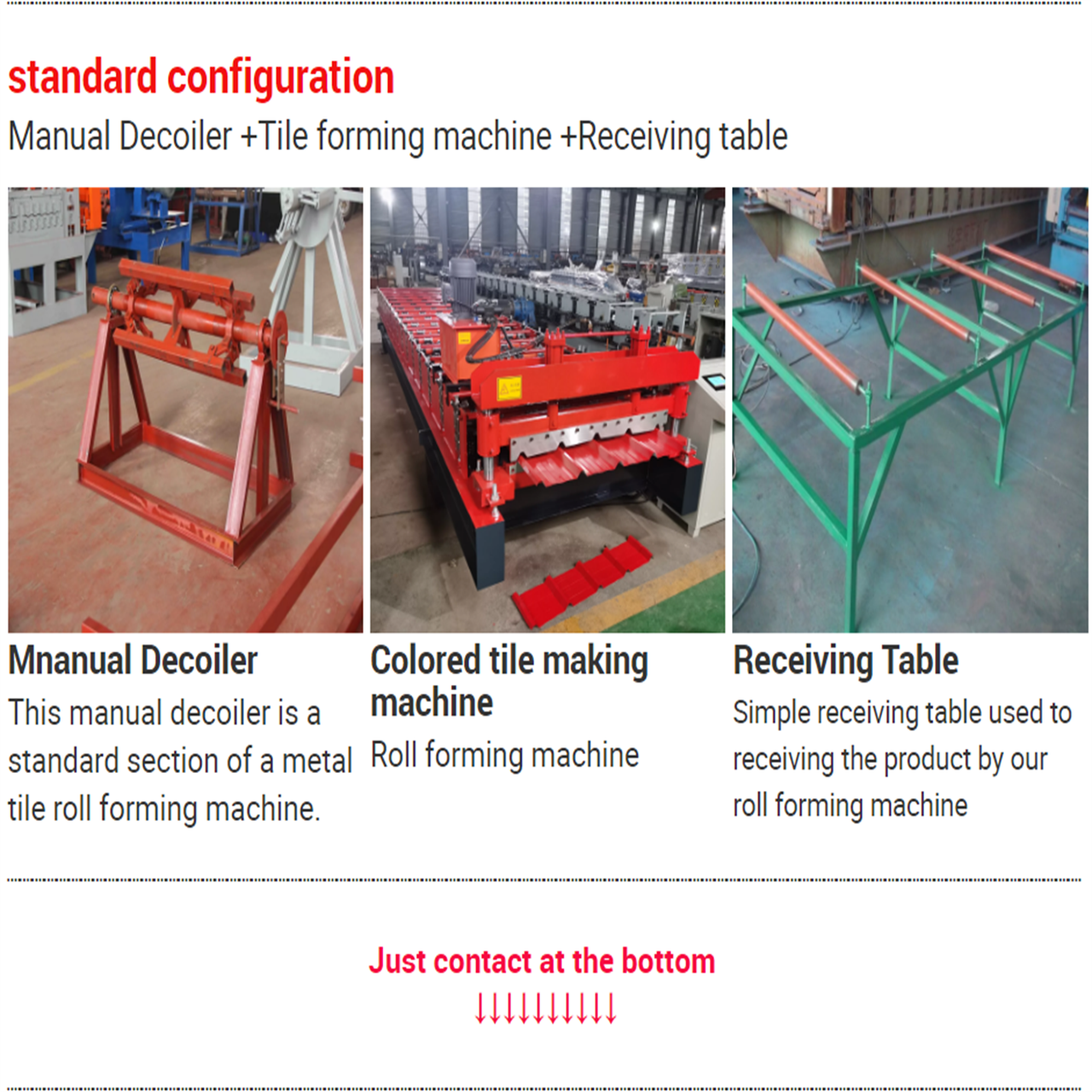
The line itself follows the standard arrangement used across this factory’s purlin range. Coil is mounted on a decoiler — available in a manual arrangement for the most economical configuration, or powered, and built to carry the coil weights buyers in the region actually purchase rather than a nominal figure assumed on a specification sheet. The strip then passes through a leveling section, which matters more than buyers expect: coil arrives with its own set from the mill and from storage, and a channel formed from unleveled strip will not sit flat. Then the forming unit, where the section is progressively brought to shape through its stations. Then punching, performed inline at the end of the forming unit, so the holes your connections require are made as part of the same pass. Then the cutting arrangement, and finally the output bracket and the control cabinet with its hydraulic pump station.
That component list is worth carrying into a quotation comparison. Two quotations for what looks like the same machine can differ because one includes leveling and inline punching and another leaves them out, or because one specifies a powered decoiler and another a manual one. Ask for the component list explicitly, item by item, and compare like with like.
How the machine cuts, and the option that is specific to this family.
The standard arrangement is a hydraulic shear, where the line briefly pauses while the finished section is cut to length and then resumes. It is the conventional and economical answer, and it suits normal volumes and varied lengths.
For thin material, there is a U-specific alternative worth knowing about: cutting the section by hydraulic twist-break rather than by shear. A shear on very thin stock can deform the profile at the cut, because the blade passes through material that has little resistance to being pushed out of shape. A twist-break separates the section by a controlled twisting action instead, which produces a cleaner end on thin material. It is a specialty option rather than a standard feature, and it exists in this archive precisely because liner and light-gauge channel producers asked for it.
For continuous high-volume production, the non-stop or flying cut remains available as it is across the purlin range: the shear travels with the moving section and cuts while the line keeps running, which makes output effectively continuous and improves cut length accuracy, at the cost of a longer machine and a higher price. Whatever the volume, the cutting arrangement should be quoted as an explicit line item rather than bundled invisibly into a total, because it is one of the few decisions that can be revisited at order stage and never afterwards.
Material capability — worth asking about early, because it is not universal.
The ordinary U range is built for coated steel coil, and that covers the great majority of channel production: galvanized and pre-painted material for framing, racking, trim and mounting rails.
Beyond that, the archive records a wide U machine designed specifically to run stainless steel. That matters because stainless behaves differently from coated carbon steel under forming, and the standard machines across both the U and C ranges — including the C purlin machines — are not designed for it. So if any part of your product is a stainless section, say so at the enquiry stage rather than after the order. A supplier who accepts a stainless requirement without adjusting the specification has not understood it. Equally, if a customer asks for a heavier gauge than a standard U machine is built for, the machine tier has to change, because the forming load rises steeply with thickness.
What decides the machine, in the buyer’s own terms.
Every U section is defined by its overall width, its side height, its material thickness, and — for the profiles that have one — its lip. Of these, thickness and width do most of the work in machine selection, because the forming load rises sharply with thickness and the frame has to grow with the widest section the machine must cover. Height and lip affect tooling rather than the overall size of the machine.
So the most useful single thing a buyer can do at the enquiry stage is state all four values as ranges: the narrowest and widest section the machine must produce, the range of side heights, the lip requirement, and the range of thicknesses. A request quoting one nominal section, or a width alone, commonly produces a quotation for a machine that cannot cover the customer’s actual range — and that misunderstanding surfaces at the worst possible moment, which is after the machine has arrived.
About the build, in plain terms.
Because U sections are lighter work than lipped sections, the frames on these machines are commonly built from channel steel rather than from the heavier H-beam and reinforced archway construction used across the C and C/Z range. A buyer comparing a U machine against a C machine and finding the frame construction lighter should read that as the correct engineering answer to a lower forming force — not as a corner being cut. Where the U work is heavier, the frame steps up accordingly, and where it is a wide or heavy channel, the frame step-up is real.
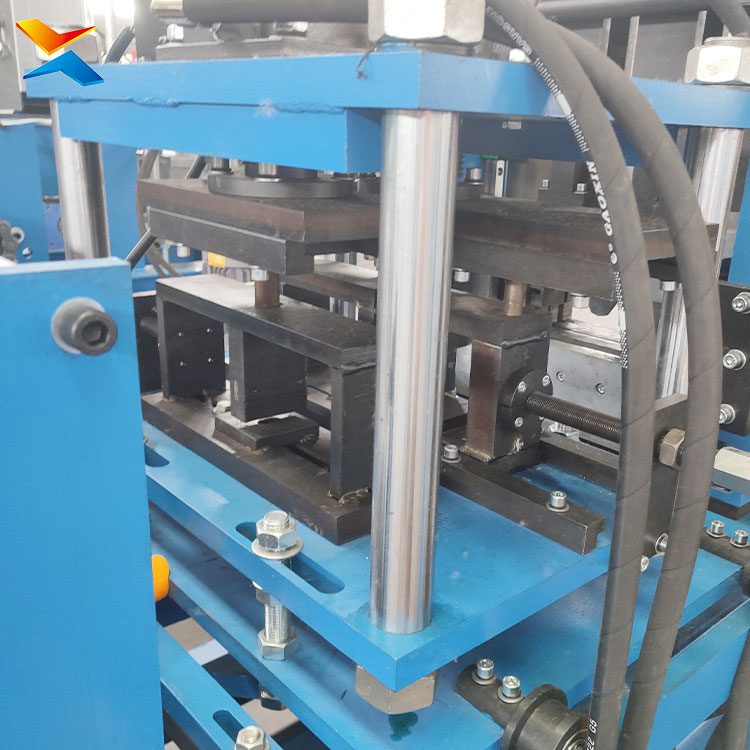
Beyond the frame, the build details that decide how a channel machine performs over years are the same ones that matter across the range: mould wheels taken through a full multi-stage process including hard quenching and a chrome plating step that is the one competitors most commonly skip; shafts turned from chromium steel, precision ground and plated; the high-wear wheel positions made from a more wear-resistant alloy rather than the standard bearing steel used elsewhere; frames and the plates locating the adjustable assemblies machined on a long CNC milling machine rather than assembled from cut plate, which matters most on machines that change size; a heavy coil decoiler; gas-shielded welding giving clean, slag-free seams; and a shot-blasted surface finished with electrostatic powder coating rather than wet paint, for adhesion and colour retention. The control system is programmed in-house rather than bought in, which is why an electrical question can be resolved over a call instead of escalated to a third party.
Two things are worth asking for in writing, whichever machine you buy. The first is that the first piece off the line is a finished, saleable product — no trial-and-error pile of scrap while the machine finds its settings. The second is a written maintenance schedule for lubrication, alignment and inspection, because a machine running daily in a hot workshop benefits from a routine that is followed rather than improvised.
Why the Gulf market suits this machine, and one honest limitation of the record.
U sections fit Gulf demand in specific ways rather than generically. The industrial and logistics building market runs on racking and shelving, and a substantial part of that racking is formed channel. Solar mounting is a major and growing use, since photovoltaic mounting structures and rails are built from formed sections, and that demand is driven by energy projects rather than by the construction cycle — which makes it a useful complement to a fabricator’s normal order book. Alongside those sit the everyday channel jobs: liner and edge members, trims and closures, guide rails, light steel framing, and cable management for the electrical and telecom work that accompanies every building programme.
On the climate side, the coastal Gulf’s humidity and salt-laden air put the emphasis on the coil and its coating or galvanizing rather than on the machine, because a channel installed in a coastal structure is exposed for the life of the building and it is the corrosion system, not the forming equipment, that decides how long it lasts. The machine forms the geometry and nothing more. Where U channels are used for solar mounting, that point is sharper still, since mounting rails are exposed on all faces for decades.
One thing should be stated plainly rather than blurred. This factory’s documented purlin deliveries in the region include the United Arab Emirates — Dubai specifically — along with Saudi Arabia, Oman and Yemen, with further deliveries to Israel and Turkey. That record, however, is documented for the lipped purlin range — the C, Z and integrated purlin machines. The U channel archive, as it stands, does not carry a country-by-country delivery list. So a UAE buyer should ask for the specific delivery record for the U profile they need, rather than accept a general claim about the region. It is a fair question to put to any supplier, and a supplier with a genuine archive can answer it. Where a U requirement falls outside the documented U range, the honest answer is that the tooling would be new, and that should be stated in writing before the order rather than discovered during commissioning.
As the manufacturer and supplier.
These machines are built and supplied directly by the factory rather than resold, and they are configured against a drawing archive rather than designed from scratch for each order. The archive holds a large body of production-proven U channel designs across the width ranges described above, alongside the special profiles — the liner machine, the waterstop machine, the twist-break machine and the stainless-capable wide machine — which are documented as designs that have actually been built.
That archive is the practical reason to buy from the manufacturer in this category. When you send your section drawing and your four values as ranges, the factory can match them against proven designs and tell you whether your requirement corresponds to one that has already been built, or whether it needs new tooling. Ask for that answer in writing before you compare prices. Beyond the machine, the supply relationship covers documentation, electrical configuration matched to your site, installation and commissioning with factory technicians on site, operator training, illustrated manuals, video guidance for the settings used most often, round-the-clock engineering support, and spare parts supply. The company’s credentials in this product line — quality management certification, European conformity marking, recognised high-technology enterprise status and a body of patents — are available and should be requested as documents rather than accepted as adjectives. The specific scope of supply, service and training belongs in the order rather than in an assumption.
To quote a U channel machine, send these items. The cross-section drawing of every section you intend to produce, with the lip requirement stated explicitly, since a channel without lips and a channel with a micro-lip are different tooling. For each section, the four values as ranges: overall width, side height, thickness, and lip. The application for each section — structural framing, purlin, racking, liner, cable management, guide rail, angle trim, or solar mounting rail — because the application tells the factory what the section has to do and helps it question a specification that does not fit. The material and its surface: coated, galvanized, pre-painted, or stainless. Whether you also need C sections, which changes the machine from a dedicated U machine to an integrated C-plus-U machine. Whether any section requires a special cut, such as the twist-break arrangement for thin material. Your production pattern: how many sections, how many sizes, and how often the machine changes size. The coil weights and widths you can buy locally, since the decoiler and feed arrangement must match them. Your cut lengths and daily output per section. Your workshop’s space, including the line length for the arrangement you choose. And your site’s voltage and frequency. With those answers the factory can propose the correct machine tier, confirm whether your profiles correspond to proven tooling or need new tooling, specify the frame, drive and cutting arrangement the work requires, and return an itemised factory-direct quotation with the line layout drawing.
In one sentence, the honest summary. A U channel machine is the simpler, lighter and less expensive section machine in this range — the right purchase for liner, racking, cable management, trim, guide rail and solar mounting work, and the wrong one for a roof purlin that has to carry load over a span, where the lips of a C or the geometry of a Z section are what the job actually needs.
♦ COMPANY PROFILE:
Hebei Xinnuo Roll Forming Machine Co., Ltd., not only produce different types of professional roll forming machines, but also develop intelligent automatic roll forming production lines, C&Z shape purline machines, highway guardrail roll forming machine lines, sandwich panel production lines, decking forming machines, light keel machines, shutter slat door forming machines, downpipe machines, gutter machines, etc.
Advantages of Roll Forming A Metal Part
There are several advantages of using roll forming for your projects:
- The roll forming process allows operations such as punching, notching, and welding to be performed in-line. Labor cost and time for secondary operations are reduced or eliminated, reducing part costs.
- Roll form tooling allows for a high degree of flexibility. A single set of roll form tools will make almost any length of the same cross-section. Multiple sets of tools for varying length parts are not required.
- It can provide better dimensional control than other competing metal forming processes.
- Repeatability is inherent in the process, allowing easier assembly of roll formed parts into your finished product, and minimizing problems due to “standard” tolerance build up.
- Roll forming is typically a higher speed process.
- Roll forming offers customers a superior surface finish. This makes roll forming an excellent option for decorative stainless steel parts or for parts requiring a finish such as anodizing or powder coating. Also, texture or pattern can be rolled into the surface during forming.
- Roll forming utilizes material more efficiently than other competing processes.
- Roll formed shapes can be developed with thinner walls than competing processes
Roll forming is a continuous process which converts sheet metal into an engineered shape using consecutive sets of mated rolls, each of which makes only incremental changes in the form. The sum of these small changes in form is a complex profile.


