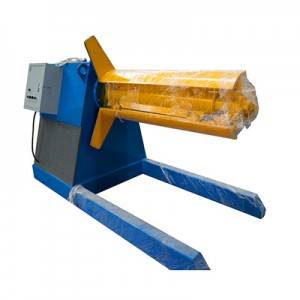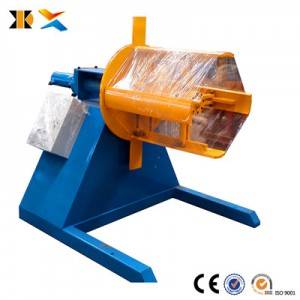

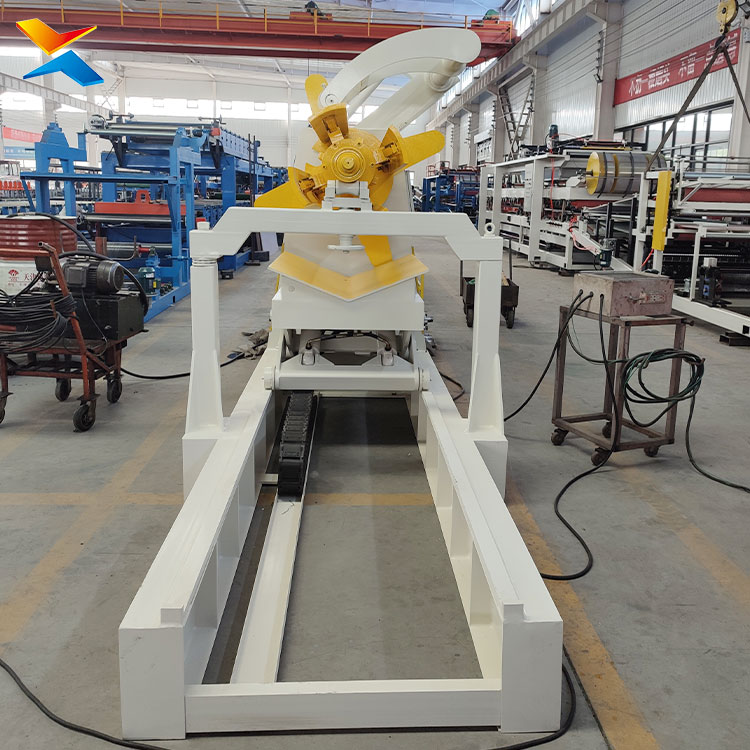
Decoiler machine — steel coil uncoiler for the metal fabrication workshop, built by the manufacturer and supplied direct to the UAE. In a fabrication workshop the decoiler stands at the head of the coil processing arrangement. It carries the steel coil, holds it under control, and pays the strip off into the line that follows it, so that flat sheet, blanks and slit strip are produced from coil rather than bought in already cut.
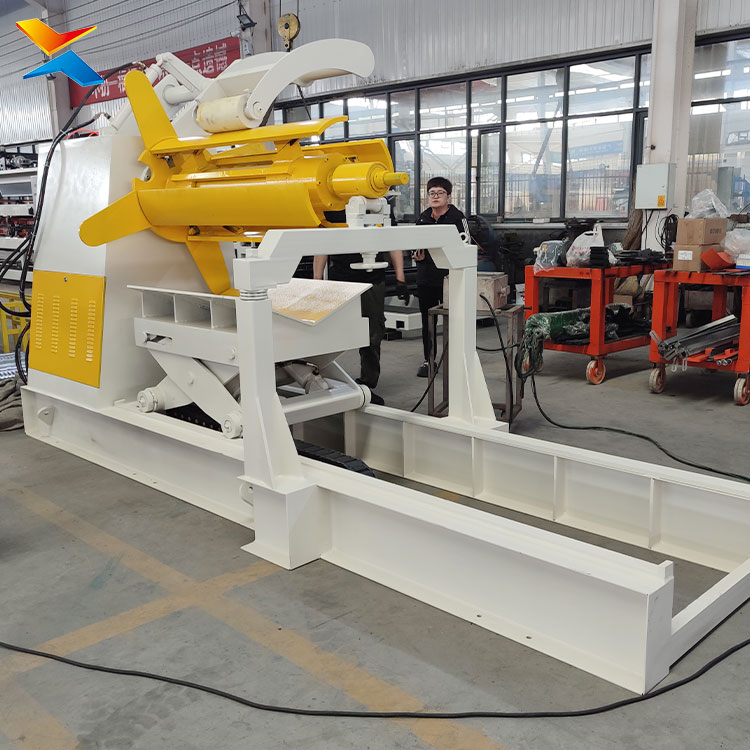
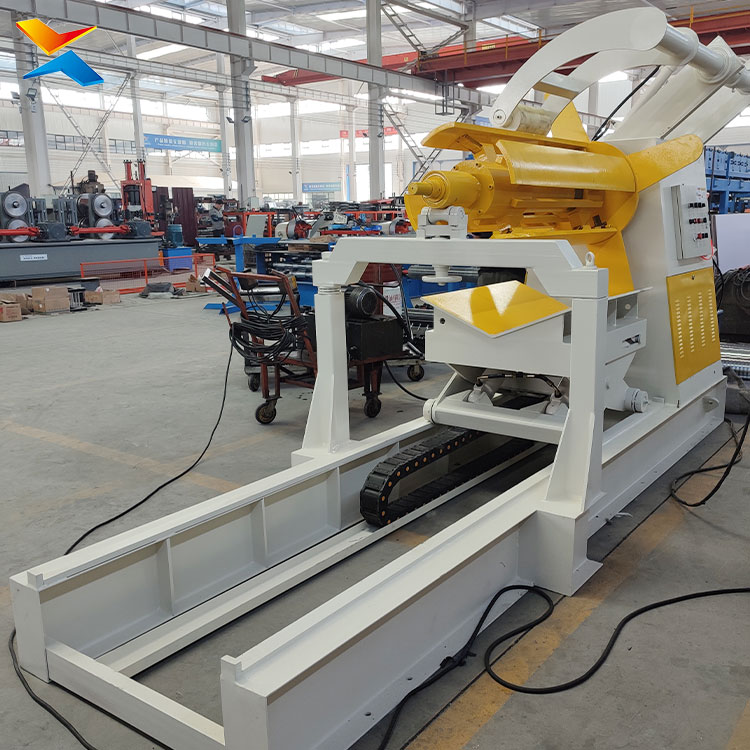
The machine comprises a frame and base, a spindle carrying an expanding mandrel, an arrangement for loading the coil onto the mandrel, and a braking and control arrangement that governs how the coil unwinds. The coil is placed onto the mandrel, the mandrel expands to grip it from the inside, the coil is brought to working position, and the leading end of the strip is threaded into the line. From there the line draws the strip and the decoiler controls it.
What a fabrication workshop is buying a decoiler for.
A workshop that buys coil instead of pre-cut sheet makes a deliberate trade. Sheet bought ready-cut arrives at the size it was ordered, which is convenient, but it costs more per unit of weight, and the workshop can only use the sizes it ordered. Coil costs less per unit of weight and comes in a continuous length, so the workshop can cut to the size the job actually needs, in the quantity it needs, and can change size job by job. What the decoiler and the line behind it do is convert that cheaper and more flexible raw material into the flat material the workshop’s other machines — press brake, shear, rolls, press, welding — already work with.
That is the reason a fabrication workshop buys a decoiler. It is not a machine that makes anything on its own. It is the machine that makes coil usable.
The decoiler is the head of an arrangement, not a self-contained line.
This is the point most often misunderstood in a workshop purchase, and it decides what actually gets delivered. A decoiler opens a coil. It does not by itself produce flat sheet that can be used.
The coil arrives with its own deformation. Strip wound into a coil and then released does not lie flat: it keeps a curvature from the coil, and a narrower or heavier coil can also carry cross-bow and twist. This is inherent in the material and cannot be removed by the decoiler. Something downstream of the decoiler must handle it, and in practice that means a leveling unit, which works the strip through a set of rolls and takes the deformation out. Only after the strip has been leveled is it flat, and only then is it something a workshop can cut to size and use.
So the decoiler is the first unit of a coil processing arrangement, and what follows it depends on what the workshop wants to make.
Two arrangements a workshop decoiler goes into.
Coil-to-sheet: decoiler with leveling and cut-to-length. The decoiler pays strip off the coil, the leveling unit removes the coil deformation, and a cutting arrangement cuts the flat strip to the required length. The output is flat sheet cut to size — the material the workshop would otherwise have bought pre-cut, now made to the size the job needs. This arrangement is the reason a workshop with a press brake, a shear and welding equipment buys a decoiler at all: it turns coil into the same flat blanks the workshop already uses, at lower material cost and at whatever size the job calls for.
Slitting: decoiler with slitting and rewinding. The decoiler pays strip off the wide coil, a slitting arrangement cuts the strip lengthwise into narrower strips, and a recoiler — a rewinding unit at the exit — winds the narrower strips back into coils. The output is a set of narrow coils. Where a workshop needs narrow strip in quantity, this replaces buying narrow coil at a premium. In this arrangement the decoiler is specifically the entry uncoiler, and it is worth noting that it is a different role from the recoiler at the far end of the same line, even though both hold a coil on a mandrel.
In both arrangements the decoiler’s job is the same: deliver strip from the coil in a controlled way to whatever unit comes next. What changes is what that unit is, and therefore what the decoiler has to feed.
Why the decoiler’s grip and tension matter more in a workshop than on a dedicated line.
A workshop that runs one product day after day can tune its decoiler to one coil and one strip and leave it. A fabrication workshop cannot. Its work varies: the coil varies between suppliers and between deliveries, the strip thickness varies with the job, the coil width varies, and the coil weight varies, because a workshop buys what is available rather than what a long production run would justify. The decoiler therefore has to accept a range of coil and has to hold each of them properly.
This has two consequences. The mandrel must expand over a range wide enough to grip the inner diameters the workshop’s coil supply actually delivers, because a coil whose inner diameter the mandrel cannot reach is a coil the workshop cannot use. And the tension control has to be adjustable over a range wide enough to suit both light and heavy strip, because a setting that holds heavy strip taut will over-tension light strip. A workshop decoiler is therefore bought for its range, not for a single set of figures.
The coil parameters that define the machine.
Four parameters of the coil decide the decoiler, and in a fabrication workshop all four are more variable than they would be on a dedicated production line.
Coil weight. This sets the frame, base, spindle and bearing arrangement, and the mandrel. It also decides how the coil must be loaded, since a coil beyond what can be handled by hand or by a simple hook has to be loaded mechanically.
Coil inner diameter. This sets the mandrel, which grips the coil from the inside and expands to suit the inner diameter of the coil on it. Inner diameter is a range, and in a workshop drawing coil from several suppliers it is the parameter that most often varies without anyone noticing until the coil will not go on.
Coil outer diameter. This sets the working envelope: how far the coil projects from the mandrel, the clearance the frame must provide, and how much the coil’s weight pulls against the spindle as the coil runs down.
Strip width. This sets how the coil sits on the mandrel and how the strip is guided as it leaves, and it has to match the line, because the strip the decoiler delivers is the strip the whole arrangement processes.
Machine construction — the main assemblies.
The frame and base. A heavy welded steel structure carrying the spindle and the coil. The base is the reference for the machine’s position in the line and is built to spread the coil load over the floor rather than concentrate it. The frame carries the bending load that the cantilevered coil applies to the spindle.
The spindle and the expanding mandrel. The spindle carries the coil. The mandrel is the assembly on it that grips the coil, expanding radially to grip from inside and contracting to release. It is the part of the decoiler that must match the workshop’s coil, and the part on which the coil’s weight bears while the coil turns.
Expansion mechanism. The mandrel is expanded and contracted mechanically, hydraulically or pneumatically. Hydraulic expansion develops its grip from oil pressure, grips firmly, and does not give up its grip in service as the coil turns — which is what holds the coil against the drag of tension control and against the inertia of a heavy coil starting and stopping.
The braking and tension arrangement. The controlled resistance that keeps the strip taut and stops the coil overrunning when the line slows or stops. It may be a brake acting on the coil or spindle, a driven spindle operated in a controlled manner, or a combination, and it is adjustable so the resistance can be set to the strip. This is what separates a decoiler from a coil stand, and it is the part that most directly affects what the line downstream receives.
The loading arrangement. How the coil reaches the mandrel. It may be a coil car that lifts the coil, carries it to the mandrel and positions it at the correct height and centre, or a simpler arrangement in which the workshop’s own lifting equipment brings the coil up. A workshop usually has less space to manoeuvre than a dedicated line, so how the coil car and the lifting route fit the available floor is part of the choice.
Coil hold-down and stripping arrangements. Where a hold-down arm or a peeler is fitted, it keeps the outer wraps under control as the coil runs down, helps the strip feed, and helps release the final wraps. These matter most on thin or easily creased strip and at the end of a coil.
The hydraulic power unit. Where expansion, the coil car or other functions are hydraulic, a pump station supplies them, arranged so the hydraulic components are of standard specification and can be sourced and serviced.
The control arrangement. The operator’s control of expansion, coil car, tension setting and line interlock. The decoiler works as part of the line, so its controls are built to work with the line’s controls and to coordinate with the line’s start, stop and speed changes.
Configurations.
Single mandrel. One mandrel carrying one coil at a time. The arrangement most workshop lines use, and the one in which the line stops for a coil change.
Double mandrel. Two mandrels on a rotating or traversing base, so a new coil can be loaded and prepared while the working coil is still being consumed and the strip transferred rather than the coil reloaded. Suited to a workshop whose line runs long enough that coil changes are a real interruption.
Mechanical, hydraulic or pneumatic mandrel expansion. Hydraulic expansion gives a firm, controlled grip that stays firm while the coil turns, which is the usual choice where coil weight is significant or where the decoiler works against tension drag.
Brake tension or driven tension. Tension applied by a brake resisting the pull of the line, by a driven spindle operated in a controlled manner, or by both. Driven tension control holds the strip steady over a wider range of coil weight and line speed, which suits a workshop running mixed material.
With or without a coil car. Whether the coil is loaded by a dedicated coil car or brought up by the workshop’s lifting equipment. Decided by coil weight, by the floor space available, and by what the workshop already has.
With hold-down arm, peeler and strip guides. To control the outer wraps as the coil runs down, help the strip feed, and release the last wraps.
As a unit of a coil processing arrangement. The decoiler is supplied with the leveling unit, the cutting or slitting arrangement, the run-out or the recoiler, and the control system, as a complete arrangement for turning coil into flat sheet or slit strip — or as a unit to match an arrangement the workshop already has.
Names for the same machine.
The machine is called a decoiler, a coil uncoiler, a coil reel, a payoff reel, a coil cradle or a coil stand, and in Chinese 开卷机, 放卷机, 放料架 or 上料架. These names describe one function, not different classes of machine. What distinguishes two machines offered under the same name is whether the mandrel expands and by what means, whether the machine has real tension control or only a carrying spindle, and how the coil is loaded.
Product features and advantages.
Built as a production unit at the head of the arrangement. The decoiler is made to run as the first unit of a coil processing arrangement, with the pass-line height, the strip direction and the controls set to work with the unit downstream of it.
Controlled tension rather than free unwinding. The machine applies a controlled resistance to the unwinding coil, so the strip arrives taut, the coil does not overrun when the line slows or stops, and strip is not delivered in slack folds.
Expanding mandrel gripping the coil from inside. The mandrel expands to grip the coil over its inner diameter, so the coil is held firmly and turns with the mandrel rather than slipping on it.
Hydraulic expansion with a grip that holds. Where hydraulic expansion is fitted, the grip is developed by oil pressure and is not relaxed by vibration or by the coil turning.
Coil range matched to what the workshop actually buys. The machine is built around the weight, inner diameter, outer diameter and strip width of the coil the workshop’s supply delivers — a range rather than a single figure — so the machine accepts the coil that arrives.
Wide mandrel expansion range. So that coil from different suppliers, with different inner diameters, can all be gripped without changing the mandrel.
Adjustable tension over a wide range. So that light and heavy strip can both be run on the same machine without delivering loose strip on one and stretched strip on the other — the setting that matters most in a workshop running mixed work.
Coil car loading for heavier coil. Where fitted, the coil is lifted, carried and positioned at the mandrel by the machine itself, so a coil change does not depend on the workshop’s lifting equipment being free.
Heavy frame and spindle for the coil load. The frame and base are built for the coil weight and spread it over the floor, and the spindle and bearing arrangement carry the coil as it turns.
Optional hold-down, peeler and strip guides. To control the outer wraps as the coil runs down and help the strip feed and release cleanly.
Aligned for straight strip travel into the line. The machine is set square and in line with the leveling unit at the correct pass-line height, so the strip runs straight into the arrangement rather than entering off-centre.
Built for the destination electrical supply. Machines are configured for the voltage, frequency and phase of the installation site.
Factory direct. The machine is built by the manufacturer and supplied direct, so the decoiler can be built to the workshop’s coil range and its arrangement rather than selected from a fixed catalogue, and technical questions are answered by the people who build it.
Where the arrangement ends: what the decoiler feeds in a fabrication workshop.
In a workshop, the decoiler is normally found at the head of one of the two arrangements described above, and what it feeds decides what the workshop gets.
Feeding a leveling and cut-to-length arrangement, it supplies flat sheet cut to length, in the sizes and quantities the workshop’s jobs need: blanks for press brake work, cut sheet for shearing, sheet for rolling, blanks for welding fabrication, and cut sheet for general metalwork.
Feeding a slitting arrangement, it supplies narrow strip wound on the recoiler: strip for roll forming or profiling in narrow widths, strip for duct and panel work, strip for tube and section production, and narrow coil for any work where the workshop would otherwise buy narrow coil at a premium.
In both cases the workshop’s gain is the same: material bought as coil at coil cost, and shaped to the job rather than to what the supplier had available.
The decoiler in UAE and Middle East conditions.
Coastal humidity and salt air. A large part of the region’s fabrication is carried out near the coast, where the air carries salt. Coil arrives with its coating, but the decoiler is exposed steel: the frame and base where the protective finish is thin, the exposed surfaces of the spindle and mandrel, unpainted metal on the coil car and the guides, and the electrical enclosures. Protective finish and routine attention to exposed surfaces are therefore both a specification matter in this market and a maintenance matter through the machine’s life.
High ambient temperature. Workshops in the region run at high ambient temperatures for long periods, and hydraulic expansion and any hydraulic drive in the machine add their own heat. High oil temperature thins the oil and reduces the firmness of a hydraulic grip and the consistency of driven tension. Machines built for this market are configured with attention to the hydraulic arrangement and to how the machine sheds heat.
Wind-blown dust and sand. Dust and sand work gradually into the mandrel expansion mechanism, the spindle bearing arrangement, the coil car guides and the control panel. The effect is progressive: expansion and contraction become less free, the mandrel grips less evenly, and the guides become harder to move.
Wide day-to-night temperature variation. Considerable swings between a hot working day and a cool night work the fastenings and fits of a heavy machine, which on a decoiler is felt in the mandrel expansion, the spindle arrangement and the coil car.
Coil storage. The region’s heat and dust also affect the coil before the decoiler sees it. Coil stored in a hot, dusty yard or an open shed arrives with dust on the wraps and its coating aged by sun and heat, and a decoiler cannot correct the condition of the coil it is given. Keeping coil under cover and handling it without damage is part of getting good material out of the arrangement, and the decoiler is where a damaged coil becomes damaged material.
Machine build quality.
The decoiler is built as a heavy fabricated machine rather than assembled from light components. The frame and base are welded from steel plate and sections, built to carry the coil load without deflection and to hold the spindle in alignment. The locating and mounting surfaces are machined, and the spindle and the mandrel assembly are made as a matched arrangement so that the mandrel grips evenly around the coil and runs true. The expansion mechanism and the braking arrangement are built for the coil range the machine is made for. The hydraulic system is assembled from standard-specification components. The electrical arrangement is wired and tested as a complete unit, and the machine is run and checked before shipment so that mandrel expansion, tension setting, the coil car motion where fitted, and the control and interlock arrangement are verified as a complete machine.
Service and support.
Machines are supplied with documentation covering the machine, including the operating manual, the electrical drawings and the hydraulic arrangement. Installation and commissioning are carried out with technicians attending site, and operator training is provided so that the coil is loaded safely, the mandrel is expanded correctly, and the tension setting is made for the strip. Illustrated manuals and video guidance cover the settings used most often, including the tension setting and its relation to strip thickness and coil diameter, and the routine attention the machine needs in a hot and dusty workshop. Engineering support is available for technical questions through the working life of the machine, and spare parts are supplied, with the mandrel components, the expansion mechanism and the hydraulic components given particular attention.
♦ COMPANY PROFILE:
Hebei Xinnuo Roll Forming Machine Co., Ltd., not only produce different types of professional roll forming machines, but also develop intelligent automatic roll forming production lines, C&Z shape purline machines, highway guardrail roll forming machine lines, sandwich panel production lines, decking forming machines, light keel machines, shutter slat door forming machines, downpipe machines, gutter machines, etc.
Advantages of Roll Forming A Metal Part
There are several advantages of using roll forming for your projects:
- The roll forming process allows operations such as punching, notching, and welding to be performed in-line. Labor cost and time for secondary operations are reduced or eliminated, reducing part costs.
- Roll form tooling allows for a high degree of flexibility. A single set of roll form tools will make almost any length of the same cross-section. Multiple sets of tools for varying length parts are not required.
- It can provide better dimensional control than other competing metal forming processes.
- Repeatability is inherent in the process, allowing easier assembly of roll formed parts into your finished product, and minimizing problems due to “standard” tolerance build up.
- Roll forming is typically a higher speed process.
- Roll forming offers customers a superior surface finish. This makes roll forming an excellent option for decorative stainless steel parts or for parts requiring a finish such as anodizing or powder coating. Also, texture or pattern can be rolled into the surface during forming.
- Roll forming utilizes material more efficiently than other competing processes.
- Roll formed shapes can be developed with thinner walls than competing processes
Roll forming is a continuous process which converts sheet metal into an engineered shape using consecutive sets of mated rolls, each of which makes only incremental changes in the form. The sum of these small changes in form is a complex profile.