

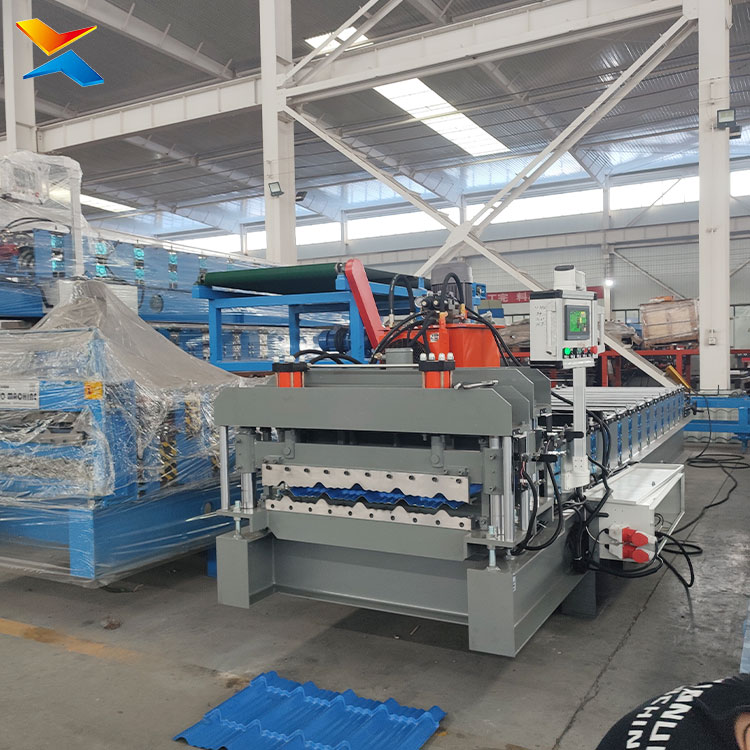
Metal tile roof roll forming machine — the step tile roll former for villa roofs, built by the manufacturer and supplied factory direct to the Middle East. The machine forms flat coated steel coil into a metal roof tile panel: a panel carrying the arc of a curved tile, divided along its length into tile-like segments by a pitch-stamping device. It is the machine that gives a metal roof the appearance of a laid tile roof while keeping the properties of formed steel.
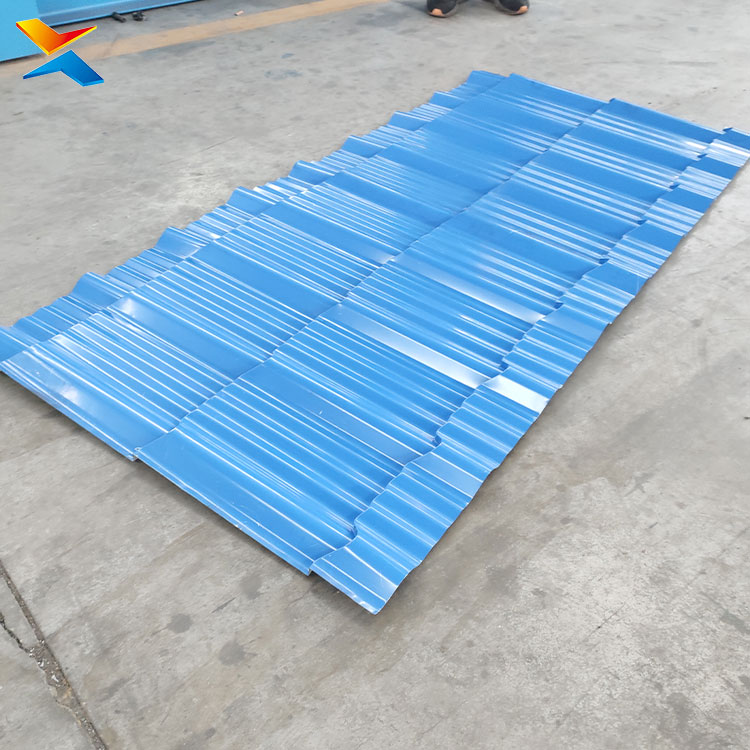
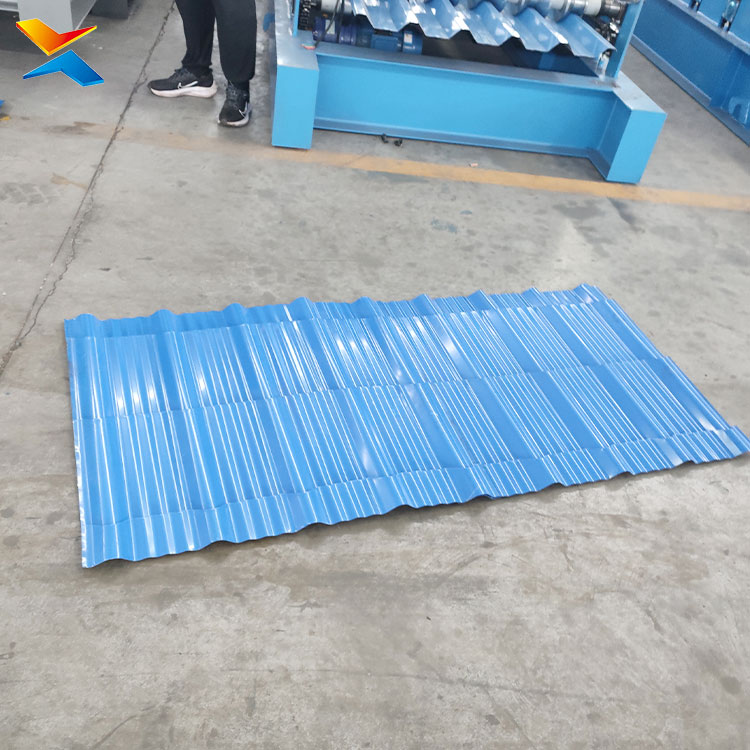
The panel leaves the machine as a finished roof tile profile, complete with the arc, the tile divisions and the interlocking edges, cut to the length the roof requires. It is then lifted onto the roof and fixed, in the same way as any other profiled metal roof sheet.
What “step tile” means, and why the name matters.
In metal roofing, the words used for a tile-imitating panel — step tile, glazed tile, imitation tile, tile profile, Roman tile — describe a panel whose surface is divided into tile-like courses rather than left as a plain continuous curve. The division is produced by an additional unit on the machine, usually described as the pitch-stamping device or pitch-forming device, which presses a division across the panel at each tile pitch as the panel passes. The result is that each arc reads as a separate tile.
This is what separates the two machines that are otherwise built from the same principle. A machine that only forms arcs produces a continuous wave: even, smooth, with no divisions. A machine with the pitch device produces the same arc with tile courses divided across it. The second is the step tile machine, and the difference between the two is a forming unit and its control — not a different machine concept.
The distinction is worth stating plainly because it decides what the machine can be used for. A plain arc panel reads as a modern profiled roof sheet and belongs on industrial buildings, warehouses and agricultural sheds. A step tile panel reads as a tiled roof and belongs on buildings where the roof is part of the appearance: villas, hospitality buildings, entrance structures, pavilions, and the architecture the region builds for its compounds and resorts.
The division is architectural, not structural.
It is worth being clear about what the pitch-stamping device does and does not do, because the assumption that a “step” must make a panel stronger is a common and expensive misunderstanding.
The panel’s strength comes from the arc formed into the steel and from the material itself. The arc is what gives a curved profile its stiffness: forming the steel into a curve means the material must be straightened again before it can deflect, and that is where a formed roof panel’s load capacity comes from. The pitch divisions are pressed into the arc as a surface feature. They alter the appearance of the panel; they are not a substitute for the arc, and a shallower arc is not made equivalent to a deeper one by adding divisions to it.
This matters at the point of purchase because the two things pull in different directions. What gives the roof its appearance is the tile division. What gives the roof its performance is the arc depth and the material. A buyer who specifies the appearance and does not consider the arc depth can end up with a roof that looks right and performs below the project’s requirement — and the reverse is equally possible.
What the machine produces, and what it does not.
The machine produces a formed metal tile panel from coated steel coil. Its output is the panel.
It is not a machine for fired clay or ceramic tile. Clay tiles are shaped and then fired in a kiln, and no roll former can produce them. It is not a machine for cast concrete tile. And it is not, by itself, a machine that produces a panel with a natural stone or ceramic granule surface: where a project requires a granule-coated tile appearance, the roll former produces the formed base panel and the granule surface is applied by a separate coating process, so the finish the project requires has to be stated at the outset and confirmed against what the machine produces.
The machine also does not install the roof. It forms the panel; the roof is built by the roofing contractor, on a roof structure designed for it, with the fixing and flashing details the project’s engineer specifies.
A villa roof asks different things of the machine than an industrial roof.
This is the part of the subject that the villa application turns on, and it is not a matter of size alone.
The roof area is small and cut up. A villa roof is not one long plane. It is a set of small planes meeting at ridges, hips and valleys, interrupted by dormers, chimneys, vents and changes of level, and closed at the eaves and verges. A villa roof therefore consumes panels in short lengths and produces a high proportion of offcuts. What the machine has to do well is not run fast; it is to produce a panel of a width and a pitch that covers each small plane properly and terminates cleanly at its edges, and to allow the profile to be changed or the length to be reset without a long interruption, because a villa project changes profile and length far more often per unit of roof area than an industrial contract does.
The roof is seen from close and from the street. On an industrial building, the roof is judged from a distance and mostly from the ground. On a villa, the roof is the building’s public face: it is seen from the garden, from the drive, from the neighbouring plot, and from directly below at the eaves and porches. Tile-pattern alignment is therefore visible in a way it is not on an industrial roof, and a misaligned course cannot be dismissed as a detail nobody will notice.
Pitch precision is a visible quantity. The divisions across the panel are set by how accurately the machine positions each stamping. If the positioning varies from division to division, the tile courses vary in spacing along the panel, and the variation accumulates over the length of the roof plane. On a villa roof this is visible as an irregular tile pattern, most obviously where panels meet and where a panel terminates against a ridge or a verge. This is why a machine whose pitch positioning is positively controlled is the appropriate choice for villa work, and why a machine whose positioning depends on a mechanical release is the appropriate choice only where the panel’s appearance is not the point. The difference in the finished roof is not a matter of degree but of whether the tile pattern is regular at all.
The arc must suit the building’s style, not only its span. A villa roof’s arc depth is chosen for how the roof reads — a fine, densely divided, delicate tile surface for a restrained building, a bolder arc with wider and deeper tile divisions for a building whose architecture is more emphatic. Both are produced on the same principle; what changes is the forming tooling and the pitch.
Coverage and edge termination — how a plane is covered.
Because a villa roof is a set of small planes, how a panel covers a plane and how it ends at the plane’s edges is worked out profile by profile, and the profile’s peak count and its edge arrangement are what settle it.
A panel’s effective width is what remains for covering the roof after the overlapping edges are accounted for. The number of tile divisions across that width, and the pitch they are set at, decide the size of the tile the roof reads as. The two are linked: for a given effective width, more divisions means a finer and denser tile pattern and fewer divisions means a broader, bolder one.
At the panel edges, the profile either ends in a full tile division or in a partial one. Where a profile is designed so that its edge carries a partial division, two panels laid side by side complete that division between them, and the joint does not read as an interruption in the tile pattern. This is a deliberate design feature of some villa profiles, because on a small roof plane every joint is close to the eye, and a joint that falls mid-tile reads as a fault. Where a project’s covering is worked out from the plane width, this is one of the first things to establish: whether the profile’s edge completes correctly when panels are joined, and whether the plane width divides into whole panels or leaves a cut panel at one side.
A villa roof almost always leaves one cut panel per plane. The machine cuts to length, so the cut is made as part of producing the panel; what the cut panel looks like at its cut edge, and how that edge is closed and fixed, is part of the roof’s design and not something the machine decides.
The profiles this machine is made in.
The profiles fall into recognisable families, and the family names describe the roof’s appearance rather than a rank of quality.
Fine pitch, delicate divisions. Closely spaced divisions and a relatively shallow arc, reading as a fine, refined tile surface. Used where the roof is meant to look restrained and detailed: high-end residential and hospitality buildings, and wall cladding as well as roofing.
Medium pitch, the mainstream. The middle of the range, dividing the panel into a small number of tile divisions per panel with an arc deep enough to read as tile from the ground. This is the family most villa projects are built on, because it balances appearance against the amount of material the roof consumes.
Deep pitch, bold divisions. Wider divisions and a deeper arc, so each tile reads as a large, strongly modelled tile and the roof has marked relief. Suited to buildings whose architecture is emphatic.
Bamboo-joint profile. The most strongly modelled of the family: the deepest arc combined with the widest division, so the panel reads in pronounced segments. Used where a traditional and richly modelled roof is wanted — gardens, temples and heritage-style buildings.
Asymmetric arc profile. An arc whose two sides are not mirror images, one side steeper than the other, which gives the panel a stronger three-dimensional reading than a symmetrical arc of the same depth. Used on high-end commercial and residential projects where the roof is a deliberate architectural statement.
Profiles with additional stiffening ribs. Where a profile carries extra ribs pressed into the flatter areas of the panel in addition to the arc and the tile divisions, the panel is stiffer across its width. Where a villa roof has to span between supports with less support than usual, or where the panel will be walked on in service, this is worth knowing about at the profile selection stage.
Two-width and multi-material versions. Some machines in this family are built to produce two panel widths from the same machine by changing part of the tooling, for projects whose buildings differ in width. Some are built to run both coated steel and resin tile material, the tooling being changed between them, which suits a project or a workshop working in both materials.
Machine construction — the main assemblies.
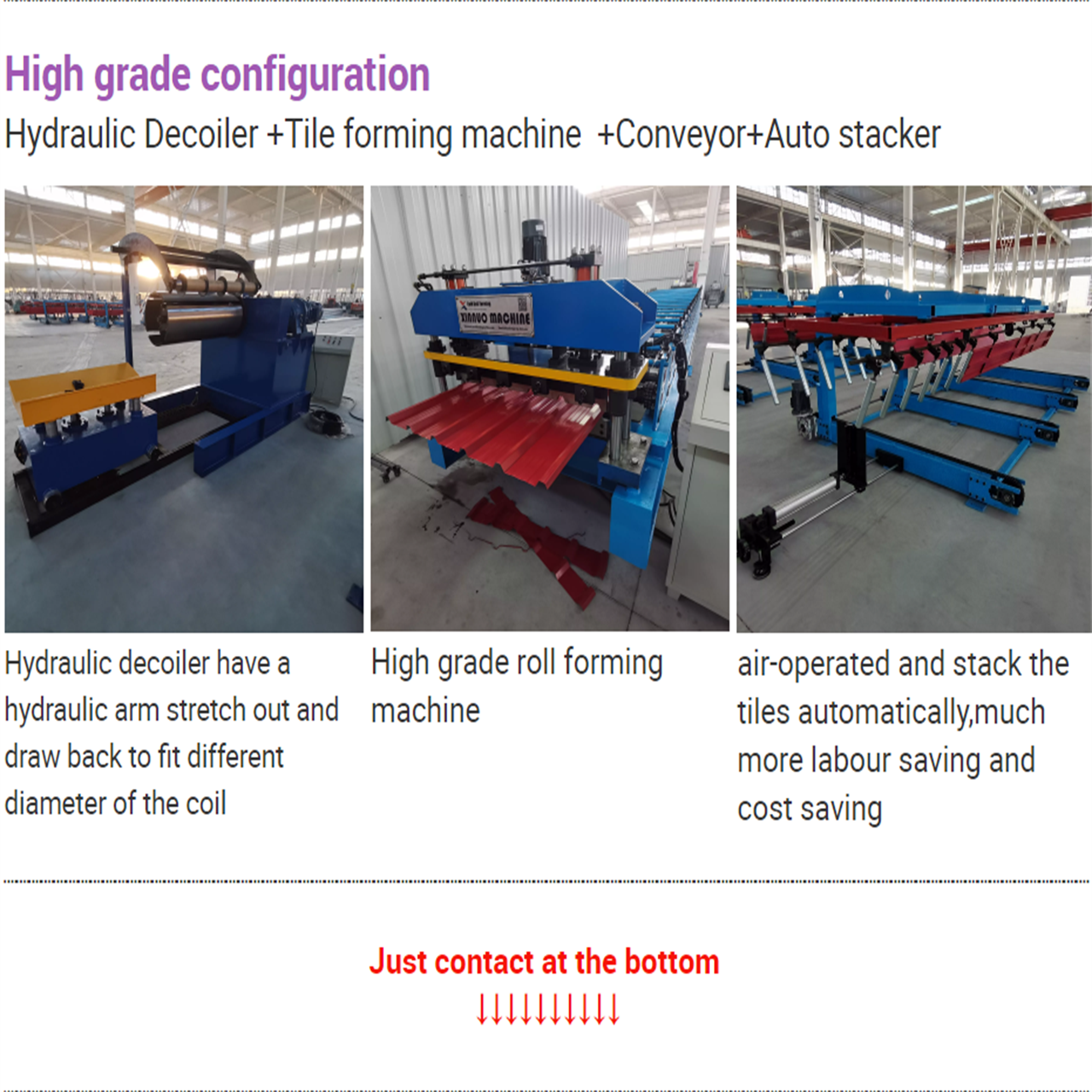
The frame. A heavy fabricated steel structure on which the roll stands and the pitch device are mounted, machined so that the stands sit in line and the shaft centres hold their positions. The frame is the machine’s accuracy: if the stands are not aligned and held, no amount of care in the tooling will produce a panel whose arc is consistent along its length.
The roll stands and shafts. The stands carry the forming rolls. The shafts are carried in bearings at both ends and are hardened and ground so that the rolls turn true. The spacing of the stands and the support given to the shafts decide how the panel is formed and how tightly its dimensions are held. A curved tile profile is a demanding shape to form — the panel is being drawn into an arc across its full width at every stand — so the working load on the shafts is significant in a way it is not on a shallow fluted profile.
The forming rollers. The rolls carry the profile. They are machined in matched pairs and hardened, and their sequence forms the flat strip stage by stage: first breaking the strip into the arc, then deepening and refining it, then setting the edges, and finally the tile divisions. The number of forming stages and the arrangement of the rolls are what determine whether the finished panel’s arc is smooth, whether the surface is marked, and whether the panel’s width holds at the tolerance the covering requires.
The pitch-stamping device. The unit that presses the tile division across the panel at each pitch. It is the assembly that makes this a step tile machine rather than an arc machine, and it is the assembly that has to be positioned and driven accurately and to repeat that accuracy over long runs. Its tooling is made for the pitch and the panel width of the profile being produced, and a change of profile or of tile pitch means a change of this tooling as well as of the forming rolls.
The drive. The machine is driven either by a standard gearbox and chain transmission or by a servo motor driving through a bevel gear arrangement. Both drive the forming stands; the difference is in how precisely the strip’s advance is controlled, and therefore in how accurately the pitch device is positioned at each division. A servo drive with a bevel gear transmission also runs more quietly than a chain transmission and holds its setting better over time, and the bevel gear arrangement does not stretch or wear in the way a chain does.
The cutting arrangement. The finished panel is cut to the length the roof requires. The machine cuts the panel as part of producing it, so a villa project’s mix of short lengths is produced directly rather than cut down afterwards, which is what keeps the offcut waste of a cut-up roof within reason. The cut is made after forming, and the machine’s control is set so that a panel is cut at a chosen length and — where the profile allows it — at a chosen point in the tile pattern, so that the panel’s end falls where the roof’s termination wants it.
The control arrangement. The control sets the panel length, the number of divisions to be formed, the run rate, and the coordination between the forming stands, the pitch device and the cutting arrangement. It is also where a villa-scale workshop’s most frequent operations live: setting a new panel length, and setting up for a different profile or pitch. A control arrangement that makes these quick and repeatable is worth more in villa work, where they happen often, than a higher forming speed.
The hydraulic arrangement. Where the machine uses hydraulic functions, a power unit supplies them with standard-specification components, and the arrangement is built so that the components can be sourced and serviced where the machine is working.
Materials.
The machine forms coated steel coil — steel with a metallic and a paint coating system applied to it, which is what gives a metal tile roof its surface and its colour, and the coating, not the forming, is what protects the panel in service. The coil is formed into the profile and the coating is expected to survive the forming: a coating that cracks or flakes at the arcs and divisions leaves bare steel at precisely the places a roof weathers first. This is a material-selection question as much as a machine question, and it is one to settle with the coil supplier as well as with the machine builder.
Coil thickness is a range, and the appropriate part of that range depends on the arc depth of the profile: a panel being drawn into a deep arc is worked harder during forming than one being drawn into a shallow arc, and the thickness that forms cleanly at one arc depth is not automatically the thickness that forms cleanly at another. The thickness and the profile therefore have to be considered together rather than selected separately.
Where resin tile material is to be produced as well, the machine is built for both, with the tooling changed between them, and the two materials are stated at the outset so that the machine is made for both rather than adapted afterwards.
Configurations.
Forming and pitch stamping in one machine. The standard arrangement: the arc is formed and the tile division pressed in the same pass, the panel emerging with both, and cut to length at the end.
Standard drive or servo drive. A standard gearbox and chain transmission, or a servo motor through a bevel gear arrangement. The second is chosen where the regularity of the tile pattern matters, which on a villa roof it usually does.
Tooling for one profile, or for a change of profile. Machines are built for a specific profile, and where a workshop intends to produce more than one panel — a ridge-cap profile, a verge and eave trim profile, or a second tile profile — the tooling set is planned for that from the beginning, because the machine’s stands and the pitch device are set up around the profiles it is intended to produce.
One panel width or two. Where the machine is built for two widths, part of the tooling is changed between them, so a project whose buildings differ in width can be covered from one machine.
Coated steel only, or coated steel and resin tile. Where the machine is built for both materials, the tooling is changed between them.
With a matching accessory set. Roofing in a villa shape needs the components that close it — ridge and hip caps, verge trims, eave and valley sections — and these are formed on the same principle, as separate profiles. They are best considered together with the main profile at the outset, because a ridge cap must be formed to the panel it caps rather than selected from a list, and a cap that does not seat on the profile leaves a roof that looks right and leaks.
Product features and advantages.
Built as a tile-producing machine, with the pitch device as a working unit. The pitch-stamping device is not an attachment; it is a forming unit designed into the machine, positioned and driven as part of the machine’s forming sequence.
Designed around the visible regularity of the tile pattern. The accuracy with which the machine positions each tile division is treated as a central specification rather than as a detail, because on a villa roof the tile pattern is looked at directly.
Positively controlled pitch positioning. Where the drive is servo with bevel gear transmission, the strip advance is controlled rather than released, so the tile divisions hold their spacing along the panel and between successive panels.
Quieter and more stable transmission on the servo arrangement. The bevel gear transmission runs more quietly than a chain and holds its setting without the stretch and wear a chain develops.
Forming tooling made for the arc being produced. The roll sequence is planned for the arc depth and the panel width of the profile, so a deep arc is formed with the number of stages and the support it needs rather than being drawn into shape in too few passes.
Forming tooling made for the tile pitch. The pitch device’s tooling is made for the profile’s pitch, so the divisions are pressed to the pitch the profile is designed around rather than approximated.
Cutting to length within the production run. Panels are produced to the lengths a cut-up villa roof actually needs, so the waste of a roof with many short planes is kept within reason instead of being created by cutting long panels down on site.
Profiles for the appearance the building wants. Fine, medium and deep pitch, bamboo-joint, asymmetric arc, and profiles with additional stiffening ribs, so the roof’s reading can be chosen rather than accepted.
Two-width and two-material versions available. To suit projects whose buildings differ in width, or workshops working in both coated steel and resin tile.
Heavy frame and adequately supported shafts. To hold the stands in line and carry the working load of drawing a full-width panel into an arc.
Built for the destination electrical supply. Machines are configured for the voltage, frequency and phase of the installation site.
Factory direct. The machine is built by the manufacturer and supplied direct, so the profile, the pitch, the panel width and the drive arrangement are settled with the people who build the machine rather than selected from a fixed list, and the machine is made around the project’s roof rather than the roof being fitted to the machine.
Where the panel is used on a villa and its surroundings.
The step tile panel is used wherever the roof is part of how the building reads. In the region it is found on the main roof slopes of villas, on the roofs of entrance porches and canopies, on tower and feature elements, on gate and guard structures, on pavilions and garden buildings, on poolside and majlis structures, and on hospitality and resort buildings where a pitched tiled roof is part of the design.
On most of these, the roof is a small part of the building’s cost and a large part of its appearance, which is the reason a pitched tiled roof is specified at all. That is the sense in which the machine’s accuracy is worth more here than its speed.
The machine in Middle East conditions.
Strong sun and high ultraviolet exposure. The panel’s coating carries the weather in this market, and the villa roof is the building’s public face. Colour stability, gloss retention and resistance to chalking are properties of the coil’s coating system rather than of the machine, and they are worth specifying with the same care as the arc and the tile pitch, because a roof whose colour has moved is a visible change on a building whose roof is looked at.
High ambient temperature and thermal movement. The region runs at high temperatures for long periods, and a metal roof panel expands and contracts with the temperature in the course of a day. In a villa shape the roof planes are short, which keeps the movement within each plane small, but the movement still has to be provided for at the fixings and at the terminations, in the way the project’s roof details provide for it.
Wind-blown dust and sand. Dust and sand are carried onto the roof constantly, and a step tile profile holds them: the divisions and the arcs give the dust a place to settle in a way a smooth roof does not. Over time this changes the roof’s appearance and holds material on the surface, and it is a reason the roof is cleaned rather than left. Sharp material carried by strong wind also abrades coatings, at the exposed arcs and at the panel edges in particular.
Salt air at coastal villas. A large part of the region’s villa building is within reach of the coast, and the roofs that suffer first are the ones with bare metal at a cut edge, a fixing point or a damaged coating. The panel field is protected by its coating; the details are where corrosion begins, which is why the coating integrity at cut edges and the choice of fixings are part of the roof design rather than afterthoughts.
Intense rain in a short season. The region’s rainfall is concentrated, and when it comes it comes hard. The roof has to pass an intense event quickly, and on a step tile roof the water’s route off the plane follows the arcs and the divisions, with the overlapping edges doing the sealing. The laps and the pitch relationship between them are therefore part of the roof’s watertightness, and they are set by the profile rather than by the installation.
The flat-roof context. Much of the region’s villa building is on flat roofs, and that is worth stating plainly: this machine makes panels for a roof that is designed as a pitched, tiled roof. It does not convert a flat roof into a pitched one, and a project whose building is designed with a flat roof is not one where this machine has a role. The villa projects this machine serves are the ones whose design already calls for a pitched tiled roof — which, in the region, they are on villa compounds, hospitality and resort buildings, and the heritage and new-classical work where the roof is the point.
Machine build quality.
The machine is built as a heavy fabricated machine rather than assembled from light components. The frame is welded from steel plate and sections, stress-relieved and machined so that the roll stands sit in line and hold the shaft centres the profile needs. The shafts are hardened and ground, carried in bearings at both ends. The forming rollers are machined in matched pairs and hardened, and the roll sequence is planned for the profile rather than adapted from another. The pitch-stamping device is made as a unit of the machine, with its tooling made for the profile’s pitch. Where the drive is servo with bevel gears, the gear arrangement is machined and set so that the transmission holds its accuracy. The electrical arrangement is wired and tested as a complete unit, and the machine is run before shipment so that the forming sequence, the pitch device’s positioning and repeatability, the cut length and the control settings are verified as a complete machine.
Service and support.
Machines are supplied with documentation covering the machine, including the operating manual, the electrical drawings and the arrangement of the forming sequence. Installation and commissioning are carried out with technicians attending site, and operator training is provided so that the profile is set up correctly, the pitch device is set and checked, the panel lengths a project needs are set in the control, and the panels are produced and inspected as the roof’s requirement demands. Illustrated manuals and video guidance cover the settings used most often, including changing a profile and checking the regularity of the tile divisions, and the routine attention the machine needs where dust and heat are constant. Engineering support is available for technical questions through the working life of the machine, and spare parts are supplied, with the pitch device’s tooling, the forming rollers and the transmission components given particular attention.
Supplying the Middle East.
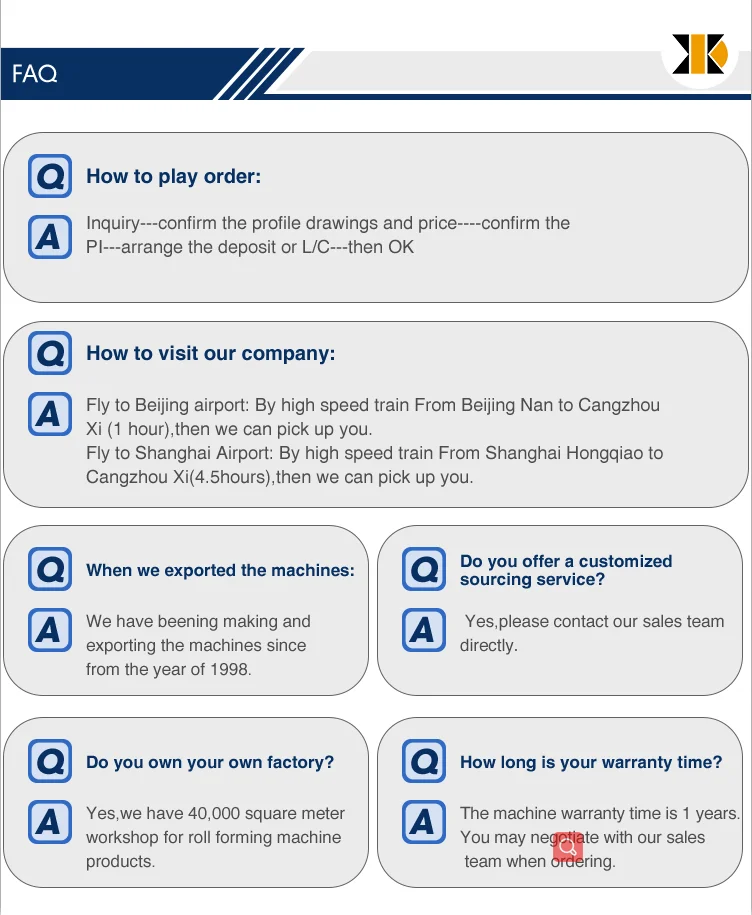
The manufacturer’s archive of arc and glazed tile machine drawings and customer records includes customers in the Middle East — Dubai, Saudi Arabia, the United Arab Emirates and Turkey among them — recorded across the arc and glazed tile families, including a machine of the asymmetric arc version supplied to Dubai. Records covering the specific models and projects involved are available on request. A project’s roof profile, pitch, panel width, lengths and material are the right starting point for a quotation, and can be worked through against the profile the building’s design calls for.
♦ COMPANY PROFILE:
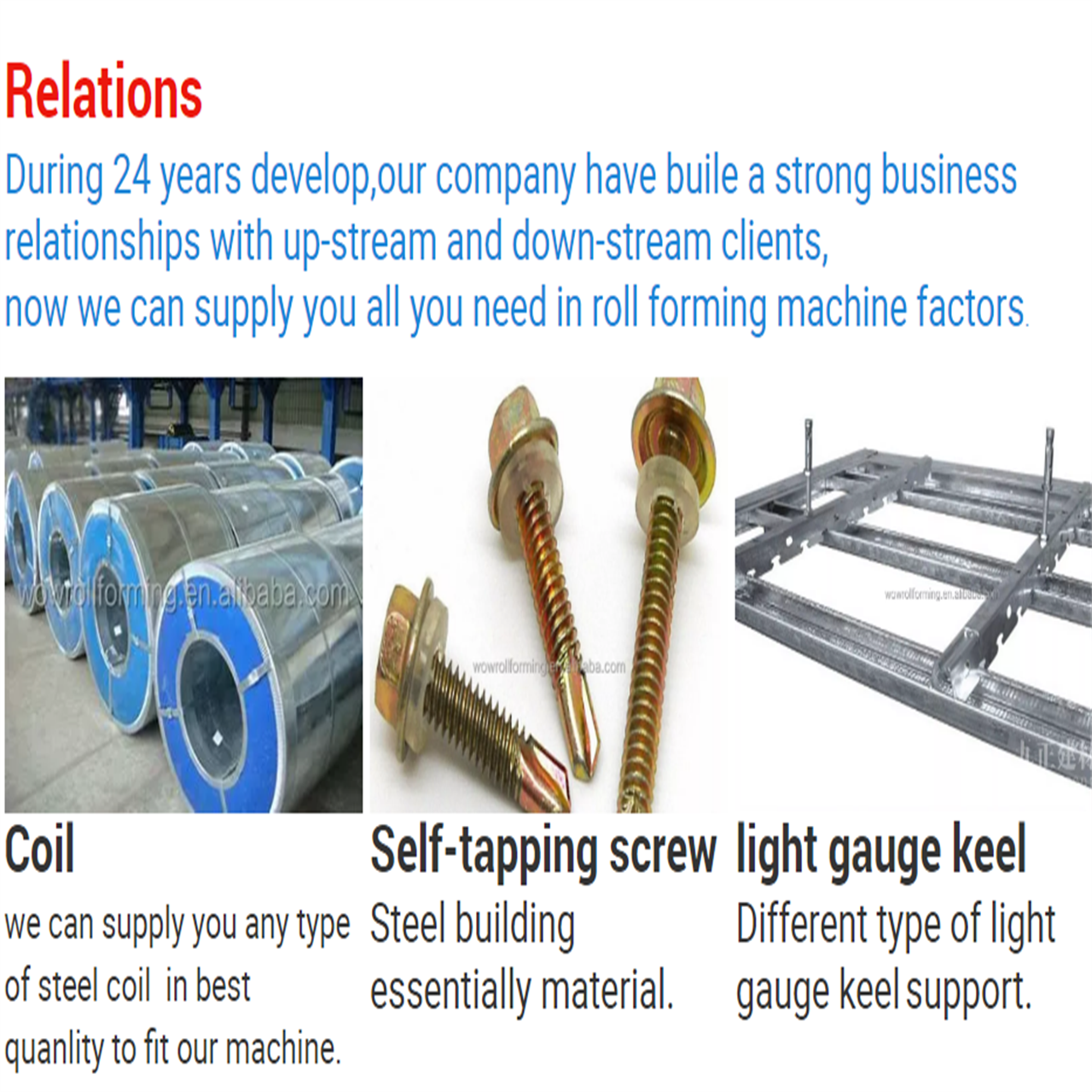
Hebei Xinnuo Roll Forming Machine Co., Ltd., not only produce different types of professional roll forming machines, but also develop intelligent automatic roll forming production lines, C&Z shape purline machines, highway guardrail roll forming machine lines, sandwich panel production lines, decking forming machines, light keel machines, shutter slat door forming machines, downpipe machines, gutter machines, etc.
Advantages of Roll Forming A Metal Part
There are several advantages of using roll forming for your projects:
- The roll forming process allows operations such as punching, notching, and welding to be performed in-line. Labor cost and time for secondary operations are reduced or eliminated, reducing part costs.
- Roll form tooling allows for a high degree of flexibility. A single set of roll form tools will make almost any length of the same cross-section. Multiple sets of tools for varying length parts are not required.
- It can provide better dimensional control than other competing metal forming processes.
- Repeatability is inherent in the process, allowing easier assembly of roll formed parts into your finished product, and minimizing problems due to “standard” tolerance build up.
- Roll forming is typically a higher speed process.
- Roll forming offers customers a superior surface finish. This makes roll forming an excellent option for decorative stainless steel parts or for parts requiring a finish such as anodizing or powder coating. Also, texture or pattern can be rolled into the surface during forming.
- Roll forming utilizes material more efficiently than other competing processes.
- Roll formed shapes can be developed with thinner walls than competing processes
Roll forming is a continuous process which converts sheet metal into an engineered shape using consecutive sets of mated rolls, each of which makes only incremental changes in the form. The sum of these small changes in form is a complex profile.


