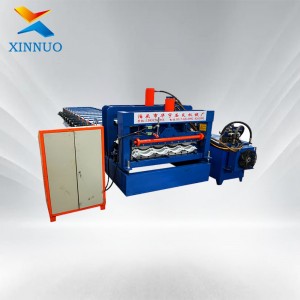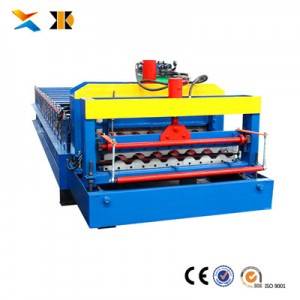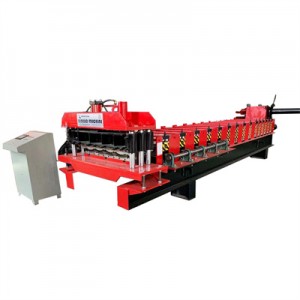

Glazed roof tile making machine for sale, factory-direct from the manufacturer, supplied to steel building projects in the UAE and Saudi Arabia.
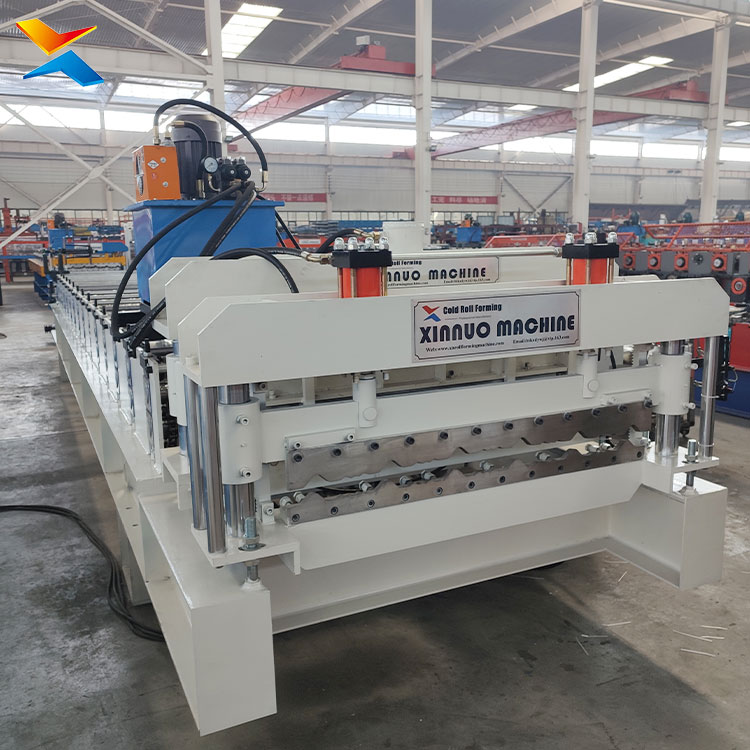
This glazed tile roll forming machine forms coated steel coil into roof and façade panels that carry the look of traditional glazed roof tile. It works in two rhythms: continuous rolling forms the curve, and a pitch-stamping device presses a segment line into every peak, so each panel reads as a row of individual antique tiles rather than a plain continuous wave.
The panel it produces is metal. It is lightweight colour-coated steel coil — not fired clay, not ceramic, and not PVC or resin. That is the reason a Gulf steel building uses it at all: the appearance of traditional roof tile without the weight and fixing penalty of real tile, so a villa roof, a mosque roof, a hotel elevation or a whole façade can carry a traditional idiom on a light steel structure.
What the glazed tile layer adds over an arc machine.
The family of curved forming machines contains two distinct products, and the pitch-stamping device is the whole of the difference.
An arc roll forming machine produces a continuous curved wave with no tile pattern. A glazed tile machine produces the same class of curve with the segment lines pressed across every peak, which is what makes the finished panel read as laid tile. The device is what makes this machine a glazed tile machine, and it is also what places it above a comparable arc machine in price.
The naming convention makes the distinction readable at a glance in a machine name or a quotation. If the name contains the character for peak, it is a glazed tile machine. If it contains only the character for wave, it is an arc machine. A glazed tile machine sits above a comparable arc machine in price, and a servo-driven version sits above the standard version.
Two further products in the same curved family also carry the tile reading. An asymmetric arc, in which one flank of each tile is steeper than the other, gives a stronger sense of relief. A bamboo-joint profile carries the deepest relief in the range on a wide pitch. Both belong to the glazed tile family rather than to the plain arc family.
Peak height decides how the machine is built.
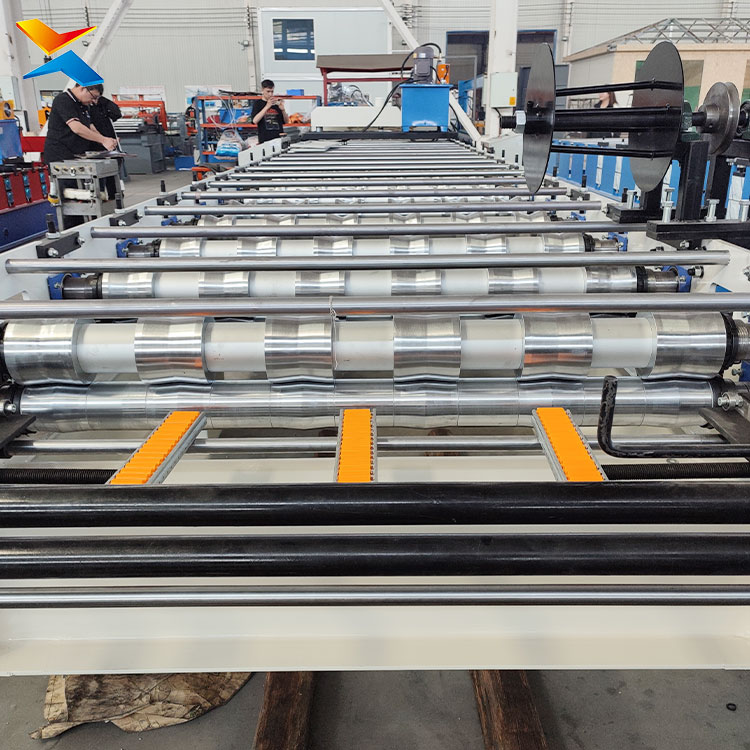
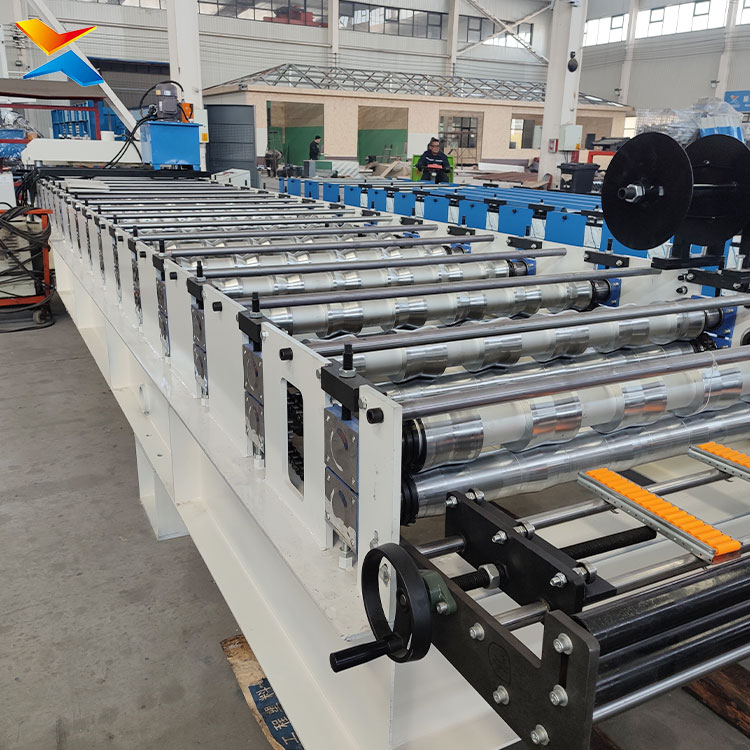
The deeper the peak, the more forming rows the machine needs in order to produce a flat, consistent panel without marking or distortion. The row count in turn drives the frame class, the shaft diameter and the motor power, so those four items belong to one another as a set rather than as four separate figures.
The frame classes follow the work. Economy builds run on channel-steel or light frame sections. Standard builds step up to heavier frames. Medium-heavy and deep-arc work moves to heavy frames. The heaviest builds in the range use a portal-style heavy frame, which the factory’s records describe as an industry-heavy specification rather than a common one.
Mass belongs to the same argument on deep-arc work. These machines are built heavy, and that mass is what keeps the forming stations from deflecting under a deep peak — which is why a light row count offered against a deep peak describes a different class of machine, whatever the headline figure suggests.
Pitch is a designed mould, not a variable that can be named freely.
Pitch decides how the finished tile looks. Small pitches give a fine, dense antique appearance suited to high-end façades and roofs in a Tang or Song idiom. Medium pitches are the mainstream specification — the volume specification of the range and the balance most projects use. Large pitches give broad, high-relief peaks in a Qing-style idiom for temples, villas and garden buildings.
Each pitch corresponds to a designed stamping mould, and the factory’s records cover long-standing pitch design experience across a wide span of values. A pitch that is not already in the archive means new tooling, which is a separate engineering step rather than an adjustment to an existing machine.
The drive decides how regular the pattern is.
Because the pattern is what a building’s users see, the drive decides the result on a large roof or a long elevation. A servo motor with bevel-gear drive positions the pitch considerably more precisely than a clutch-and-brake arrangement, and the difference becomes visible across the many repetitions a single elevation requires. The bevel gear train is also documented as quieter and smoother in service than chain drive.
Where throughput matters more than maximum pattern precision, the newer higher-power builds in the range run faster and handle slightly thicker material. The most recent builds in the family use a helical gear reducer, which gives better efficiency and a quieter, longer-lived drive.
The curved variants in the range.
The range holds several curved variants that answer specific briefs, and they are tooling variants of the same machine rather than different machines.
Asymmetric arc. One flank of each tile steeper than the other, giving a stronger sense of depth. Recorded for high-end commercial and residential work.
Bamboo joint. The deepest relief in the range on a wide pitch, for gardens, temples and boutique hospitality.
With A. An A-shaped reinforcing rib pressed across the flat between peaks, raising panel stiffness without increasing peak height.
Half peak. A partial peak at each edge, so adjoining panels join into complete peaks and coverage improves across a roof plane.
Dual width. Two panel widths from one machine by changing part of the tooling, avoiding a second machine where a project specifies more than one width.
Resin and glazed dual purpose. A build recorded as switchable between colour-coated steel glazed tile and resin tile by changing the tooling, for a workshop supplying both material markets.
Materials.
The family forms thin-gauge colour-coated steel coil. A deep peak deforms the material heavily and is not suited to thick plate, while the heaviest builds extend to a somewhat thicker gauge because their frames and drives are built to move that material. The working gauge is confirmed against the specific model, because the gauge a machine forms cleanly follows from its row count and frame class rather than from a general figure.
The coating is asked to survive the forming as well as the weather. A coating that cracks at the arcs and segment lines exposes bare steel exactly where a roof weathers first.
Where the panel is used.
The mainstream use is the project that specifies a traditional idiom: villa roofs and elevations, mosques and religious buildings, tourist and heritage developments, boutique hospitality, and new-style façades in which the tile reading is an architectural intention rather than a covering. In these projects the panel is formed to the building’s own lengths, closes the roof or the elevation quickly, and takes its colour from the coil coating system rather than from tiles laid piece by piece.
There is a second use that matters in this region. A small arc with a dense wave suits integrated housing and light-steel roofs, where this family competes directly with single-layer trapezoidal panels — the advantage being the more attractive arc at a comparable weight. The factory’s records note this dense-wave work as common in the Middle East market, which is why the range includes it as a standard offering for Gulf customers rather than as an exotic option.
UAE and Saudi Arabia are two different service conditions.
The same machine serves both markets, and both markets ask for the tile panel for the same kind of building. What differs between them is the exposure the finished roof lives under, and the two exposures put their emphasis on different parts of the specification.
On UAE projects, the dominant exposure is maritime. Much of the country’s building stands close to the coast, and the air carries salt. That exposure concentrates on the details of a roof rather than on its field: every cut edge, every fixing, every drilled hole and every lap is a place where corrosion begins, and the panel field between them is protected by its coating. It follows that on a near-coast project the coil and its coating system carry more of the outcome than the machine does — the machine forms the geometry, and the coating decides how long the appearance survives. A durability question answered with a machine figure is an answer to a different question.
On Saudi Arabian projects, the dominant exposure is inland. Extreme solar loading, high ambient temperature for long periods, and a wide swing between day and night temperatures. Thermal movement is therefore part of the roof’s design rather than a footnote: a formed panel in strong sun expands and contracts, and the fixings and the laps have to allow for that movement rather than fighting it. Wind-blown dust and sand are constant, and they settle into the tile segment lines and the arc troughs — which matters on a tile profile because the relief that gives the tile its look is also what holds the dust.
Both markets share the consequence. The machine forms the geometry and the coating carries the appearance, so the specification conversation that decides a project’s outcome is the one about the coil, and it happens before the machine is ordered rather than after the roof is up.
Records for the region.
Machines from this family have been supplied to Dubai and to the wider region, alongside other export markets with traditional-architecture demand. Those are archive records of what was built and for which market, rather than a claim about installed base or market share.
How the machine is configured for a market.
The machine is configured for the project and the site rather than sold from a fixed catalogue. The panel is formed to the lengths the building needs. The section is matched against an existing production-proven blueprint where possible, and where it is not, the gap between the buyer’s section and the archive is identified before tooling is committed. The electrical configuration is set to the workshop supply of the destination. Documentation, and reference material for the market, are provided with the order.
The process behind the profile.
The manufacturing standard is the same one used for the factory’s single-layer panel machines.
Forming dies are forged from carbon steel and carried through a multi-step process of rough turning, hardening, finish turning, keyway cutting, polishing and electroplating, so that the working surface is hard, accurate and finished rather than merely shaped. Dies are made in matched pairs, because a profile is formed between two rolls.
Shafts are alloy steel, finish turned and externally ground for roundness and straightness under load.
Frames are machined on CNC gantry mills so that every forming station measures from one flat reference — which is what allows a long machine with many forming rows to hold a consistent section along the whole length of a panel.
Welding is shielded and slag-free, and surfaces are shot blasted and then electrostatically sprayed and baked for protection.
Product features and advantages.
A pitch-stamping device on the forming line. The arc is formed and the tile segment line pressed in the same pass, so the panel leaves the machine reading as laid tile rather than as a plain wave — the feature that separates this machine from an arc roll former.
Forming and cutting in one operation. Panels are cut to the building’s own lengths within the production run, so a roof or an elevation is closed with panels made to the sizes it needs.
Peak height, row count, frame class, shaft and motor sized as one set. So that a deep peak is carried by the machine class that can hold it rather than by a light machine with a deep tool.
A heavy frame on deep-arc work. Including a portal-style heavy frame on the heaviest builds, with the mass that keeps the forming stations from deflecting under a deep peak.
Pitch designed as a mould. Each pitch is a designed stamping mould rather than an adjustment, and the factory’s archive covers a wide span of pitch values, so an established pitch is built on proven tooling.
Servo pitch positioning with a bevel gear train. For a more regular tile line across a long roof or elevation, and a drive documented as quieter and smoother in service than chain drive.
Higher-power builds for throughput. Faster running and slightly thicker material for work where output matters more than maximum pattern precision.
A helical gear reducer on the newest builds. For better efficiency and a quieter, longer-lived drive.
Tooling variants within one machine. Asymmetric arc, bamboo joint, a pressed A rib, a half-peak edge, dual width, and a resin-switchable build, so a specific brief is met by the appropriate tooling rather than by a different machine.
A profile formed on thin-gauge coated steel. Light enough for a light steel structure, in the appearance of traditional roof tile.
Coil width matched to a strip the market can supply. Because a machine whose feed width corresponds to no strip available locally is a machine that will stand idle.
Build quality. Forged, hardened, finish turned, polished and electroplated dies in matched pairs; alloy steel shafts ground for roundness and straightness under load; CNC gantry machined frames giving every station one flat reference; shielded welding with shot blasting and an electrostatically sprayed, baked finish.
Configured for the destination supply. Voltage, frequency and phase of the installation site.
Factory direct. Built and supplied by the manufacturer rather than resold, and built from a tooling archive rather than designed from scratch for each order.
Service and support.
Machines are supplied with documentation covering the machine, including the operating manual, the electrical drawings and the arrangement of the forming sequence, together with the profile, pitch, peak height and panel width the tooling was made for. Installation and commissioning are carried out with technicians attending site, and operator training covers the settings adjusted most often, the cutting arrangement, and the inspection of panels against the standard the product requires. Illustrated manuals and video guidance cover the recurring settings and the routine attention the machine needs where heat and dust are constant. Engineering support is available for technical questions through the working life of the machine, and spare parts are supplied, with the pitch-stamping tooling, the forming dies and the transmission components given particular attention.
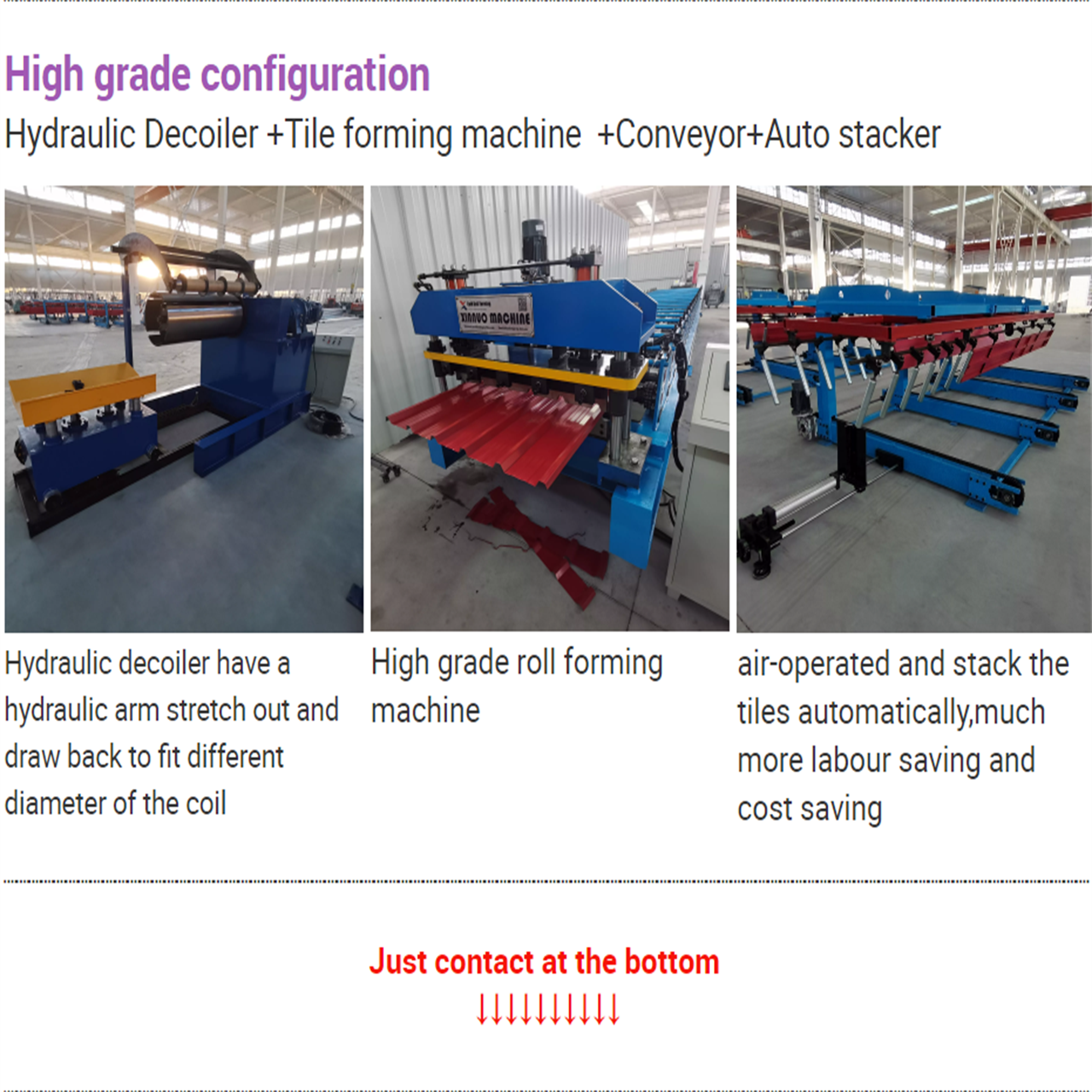
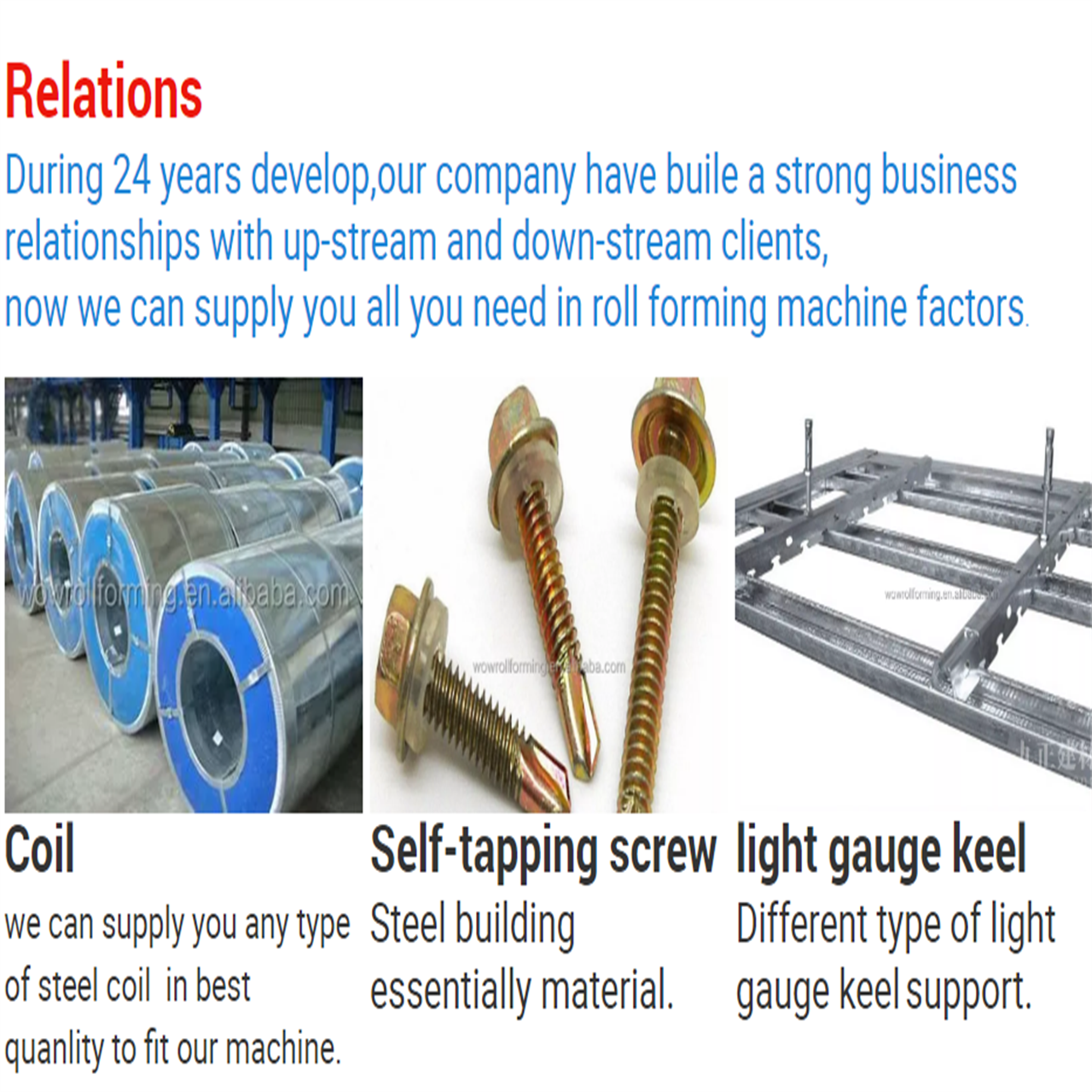

♦ COMPANY PROFILE:
Hebei Xinnuo Roll Forming Machine Co., Ltd., not only produce different types of professional roll forming machines, but also develop intelligent automatic roll forming production lines, C&Z shape purline machines, highway guardrail roll forming machine lines, sandwich panel production lines, decking forming machines, light keel machines, shutter slat door forming machines, downpipe machines, gutter machines, etc.
There are several advantages of using roll forming for your projects:
- The roll forming process allows operations such as punching, notching, and welding to be performed in-line. Labor cost and time for secondary operations are reduced or eliminated, reducing part costs.
- Roll form tooling allows for a high degree of flexibility. A single set of roll form tools will make almost any length of the same cross-section. Multiple sets of tools for varying length parts are not required.
- It can provide better dimensional control than other competing metal forming processes.
- Repeatability is inherent in the process, allowing easier assembly of roll formed parts into your finished product, and minimizing problems due to “standard” tolerance build up.
- Roll forming is typically a higher speed process.
- Roll forming offers customers a superior surface finish. This makes roll forming an excellent option for decorative stainless steel parts or for parts requiring a finish such as anodizing or powder coating. Also, texture or pattern can be rolled into the surface during forming.
- Roll forming utilizes material more efficiently than other competing processes.
- Roll formed shapes can be developed with thinner walls than competing processes
In modern construction and manufacturing, the roll forming machine (commonly known as a roof tile or sheet metal roll former) has revolutionized profile fabrication. By replacing labor-intensive traditional press brake methods, advanced roll forming technology offers unmatched efficiency, quality, and cost savings for metal roofing and wall panel production.
Here are the key advantages of implementing a modern roll forming machine in your operations:
1. Unmatched High Efficiency and Output Speed
High-speed roll forming lines operate continuously, producing custom metal panels at speeds up to 20–40 meters per minute. This automated process significantly shortens lead times and accelerates project delivery cycles.
2. High Precision and Consistent Quality
Engineered with heavy-duty steel frames, high-precision roller dies, and PLC automated control systems, roll formers deliver pinpoint dimensional accuracy. Every panel exhibits uniform thickness, sharp profiles, and precise hole punching, ensuring seamless job-site installation.
3. Material Efficiency and Reduced Waste
Continuous roll forming minimizes scrap metal generation compared to conventional stamping. Precise coil feeding and automated hydraulic flying shears ensure optimal material utilization and reduced raw material costs.
4. Low Maintenance and Extended Durability
Constructed with heat-treated chrome-plated rollers and robust drive systems, industrial roll forming machines require minimal downtime while delivering a long service life under heavy daily operation.
Conclusion
Investing in a reliable roll forming machine boosts productivity, lowers labor costs, and guarantees consistent product quality—delivering maximum long-term return on investment (ROI) for metal fabrication businesses.
Metal roll forming is a continuous, automated metal fabrication process used to shape long strips of sheet metal (usually coiled steel or aluminum) into specific, uniform cross-sectional profiles.
Unlike traditional metal bending techniques like press braking—which shapes sheets batch by batch—roll forming operates as a continuous production line, making it one of the most efficient manufacturing methods for structural profiles, roofing panels, and automotive components.
How the Metal Roll Forming Process Works
The process passes coil stock through a series of consecutive roller dies to incrementally shape the metal into a finished cross-section:
-
Uncoiling: A heavy coil of sheet metal (often pre-painted, galvanized, or stainless steel) is mounted onto a decoiler and fed continuously into the line.
-
Progressive Forming: The strip passes through a sequence of mating roller stations (known as flower patterns). Each set of rollers gradually bends the metal by a few degrees. By making incremental bends, the process avoids overstressing the material or cracking protective coatings.
-
In-Line Processing (Optional): Pre-punching, post-punching, slitting, or embossing can be integrated directly into the automated line before or after forming.
-
Cutting to Length: Once the final profile is shaped, an automated flying shear or hydraulic cutter cuts the continuous panel into precise custom lengths without interrupting the line speed.
Key Advantages of Metal Roll Forming
-
Continuous High Output: Roll forming lines operate at high speeds (typically 20–50 meters per minute), significantly outperforming press brakes for mass production.
-
Tight Dimensional Tolerances: Advanced PLC automation and precision-machined rollers ensure strict dimensional consistency across every piece produced.
-
Material & Cost Efficiency: Minimizes scrap metal waste and eliminates extra handling steps by integrating punching, bending, and cutting into a single automated line.
-
Design Flexibility & Surface Protection: Capable of producing complex, multi-bend profiles while preserving surface finishes, galvanization, and paint coats.
Common Applications
Metal roll forming is widely used across multiple heavy-duty industries:
| Industry | Common Roll-Formed Products |
| Building & Construction | Trapezoidal roof tiles, standing seam panels, C/Z purlins, drywall studs, rain gutters |
| **Automotive &# What is Metal Roll Forming? |
Metal roll forming is a continuous, high-volume manufacturing process that bends long strips of sheet metal—usually coiled steel or aluminum—into custom cross-sectional profiles.
Unlike traditional press braking or stamping, which processes metal in single discrete batches, roll forming shapes metal incrementally at room temperature (cold forming) through a series of consecutive roller dies.
How Metal Roll Forming Works
The roll forming process relies on a line of paired roller stations that gradually shape the metal in steps:
-
Coil Unloading & Uncoiling: A heavy coil of flat metal strip is loaded onto an uncoiler and fed continuously into the machine.
-
In-Line Pre-Punching: Automatic presses notch, punch holes, or create slots in the flat strip prior to shaping.
-
Progressive Roll Shaping: The strip passes through multiple sets of upper and lower rollers (called roll stations). Each station bends the metal slightly more than the previous one, preventing stress fractures and material strain.
-
Cutting & Shearing: A flying hydraulic shear cuts the finished profile to exact target lengths without stopping the continuous line.
Key Benefits of Roll Forming
-
High Speed & Efficiency: Lines operate at speeds up to 20–50 meters per minute with minimal manual labor required.
-
Consistent Quality & Precision: Heavy-duty tool steel rollers controlled by PLC automation ensure exact tolerances across thousands of identical panels.
-
Material Waste Reduction: Continuous coil processing generates virtually zero scrap compared to conventional sheet stamping or trimming.
-
Complex Profiles: Produces intricate shapes—such as standing seam panels, hat channels, C/Z purlins, and tubular sections—in a single continuous pass.
Common Applications
-
Building & Construction: Roof tiles, wall cladding panels, gutters, structural purlins, and steel framing studs.
-
Automotive: Bumper beams, door impact bars, and chassis structural rails.
-
Solar & Energy: Solar panel mounting racks and support structures.
-
Storage & Industrial: Warehouse racking systems, shelving, and heavy-duty tracks.