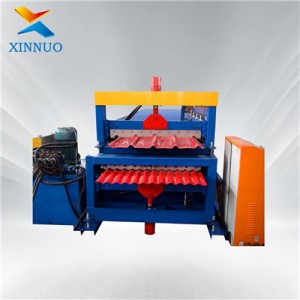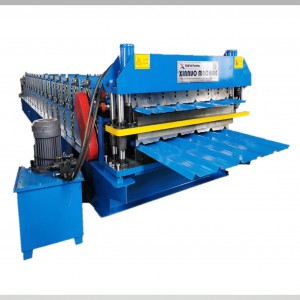

This machine carries two complete sets of forming rolls in one frame: one set tooled for a corrugated roof sheet, one set tooled for a trapezoidal roof sheet. Either profile is produced without changing machines — the strip path at the entry is redirected into the upper or the lower roll set, and the same main drive, the same floor position and the same control system serve both.
Corrugated and trapezoidal are the two roof families most markets actually build, and pairing them is the most commonly exported double layer configuration for that reason. But the pair also carries a specific engineering question that a buyer should understand before the machine is drawn: the two profiles are not formed the same way, and one shared drive has to make both of them run cleanly.
First, the two profiles are genuinely different objects.
A corrugated sheet is a continuous wave. Its section is a sequence of curves with no flat flange between them. The forming rolls work the material through a series of gradual bends, and the shape is held by the geometry of the wave rather than by flat surfaces that can be pressed against.
A trapezoidal sheet is flat flanges joined by straight webs. It has surfaces that a roll can press flat against, a defined rib pitch, and a much larger flat area per unit of width, which is what makes it the profile for structural roof decks and for wall cladding that has to look flat.
The practical difference is what each is for. The wave profile sheds water and covers a roof economically, and it is the traditional roof of industrial sheds and warehouses. The trapezoidal profile spans further between supports, takes foot traffic better, and gives a flatter, more architectural surface. A producer serving a normal construction market is asked for both, and usually by different customers.
Why this pair is the most exported combination.
Neither layer needs anything except forming. There is no pitch stamping, no embossing, no punching step inside the machine — both layers are plain roll forming, so both tooling sets are built by the same process and the machine carries one technology rather than two. That is what makes this the friendliest pairing to build, to align and to run, and it is why it is the configuration most often shipped.
The pair also covers the two demand patterns in one purchase. One profile serves the industrial and warehouse market, which is volume work at tight margins; the other serves structural and commercial roofing, which is where the specification and the margin are. A dealer or a producer who carries only one of them turns away work; the double layer machine lets both be offered from one floor.
Where the pairing has to be engineered rather than assumed.
The pass balance is the real design question. A wave profile is formed gradually, because each bend has to be small enough not to mark the coated surface, so the corrugated layer typically needs a long train of rolls. A trapezoidal profile can be brought to shape in fewer stands. Both layers, however, run from one drive at one line speed, and rolls of different diameter turn at different surface speeds at the same shaft speed.
When one layer has a much longer train than the other, the strip is gripped differently on each side of the machine, and the layer with the shorter train is the one that runs unevenly — the defects show on the lighter layer, not on the heavier one, which is the opposite of what most buyers expect. A moderate difference can be absorbed by giving the slower layer more motor power or by adjusting the chain ratio. A large difference has to be looked at by an engineer before the machine is specified, because the correction belongs to the drive and not to the tooling.
Entry width is the second question. Both layers running from the same strip width is the clean arrangement: one decoiler, one feed, and a changeover that is a guide adjustment. A small width difference can be taken up by the guide blocks. A large difference means two guide systems in one entry, moved by hand at each changeover — the machine still works, but the change becomes a task and that labour should be counted before the machine is bought.
Third, the frame and the chain. The frame is sized by the heavier of the two layers, one grade above what that layer would need alone, because the weight of both sets sits in one structure and the upper set works above the lower one. The chain is sized by the layer that demands the higher torque, not by an average, because the chain that is only just adequate for one layer is the part that fails first.
What “automatic” means on this machine, and what it does not.
The word automatic is used loosely in this trade, so it is worth separating the parts of the cycle that genuinely run themselves from the parts that are still done by a person.
What runs by itself. The main drive and the line sequence are controlled together. Length is set at the control and the cut-off acts on the measured length, so a sheet of a given length comes out without the operator measuring it. The cut-off fires in sequence with the line, and the run stops when the count or the length requirement is met. If the line is fitted with a stacking section, the discharge runs as part of the same sequence.
What is still done by hand. The layer change. The two roll sets are stacked in one frame and the strip is directed into one or the other by moving the guide plates and baffles at the entry. That is a guided path change made by the operator, and it takes minutes — it is not a push-button selection, and any description of a double layer machine that implies the second profile arrives at the press of a key is describing a different and much more expensive machine. Coil loading is also manual, because a coil is a heavy object that has to be brought to the mandrel. Alignment and gap setting at commissioning is skilled hand work, and on a double layer machine it is done twice, in one frame, with the two sets having to be true to each other as well as to the strip.
Writing this down matters commercially. A producer who buys “automatic” expecting the changeover to be unattended will plan production around a capability the machine does not have. A producer who knows the change is a few minutes of guided work plans around it correctly, and finds that a few minutes between profiles is not the constraint — the constraint is that only one profile can run at a time.
One more clarification on the word automatic in this configuration. Automation here belongs to the line’s behaviour — measured length, sequenced cutting, counted output — not to the tooling. The tooling change is a mechanical event, and it stays one. That is not a limitation to be apologised for; it is why this machine can carry two profiles at a price below two machines.
From the factory: where the pairing is actually settled.
The two profiles, the pass counts, the entry widths and the frame grade are settled at the drawing stage. That is the point at which the pair is checked against each other — whether the two roll trains balance against one drive, whether one entry can serve both widths, and how much frame the heavier layer demands.
Because the rolls, the frame and the assembly are made in one place, that check is not a letter written between two suppliers. A pairing that does not balance is corrected on the drawing, before anything is cut. A buyer who orders two profiles from two different machine builders is the one who discovers the mismatch, because each builder has made a correct machine for one profile and nobody has checked the pair.
The profile drawings the customer supplies are what the tooling is set against. They are worth settling early, because a profile re-chosen after the frame is built is a set of rolls that has to be made again.
What arrives with the machine.
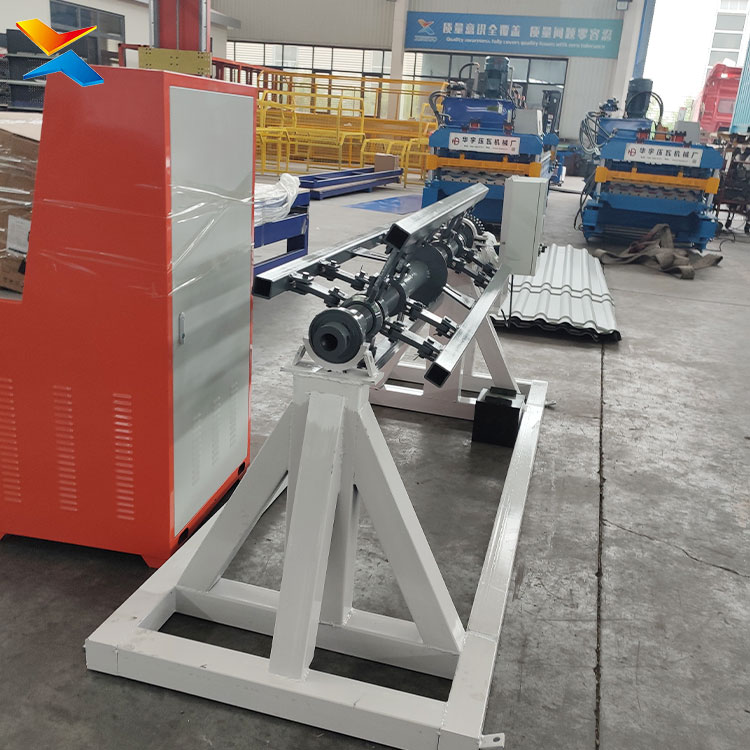
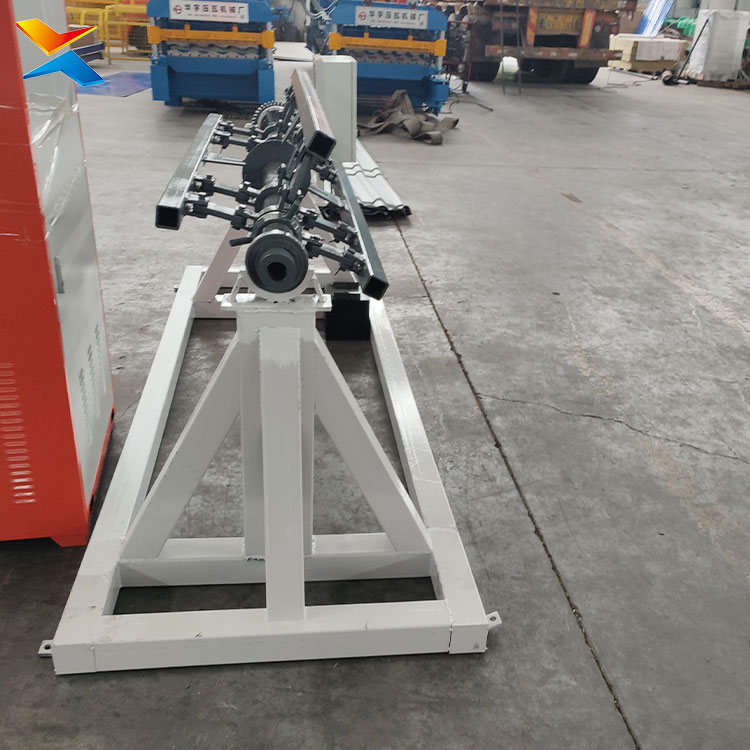
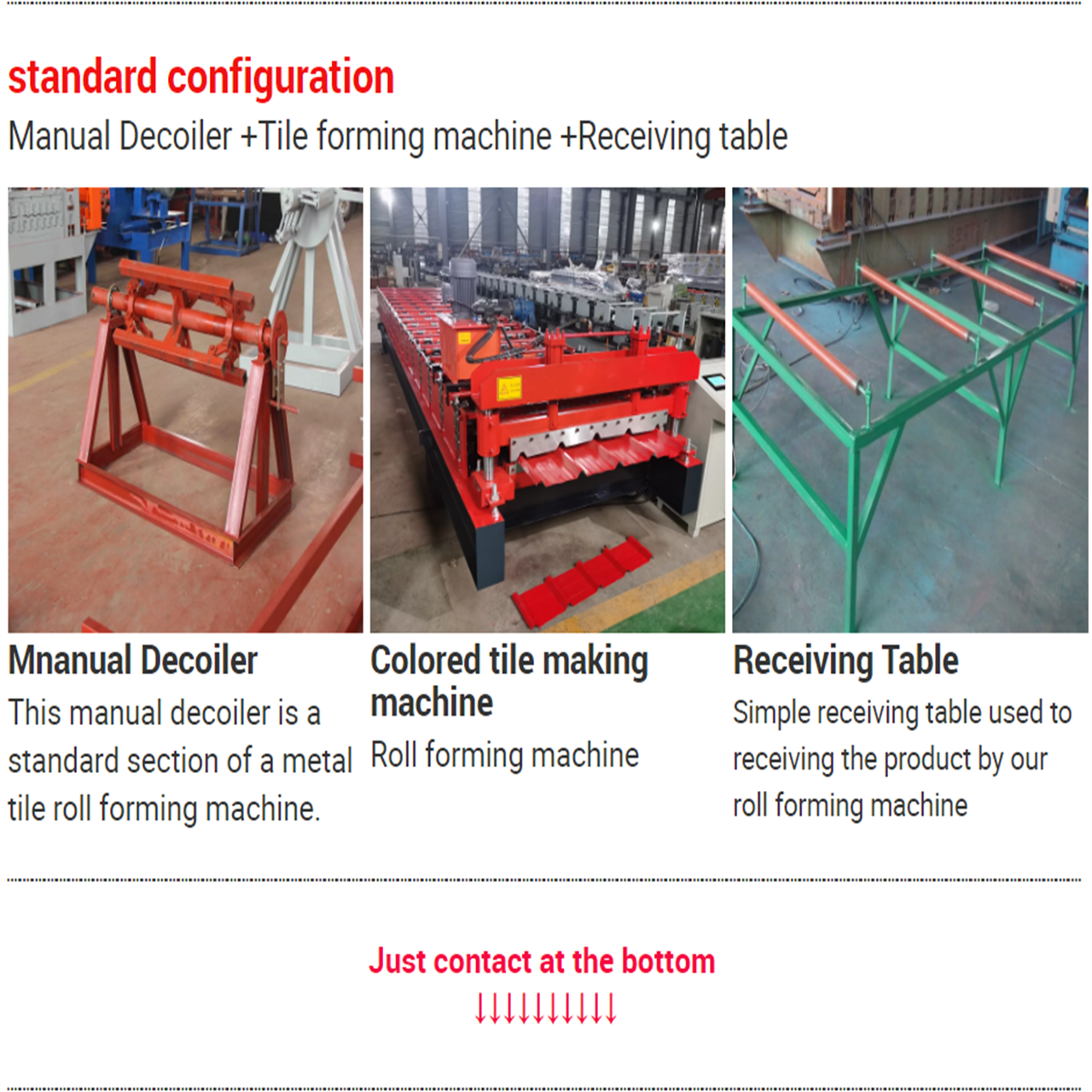
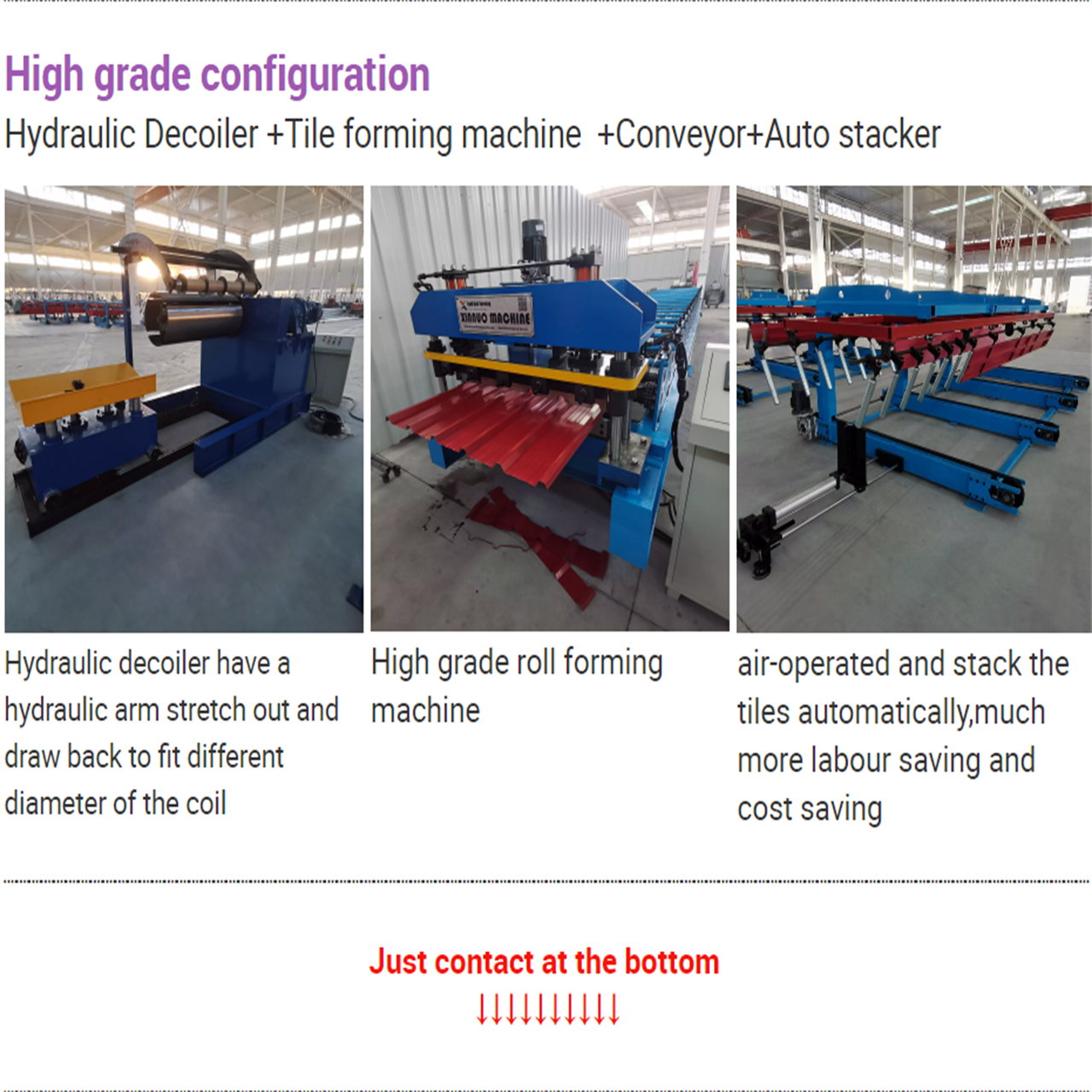
One frame with both tooling sets installed and aligned; one main drive; an entry arranged for both strip paths; a cut-off with length control; and the control system. The decoiler, the run-out or stacking section, and the roof accessories are separate items of scope — a scope that covers the forming machine does not thereby cover them.
Installation needs a level floor that carries the weight of the stacked frame, a power supply sized for the drive, and headroom. Headroom is on this list for a specific reason: a machine with two roll sets stacked vertically is taller than a single layer machine of either profile, and the upper set is the one that is worked on from height. A workshop with a low portal frame has to check this before the machine is built rather than after it lands.
Commissioning is planned around the pair. One frame, two sets of rolls, and two alignments that must agree with each other. That is why the installation of a double layer machine is scheduled differently from a single layer machine and why the profile drawings should be in hand before the machine is on the floor.
The Middle East conditions that act on this pair.
The two profiles are used on different buildings here, and that shapes what the machine is asked to do. The wave profile covers the industrial shed and the warehouse — roofs that are large, low in specification and built to a budget. The trapezoidal profile covers the structural roof and the commercial envelope, where the span is longer, the sheet is seen from the ground, and the flatness of the surface is part of what is being sold.
Heat and movement. Roof sheets in this region run hot and move with the daily swing, and movement has to be taken up at the fixings and at the laps rather than absorbed by the sheet. That is a roofing design question, but it decides which profile suits which building: the wave profile’s continuous curvature gives it room to move, while a trapezoidal sheet’s flat flange and straight web are less forgiving at the fixing line and rely on the fastening detail to do the work.
Dust on the strip. Both layers receive the strip through the same entry, so both profiles are exposed to the same workshop air. The second profile does not get a cleaner path than the first. A workshop that fights dust fights it once for the whole machine.
Coastal exposure and the cut edge. Where the site is near the coast, the vulnerable point on either profile is the cut end and the fixing hole — the places where the coating and the zinc are interrupted. The profile does not make the corrosion, and the profile does not prevent it; the machine’s contribution is to cut cleanly and to form without cracking the coating at the bend, which is why a wave profile is formed gradually rather than in a few hard passes.
The commercial pattern this pair fits. A producer or dealer who supplies industrial roofing most weeks and structural or commercial roofing on the better jobs is exactly the customer this configuration exists for. The wave profile carries the volume; the trapezoidal profile carries the specification work. Neither one alone justifies a full line; together they do.
The case this machine is wrong for. A business that needs both profiles in continuous volume, every week, at the same time. One frame makes one profile at a time. That business needs two machines, and buying a double layer machine instead buys a queue — a well-built queue, but a queue.
It is also the wrong machine for decorative profiles. A glazed or step tile profile needs a pitch-stamping step that this pairing does not have, and a producer who also wants a decorative roof should have that requirement raised at the drawing stage, because a third profile is a different machine rather than another set of rolls.
In one sentence: this is the pairing that puts the two roof families a normal market actually builds into one frame — wave and trapezoidal, both plain forming, one drive, one floor, one profile at a time.
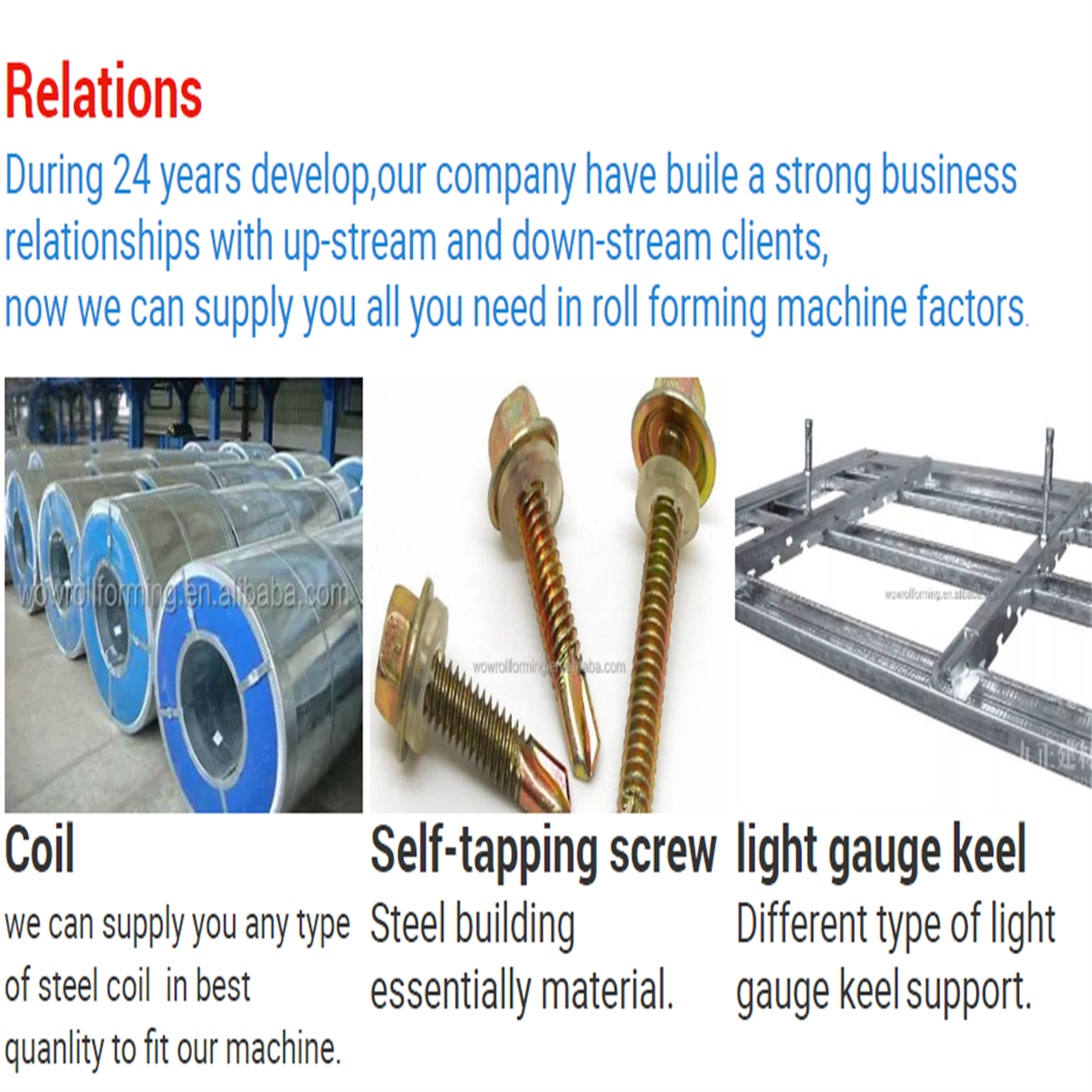

♦ COMPANY PROFILE:
Hebei Xinnuo Roll Forming Machine Co., Ltd., not only produce different types of professional roll forming machines, but also develop intelligent automatic roll forming production lines, C&Z shape purline machines, highway guardrail roll forming machine lines, sandwich panel production lines, decking forming machines, light keel machines, shutter slat door forming machines, downpipe machines, gutter machines, etc.
There are several advantages of using roll forming for your projects:
- The roll forming process allows operations such as punching, notching, and welding to be performed in-line. Labor cost and time for secondary operations are reduced or eliminated, reducing part costs.
- Roll form tooling allows for a high degree of flexibility. A single set of roll form tools will make almost any length of the same cross-section. Multiple sets of tools for varying length parts are not required.
- It can provide better dimensional control than other competing metal forming processes.
- Repeatability is inherent in the process, allowing easier assembly of roll formed parts into your finished product, and minimizing problems due to “standard” tolerance build up.
- Roll forming is typically a higher speed process.
- Roll forming offers customers a superior surface finish. This makes roll forming an excellent option for decorative stainless steel parts or for parts requiring a finish such as anodizing or powder coating. Also, texture or pattern can be rolled into the surface during forming.
- Roll forming utilizes material more efficiently than other competing processes.
- Roll formed shapes can be developed with thinner walls than competing processes
In modern construction and manufacturing, the roll forming machine (commonly known as a roof tile or sheet metal roll former) has revolutionized profile fabrication. By replacing labor-intensive traditional press brake methods, advanced roll forming technology offers unmatched efficiency, quality, and cost savings for metal roofing and wall panel production.
Here are the key advantages of implementing a modern roll forming machine in your operations:
1. Unmatched High Efficiency and Output Speed
High-speed roll forming lines operate continuously, producing custom metal panels at speeds up to 20–40 meters per minute. This automated process significantly shortens lead times and accelerates project delivery cycles.
2. High Precision and Consistent Quality
Engineered with heavy-duty steel frames, high-precision roller dies, and PLC automated control systems, roll formers deliver pinpoint dimensional accuracy. Every panel exhibits uniform thickness, sharp profiles, and precise hole punching, ensuring seamless job-site installation.
3. Material Efficiency and Reduced Waste
Continuous roll forming minimizes scrap metal generation compared to conventional stamping. Precise coil feeding and automated hydraulic flying shears ensure optimal material utilization and reduced raw material costs.
4. Low Maintenance and Extended Durability
Constructed with heat-treated chrome-plated rollers and robust drive systems, industrial roll forming machines require minimal downtime while delivering a long service life under heavy daily operation.
Conclusion
Investing in a reliable roll forming machine boosts productivity, lowers labor costs, and guarantees consistent product quality—delivering maximum long-term return on investment (ROI) for metal fabrication businesses.
Metal roll forming is a continuous, automated metal fabrication process used to shape long strips of sheet metal (usually coiled steel or aluminum) into specific, uniform cross-sectional profiles.
Unlike traditional metal bending techniques like press braking—which shapes sheets batch by batch—roll forming operates as a continuous production line, making it one of the most efficient manufacturing methods for structural profiles, roofing panels, and automotive components.
How the Metal Roll Forming Process Works
The process passes coil stock through a series of consecutive roller dies to incrementally shape the metal into a finished cross-section:
-
Uncoiling: A heavy coil of sheet metal (often pre-painted, galvanized, or stainless steel) is mounted onto a decoiler and fed continuously into the line.
-
Progressive Forming: The strip passes through a sequence of mating roller stations (known as flower patterns). Each set of rollers gradually bends the metal by a few degrees. By making incremental bends, the process avoids overstressing the material or cracking protective coatings.
-
In-Line Processing (Optional): Pre-punching, post-punching, slitting, or embossing can be integrated directly into the automated line before or after forming.
-
Cutting to Length: Once the final profile is shaped, an automated flying shear or hydraulic cutter cuts the continuous panel into precise custom lengths without interrupting the line speed.
Key Advantages of Metal Roll Forming
-
Continuous High Output: Roll forming lines operate at high speeds (typically 20–50 meters per minute), significantly outperforming press brakes for mass production.
-
Tight Dimensional Tolerances: Advanced PLC automation and precision-machined rollers ensure strict dimensional consistency across every piece produced.
-
Material & Cost Efficiency: Minimizes scrap metal waste and eliminates extra handling steps by integrating punching, bending, and cutting into a single automated line.
-
Design Flexibility & Surface Protection: Capable of producing complex, multi-bend profiles while preserving surface finishes, galvanization, and paint coats.
Common Applications
Metal roll forming is widely used across multiple heavy-duty industries:
| Industry | Common Roll-Formed Products |
| Building & Construction | Trapezoidal roof tiles, standing seam panels, C/Z purlins, drywall studs, rain gutters |
| **Automotive &# What is Metal Roll Forming? |
Metal roll forming is a continuous, high-volume manufacturing process that bends long strips of sheet metal—usually coiled steel or aluminum—into custom cross-sectional profiles.
Unlike traditional press braking or stamping, which processes metal in single discrete batches, roll forming shapes metal incrementally at room temperature (cold forming) through a series of consecutive roller dies.
How Metal Roll Forming Works
The roll forming process relies on a line of paired roller stations that gradually shape the metal in steps:
-
Coil Unloading & Uncoiling: A heavy coil of flat metal strip is loaded onto an uncoiler and fed continuously into the machine.
-
In-Line Pre-Punching: Automatic presses notch, punch holes, or create slots in the flat strip prior to shaping.
-
Progressive Roll Shaping: The strip passes through multiple sets of upper and lower rollers (called roll stations). Each station bends the metal slightly more than the previous one, preventing stress fractures and material strain.
-
Cutting & Shearing: A flying hydraulic shear cuts the finished profile to exact target lengths without stopping the continuous line.
Key Benefits of Roll Forming
-
High Speed & Efficiency: Lines operate at speeds up to 20–50 meters per minute with minimal manual labor required.
-
Consistent Quality & Precision: Heavy-duty tool steel rollers controlled by PLC automation ensure exact tolerances across thousands of identical panels.
-
Material Waste Reduction: Continuous coil processing generates virtually zero scrap compared to conventional sheet stamping or trimming.
-
Complex Profiles: Produces intricate shapes—such as standing seam panels, hat channels, C/Z purlins, and tubular sections—in a single continuous pass.
Common Applications
-
Building & Construction: Roof tiles, wall cladding panels, gutters, structural purlins, and steel framing studs.
-
Automotive: Bumper beams, door impact bars, and chassis structural rails.
-
Solar & Energy: Solar panel mounting racks and support structures.
-
Storage & Industrial: Warehouse racking systems, shelving, and heavy-duty tracks.
-
roling machine double layer machine double laye...
-
Customized Double Layer Roofing Sheet Forming M...
-
CE Approved Double Layer Single Plate Roll Form...
-
Double layer IBR and corrugated roofing sheet r...
-
Export Standard Double Layer Roof Panel Machine...
-
Double Layer Trapezoidal Roll Forming Machine |...