

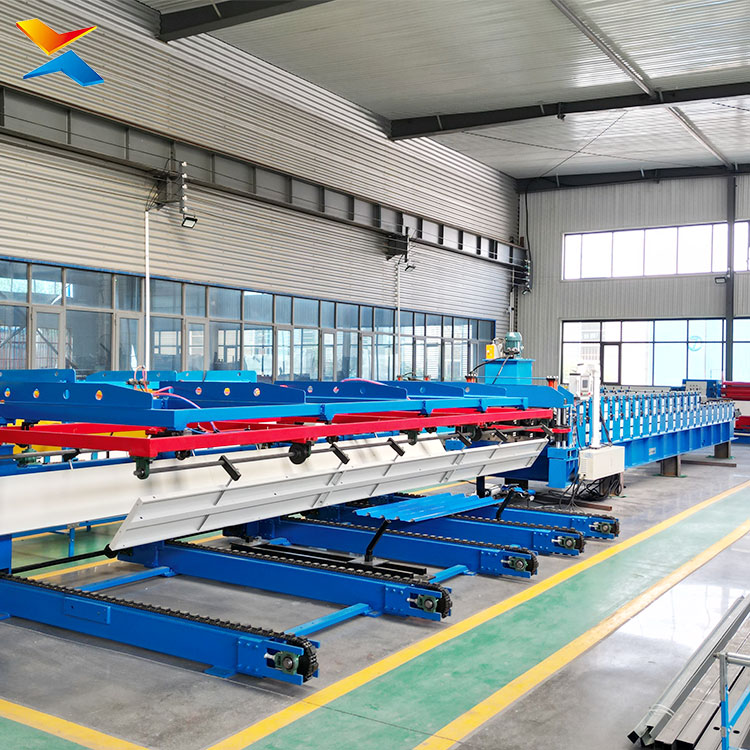
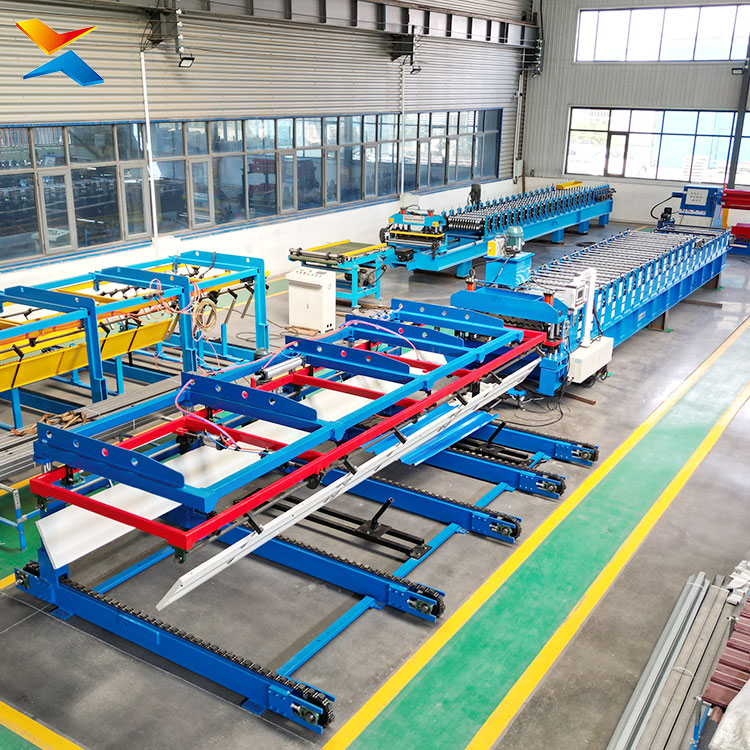
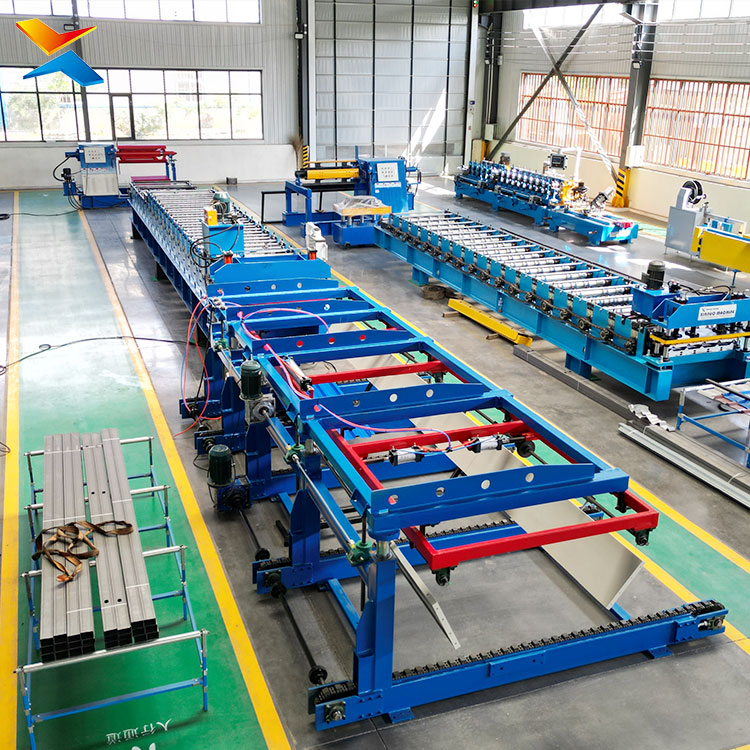
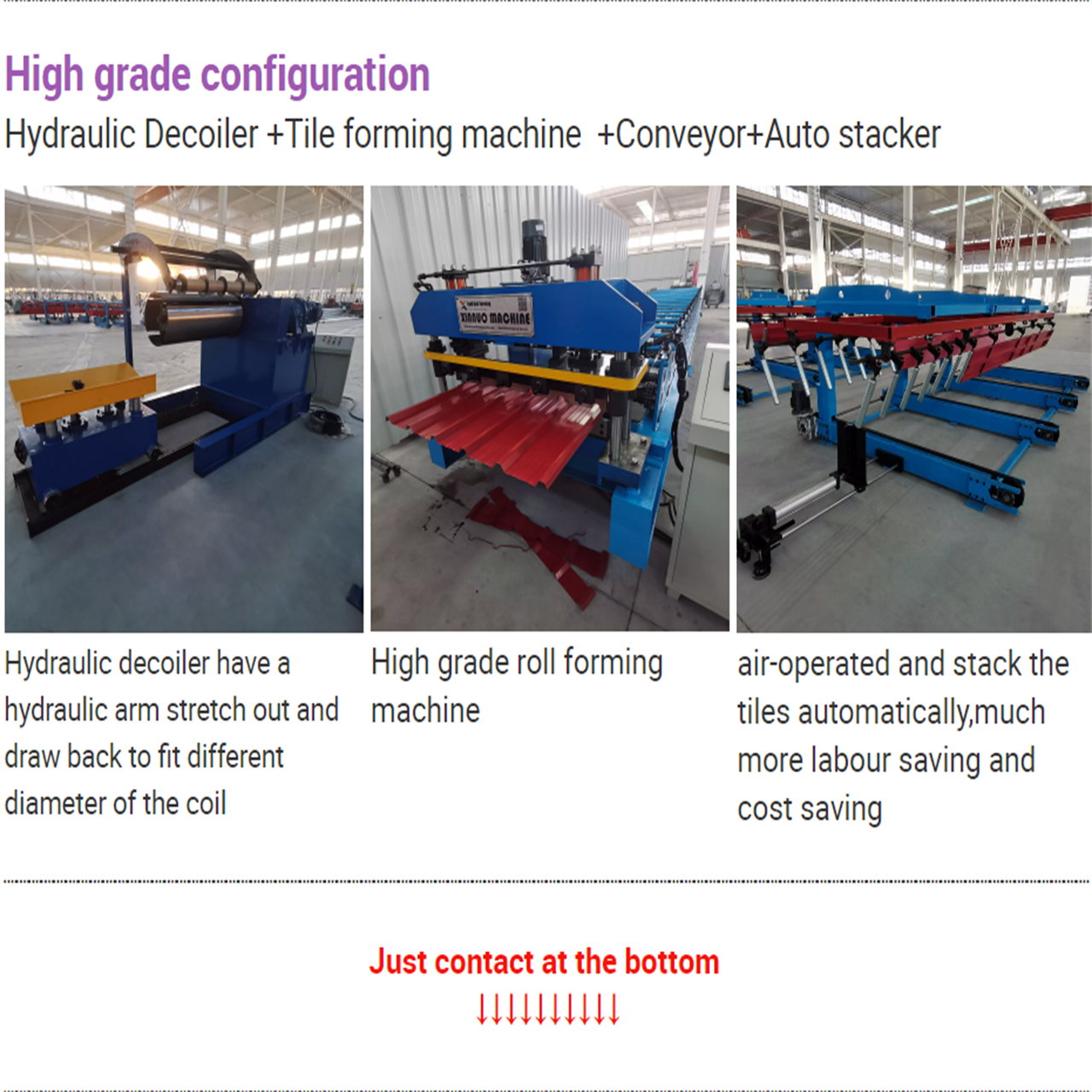
A double layer roll forming machine with an automatic sheet stacker is a complete roof panel production line rather than a forming machine on its own. The machine carries two sets of forming rolls in one frame and produces one roof profile at a time; the stacker sits at the discharge end, receives each finished panel as the shear releases it, and builds it into a squared, counted stack ready to be strapped and moved.
The two halves of that sentence belong together, because a roof panel that has just been cut is not yet a product. It is a long, thin, coated sheet with ribs pressed into it, standing or lying at the end of a line, and everything that happens to it between the shear and the strapping is where a good panel becomes a damaged one.
A stacker is not a run-out table, and the difference is the whole point.
A run-out table catches the panel and lets it lie there. Someone then lifts it, walks it to a pile, and lays it down by hand — and on a roof panel that is a long reach, a sharp edge and a coated surface all at once.
A stacker does the part that hands cannot do consistently: it squares the stack and it counts it. The panel is delivered onto a stacking platform, and the stack is aligned on three sides — from the left, from the right and from the rear — so that each sheet lands in the same position as the one before it. The result is a stack whose edges are true, which is what makes it strappable, forkliftable and countable. A pile is not a bundle; the difference is alignment.
That distinction matters more on a roof panel line than on almost any other. A roof panel is long relative to its width, light for its size, and coated on the face that will be seen. Laid by hand, long panels fan out at one end, overlap at the other, and slide against each other on the way down. Every one of those movements marks the coating, and the marks are on the visible face of a roof. The stacker removes the handling rather than making the handling faster.
Counting is the second job, and it is a commercial one.
A counted stack is an invoice. A dealer who sells in bundles of a known quantity cannot build the bundle by weighing it or by measuring its height; the count has to come from the line. A stacker with a counter turns output into a quantity, and it does it at the point where the panel is still under control rather than at dispatch, where a miscount means either a short delivery or a remainder nobody wants.
Where the stacker sits in a double layer line, and why that is not a trivial question.
The stacker is downstream of the cut-off, and on a double layer machine the cut-off is not at a single height. The two roll sets are stacked vertically in one frame, so the strip leaves the machine from two different levels depending on which layer is running. The receiving end therefore has to suit the layer that is active, and that is a layout decision taken together with the machine, not an accessory chosen afterwards. A stacker drawn for one discharge height and fitted to a machine with two is a stacker that works for one profile and is awkward for the other.
The stacking zone is longer than buyers expect. In the standard layout of a roof panel line with an automatic stacker, the stacking zone is measured on the same order as the forming section itself — a line that forms in one length discharges in another. Floor space has to be planned for the whole line, and the space at the discharge end is not the small margin left over after the machine is placed.
Why the zone is long: the panel decides it.
A stacker has to place a panel that is as long as the roof it will cover. The travel from the shear to the far end of the stack is a travel at panel length, and the stack itself has to be as long as the panel. That is why a roof panel line with stacking is laid out end to end and why the building has to be long before it is wide.
The stacker also fixes the practical limit on how short a panel can be handled well. A very short panel is easy to stack and hard to stack squarely — there is less length to correct against, so the alignment stops do less work. Long panels are where a stacker earns its place; short panels are where a run-out table and a pair of hands are still competitive.
The stacker can become the bottleneck, and that is the honest risk in buying one.
The line runs at the speed of its slowest station, and the stacker is a station with a cycle of its own. Every panel has to be carried, placed, aligned and released before the next one can be received, and the time that takes grows with panel length and with stack height. If the stacking cycle is longer than the forming cycle, the line waits — the machine is capable of more, and the line delivers less.
This is why the stacker is specified with the line and not added to it. The panel length the machine will actually run, the stack height the bundle will actually reach, and the way the finished bundle will leave the floor are the three inputs that set the stacker’s cycle — and all three are known before the machine is built and rarely afterwards.
What the stacker does not do.
It does not correct a panel that left the shear out of square. Alignment acts on the stack, not on the sheet: a panel whose ends are not true produces a stack with neat outer edges and a wrong inside. Squareness comes from the cut-off and from the machine being set true, and no amount of pushing at the discharge end cures it.
It does not wrap, strap, band or palletise. It produces the bundle; it does not finish it. Strapping is a separate operation and a separate piece of equipment.
It does not lift the bundle onto a truck. The stack leaves on a forklift or a crane, and the route that bundle takes out of the building is part of the layout.
And it does not make a two-profile machine into a two-profile-at-once machine. The double layer machine still runs one layer at a time, and the stacker serves whichever layer is discharging.
What the double layer side contributes to the same line.
The two layers share one frame, one main drive and one floor position, and they change over by redirecting the strip path at the entry rather than by exchanging tooling. On a line with a stacker, that is an advantage in a way it is not on a line without one: the forming end changes profile in a short intervention, while the discharge end keeps the same platform, and the space that would have been occupied by a second machine and a second stacking zone is simply not needed. A producer running two roof profiles from one line with one stacking area occupies a building that would otherwise have to be appreciably longer.
The pairing rules still apply. Two profiles that share a strip width change over cleanly; two that differ widely need the entry re-set as well, and two whose pass counts are far apart run unevenly because one drive gives one line speed. A stacker does not change any of that — it only changes what happens to the panel after it is cut.
What the roof panel itself demands of the discharge end.
The face that lands on the stack is the face that presses against the next sheet. Coated panels stacked face to face mark one another, and the marking is a function of how far the sheet falls and how it lands rather than of the coating alone. A stacker that places the panel instead of dropping it removes most of that, which is why the discharge detail matters more than the discharge speed.
Ribs make the stack a structure rather than a pile of flat sheets. The panels nest, and nesting is what allows a bundle to be tall without being unstable — but nesting only works if the panels are aligned, because a rib that lands on a rib instead of in the valley between two raises one side of the stack. Three-sided alignment is what keeps the nest consistent from the bottom sheet to the top.
The Middle East working conditions that act on the discharge end.
Dust does not stop at the forming machine. Panels stacked in an open or semi-open bay collect dust between the sheets, and a bundle that travels by road then rubs that dust against the coating for the whole journey. The stack is where a clean panel stops being clean, and the practical answer is at the building rather than at the machine: a covered stacking area, and a bundle closed as soon as it is built.
Heat acts on the stacker’s own drives and on the bundle that waits. Motors, gearboxes and any pneumatic element at the discharge end sit in the same ambient as the line, and a bundle left standing in sun before loading is a bundle whose coating is at its most markable.
Wind is a factor that flat-sheet lines do not have. A long light panel between the shear and the stack is a surface, and in an open bay a gust moves it. This is one more reason the discharge end is enclosed or screened rather than left open to the yard.
The bundle has to leave the building, and in this region it leaves by road. A squared stack straps tightly, sits flat on a trailer, and arrives as the quantity that was invoiced. A stack that was hand-piled leans, straps loosen, edges rub, and the difference is discovered by the customer. The stacker is the cheapest place in the whole chain to prevent that.
A product mix the line fits.
A producer or dealer running one roof profile for industrial and warehouse work and a second profile for villas and commercial frontage, from one building, with one stacking area and one forklift route, is the case this line is built for. The industrial profile carries the volume; the second profile takes the smaller, better-margin work. The stacker is what makes the volume side efficient, and the double layer machine is what makes the second profile possible without a second line.
The case it does not fit is a business that needs both profiles every week, at volume, at the same time. One frame makes one profile at a time, and one stacker receives one panel at a time — that business needs two machines, and paying for a double layer machine instead buys a queue.
What arrives, and what the line needs in order to run.
The machine arrives as one frame with two tooling sets installed and aligned, a main drive, an entry arranged for both layers, a cut-off, and a control system; the stacker arrives as its own unit to be set at the discharge and connected to the line’s sequence. The line needs a level floor that carries the weight of the stacked frame and the loaded stacker, a power supply sized for the drives, a length of building that accommodates the forming section and the stacking zone together, and access for a coil to be presented at the entry and for a finished bundle to leave at the far end.
Commissioning covers both ends. The forming side has two sets of rolls to align in one frame and to make true to each other as well as to the strip; the discharge side has a stacking platform that has to be true to the machine before the first panel is counted. The panel drawing, the strip width and the bundle size the customer actually ships are what both ends are set against — and they are worth settling before the machine is built, because a bundle size chosen afterwards is a stacker re-set afterwards.
In one sentence: the double layer machine gives a producer two roof profiles from one frame, and the automatic stacker turns what comes out of it into a bundle that can be invoiced and shipped without being handled twice.
♦ COMPANY PROFILE:
Hebei Xinnuo Roll Forming Machine Co., Ltd., not only produce different types of professional roll forming machines, but also develop intelligent automatic roll forming production lines, C&Z shape purline machines, highway guardrail roll forming machine lines, sandwich panel production lines, decking forming machines, light keel machines, shutter slat door forming machines, downpipe machines, gutter machines, etc.
There are several advantages of using roll forming for your projects:
- The roll forming process allows operations such as punching, notching, and welding to be performed in-line. Labor cost and time for secondary operations are reduced or eliminated, reducing part costs.
- Roll form tooling allows for a high degree of flexibility. A single set of roll form tools will make almost any length of the same cross-section. Multiple sets of tools for varying length parts are not required.
- It can provide better dimensional control than other competing metal forming processes.
- Repeatability is inherent in the process, allowing easier assembly of roll formed parts into your finished product, and minimizing problems due to “standard” tolerance build up.
- Roll forming is typically a higher speed process.
- Roll forming offers customers a superior surface finish. This makes roll forming an excellent option for decorative stainless steel parts or for parts requiring a finish such as anodizing or powder coating. Also, texture or pattern can be rolled into the surface during forming.
- Roll forming utilizes material more efficiently than other competing processes.
- Roll formed shapes can be developed with thinner walls than competing processes
In modern construction and manufacturing, the roll forming machine (commonly known as a roof tile or sheet metal roll former) has revolutionized profile fabrication. By replacing labor-intensive traditional press brake methods, advanced roll forming technology offers unmatched efficiency, quality, and cost savings for metal roofing and wall panel production.
Here are the key advantages of implementing a modern roll forming machine in your operations:
1. Unmatched High Efficiency and Output Speed
High-speed roll forming lines operate continuously, producing custom metal panels at speeds up to 20–40 meters per minute. This automated process significantly shortens lead times and accelerates project delivery cycles.
2. High Precision and Consistent Quality
Engineered with heavy-duty steel frames, high-precision roller dies, and PLC automated control systems, roll formers deliver pinpoint dimensional accuracy. Every panel exhibits uniform thickness, sharp profiles, and precise hole punching, ensuring seamless job-site installation.
3. Material Efficiency and Reduced Waste
Continuous roll forming minimizes scrap metal generation compared to conventional stamping. Precise coil feeding and automated hydraulic flying shears ensure optimal material utilization and reduced raw material costs.
4. Low Maintenance and Extended Durability
Constructed with heat-treated chrome-plated rollers and robust drive systems, industrial roll forming machines require minimal downtime while delivering a long service life under heavy daily operation.
Conclusion
Investing in a reliable roll forming machine boosts productivity, lowers labor costs, and guarantees consistent product quality—delivering maximum long-term return on investment (ROI) for metal fabrication businesses.
Metal roll forming is a continuous, automated metal fabrication process used to shape long strips of sheet metal (usually coiled steel or aluminum) into specific, uniform cross-sectional profiles.
Unlike traditional metal bending techniques like press braking—which shapes sheets batch by batch—roll forming operates as a continuous production line, making it one of the most efficient manufacturing methods for structural profiles, roofing panels, and automotive components.
How the Metal Roll Forming Process Works
The process passes coil stock through a series of consecutive roller dies to incrementally shape the metal into a finished cross-section:
-
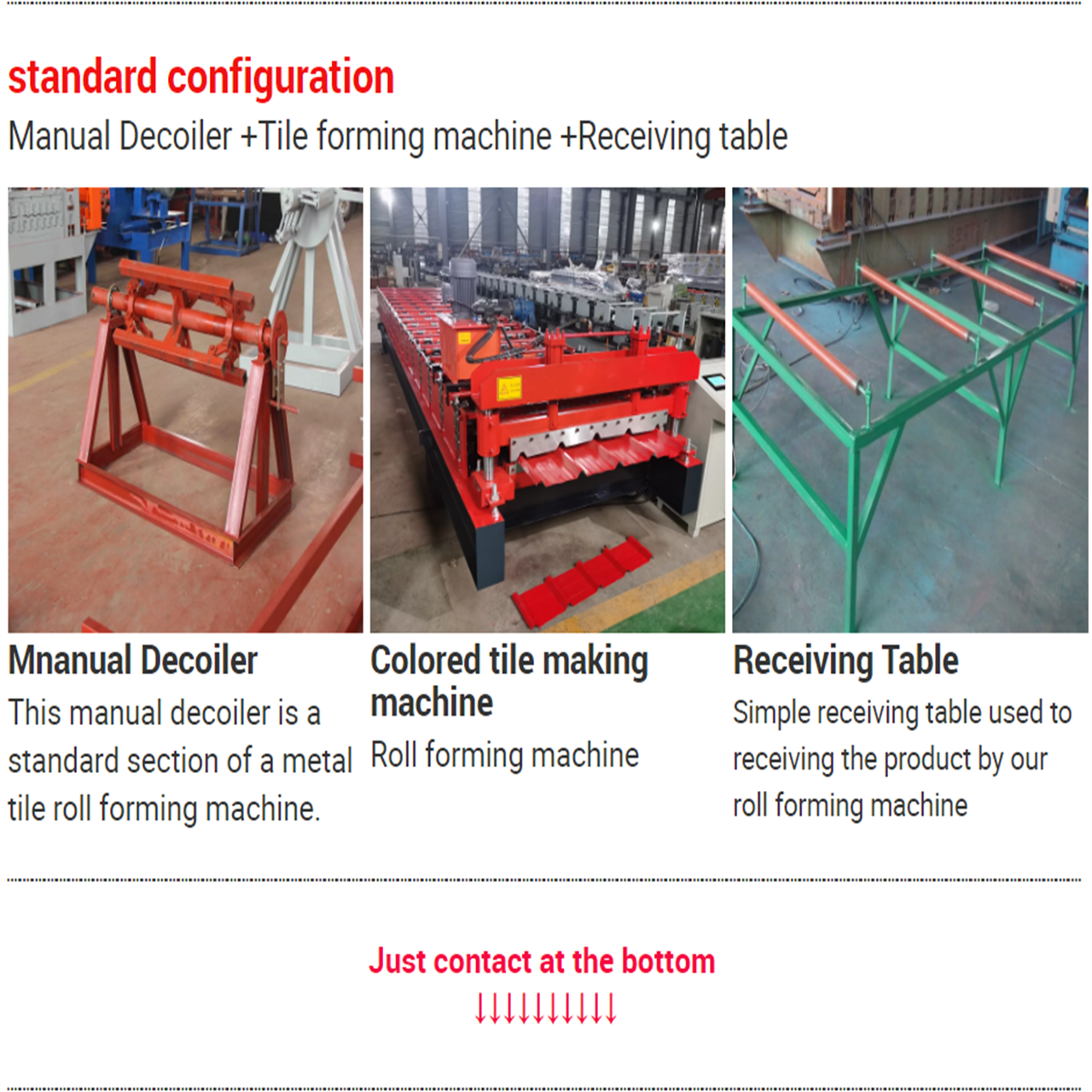
Uncoiling: A heavy coil of sheet metal (often pre-painted, galvanized, or stainless steel) is mounted onto a decoiler and fed continuously into the line.
-
Progressive Forming: The strip passes through a sequence of mating roller stations (known as flower patterns). Each set of rollers gradually bends the metal by a few degrees. By making incremental bends, the process avoids overstressing the material or cracking protective coatings.
-
In-Line Processing (Optional): Pre-punching, post-punching, slitting, or embossing can be integrated directly into the automated line before or after forming.
-
Cutting to Length: Once the final profile is shaped, an automated flying shear or hydraulic cutter cuts the continuous panel into precise custom lengths without interrupting the line speed.
Key Advantages of Metal Roll Forming
-
Continuous High Output: Roll forming lines operate at high speeds (typically 20–50 meters per minute), significantly outperforming press brakes for mass production.
-
Tight Dimensional Tolerances: Advanced PLC automation and precision-machined rollers ensure strict dimensional consistency across every piece produced.
-
Material & Cost Efficiency: Minimizes scrap metal waste and eliminates extra handling steps by integrating punching, bending, and cutting into a single automated line.
-
Design Flexibility & Surface Protection: Capable of producing complex, multi-bend profiles while preserving surface finishes, galvanization, and paint coats.
Common Applications
Metal roll forming is widely used across multiple heavy-duty industries:
| Industry | Common Roll-Formed Products |
| Building & Construction | Trapezoidal roof tiles, standing seam panels, C/Z purlins, drywall studs, rain gutters |
| **Automotive &# What is Metal Roll Forming? |
Metal roll forming is a continuous, high-volume manufacturing process that bends long strips of sheet metal—usually coiled steel or aluminum—into custom cross-sectional profiles.
Unlike traditional press braking or stamping, which processes metal in single discrete batches, roll forming shapes metal incrementally at room temperature (cold forming) through a series of consecutive roller dies.
How Metal Roll Forming Works
The roll forming process relies on a line of paired roller stations that gradually shape the metal in steps:
-
Coil Unloading & Uncoiling: A heavy coil of flat metal strip is loaded onto an uncoiler and fed continuously into the machine.
-
In-Line Pre-Punching: Automatic presses notch, punch holes, or create slots in the flat strip prior to shaping.
-
Progressive Roll Shaping: The strip passes through multiple sets of upper and lower rollers (called roll stations). Each station bends the metal slightly more than the previous one, preventing stress fractures and material strain.
-
Cutting & Shearing: A flying hydraulic shear cuts the finished profile to exact target lengths without stopping the continuous line.
Key Benefits of Roll Forming
-
High Speed & Efficiency: Lines operate at speeds up to 20–50 meters per minute with minimal manual labor required.
-
Consistent Quality & Precision: Heavy-duty tool steel rollers controlled by PLC automation ensure exact tolerances across thousands of identical panels.
-
Material Waste Reduction: Continuous coil processing generates virtually zero scrap compared to conventional sheet stamping or trimming.
-
Complex Profiles: Produces intricate shapes—such as standing seam panels, hat channels, C/Z purlins, and tubular sections—in a single continuous pass.
Common Applications
-
Building & Construction: Roof tiles, wall cladding panels, gutters, structural purlins, and steel framing studs.
-
Automotive: Bumper beams, door impact bars, and chassis structural rails.
-
Solar & Energy: Solar panel mounting racks and support structures.
-
Storage & Industrial: Warehouse racking systems, shelving, and heavy-duty tracks.


