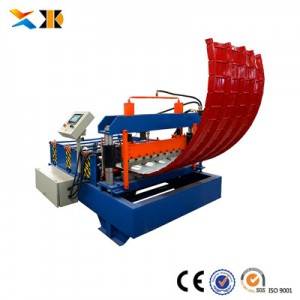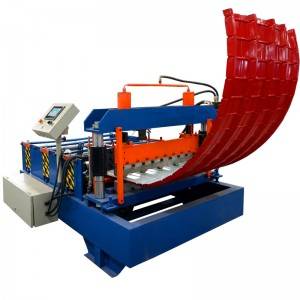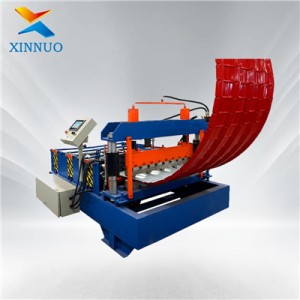

Arch roof roll forming machine for the curved steel roof building, built by the manufacturer and supplied factory direct to the Middle East.
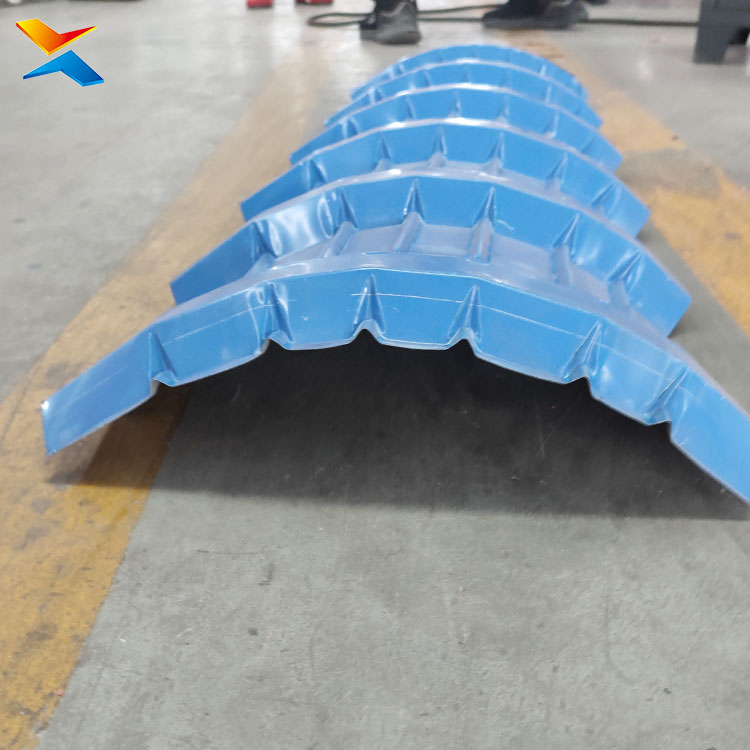
The machine produces the curved steel panel that an arch roof building is made of. It takes coated steel coil, forms the panel’s trapezoidal or corrugated profile, and curves it along its length into the arc the building’s span calls for.
A curved steel roof building is a structure, not a covering.
This is the first thing to hold on to, because it changes what the machine is for. In an ordinary roof the panel covers a structure that is already there: purlins, rafters, a frame. In an arch roof building the panel is the structure. It springs from a foundation on one side, carries itself over the clear span, and lands on a foundation on the other side. There are no internal columns, and often no purlins either.
The consequence runs straight into the machine. The panel’s side seam is not a weather joint; it is the structural connection. Two adjacent panels are locked together along their length, and that lock is what makes a row of curved sheets behave as one arch. A machine that produces a beautiful arc but an edge that seams poorly has produced a roof that cannot carry its own span.
One panel runs the whole arc.
An arch roof panel is not cut into short lengths and lapped. A single panel runs from the eave, over the crown, and down to the opposite eave, so its length is the developed length of the arc — longer than the span, because the arc is longer than the straight line between its ends. That single fact drives most of what is unusual about this product.
It cannot be transported as a panel. A panel of that length will not travel on a truck without bowing, and once bowed it does not straighten back into a true arc. So the machine either sits at the site or in a yard beside it, and the coil is what travels. The coil ships compact; the panel is made where it is used, at the length the arc needs. That is why this machine is bought by contractors and by site-based producers rather than only by panel manufacturers with a fixed factory.
The radius is a structural decision before it is an aesthetic one.
Every profile has a limit on how tightly it can be curved. The minimum radius scales with the depth of the rib — a deeper rib takes a larger minimum radius, a shallower rib a tighter one. Below that limit the rib distorts: the flanges buckle or the rib opens, and the panel loses the very depth that was giving the arch its capacity.
The practical consequence is that the building’s shape and the panel’s profile are one decision, not two. If a design calls for a tighter arch than the chosen panel can take, the answer is not a more forceful curving machine — it is a different panel. A machine that curves past the limit produces a panel that looks curved and no longer performs as an arch. That is the expensive version of the mistake, because it is only discovered under load.
The arch pushes outward at its feet.
An arch carries its load in compression, and a compression arch thrusts outward at its supports. The foundation has to take that thrust, and the flatter the arc, the greater the outward push for the same span. This is why the radius question is not settled on the machine alone: the arc the machine produces is the arc whose thrust the foundation has to resist.
Two production routes, and the difference is what the buyer already owns.
The factory builds both, and they are not interchangeable.
In-line curving. Forming and curving happen in one pass: the coil goes in, the panel comes out already arched. This is the route for a producer who has no separate forming machine — one machine, one operator, the complete panel. It is built on a vertical layout with a single row of rolls, chain drive and a direct-coupled motor.
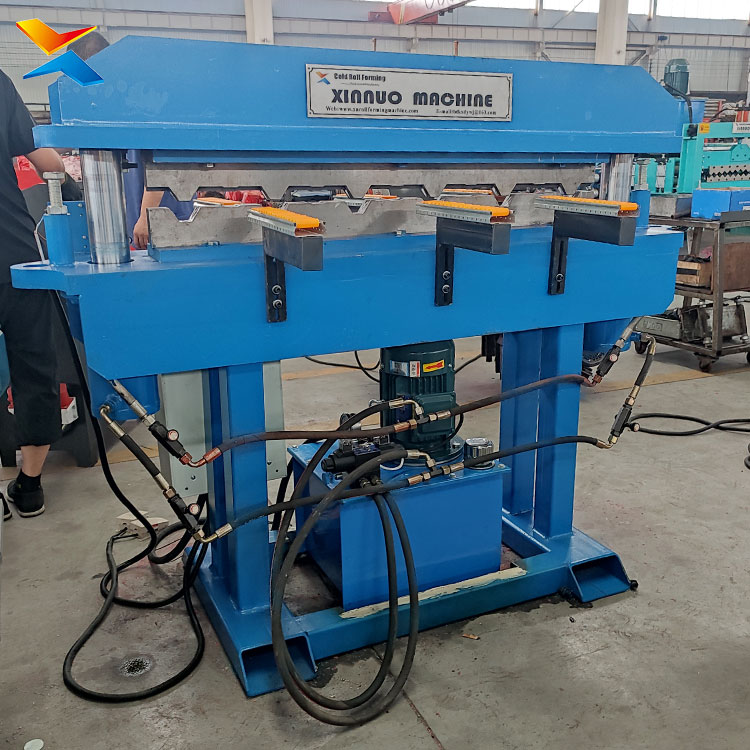
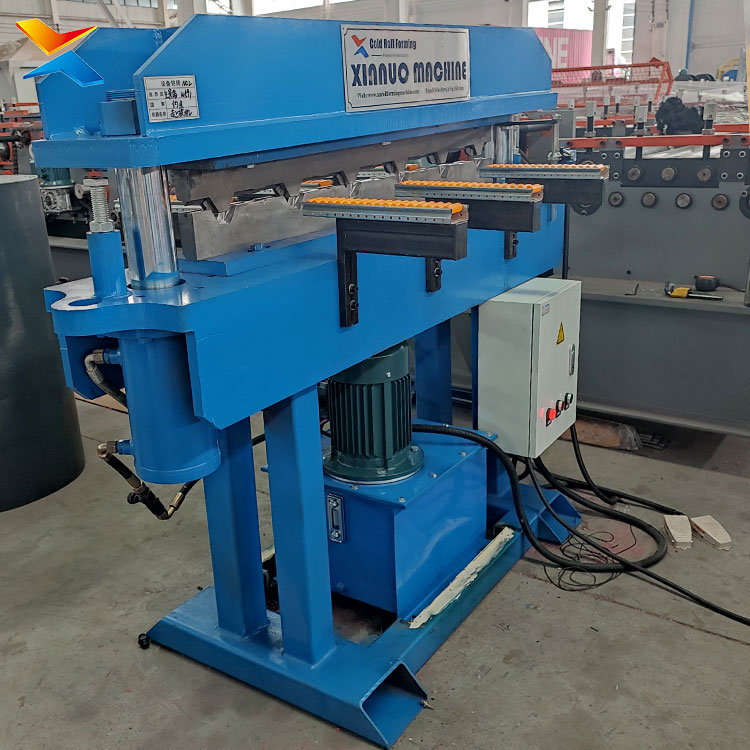
Independent hydraulic curving. The panel is formed flat first, on a roll former, and then pressed into an arc segment by segment in a separate machine. This is the route for a shop that already forms panels and wants to add arch work. It has a heavier centre plate and several rows of rolls, driven by a hydraulic motor or by servo, and it accepts a wider range of radii. Because the curving tooling can be changed independently of the forming rolls, one curving machine can serve several panel widths.
What the machine must hold, panel after panel.
A consistent arc. The panel’s whole structural behaviour is the arc, so an arc that varies along the run is a roof whose capacity varies with it. The consistency comes from the frame and the roll set holding their geometry under the load of a deep, long panel — not from the operator’s attention.
An edge that seams. The seam is the structure. The edge form is produced by the machine and cannot be corrected on site.
An unmarked coating. The panel’s face is visible for the life of the building, and the curving rolls are in contact with it along its whole length. Roll marking is not cosmetic on a curved roof: it is visible from every angle, and it is where a coating starts to fail.
A square cut at the arc’s end. The panel’s end lands on the foundation detail, and an end cut out of square leaves a gap that has to be closed at the most loaded point of the building.
Product features and advantages.
Forming and curving matched to one panel. The roll set and the curving geometry are produced as one specification, so the arc that comes out is the arc the profile was designed to take.
A radius range built around the panel, not around a single number. Standard machines cover the arcs that ordinary building spans call for, and tighter or larger arcs are built as a specification rather than forced out of a standard unit.
Vertical layout on the in-line machine. A short footprint and a straight line from coil to finished arc, which matters when the machine is working on a site rather than in a factory.
Heavy centre plate on the independent machine. The plate takes the curving load, and its thickness is what keeps the rolls from opening under a long, heavy panel.
Graded builds. The range runs from a light standard build for ordinary production to a heavy hydraulic build for thick material and continuous work. The difference between the grades shows up in what the machine holds over a long run rather than in what it can produce once.
Electrical configuration built for the destination. Export machines are configured to the supply of the market they are going to, which for the Gulf is a different configuration from the domestic one. The supply is confirmed when the machine is specified.
Where a curved steel roof building is used.
Warehousing and storage. A clear span with no internal columns gives an unobstructed floor, which is the whole value of the building type for bulk storage and for equipment that has to move freely.
Aircraft and vehicle shelters. The arch profile gives a high, uninterrupted interior, and the building goes up quickly because the panel is the structure.
Sports and assembly halls, workshops and plant shelter. Covered areas where the clear span matters more than a flat ceiling.
Agricultural and livestock buildings. The arch sheds water and sheds the sun, and the interior volume keeps the space cooler than a low flat roof.
Canopies, covered walkways and site shelters. Where a small arch is wanted and the panel can be produced to the arc directly.
Temporary and relocatable structures. Because the panel is light and the building needs no internal frame, the whole structure can be moved and re-erected.
The machine in Middle East conditions.
The region is one of the markets this machine is built for, and the factory’s records show it in the graded builds: the heavy hydraulic build is associated with customers in Oman and India, and the high-speed servo build with Dubai, where a faster and quieter machine is wanted for higher-end work.
The conditions act on the panel and on the site work.
Sun and heat. A coated steel panel in direct sun runs far above air temperature and expands along its length. On an arch roof the panel is very long and its ends are fixed at the foundations, so the movement has to be accommodated in the end detail rather than absorbed by the panel. Site work in the heat also sets the hours: panels are laid and seamed in the cooler part of the day where the programme allows.
Wind-blown dust and sand. Dust settles into the ribs and against the seams, and wind-driven sand abrades the coating on the exposed faces. The arch’s curvature helps it shed dust; the seams and the rib troughs are where it collects.
Coastal humidity and salt air. Gulf sites are frequently coastal, and the panel’s cut ends and fixing points are where corrosion begins. A seamed joint that is not fully closed is a salt trap along the whole length of the building.
Site production. Because the panel is made at or near the site, the machine works in a temporary yard rather than a factory: the ground has to be level enough to keep the machine true, the coil has to be stored out of the sun, and the panel run-out has to be long enough to take the full arc without support.
Machine build quality.
The frame. A fabricated steel structure machined so the stands sit in line and the shaft centres hold under curving load. On a long panel the frame’s stiffness is what keeps the arc from drifting along the run.
The rolls and shafts. Forming and curving rolls are produced as matched sets, hardened and finished so the working face keeps its shape. Shafts are alloy steel, ground, and sized to the load the profile imposes.
The centre plate. On the independent machine the centre plate carries the curving load; its thickness is what stops the roll gap opening when a heavy panel is pulled through.
The drive. Chain drive with a direct-coupled motor on the in-line machine; gear transmission inside the centre plate and a hydraulic motor or servo on the independent machine, chosen for the load and for the noise and speed the buyer wants.
Finish. Structural parts are welded under shielding gas, stress-relieved where the design calls for it, shot-blasted, then electrostatically coated and cured in an oven.
Service and support.
Installation and commissioning support, operator training, illustrated manuals and a spare parts list are supplied with the machine, together with engineering support for the arc and profile a project requires. Because the curving geometry is set to the panel, the tooling record travels with the machine: it is what allows a later building of the same span to be produced on the same arc, and what allows the rolls to be reset correctly after a change.
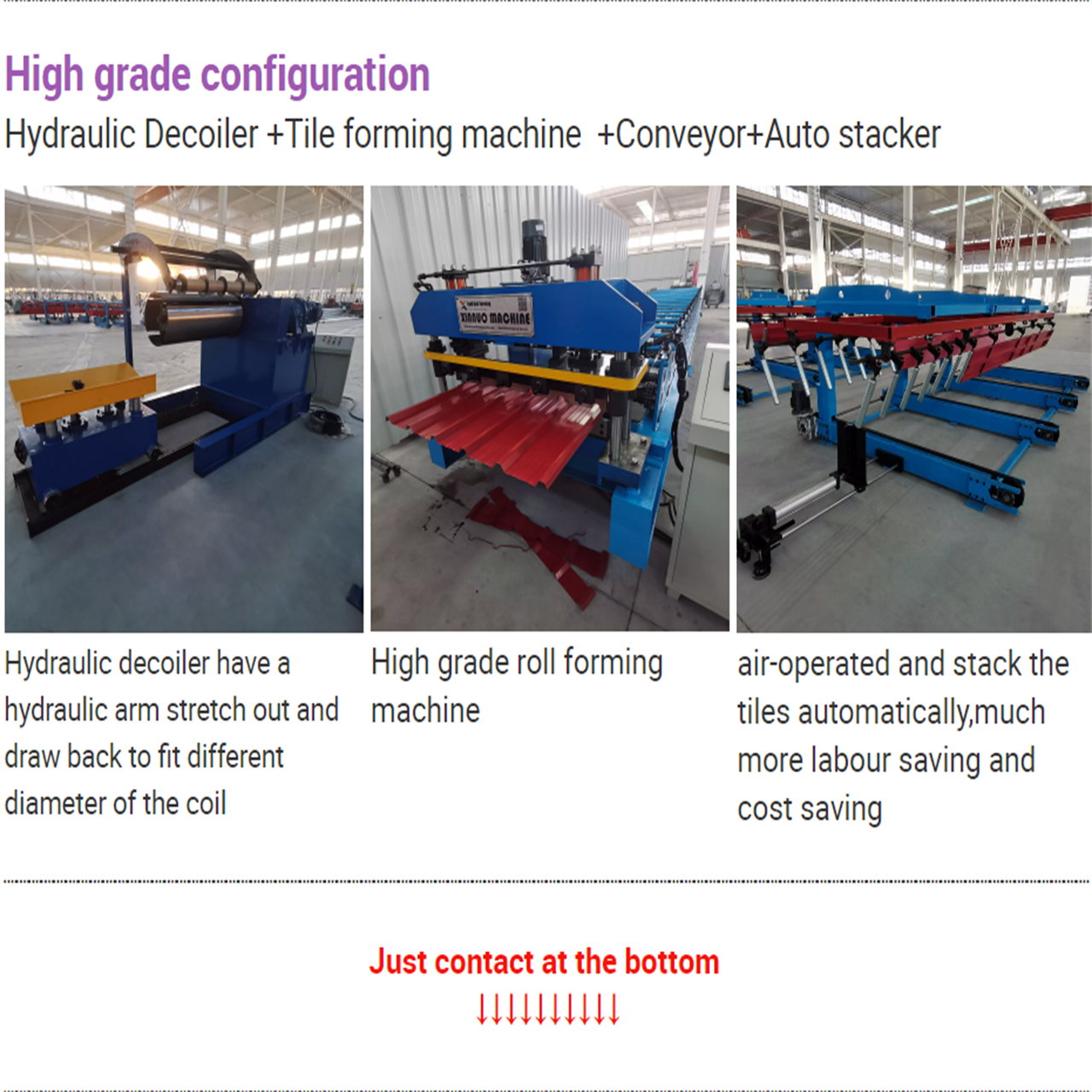
♦ COMPANY PROFILE:
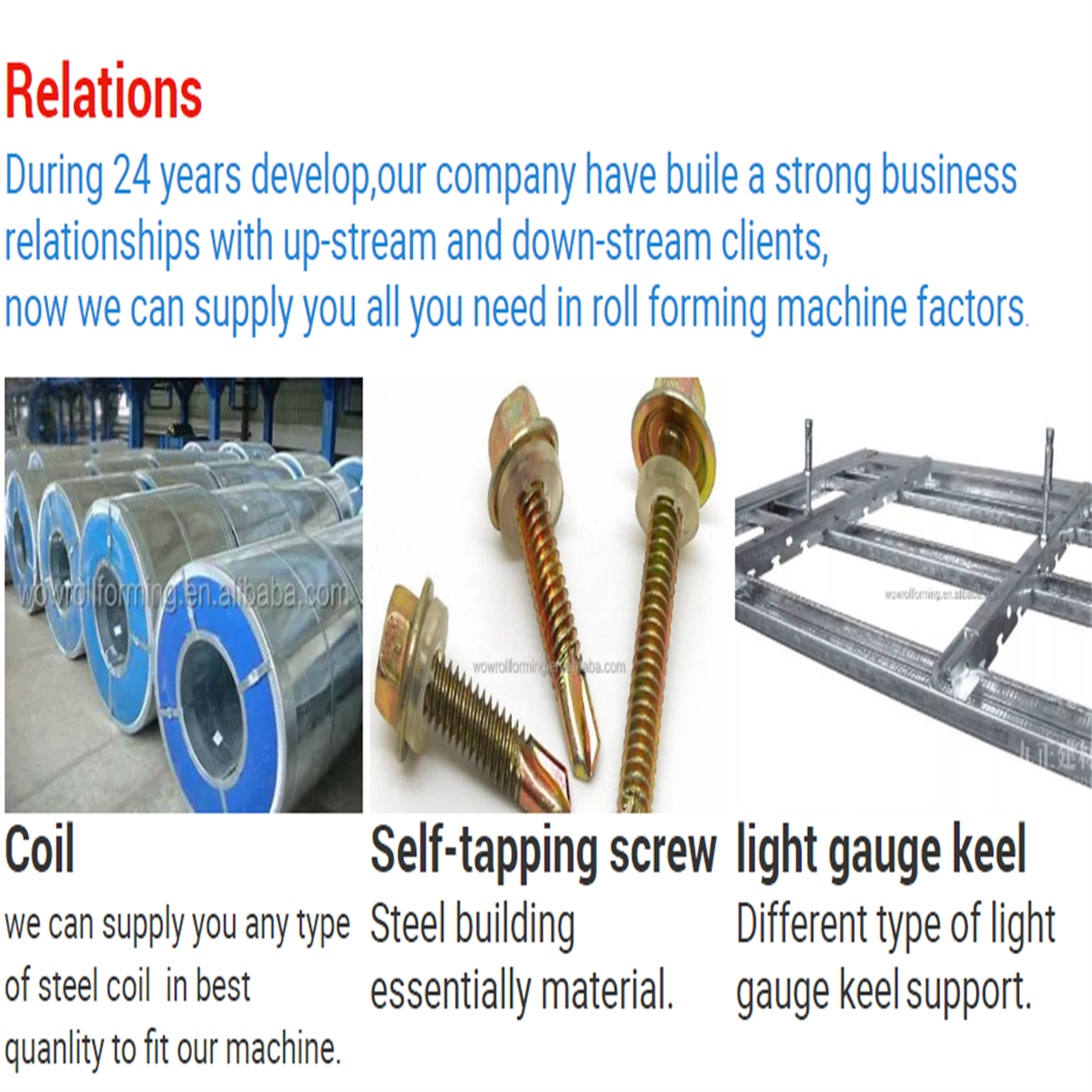
Hebei Xinnuo Roll Forming Machine Co., Ltd., not only produce different types of professional roll forming machines, but also develop intelligent automatic roll forming production lines, C&Z shape purline machines, highway guardrail roll forming machine lines, sandwich panel production lines, decking forming machines, light keel machines, shutter slat door forming machines, downpipe machines, gutter machines, etc.
There are several advantages of using roll forming for your projects:
- The roll forming process allows operations such as punching, notching, and welding to be performed in-line. Labor cost and time for secondary operations are reduced or eliminated, reducing part costs.
- Roll form tooling allows for a high degree of flexibility. A single set of roll form tools will make almost any length of the same cross-section. Multiple sets of tools for varying length parts are not required.
- It can provide better dimensional control than other competing metal forming processes.
- Repeatability is inherent in the process, allowing easier assembly of roll formed parts into your finished product, and minimizing problems due to “standard” tolerance build up.
- Roll forming is typically a higher speed process.
- Roll forming offers customers a superior surface finish. This makes roll forming an excellent option for decorative stainless steel parts or for parts requiring a finish such as anodizing or powder coating. Also, texture or pattern can be rolled into the surface during forming.
- Roll forming utilizes material more efficiently than other competing processes.
- Roll formed shapes can be developed with thinner walls than competing processes
In modern construction and manufacturing, the roll forming machine (commonly known as a roof tile or sheet metal roll former) has revolutionized profile fabrication. By replacing labor-intensive traditional press brake methods, advanced roll forming technology offers unmatched efficiency, quality, and cost savings for metal roofing and wall panel production.
Here are the key advantages of implementing a modern roll forming machine in your operations:
1. Unmatched High Efficiency and Output Speed
High-speed roll forming lines operate continuously, producing custom metal panels at speeds up to 20–40 meters per minute. This automated process significantly shortens lead times and accelerates project delivery cycles.
2. High Precision and Consistent Quality
Engineered with heavy-duty steel frames, high-precision roller dies, and PLC automated control systems, roll formers deliver pinpoint dimensional accuracy. Every panel exhibits uniform thickness, sharp profiles, and precise hole punching, ensuring seamless job-site installation.
3. Material Efficiency and Reduced Waste
Continuous roll forming minimizes scrap metal generation compared to conventional stamping. Precise coil feeding and automated hydraulic flying shears ensure optimal material utilization and reduced raw material costs.
4. Low Maintenance and Extended Durability
Constructed with heat-treated chrome-plated rollers and robust drive systems, industrial roll forming machines require minimal downtime while delivering a long service life under heavy daily operation.
Conclusion
Investing in a reliable roll forming machine boosts productivity, lowers labor costs, and guarantees consistent product quality—delivering maximum long-term return on investment (ROI) for metal fabrication businesses.
Metal roll forming is a continuous, automated metal fabrication process used to shape long strips of sheet metal (usually coiled steel or aluminum) into specific, uniform cross-sectional profiles.
Unlike traditional metal bending techniques like press braking—which shapes sheets batch by batch—roll forming operates as a continuous production line, making it one of the most efficient manufacturing methods for structural profiles, roofing panels, and automotive components.
How the Metal Roll Forming Process Works
The process passes coil stock through a series of consecutive roller dies to incrementally shape the metal into a finished cross-section:
-
Uncoiling: A heavy coil of sheet metal (often pre-painted, galvanized, or stainless steel) is mounted onto a decoiler and fed continuously into the line.
-
Progressive Forming: The strip passes through a sequence of mating roller stations (known as flower patterns). Each set of rollers gradually bends the metal by a few degrees. By making incremental bends, the process avoids overstressing the material or cracking protective coatings.
-
In-Line Processing (Optional): Pre-punching, post-punching, slitting, or embossing can be integrated directly into the automated line before or after forming.
-
Cutting to Length: Once the final profile is shaped, an automated flying shear or hydraulic cutter cuts the continuous panel into precise custom lengths without interrupting the line speed.
Key Advantages of Metal Roll Forming
-
Continuous High Output: Roll forming lines operate at high speeds (typically 20–50 meters per minute), significantly outperforming press brakes for mass production.
-
Tight Dimensional Tolerances: Advanced PLC automation and precision-machined rollers ensure strict dimensional consistency across every piece produced.
-
Material & Cost Efficiency: Minimizes scrap metal waste and eliminates extra handling steps by integrating punching, bending, and cutting into a single automated line.
-
Design Flexibility & Surface Protection: Capable of producing complex, multi-bend profiles while preserving surface finishes, galvanization, and paint coats.
Common Applications
Metal roll forming is widely used across multiple heavy-duty industries:
| Industry | Common Roll-Formed Products |
| Building & Construction | Trapezoidal roof tiles, standing seam panels, C/Z purlins, drywall studs, rain gutters |
| **Automotive &# What is Metal Roll Forming? |
Metal roll forming is a continuous, high-volume manufacturing process that bends long strips of sheet metal—usually coiled steel or aluminum—into custom cross-sectional profiles.
Unlike traditional press braking or stamping, which processes metal in single discrete batches, roll forming shapes metal incrementally at room temperature (cold forming) through a series of consecutive roller dies.
How Metal Roll Forming Works
The roll forming process relies on a line of paired roller stations that gradually shape the metal in steps:
-
Coil Unloading & Uncoiling: A heavy coil of flat metal strip is loaded onto an uncoiler and fed continuously into the machine.
-
In-Line Pre-Punching: Automatic presses notch, punch holes, or create slots in the flat strip prior to shaping.
-
Progressive Roll Shaping: The strip passes through multiple sets of upper and lower rollers (called roll stations). Each station bends the metal slightly more than the previous one, preventing stress fractures and material strain.
-
Cutting & Shearing: A flying hydraulic shear cuts the finished profile to exact target lengths without stopping the continuous line.
Key Benefits of Roll Forming
-
High Speed & Efficiency: Lines operate at speeds up to 20–50 meters per minute with minimal manual labor required.
-
Consistent Quality & Precision: Heavy-duty tool steel rollers controlled by PLC automation ensure exact tolerances across thousands of identical panels.
-
Material Waste Reduction: Continuous coil processing generates virtually zero scrap compared to conventional sheet stamping or trimming.
-
Complex Profiles: Produces intricate shapes—such as standing seam panels, hat channels, C/Z purlins, and tubular sections—in a single continuous pass.
Common Applications
-
Building & Construction: Roof tiles, wall cladding panels, gutters, structural purlins, and steel framing studs.
-
Automotive: Bumper beams, door impact bars, and chassis structural rails.
-
Solar & Energy: Solar panel mounting racks and support structures.
-
Storage & Industrial: Warehouse racking systems, shelving, and heavy-duty tracks.
-
manual sheet metal curving machine tile manufac...
-
Arch Sheet Roll Forming Machine for Middle East...
-
Arch Bending Machine | High Precision Steel Arc...
-
manual sheet metal curving machine tile manufac...
-
Middle East Desert-Ready Arch Sheet Machine | 1...
-
Hydraulic arch crimping curving roofing machine...