

1. Executive Summary
Hebei Xinnuo Roll Forming Machinery Co., Ltd. (河北鑫诺压瓦机械有限公司, successor to Huayu Roll Forming Machine Factory 华宇压瓦机厂) has put the cutting stage at the centre of its composite panel offer. The XN-BS flying band saw cuts 50–200 mm thick insulated panels, up to 1200 mm wide, to lengths from 1,000 to 12,000 mm within ±1 mm and ±0.5 mm squareness, with the saw carriage accelerating to line speed before the blade enters the panel — so the lamination line never stops to make a cut.
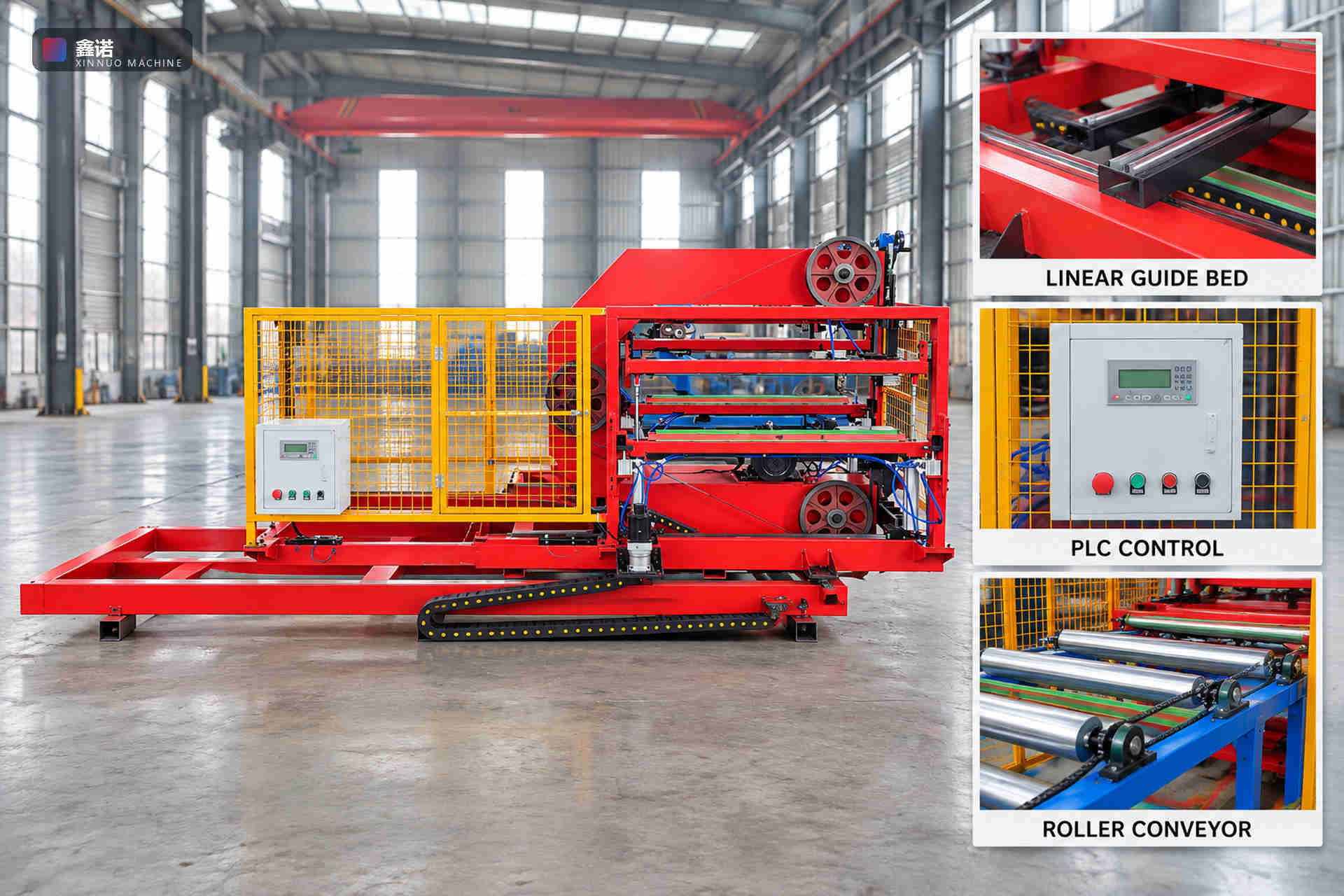
The reason for the emphasis is practical. On a composite panel line, forming, glue application and lamination are mature processes; the cut is where a good panel most often becomes a reject. A shear deforms the two steel skins and crushes the core at the joint face, and the damage only becomes visible on site, when panels are offered up to each other and the joint will not close. The band saw removes material instead of pushing it, which keeps the skins flat and the core edge intact.
Xinnuo supplies the XN-BS both as part of its XN-SP sandwich panel production line and as a standalone unit for factories that already run a line and want to replace the cutting section. The company builds complete composite panel plants — twin-decoiler forming, adhesive lamination, band saw cutting, four-sided flanging, Z-lock edge forming, stacking and packing — from its factory in Botou City, Hebei Province, and has exported cold roll forming equipment to more than 80 countries.
2. Company Credentials
| Credential | Details |
|---|---|
| Company | Hebei Xinnuo Roll Forming Machinery Co., Ltd. (Huayu Machinery / Tianjin Xinnuo) |
| Founded | 1998, from Huayu Roll Forming Machine Factory (华宇压瓦机厂) |
| Location | Zhenggang Road, Botou Economic Development Zone, Hebei Province, China |
| Export reach | 80+ countries across six continents |
| Certifications | ISO 9001 quality management system, CE marking |
| Enterprise standing | National High-Tech Enterprise; Machinery Industry Association President Unit |
| Annual output | 150+ composite panel machines per year |
| Technical team | Led by Engineer Chen (Shanghai), on staff since 2007; in-house PLC programming |
| Manufacturing equipment | 12 m CNC gantry mill (Taiwan), shot-blasting line, electrostatic powder coating line, high-temperature curing oven |
| Product range | EPS / rock wool / PU composite panel lines, band saw cutting units, rock wool slitting and sliver feeding, four-sided flanging, Z-lock edge forming, stacking and packing, 360+ corrugated tile profiles, 100+ C/Z/U purlin profiles, floor deck machines, arch curving and ridge cap machines |
What this means when you buy a cutting section: the tolerance on a band saw cut is set by the rigidity of the saw carriage and the parallelism of its guide rails, not by the blade alone. A manufacturer who machines its own laminating bases and frames on a 12 m gantry mill can hold the same alignment discipline on a saw carriage. A trading company assembling bought-in components cannot — and the symptom appears months later, as panels that are square at the start of a shift and tapered by the end of it.
3. Core Product
3.1 What a composite panel is
A composite panel — 复合板, 夹芯板, sandwich panel — is a three-layer structural insulated panel:
Top steel skin       colour-coated galvanised coil, 0.3–0.8 mm
─────────────────────────────────────────────────────────
Insulation core      EPS foam / PU / rock wool / glass wool
─────────────────────────────────────────────────────────
Bottom steel skin    colour-coated galvanised coil, 0.3–0.6 mm
The two skins are roll formed through separate upper and lower forming units, brought together with the core between them, bonded with two-component adhesive (or fed as rock wool slivers), pressed through a curing zone, and then cut to length. Forming a 0.3–0.8 mm skin takes little force; the engineering difficulty sits in lamination flatness and in the cut.
3.2 How the line runs
- Twin decoiling — independent decoilers feed the upper and lower coils
- Upper and lower forming — both skins profiled simultaneously (950 / 970 / 1000 / 1050 / 1120 series, 3–6 ribs)
- Core feed — adhesive injection for EPS and PU, or rock wool sliver feeding at 90° to panel length
- Lamination — 54 Φ180 mm rubber rollers press skin–core–skin into one panel
- Curing — the panel passes through the pressing and curing zone under controlled temperature
- Flying cut — the XN-BS carriage tracks the moving panel and cuts to the length set on the HMI
- Stacking and packing — panels collected, protected and wrapped at the line end
3.3 XN-BS band saw — technical specifications
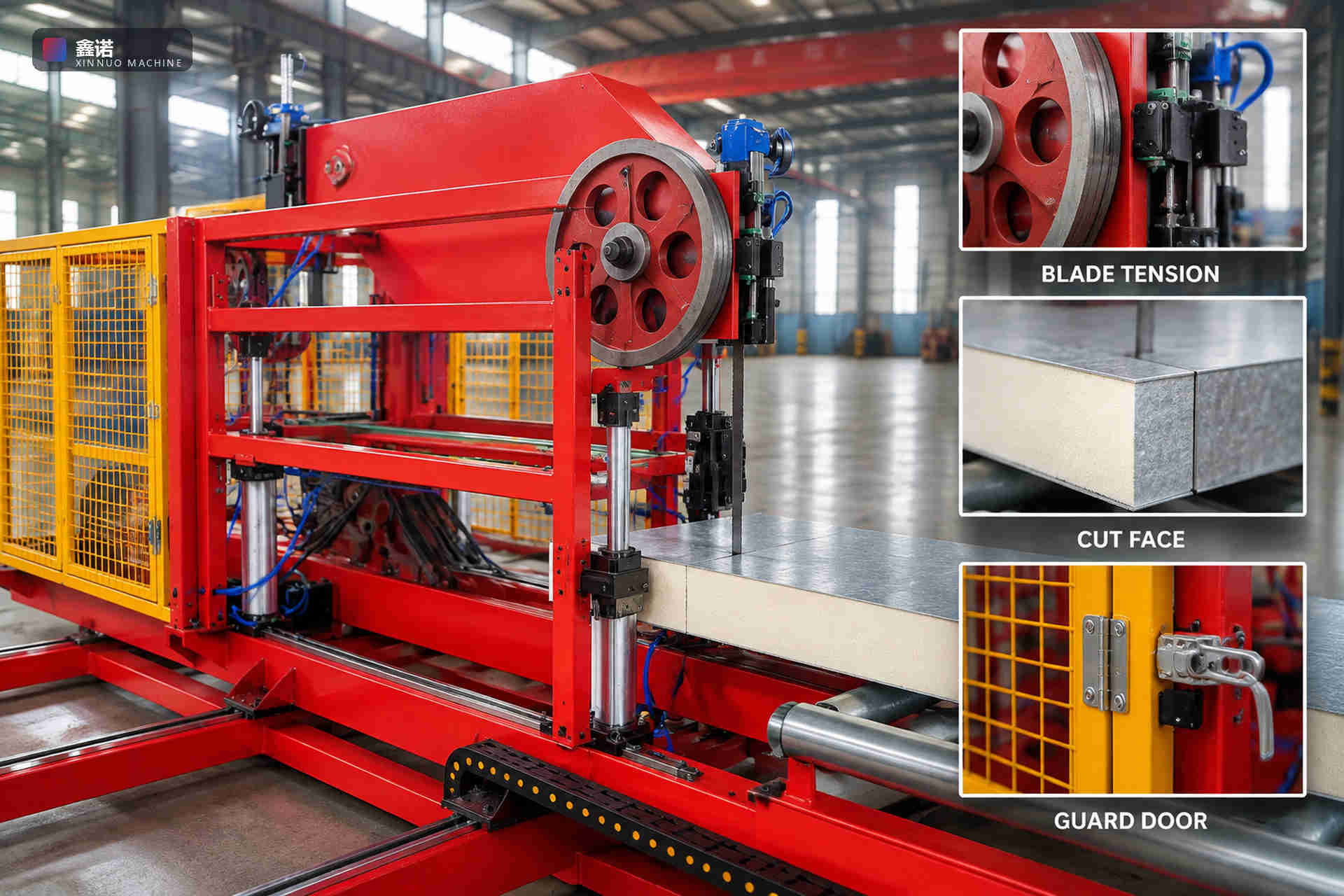
| Parameter | Value |
|---|---|
| Panel thickness | 50–200 mm |
| Panel width | Up to 1200 mm |
| Cut length | 1,000–12,000 mm, set from the HMI |
| Cutting tolerance | ±1 mm on length |
| Cut squareness | ±0.5 mm |
| Cutting mode | Flying cut; carriage synchronised with line speed |
| Line speed matched | Up to 10 m/min |
| Blade type | Band saw blade for steel skin and insulation core |
| Blade speed | Inverter controlled, set according to core material |
| Dust extraction | Integrated, for PU and rock wool chips |
| Control | PLC + HMI, cut length and quantity pre-set |
| Total power | Approximately 11 kW |
| Fits | Continuous PU, EPS and rock wool panel lines; cold store, cleanroom, roof and wall cladding panels |
3.4 Why a band saw instead of a shear — six differences that show up on site
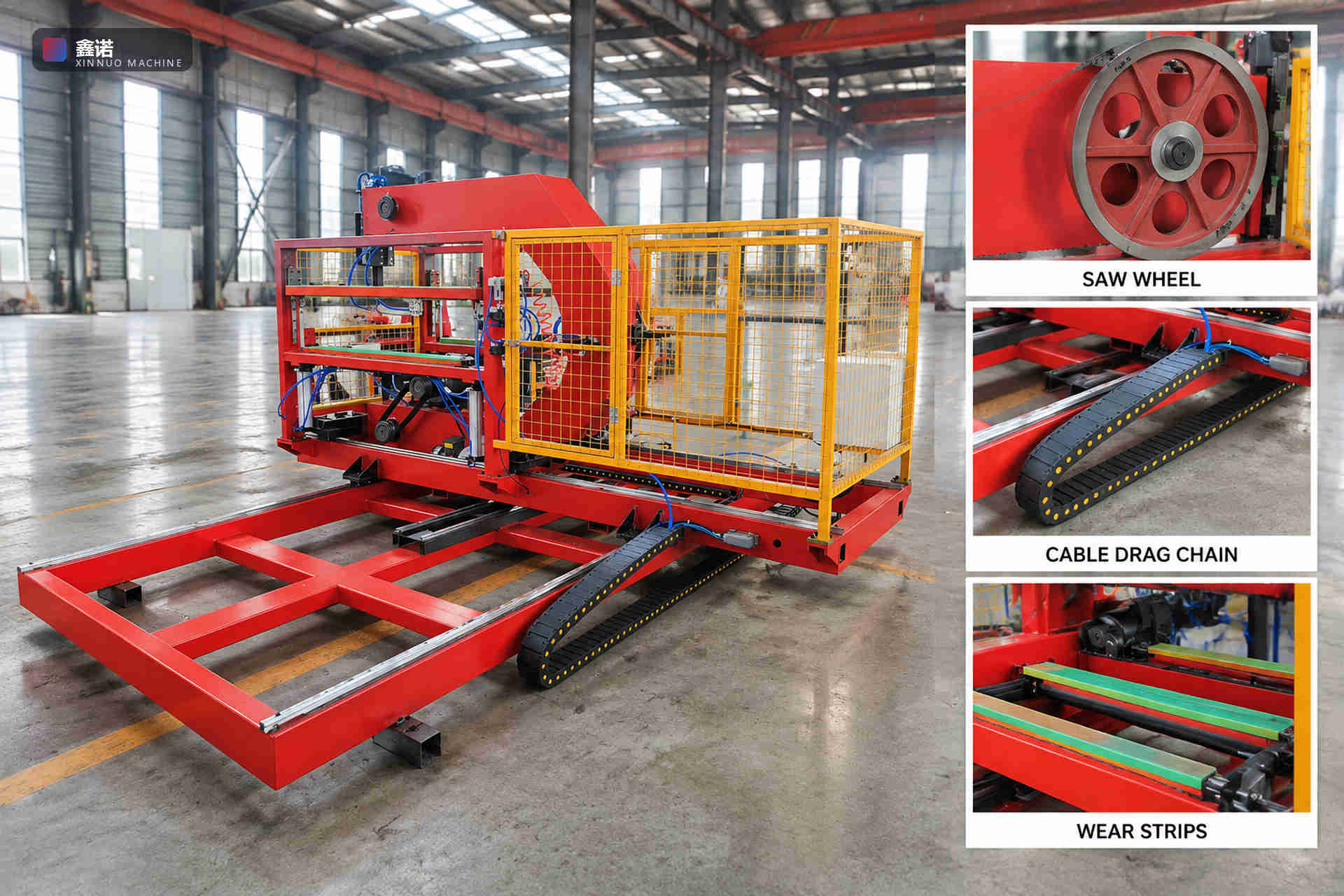
① The cut removes material, it does not deform it. A shear pushes the two skins through the core; the skins bow at the cut face and the core edge crushes. The panel is the right length but the edge is no longer the edge it was designed to be. A band saw takes a kerf out of the panel, so both skins stay flat and the core keeps its cell structure at the joint.
② The joint closes. On cold store and cleanroom projects the panels are pushed together with a gasket or a tongue-and-groove profile; a crushed or dusty edge will not seat. Cutting with continuous extraction takes the PU and rock wool debris away as it is produced, instead of leaving it in the joint where it prevents the seal.
③ The line does not stop. The carriage accelerates to line speed before the blade engages. Cutting happens while the panel is moving, so the lamination line holds its rhythm and the cured panel is not exposed to a stop-start cycle that shows up as a pressure mark.
④ Squareness is a machine property, not an operator skill. ±0.5 mm squareness comes from the carriage tracking the line and the blade running in a fixed plane relative to that carriage. The operator sets a length on the HMI; the geometry is repeated cut after cut.
⑤ One blade setting does not suit every core. Blade speed is inverter controlled and set by core material — PU, EPS and rock wool behave differently under the same blade. Running rock wool at a PU blade speed is how edges start to tear.
⑥ 50–200 mm in one unit. Insulated panels for cold rooms, industrial doors and modular buildings are thick; the XN-BS range covers that thickness band without a change of machine, up to 1200 mm in width.
3.5 The 8 core advantages of the XN-SP composite panel line
① 0.05 mm laminating base. The glue-roller base is machined in one pass on a 12 m gantry mill to 0.05 mm flatness — four times tighter than the ±0.2 mm industry norm — which sets roller parallelism and therefore panel flatness.
② 54 × Φ180 mm grade-A laminating rollers. Industry machines typically use 32–40. More rollers mean a longer contact zone under pressure and a stronger bond; the rubber compound meets EU VOC requirements.
③ Patented one-way steel belt. A freewheel principle: active material feed, passive belt advance. Belt jamming — the chronic failure on bidirectional belt systems — does not occur, and the belt is adjustable on four axes.
④ Four-pump, dual-circuit adhesive system. Independent A and B delivery through dual motors and dual VFDs; adhesive savings of roughly 20% against single-circuit systems, with no starvation at the roller ends.
⑤ In-house programmed PLC. Delta PLC and VFDs, programmed by Xinnuo’s own engineers — a fault can be diagnosed over one video call instead of waiting for a third-party integrator.
⑥ 5.6 metric tons of machine. The main frame is built from 200 × 100 mm section; the machine weighs about 40% more than light-frame alternatives, which is what keeps a 12 m base flat over years of production.
⑦ Dual-cutting architecture. Separate cutting arrangements for EPS and for rock wool, with dust extraction included — the two cores do not share a compromise blade geometry.
⑧ 12-station edge forming. Up from the industry-standard 9 stations, on a 50 mm main shaft instead of 40 mm — the edge profile that carries the joint is formed, not pressed.
4. Complete Auxiliary Facilities
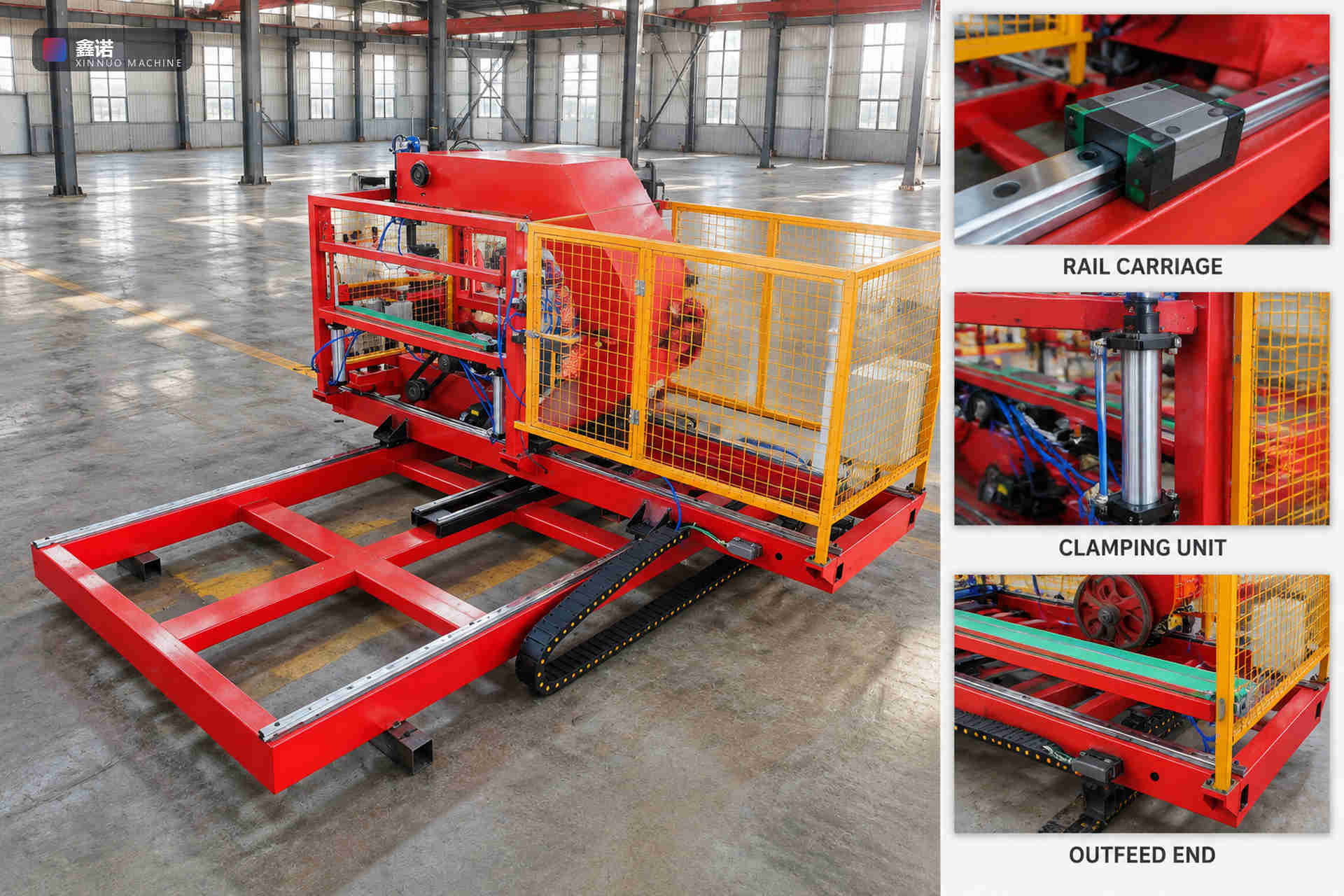
A composite panel plant is rarely one machine. Xinnuo supplies the line and the equipment around it from one works, so the interfaces — panel width, line speed, cut length, stacking height — are matched before shipment rather than on site.
Corrugated tile machines. 360+ proven profiles, 600–1,200 mm widths, 3–12 peaks, for the roof and wall sheets that sit alongside insulated panels in the same building.
Four-sided flanging machine (XN-FSF). Forms tongue and groove on all four edges of insulated panels, 50–200 mm thickness and 950–1150 mm width, with edge forming held to ±0.3 mm and controlled core set-back; speed matched to the 3–10 m/min line, with PLC recipe storage.
Z-lock edge forming (XN-ZL). Metal-to-metal Z-lock edge roll formed within ±0.3 mm with a gasket groove, panel thickness held to ±1 mm across PU, EPS, rock wool and PIR cores.
Rock wool slitting and sliver feeding. Rock wool slab is slit and fed as slivers at 90° to panel length, with feed rate synchronised to line speed — the difference between running rock wool as a core and fighting it.
Stacking and packing. Automatic collection and wrapping at the line end, so that panels cut to ±1 mm are not distorted by manual handling afterwards.
Decoilers and handling. Cantilever 3 t and A-frame 5 t decoilers, single, dual and quad configurations, matched to the twin-coil requirement of a composite line.
One-stop advantage. A single supplier owns the whole interface chain: the forming units, the lamination base, the saw carriage and the stacker were designed to the same drawing standard and commissioned together. When a cut length drifts, there is one party to call.
5. Market Strategy — Why Buyers Are Re-Specifying the Cutting Stage
| What buyers report | What it usually means | What the XN-BS changes |
|---|---|---|
| “The length is right but the panels will not close” | Shear-deformed skins and crushed core at the joint face | Material-removal cutting keeps the joint geometry intact |
| “Our reject rate spikes on thick panels” | Shear force rises with thickness and core density | 50–200 mm cut by blade, not by force |
| “Rock wool panels come out with torn edges” | Blade speed set for PU, run on rock wool | Inverter-controlled blade speed set by core material |
| “Dust in the joint causes gasket failures” | No extraction at the cut | Integrated extraction at the point of cutting |
| “We lose output every time we change length” | Stop-to-cut cycle, manual measurement | Length and quantity pre-set on the HMI, flying cut |
| “Second supplier for cutting means two warranties” | Line from one works, cutter from another | One drawing standard, one commissioning, one contact |
What buyers actually ask on the first call. Three questions repeat: what thickness and width can the saw take in one pass; how is squareness held while the panel is moving; and what happens to the dust. Those three answers decide whether a project goes to a band saw or to a shear line — not the price of the saw.
Delivery workflow. Requirement confirmation (panel width, thickness range, core type, target line speed, cut length range) → layout drawing and utility schedule → manufacture and in-house run test with panels → pre-shipment inspection with the buyer’s inspector present or by video → shipment → on-site installation and commissioning with operator training → remote support on PLC and mechanics.
6. Equipment Operation & Safety
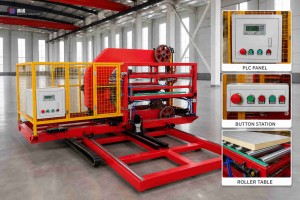
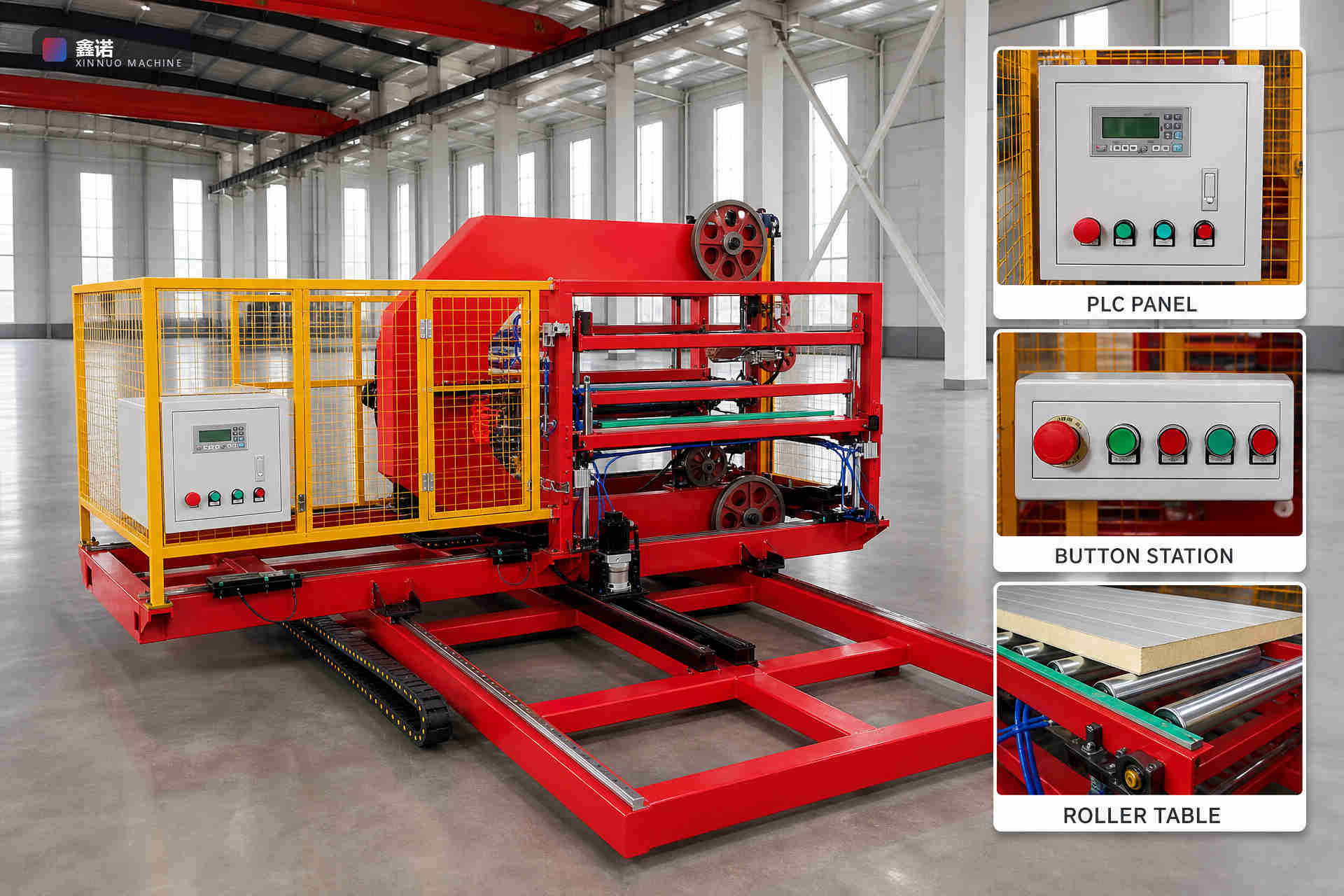
6.1 Daily checklist (start of shift)
| Check | What to look for | Action if out of spec |
|---|---|---|
| Blade condition | Missing teeth, cracks at the weld, glazed kerf | Replace blade before production |
| Blade tension / air pressure | Tension below the setting mark; air pressure below spec | Restore tension and pressure before cutting |
| Blade tracking | Blade riding off the wheel centre line | Re-track and re-check the guide blocks |
| Carriage synchronisation | Carriage hesitating or lagging the panel at engage | Stop the line; check the synchroniser and encoder |
| Cut length calibration | First panel of the shift measured at both ends | Re-enter calibration before running the batch |
| Dust extraction | Reduced suction, blocked duct, full bin | Clear the duct and bin; never cut rock wool with extraction off |
| Guarding and interlocks | Guards in place, interlocks live | Do not run |
| Stacker and run-out | Clear of obstruction, panel path free | Clear before start |
6.2 Monthly maintenance
- Inspect the blade guide blocks and thrust bearings for wear and replace as a set
- Check carriage rail parallelism and clean and re-lubricate the rails
- Verify the encoder coupling and synchroniser response against line speed
- Clean the extraction ducting fully, including the bend sections where rock wool fibre collects
- Check the inverter parameters against the core-material settings recorded for each product
- Torque-check the blade wheel mounts and the carriage clamping bolts
- Record all findings; a repeated blade break at the same position is a tracking problem, not a blade problem
6.3 Ten safety rules
- Only trained operators run the saw; training is part of commissioning, not optional.
- Isolate and lock off before any work inside the cutting zone — blade change included.
- Never reach into the carriage path while the line is running or the carriage is under power.
- Keep both blade guards and the extraction hood in place; they are not for access.
- Wear eye protection and cut-resistant gloves; rock wool fibre requires long sleeves and respiratory protection.
- Do not wear loose clothing, ties or jewellery near the blade or the carriage drive.
- Never cut material outside the specified thickness and width range — a bowed or oversized panel can bind the blade.
- Keep the floor around the saw clear of panels, offcuts and fibre; wet or fibre-covered floors cause falls.
- Treat a jam as a stop condition: isolate, then clear. Never free a jammed blade with the machine live.
- Record every blade change, jam and near-miss — the pattern is what prevents the next one.
7. Frequently Asked Questions
Q1: Why fit a band saw when a shear is cheaper? Because a shear changes the panel at the cut face. It deforms the steel skins and crushes the core, and the damage shows at installation as a joint that will not close. A band saw removes a kerf of material and leaves the skins flat and the core edge intact — which is what the joint geometry was designed around.
Q2: How is the cut kept square while the panel is moving? The saw carriage accelerates to line speed before the blade engages. Cutting therefore happens with zero relative velocity between carriage and panel, so the cut face is square within ±0.5 mm and the line does not stop.
Q3: What panel thickness and width does the XN-BS handle? 50–200 mm thickness and up to 1200 mm width, in cut lengths from 1,000 mm to 12,000 mm set from the HMI, to ±1 mm on length.
Q4: Is dust extracted during cutting? Yes — extraction is integrated at the cutting point for both PU and rock wool. Cutting rock wool without extraction leaves fibre in the joint face and in the working area, and both are avoidable.
Q5: Can it cut EPS, PU and rock wool on the same machine? Yes, with blade speed set for each core through the inverter. A single blade speed across all three is the usual cause of torn rock wool edges and smeared PU.
Q6: Can the XN-BS be fitted to a line we already run? It is supplied as a standalone unit as well as part of a Xinnuo line. The information needed is the panel width, thickness range, core type, existing line speed and the space available at the output end; the interface is confirmed on a layout drawing before the order.
Q7: What wears, and what does that cost in production time? The blade is a consumable, and blade life depends on core type and cut length — rock wool is harder on a blade than EPS. Guide blocks and thrust bearings wear more slowly and are replaced as a set. Both are covered in commissioning training, and spares are quoted with the machine so the first replacement is on the shelf, not on a ship.
8. Shipping & Packaging
Cutting units are shipped as a separate, rigid assembly rather than loose on the main frame: the saw carriage is blocked and braced inside its own transport frame so that rail alignment survives the container, and blades ship in an independent case so that nothing loads the teeth in transit. Electrical cabinets travel with desiccant and are sealed against humidity; the VFD and PLC documentation ships with the machine, not by email afterwards.
Documentation set: layout drawing, electrical schematic, PLC parameter list, operation and maintenance manual, and the spare-parts list used at commissioning. Wooden packing meets ISPM 15 for international shipment, and machines are photographed at each packing stage so that the shipped condition is on record.
9. Equipment Tiers
| Configuration | Scope | Suits |
|---|---|---|
| Cutting module | XN-BS flying band saw, dust extraction, HMI length and quantity control, interface to an existing line | Factories replacing a shear or a manual cutting station |
| Line with band saw | XN-SP composite panel line — twin decoilers, upper and lower forming, adhesive or core feed, lamination, curing, XN-BS cut, run-out | New panel plants producing one panel family |
| Turnkey plant | Line with band saw plus rock wool slitting and sliver feeding, four-sided flanging, Z-lock edge forming, stacking and packing, plus tile and purlin machines | Producers building a full insulated-panel and cladding offer |
Quotation follows the configuration: panel width, thickness range, core type, target line speed, cut length range and the degree of downstream automation all change the build. Xinnuo quotes against a confirmed specification rather than a catalogue list price.
10. About the Company
Hebei Xinnuo Roll Forming Machinery Co., Ltd. began in 1998 as Huayu Roll Forming Machine Factory in Botou City, Hebei Province — the centre of China’s cold roll forming industry. Nearly three decades later the same works builds composite panel lines, band saw cutting units and the auxiliary equipment around them: 360+ corrugated tile profiles, 100+ purlin profiles, floor deck machines, arch curving and ridge cap machines, decoilers and handling equipment.
The company is a National High-Tech Enterprise and a Machinery Industry Association President Unit, holds ISO 9001 and CE marking, and produces more than 150 composite panel machines a year. Its technical direction is led by Engineer Chen, who has been with the works since 2007, and its PLC and drive programming is done in-house — which is why a control fault is usually resolved on a video call rather than by an integrator’s site visit. Equipment built in Botou is running in more than 80 countries.
Post time: Nov-11-2026