

In multi-storey steel buildings, industrial plants and warehouses, floor deck panels play an important role in coordinating the floor system before concrete is poured. Effective width, rib geometry, steel grade and forming stability all influence installation efficiency and the fit between the deck panel and the building structure.
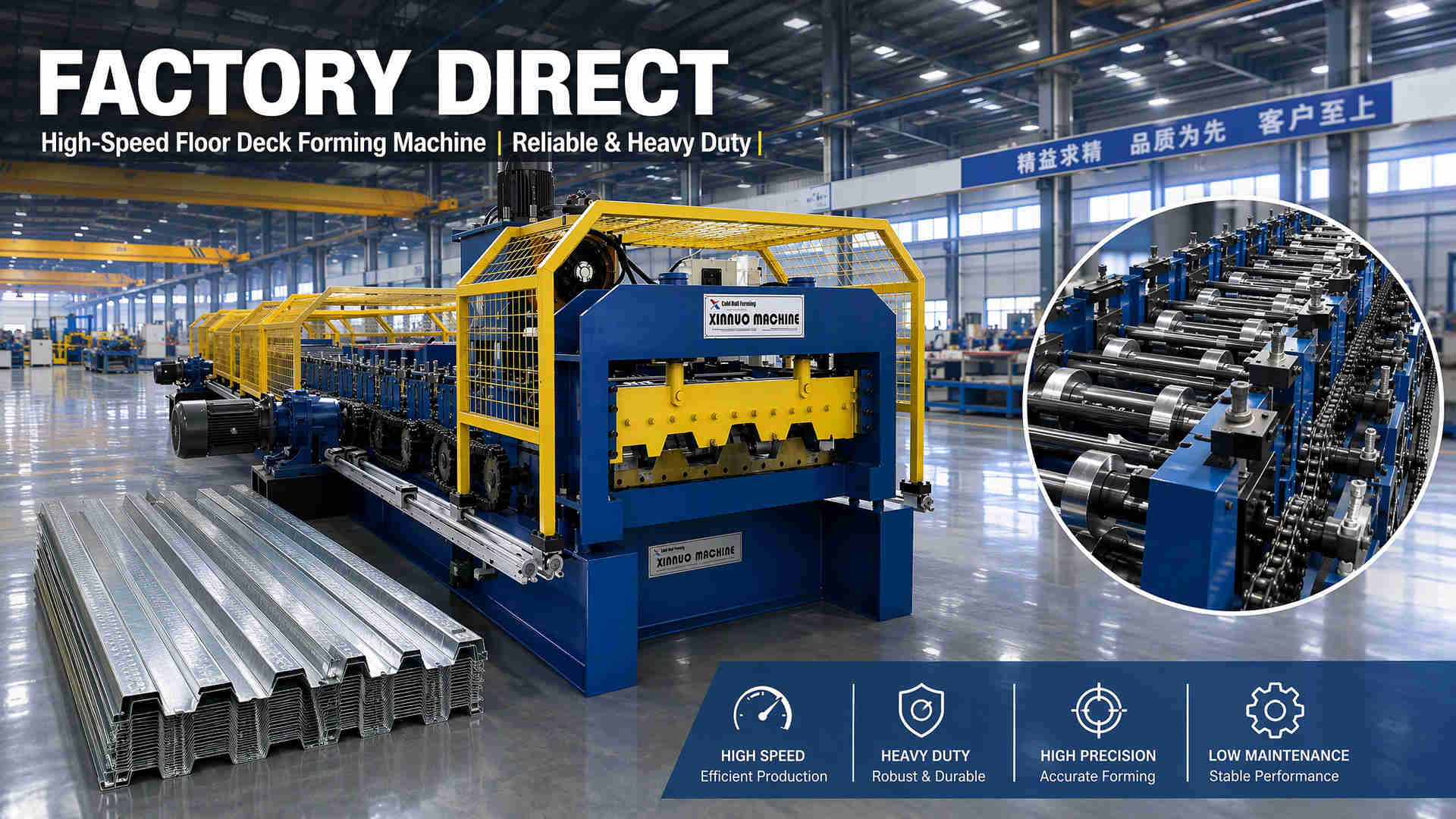
For 950-size floor deck production, Hebei Xinnuo Roll Forming Machinery Co., Ltd. provides equipment solutions that can combine the forming machine, decoiler, cutting system, conveyor and stacking unit. The configuration is selected according to the customer’s profile drawing, material specifications, production requirements and factory conditions.
The 950 Profile Must Be Confirmed Before Machine Selection
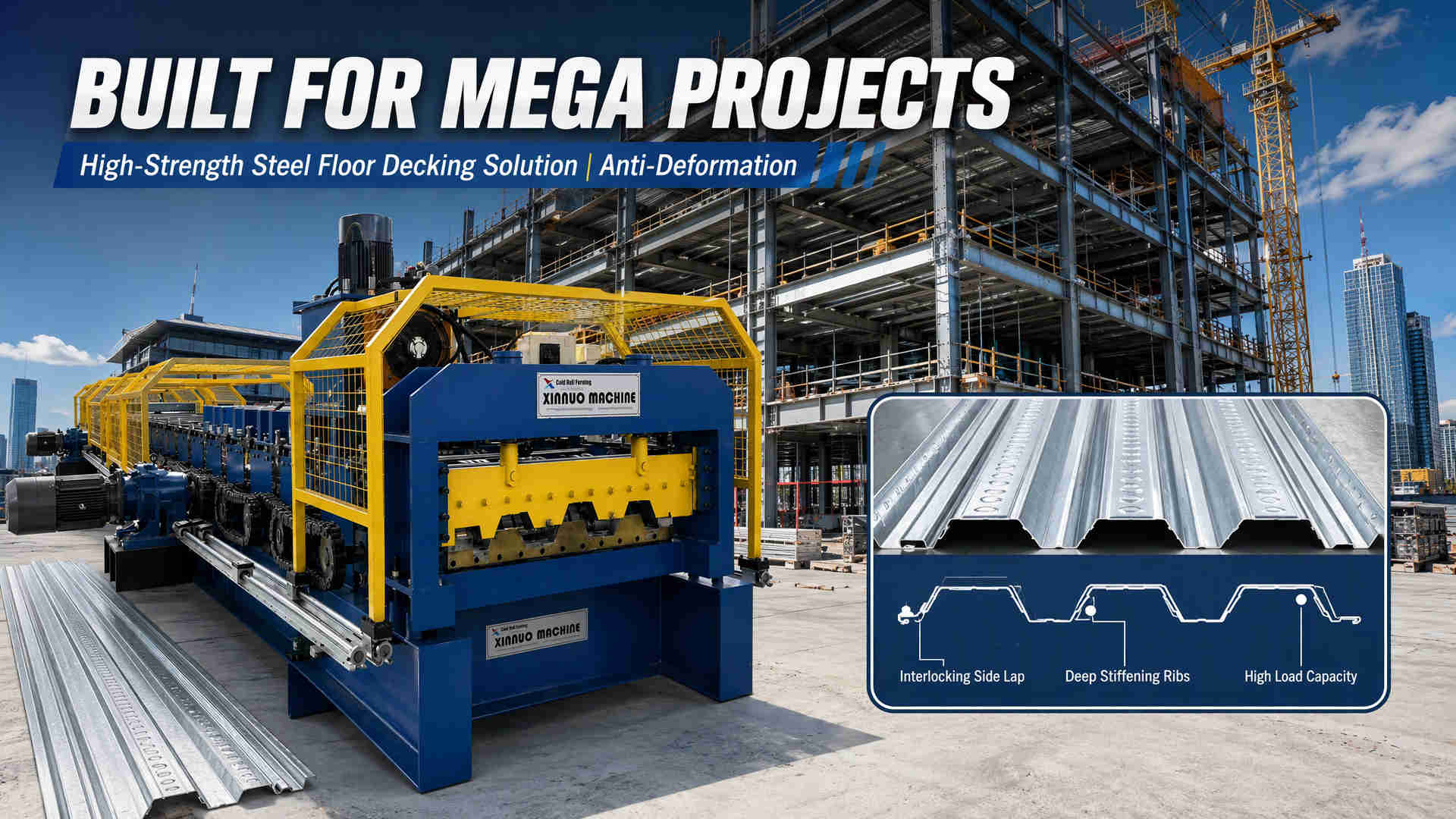
A floor deck machine should not be selected from the number “950” alone. In most projects, 950 refers to the effective coverage width of the finished panel. It is not the same as the steel coil entry width and does not indicate the length of the machine. Different cross-sections, rib heights, rib spacing and joint designs may require different entry widths, roll structures and forming stations.
Before confirming the machine, Xinnuo normally checks the customer’s profile drawing, steel grade, material thickness and expected output. If the project uses G550 high-strength steel, the material strength must also be checked against the selected cross-section. A standard roof panel machine should not be used as a substitute for equipment designed for floor deck production without an engineering review.
From Coil Entry to Finished Panel Stacking
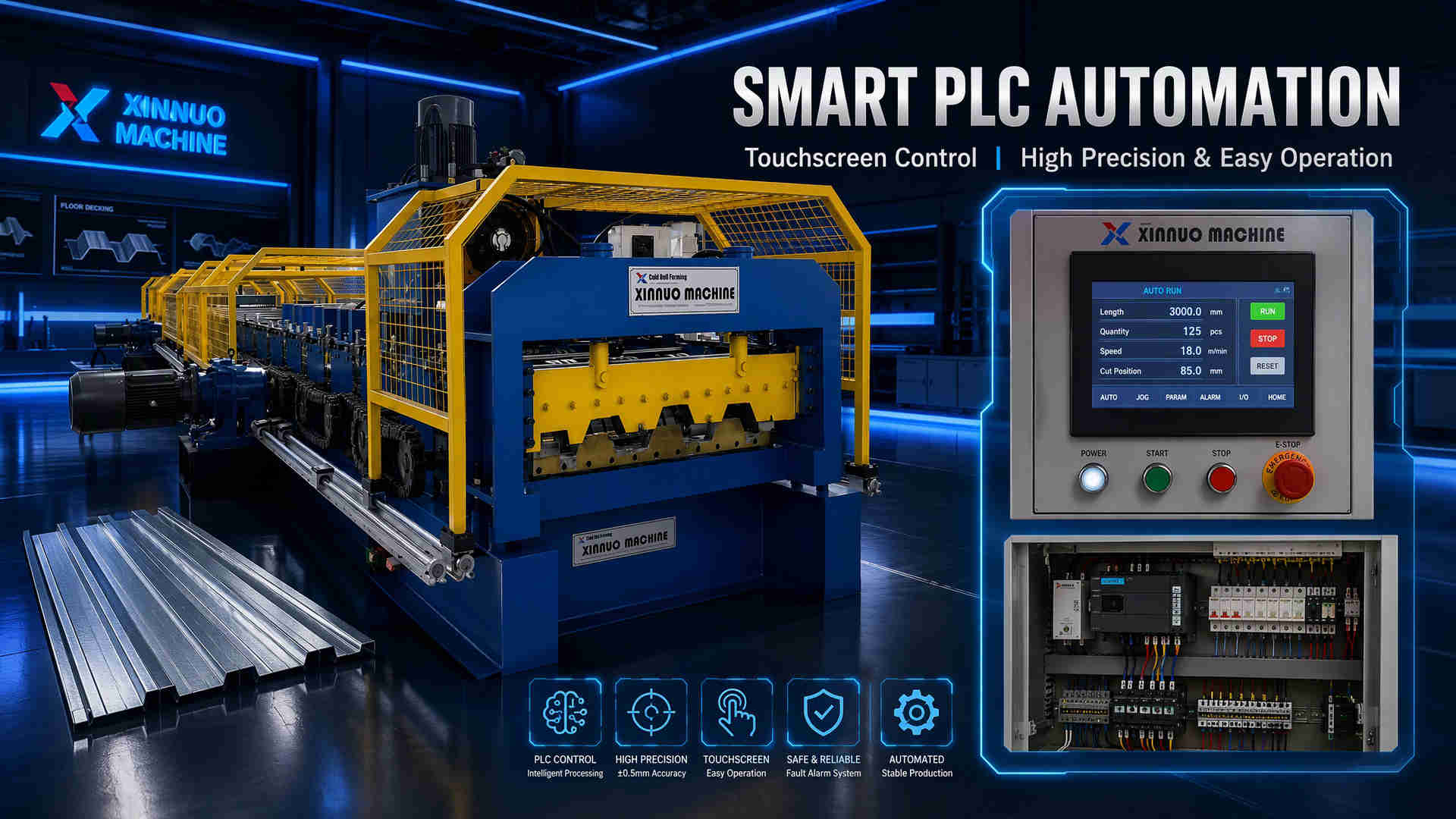
Production starts when the steel coil is fed into the forming line through the decoiling system. For heavier coils or longer production runs, a hydraulic decoiler and loading trolley can be added to reduce manual handling during coil loading.
The strip then passes through the guiding section and a series of forming rollers. Each station gradually creates the longitudinal ribs of the floor deck panel. This progressive forming method helps reduce deformation caused by a single heavy bending operation and supports more consistent rib geometry and panel straightness.
After forming, the hydraulic cutting system cuts the panel to the programmed length. The finished panels are then transferred to the receiving and stacking area. Depending on the production configuration, the panels may be collected manually or handled by an automatic stacking machine.
The equipment shown in the accompanying image uses a blue main frame with yellow components used to identify functional and safety areas. The front conveying and leveling section supports the sheet as it moves toward the following production stages.
Heavy-Duty Construction for Deep-Rib Panel Forming
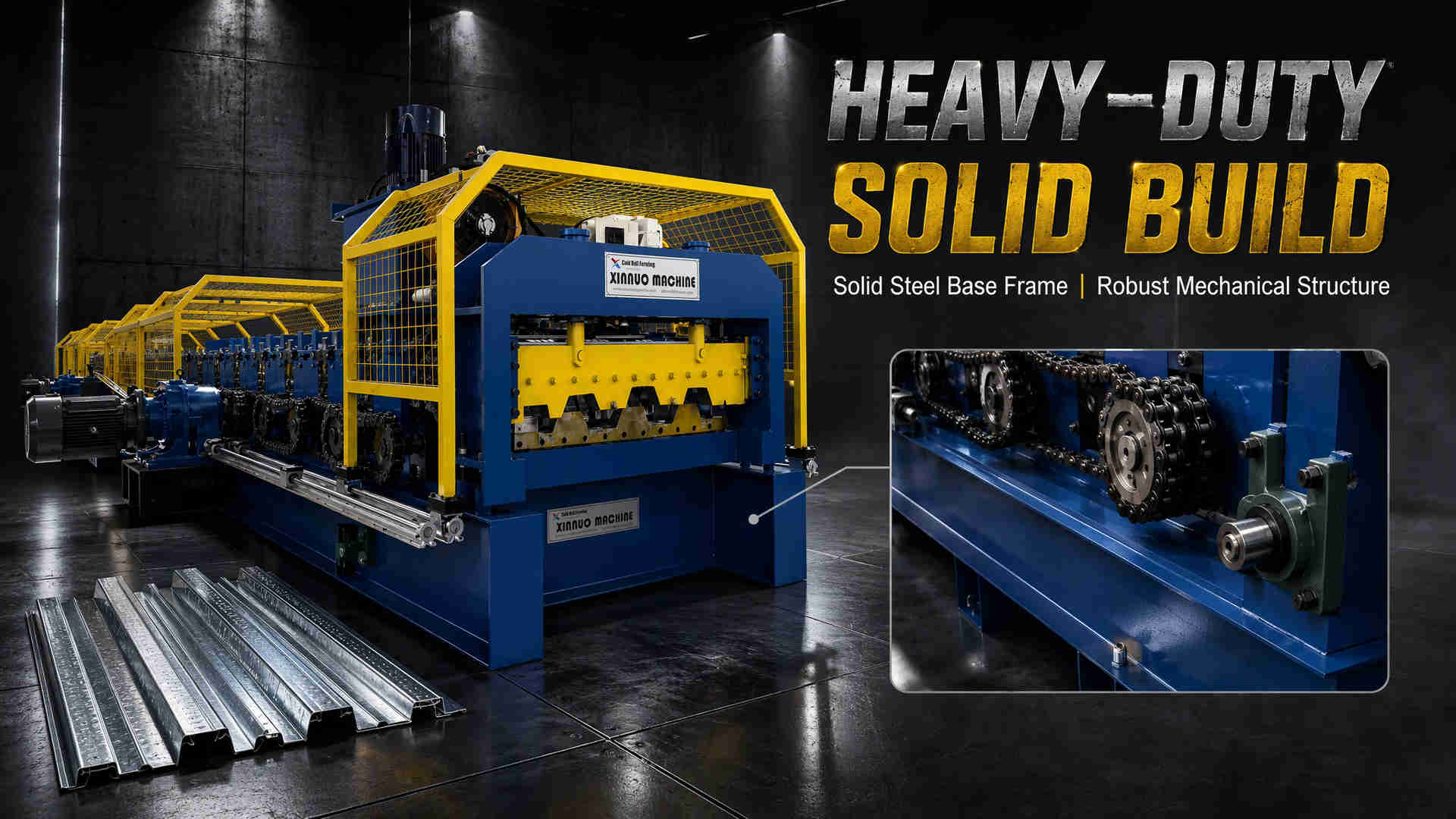
Floor deck machines generally operate under a heavier load than ordinary roof panel machines. Their design needs to consider material thickness, steel strength, rib depth and continuous operating time at the same time.
For floor deck projects, Xinnuo can configure a heavy welded frame, solid shafts, bearing-steel rollers and a suitable chain transmission system according to the confirmed profile. Frame rigidity and roller machining quality affect the straightness, rib consistency and long-term operating stability of the finished panels. Guiding components, side adjustment mechanisms and forming alignment should be checked during commissioning.
For export projects, the voltage, frequency, phase system, control language, protective devices, lifting points and container-loading method should be confirmed in the technical agreement. The final number of forming stations, motor power, production speed and cutting configuration depend on the customer’s profile drawing, material data and factory test results.
Hydraulic Decoiling and Automatic Stacking Can Be Matched to Output
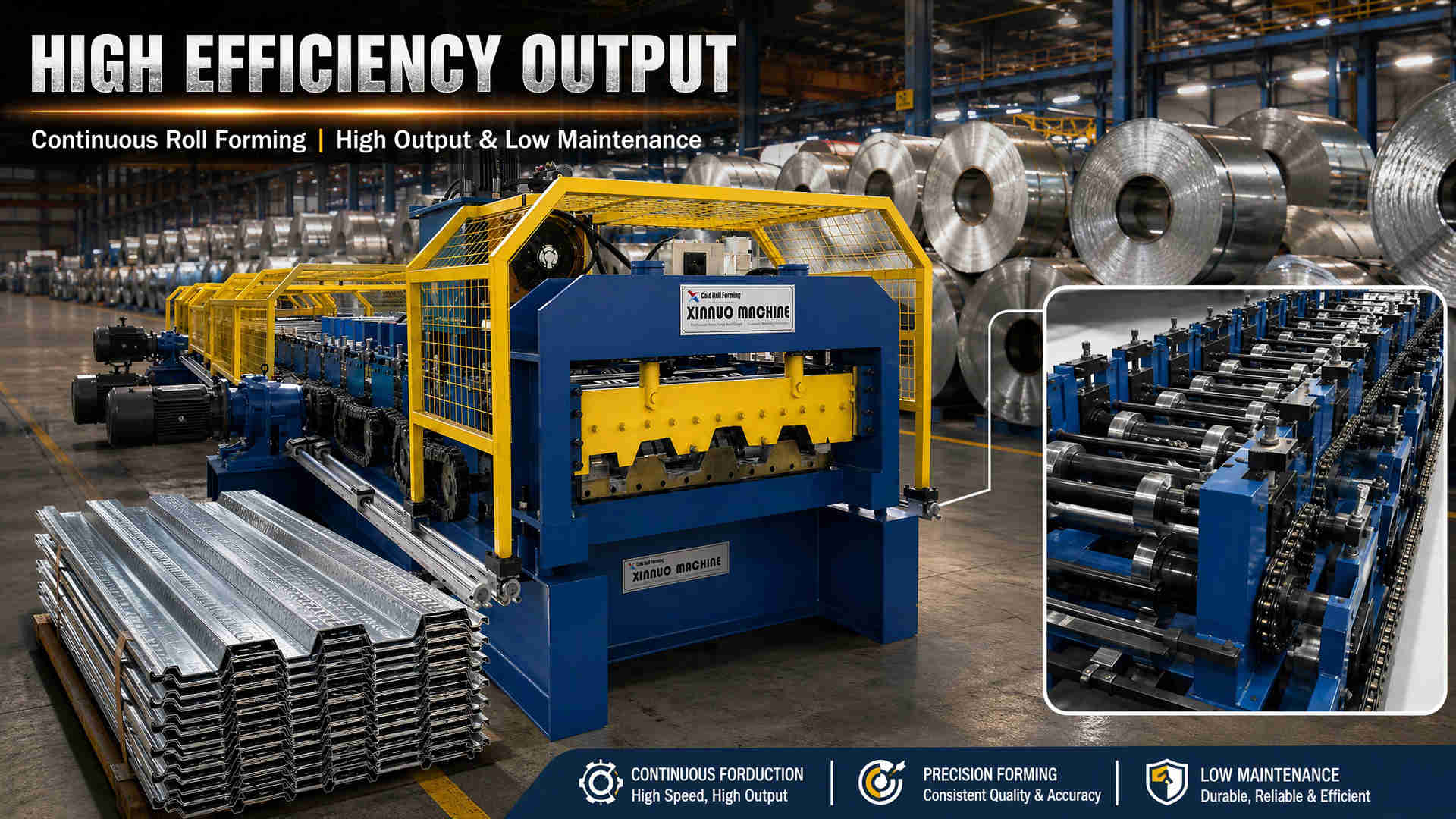
Not every 950 floor deck project requires a fully automated production line. For short batches and frequent changes in panel length, a forming machine with cutting and basic receiving equipment may be sufficient. When the steel coils are heavy or production is more continuous, hydraulic decoiling and automatic stacking can reduce manual handling and make the material flow more consistent.
An automatic stacker receives the cut panels and places them into orderly stacks according to the selected setting. This can reduce impact and disorder during handling, while making packing, loading and dispatch easier. The appropriate configuration depends on panel length, daily output, available factory space and the internal logistics route.
Equipment Support for Steel Building Material Manufacturers
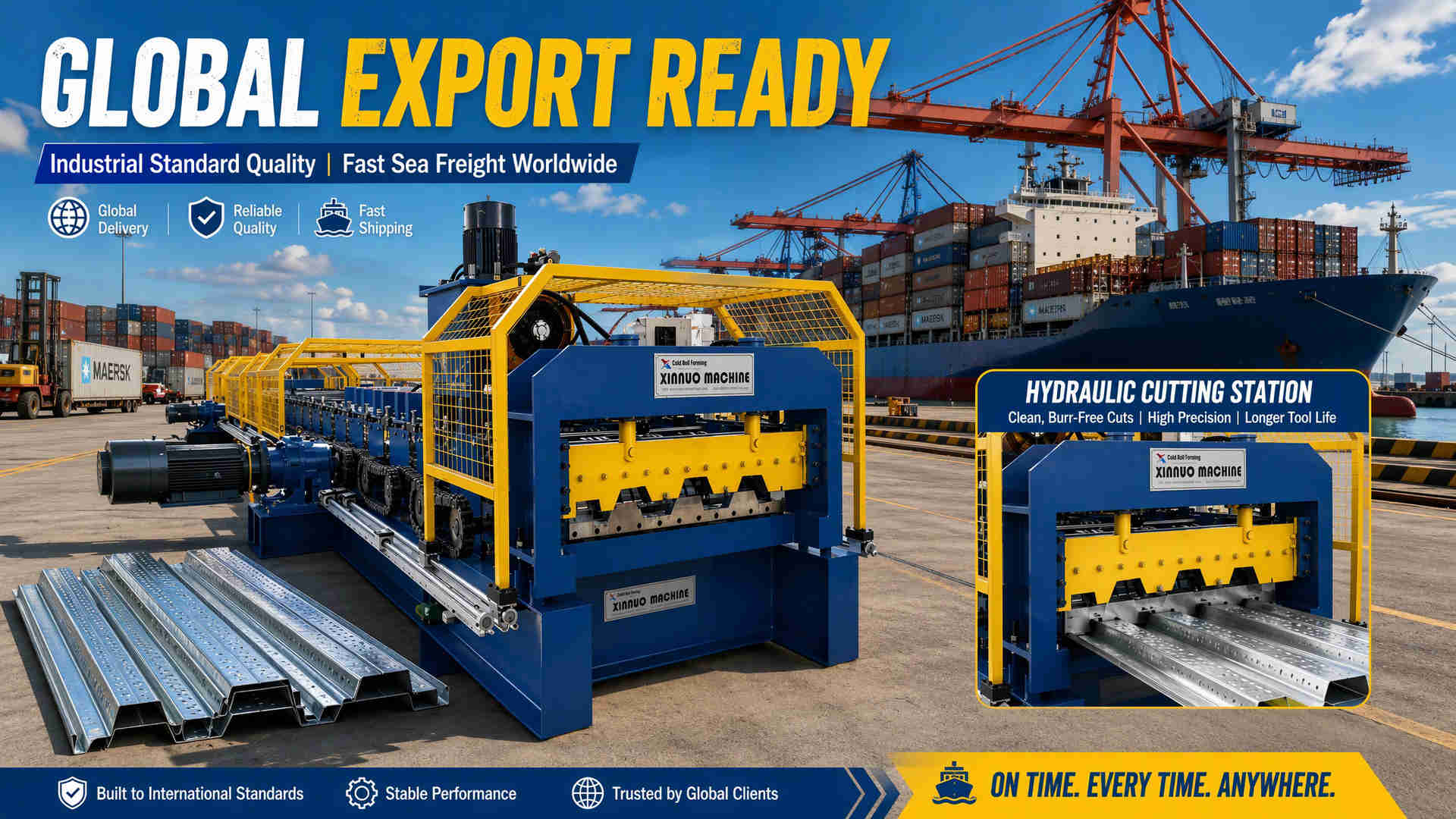
A 950 floor deck roll forming machine can be used for multi-storey steel buildings, industrial plants, warehouses and other projects requiring steel floor deck panels. For a building material manufacturer planning to expand its floor deck product range, the practical approach is to confirm the target profile and material first, then select the frame, forming stations, transmission, cutting system and downstream handling equipment.
Hebei Xinnuo Roll Form Machinery Co., Ltd. traces its manufacturing background to the Huayu Roll Forming Machine Factory, established in 1998. The company operates under the Huayu Machinery and Tianjin Xinnuo brands. Its products have been exported to more than 80 countries and regions, and the company holds ISO 9001 quality management certification and CE Marking. The actual performance and delivery scope of each floor deck machine remain subject to the technical agreement, factory test records and acceptance documents confirmed by both parties.
Information to Prepare Before Requesting a Quotation
To improve the accuracy of the machine proposal, buyers are advised to provide:
- A floor deck cross-section drawing or clear sample photographs;
- An explanation of what the 950mm dimension represents;
- The steel grade, strength and thickness range;
- Required panel lengths and length tolerance;
- Expected daily or monthly output;
- Steel coil weight, width and inner and outer diameter;
- Available factory length, width and lifting height;
- Local voltage, frequency and three-phase power requirements;
- Whether a hydraulic decoiler, loading trolley or automatic stacker is required.
The more complete the information, the easier it is to match the equipment to the actual production conditions. For high-strength steel, deep-rib profiles and export projects, the profile drawing and technical parameters should be confirmed item by item before the quotation is finalized.
The value of a 950 floor deck roll forming machine is not determined by one specification alone. It lies in the stable coordination of decoiling, forming, cutting, conveying and stacking. For steel building material manufacturers, confirming the profile and material first and then selecting the matching machine structure and automation level is generally more reliable than comparing the machine appearance or one price item in isolation.
Post time: Nov-17-2026