

Namibia Metal Roofing Trends 2026: A Guide to Metal Roof Panel Roll Forming Machines
Date: 5 October 2026 | Source: Xinnuo Roll Forming Machinery Co., Ltd.
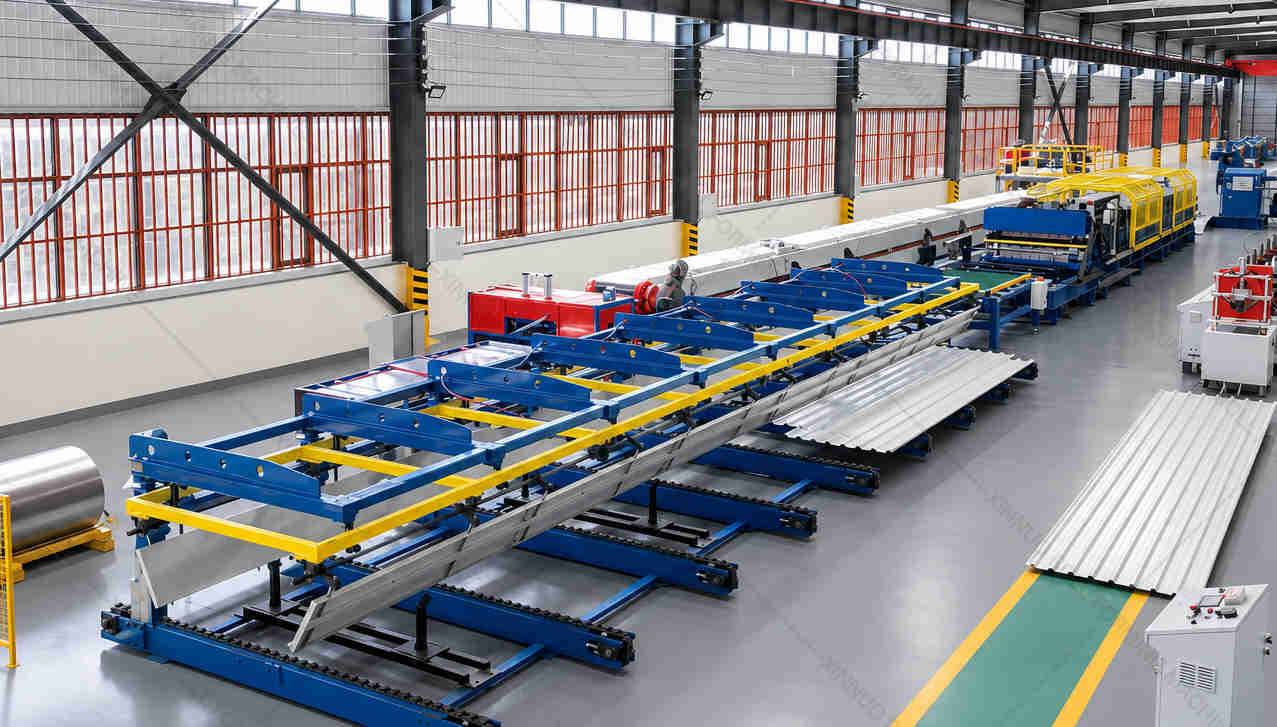
Namibia’s metal tile and metal roofing sector is moving through a period of rapid growth and trade-up. Strong ultraviolet radiation, coastal salt spray and wide day-night temperature swings, combined with a construction industry that is modernising quickly, have made metal roofing the country’s dominant roof choice. Every step of that upgrade — from plain galvanized iron sheets to alu-zinc and colour-coated steel, from traditional tile profiles to stone-coated tiles and concealed-fixed cladding — travels upstream as new demand for roll forming equipment. Thinner sheet, more precise coatings, wider panels and more complex interlocking edges all raise the bar for forming stations, frame rigidity, shaft accuracy and drive configuration.
Xinnuo Roll Forming Machinery Co., Ltd. reviews the panel trends now defining the Namibian market and the machine configurations that match them.
1. Market Background: Why Namibia’s Metal Roofing Market Is Upgrading
The shift in Namibia’s metal roofing market is not a matter of changing taste. It is driven by local climate and by the structure of the local supply chain.
| Driver | What it looks like on the ground | What it means for panels and forming equipment |
|---|---|---|
| Intense UV and heat | High solar exposure; roofs under constant sunlight | UV-resistant and heat-reflective surfaces required; coatings must survive forming undamaged |
| Coastal salt spray | Strong salt-laden wind in coastal port cities | Substrate upgrades from plain galvanized to alu-zinc coated steel |
| Inland dust and wide temperature swings | Abrasive dust; thermal expansion and contraction | Higher forming accuracy and profile rigidity |
| Construction modernisation | Demand spans economical housing to high-end residential, commercial and tourism projects | Shift from single profiles to multiple categories, wider panels and concealed fixings |
| Heavy import dependence | Local supply of building materials is largely sourced from abroad | Room for local processing and forming capacity to grow |
Together these forces are pushing Namibian roofing toward high weather resistance, heat reflection and greater visual variety at the same time.
2. Trend One: Alu-Zinc and Colour-Coated Steel Roof Sheet Replace Plain Galvanized Tile
Alu-zinc coated steel and colour-coated steel roof sheet, both with strong corrosion resistance, have become the substrate of choice for engineering projects and mid-to-high-end housing, steadily displacing plain galvanized iron tile. For equipment buyers, the practical question is which metal roof panel roll forming machine matches these substrates.
Matching equipment: colour-coated and alu-zinc roof panel roll forming machines (single-layer panel machines).
This is the most widely applied machine category in metal roofing. A steel coil is decoiled, roll formed and cut to length in a continuous pass to produce trapezoidal corrugated roof and wall panels. The profile is defined by four variables:
| Profile variable | Range |
|---|---|
| Effective width | 600–1200 mm |
| Peak count | 3–12 peaks |
| Peak height | 9–45 mm |
| Feed width | 750–1500 mm |
For the 840, 900, 1000 and 1050 profiles (5-peak) most commonly ordered for the Namibian market, the standard configuration is 14–16 forming stations, a 350H frame, Φ75–80 mm shafts, a 5# 4 kW main motor and 6-fen double-row chain, with a feed width of 1000–1220 mm. This configuration balances forming stability, panel flatness and output, and it is the baseline specification most frequently applied in export orders.
Coating-safe forming: what the machine has to get right. In a coastal salt-spray environment, substrate and coating selection decide service life, and a coating scratched or dented during forming loses most of its protective value. Three machine-side factors therefore carry the most weight:
- Roll surface finish — forming rolls are polished and kept free of burrs and build-up, so the coated face is never scored.
- Pass distribution — an even progression of deformation across forming stations prevents the coating cracking that follows a single heavy reduction.
- Strip alignment — accurate guiding keeps the coated face centred through the line, so edge contact and edge marking are avoided.
Cut-to-length shear condition and a post-forming film application unit (optional) complete the surface-protection chain through to packing.
3. Trend Two: Heat-Reflective and UV-Resistant Coated Roof Sheet
Namibia’s high solar exposure has driven fast growth in demand for metal tiles carrying UV-resistant coatings and heat-reflective roof coatings. These coatings reflect a large share of infrared radiation and lower roof surface temperature, cutting indoor air-conditioning load. High-end residential and commercial projects are the most active buyers.
Matching equipment: high-precision forming sections, with an optional protective film station.
Heat reflection and UV resistance belong to the coating process. A forming machine does not change the coating formulation; it determines whether the coating leaves the line intact. Xinnuo Roll Forming Machinery Co., Ltd. offers two targeted configurations for this class of sheet:
- High-precision forming section — additional forming passes and an optimised roll curve produce progressive deformation, avoiding the coating cracking and marking caused by excessive deformation in a single pass.
- Post-forming film application (optional) — a protective film is applied immediately after forming, reducing surface damage during handling, shipping and site installation.
For roof projects that require reversed installation or a specific pressing direction, reverse-press machine configurations complete the profile without altering the visible face of the panel.
4. Trend Three: Stone-Coated Metal Roof Tiles — Substrate Forming and Granule Bonding
Stone-coated metal roof tiles, which bond alu-zinc coated steel sheet with natural coloured mineral granules, are increasingly popular for high-end housing and tourism accommodation in Namibia. They keep the traditional look of clay or thatch tiles while removing the weight, brittleness and leakage problems of the originals, and they carry warranties of 30–50 years.
Matching equipment: the substrate forming section of a stone coated metal roof tile machine.
Production runs in two stages: metal substrate forming, then granule bonding and coating. The substrate stage takes alu-zinc coated steel as its input and produces the tile-shaped base through roll forming, with pressing steps where the pattern requires them. The classic, Roman and wood-grain appearances seen on the market each correspond to a different substrate profile and embossed pattern.
Xinnuo’s library of 360+ production-proven single-layer profiles covers the wide, low-peak, continuous tile structures stone-coated tiles require, and connects to the downstream granule bonding, coating and curing stages to form a complete tile production line.
5. Trend Four: Concealed-Fixed and Standing Seam Roof Panel Machines
Contemporary roof design for residential and commercial projects — folded roofs, butterfly roofs and similar forms — has brought two product families to the fore: flat, modern metal tiles with straight ribbing and hidden fixings, and high-strength snap-lock standing seam panels. Both are valued for leaving no exposed screws and no leakage path.
Matching equipment: standing seam and concealed-fixed roof panel forming lines (heavy-duty or high-speed tiers).
Concealed fixing and standing seam place heavier demands on the machine. The lock rib is complex, the panels are long, and seam accuracy is critical. These profiles generally require:
- A higher forming station count (22–24 stations) for progressive forming and dimensional consistency at the seam;
- Greater frame rigidity (400–500H archway frame) and Φ85–100 mm shafts;
- Hydraulic motor or gearbox drive for smooth running and low vibration at speed.
Xinnuo’s archway heavy-duty tier is built for this class of work, and the same tier is the usual choice where long panels must hold their shape across a full roof run.
6. Trend Five: Wider Economical Metal Tiles — Wide Panel Roll Forming Machines
The local market has introduced metal steel tiles roughly 30 percent wider than the previous generation. A wider tile means fewer seams, faster installation and lower labour cost — a close fit with local builders’ focus on value for money. Producing them calls for a wide panel roll forming machine rather than a standard-width line.
The wider the profile, the higher the demands on the machine. Take the 9-peak 1096 profile in Xinnuo’s library: it takes a feed width of 1250 mm and requires:
- Longer, thicker shafts and bearings to resist the forming reaction of a wide panel;
- A higher-grade transmission (1-inch double-row chain or a gearbox) to prevent synchronisation drift while forming wide sheet;
- Even roll gap settings so peak height stays consistent across both edges and the middle of the panel.
7. Trend Six: Thatch Conversion Roofing and Building-Integrated Photovoltaics
Thatch conversion. Namibia has a large stock of tourism accommodation and character buildings under traditional thatch roofs, which are flammable, age quickly and cost a great deal to maintain. Replacing or over-cladding them with fire-resistant steel tiles that keep the traditional look has become a common approach in commercial hospitality property.
Building-integrated photovoltaics. As the country pursues green energy and solar transition, photovoltaic metal roofing and solar metal tiles — which combine weather protection with power generation — are drawing attention from high-end developers and green building projects.
Matching equipment: accessory forming lines and photovoltaic mounting profile forming machines.
A complete roof system never rests on the main panel alone. These applications also call for:
| Requirement | Matching equipment capability |
|---|---|
| Ridge closure | Ridge cap roll forming machines (V-shape, arc and multi-angle; 41 production profiles) |
| Gutters and drainage runs | Special profile forming machines (gutter, water channel and downpipe sections) |
| Gable and eave flashings | Special profile edge forming lines |
| Photovoltaic mounting profiles | Dedicated PV mounting profile roll forming machines |
| Coil handling | Cantilever (3 t) and A-frame (5 t) decoilers, with dual- and quad-shaft options |
The value of single-source supply: in a market as import-dependent as Namibia, buying the main panel machine, the ridge cap machine and the flashing equipment from separate suppliers multiplies shipping batches, site coordination and after-sales response costs. Supplying them as one set lets every unit be checked against the same sheet standard, which reduces commissioning risk on site.
8. Matching the Machine Tier to the Job
Xinnuo’s single-layer forming machines are grouped by forming station count, frame structure, shaft specification and drive mode, so buyers can select against profile complexity and output target.
| Tier | Forming stations | Frame | Shaft | Power | Chain | Drive |
|---|---|---|---|---|---|---|
| Economy | 9–12 | 250–300 channel steel | Φ65–70 | 3–4 kW | 6-fen single | Motor |
| Standard | 12–16 | 300–350H | Φ70–80 | 4–5.5 kW | 6-fen double | Motor |
| Heavy-duty | 16–22 | 350H | Φ75–85 | 5.5–7.5 kW | 6-fen double / 1-inch | Motor |
| High-speed | 18–22 | 350–400H | Φ80–90 | 7.5 kW+ / 600 motor | 1-inch double | 600 motor / hydraulic |
| Archway | 22–24 | 400–500H archway | Φ85–100 | Hydraulic motor | Gearbox / 1-inch double | Hydraulic motor |
Selection guidance:
- Standard trapezoidal roof and wall panels in volume — the standard tier (14–16 stations) covers the requirement at the best cost-performance point.
- Wide panels, multi-peak close-rib profiles, low-peak special profiles — move up to the heavy-duty or high-speed tier to hold peak height consistently across the width.
- Concealed-fixed, standing seam and long high-strength roof panels — the archway tier with hydraulic motor or gearbox drive is the appropriate choice.
9. Why Now: Five Factors Driving Equipment Demand in Namibia
| Factor | Basis | Implication for equipment |
|---|---|---|
| Higher weather-resistance standards | Coastal salt spray and intense UV demand better corrosion protection | Machines must deliver stable accuracy without damaging coatings |
| Broader panel range | Wide tiles, concealed fixing and stone-coated products coexist | Requires forming capability across profiles and widths |
| Local processing demand | Heavy import reliance leaves room for local forming | Stronger case for buying complete roll forming lines |
| Labour and installation efficiency | Wider tiles mean fewer seams and shorter programmes | Wider-panel machines and accessory lines rise together |
| Energy transition | PV-integrated roofing draws high-end developer interest | Joint demand for PV mounting profiles and roof panel machines |
10. About Xinnuo Roll Forming Machinery Co., Ltd.
| Item | Detail |
|---|---|
| Company | Xinnuo Roll Forming Machinery Co., Ltd. |
| Founded | 1998 |
| Location | China’s cold roll forming equipment manufacturing belt |
| Core products | Single-layer panel machines, double-layer machines, sandwich panel production lines, C/Z/U purlin machines, floor deck machines, ridge cap machines, arch curving machines, rolling shutter machines and special profile forming machines |
| Engineering base | 360+ production-proven single-layer roof panel profiles covering 600–1200 mm effective width and 3–12 peak configurations |
| Auxiliary capability | 41 ridge cap profiles, 100+ C/Z/U purlin profiles, 71 floor deck profiles, 120+ special profile sections |
| Certifications | ISO 9001 quality management system; CE marking |
| Enterprise status | National High-Tech Enterprise; president unit of an industry association |
| Export reach | 80+ countries across six continents |
With close to three decades of cold roll forming equipment manufacturing behind it and an extensive production profile library, Xinnuo Roll Forming Machinery Co., Ltd. matches machines and designs custom configurations from the target section, sheet thickness, strip width and output requirement supplied by the customer.
11. Operating Experience: Commissioning and Maintenance in a Coastal Climate
Export projects in salt-spray and high-humidity markets settle into a repeatable pattern. The points below are the ones that repay attention most, based on how these lines are commissioned and kept running in coastal conditions.
At commissioning
- Check that the strip runs centred through every station before the first production coil is released; misalignment is the most common cause of edge marking on coated sheet.
- Verify that the coated face is running against the polished rolls and that no guide, guard or shear component touches the finished surface.
- Confirm roll gaps against the approved profile sample, then run a full panel and compare peak height at both edges and the centre.
- Record the settings that produced the approved sample so the line can be returned to them after any changeover.
During operation
- Keep forming rolls, guides and the shear area free of metal dust and coating debris; in humid coastal air, residue on rolls transfers to the coated face.
- Follow the lubrication and inspection intervals set out in the operating documentation supplied with the machine.
- Check chain tension and drive alignment at the intervals in the same documentation; a wide panel amplifies any synchronisation drift.
- Store coated coil and spare rolls dry and clear of the floor, and keep protective film on finished panels until installation.
Maintenance reality in coastal service
Humidity and salt-bearing air attack unprotected steel surfaces far faster than dry inland conditions. The practical response is not a different machine but a disciplined routine: protect exposed shaft ends and unpainted surfaces, keep the machine covered when idle for long periods, and treat surface condition as a scheduled check rather than a repair after the fact.
12. Scope and Limitations
Stating the boundary of what a forming machine does is part of quoting it honestly.
- A forming machine does not change coating performance. Heat reflection, UV resistance and corrosion class are set by the coated steel the customer buys. The machine’s role is to deliver that sheet to the roof without degrading it.
- A forming machine does not replace structural design. Fixing spacing, wind uplift, purlin sizing and drainage are engineering decisions taken on the building, not machine parameters.
- Profile figures describe capability, not a quotation. The widths, peak counts and station numbers in this article describe the range of profiles and configurations the equipment covers. A specific machine is specified against the customer’s profile drawing, sheet specification, strip width and output target.
- Tier names group specifications, not prices. Final configuration, electrical specification and accessory scope are confirmed in the order contract.
- Certifications cover the manufacturing system. ISO 9001 and CE marking apply to the quality management system and to the marked equipment; they are not a statement about any third-party coating or substrate product.
13. Pre-Shipment Verification
Every line is checked against the same list before it leaves the works:
| Check | Purpose |
|---|---|
| Profile sample run | Confirms the formed section matches the approved drawing |
| Roll surface inspection | Confirms no burrs, build-up or damage can mark the coated face |
| Shaft and station alignment | Confirms even forming progression across all stations |
| Electrical configuration | Confirms control system and components are set for the destination supply |
| Packing and bracing | Confirms long components and precision parts are protected for sea freight |
| Documentation set | Confirms drawing, operating and packing documents travel with the equipment |
14. Frequently Asked Questions
Q1: In Namibia’s coastal salt-spray environment, how does a forming machine help extend roof service life? The machine does not change the coating or the substrate specification. Its contribution is that it forms the panel without damaging the coating — high-finish forming rolls, evenly distributed passes and accurate strip alignment prevent surface scratching and marking. For orders with the highest surface requirements, a post-forming film application unit can be added.
Q2: What is the standard configuration for the 840, 900 and 1000 roof panels most often specified locally? For common 5-peak roof panels the baseline is 14–16 forming stations, a 350H frame, Φ75–80 mm shafts, a 5# 4 kW main motor and 6-fen double-row chain, with a feed width of 1000–1220 mm depending on profile.
Q3: What changes if we want to produce wider tiles? Wide profiles — for example the 9-peak 1096 type with a 1250 mm feed width — require higher frame and shaft rigidity together with an upgraded transmission (1-inch double-row chain or gearbox) so that forming stays consistent across the edges and the middle of the panel.
Q4: Which tier suits concealed-fixed and standing seam panels? The archway tier is the appropriate choice: 22–24 forming stations, a 400–500H archway frame, Φ85–100 mm shafts and hydraulic motor drive, matching the seam complexity and the length accuracy these panels demand.
Q5: Can the equipment be configured for a different supply voltage and frequency? Yes. Control systems and electrical components can be specified for the destination market. Site supply parameters — voltage, frequency and phase — should be confirmed during machine selection so the electrical configuration can be verified before production.
Q6: What should be considered when shipping the equipment to Namibia? Export machines are packed in sections or as a reinforced whole, with long components and deformation-sensitive parts braced separately. On arrival at a Namibian port, the packing list should be checked item by item and the protection on forming rolls, shafts and other precision parts inspected before the machine is positioned for installation.
Q7: Can we buy the forming machine only and complete the remaining processing locally? Yes. A roll forming line can be delivered as a stand-alone unit or connected to downstream coating, granule bonding and cut-to-length stages to form a complete production line, depending on the customer’s capacity plan and factory conditions.
Q8: How is the right machine specified? From four inputs: the target profile drawing or section, the sheet specification and thickness, the strip width, and the required output. From these, station count, frame and shaft size, drive type and accessory scope are set, and the configuration is confirmed in the order contract.
Q9: Is installation and commissioning support available? The equipment is delivered with installation drawings and operating documentation. Commissioning arrangements and any on-site support are agreed per order, and the electrical specification is verified against the site supply before shipment.
Q10: How are spare parts and wear items handled? Forming rolls, shafts, bearings, chains and motors are specified per machine. The recommended spare parts list and the wear items for the delivered configuration are set out in the order documentation, and warranty terms are defined in the order contract.
Basis of Information
The market observations in this article reflect the panel trends reported by buyers and specifiers in the Namibian metal roofing market. All machine figures — profile ranges, forming station counts, frame and shaft specifications, tier groupings, accessory profile counts and company credentials — are taken from Xinnuo Roll Forming Machinery Co., Ltd.’s production profile library and equipment technical documentation. Figures describe equipment capability; they are not a quotation for any specific machine.
Namibia’s metal roofing market is moving in one clear direction: substrates consolidating on alu-zinc and colour-coated steel, appearances extending toward stone-coated and concealed-fixed tiles, panels getting wider, and functions expanding into heat reflection and photovoltaic integration. For equipment suppliers, that means the market no longer needs a machine built for a single profile. It needs a roll forming solution that handles multiple profiles, multiple panel widths, complex seam structures and demanding coating protection together.
Xinnuo Roll Forming Machinery Co., Ltd. continues to develop its forming solutions around these panel trends, supporting customers in Namibia and across the wider African market from profile matching and machine selection through to complete accessory supply.
Namibia is one market, and the change it is going through is not confined to Namibia. The same move from plain galvanized sheet to alu-zinc and colour-coated roofing, and from standard tiles to stone-coated finishes and concealed-fixed standing seam panels, is under way in the markets we serve on six continents. Xinnuo Roll Forming Machinery Co., Ltd. builds each roll forming line around the profile, climate and power supply of the market it will work in, so the engineering that answers Namibia’s salt spray and high UV is adapted rather than repeated for every other destination.
Post time: Oct-05-2026