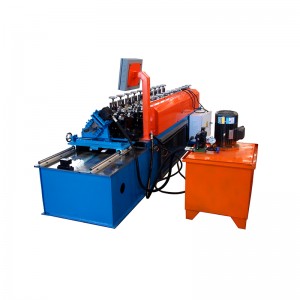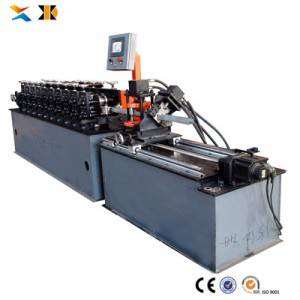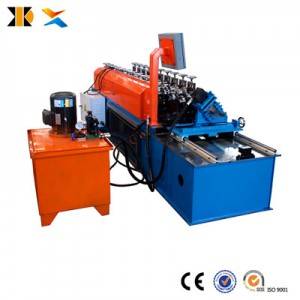

Keel Machine Product Description
As a core production equipment in the field of building decoration, the keel machine is specially designed for the cold bending forming of metal coils. It can process raw materials such as galvanized steel plates, stainless steel plates and aluminum plates into various types of building keels in one go. As the “skeleton” of prefabricated buildings, ceilings and partition walls, it is widely used in various construction projects, helping to upgrade the industrialization and efficiency of building construction.
The equipment adopts advanced cold bending forming technology, which does not require high-temperature heating, avoids thermal deformation of materials, and completely retains the surface coating and structural strength of raw materials. The processed keels have a regular cross-section and meet the strength requirements, fully complying with national building material standards. The whole machine realizes fully automatic operation. From coil loading, guiding and straightening, multi-pass cold bending forming, to fixed-length cutting and finished product receiving, the whole process is controlled with one key, without manual intervention in the middle, which greatly improves production efficiency and reduces labor costs.
The product has the advantages of multi-specification adaptation and strong customization. It can produce various common keels such as C-type, U-type, T-type, L-type and Ω-type by replacing molds, which are suitable for various scenarios such as ceilings, partition walls, light steel villas and prefabricated houses. At the same time, it supports customizing keel thickness, width, cross-sectional shape and processing speed according to customer needs, flexibly matching different construction requirements.
The main body of the equipment is welded with high-quality square steel, with a stable structure; the forming rollers are made of GCR15 quenched material, which has high hardness, wear resistance and durability, and can withstand long-term high-intensity continuous production with a service life of more than 10 years. Equipped with PLC intelligent control system and touch operation interface, it is simple and easy to operate, and new users can get started quickly. At the same time, it is equipped with complete safety protection devices and fault self-diagnosis function, ensuring safe operation and convenient maintenance.
Compared with traditional processing methods, the keel machine has a significant effect in energy saving and consumption reduction. The servo drive system saves 30%-40% energy compared with the traditional hydraulic system, and the utilization rate of coil fixed-length processing is as high as 99% or more, with almost no waste generated. It not only saves costs, but also conforms to the concept of green and environment-friendly production. Whether it is mass production by building material manufacturers or on-site processing by construction enterprises, it is an ideal choice with high efficiency, worry-saving and high cost performance.

♦ COMPANY PROFILE:
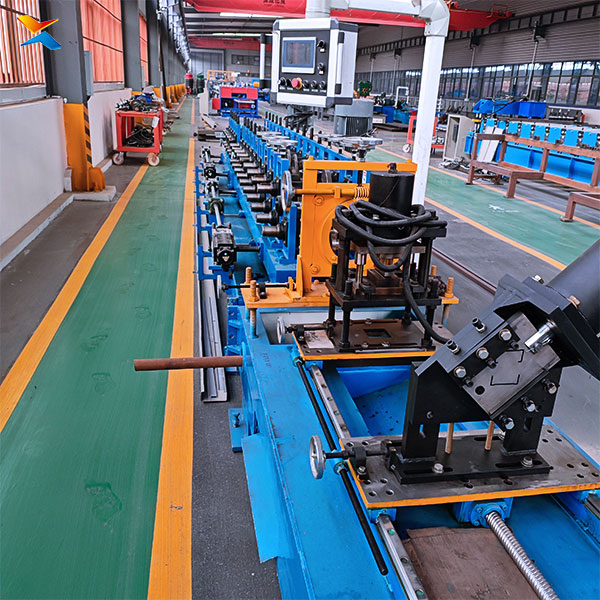
Hebei Xinnuo Roll Forming Machine Co., Ltd., not only produce different types of professional roll forming machines, but also develop intelligent automatic roll forming production lines, C&Z shape purline machines, highway guardrail roll forming machine lines, sandwich panel production lines, decking forming machines, light keel machines, shutter slat door forming machines, downpipe machines, gutter machines, etc.
Advantages of Roll Forming A Metal Part
There are several advantages of using roll forming for your projects:
- The roll forming process allows operations such as punching, notching, and welding to be performed in-line. Labor cost and time for secondary operations are reduced or eliminated, reducing part costs.
- Roll form tooling allows for a high degree of flexibility. A single set of roll form tools will make almost any length of the same cross-section. Multiple sets of tools for varying length parts are not required.
- It can provide better dimensional control than other competing metal forming processes.
- Repeatability is inherent in the process, allowing easier assembly of roll formed parts into your finished product, and minimizing problems due to “standard” tolerance build up.
- Roll forming is typically a higher speed process.
- Roll forming offers customers a superior surface finish. This makes roll forming an excellent option for decorative stainless steel parts or for parts requiring a finish such as anodizing or powder coating. Also, texture or pattern can be rolled into the surface during forming.
- Roll forming utilizes material more efficiently than other competing processes.
- Roll formed shapes can be developed with thinner walls than competing processes
Roll forming is a continuous process which converts sheet metal into an engineered shape using consecutive sets of mated rolls, each of which makes only incremental changes in the form. The sum of these small changes in form is a complex profile.