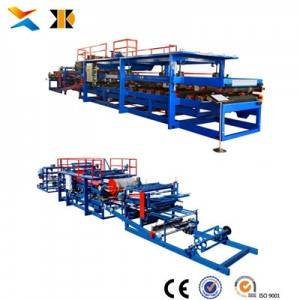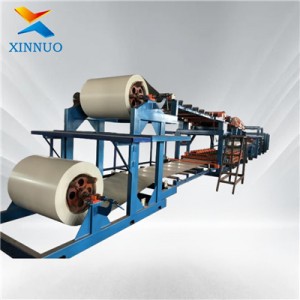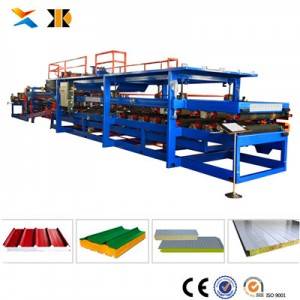

3 Sets of Different Composite Board Production Line Product Descriptions (English)
Version 4 (Focus on Cost-Effectiveness & Practicality)
Our composite board production line is a cost-effective and practical complete equipment, specially designed for small and medium-sized enterprises and start-ups. It realizes semi-automatic to fully automatic production conversion, with simple structure, low investment cost and quick return on investment. The line can produce various conventional composite boards, with stable production performance and easy operation, no professional technical team is needed. It adopts energy-saving design to reduce daily operation cost, and the finished products have good flatness and bonding force, which can meet the basic needs of construction, decoration and furniture industries. We provide intimate after-sales guidance to help customers get on the production track quickly.
Version 5 (Focus on High-End Quality & International Standards)
Designed in line with international industry standards, our composite board production line is committed to producing high-end, high-performance composite boards for global high-end markets. The equipment adopts imported core components and precision control technology, which can realize ultra-precise production of composite boards, with uniform thickness error within ±0.1mm. It supports the production of high-grade decorative composite boards, anti-corrosion composite boards and other high-value-added products, which are widely used in high-end buildings, luxury furniture and export projects. The production line complies with CE, ISO and other international certifications, with strict quality inspection system, ensuring that each batch of products meets international export standards.
Version 6 (Focus on Environmental Protection & Sustainable Development)
As a green and sustainable composite board production solution, our production line takes environmental protection as the core design concept, realizing zero pollution and low energy consumption in the whole production process. It adopts recyclable raw material processing technology, can fully utilize waste resources (such as waste wood, waste plastic) to produce composite boards, realizing resource recycling. The equipment is equipped with advanced dust removal, waste gas treatment and noise reduction systems, which fully complies with global environmental protection policies. The composite boards produced are non-toxic, tasteless and recyclable, meeting the needs of green buildings and low-carbon life. It is an ideal choice for enterprises to take the green development path and enhance brand competitiveness.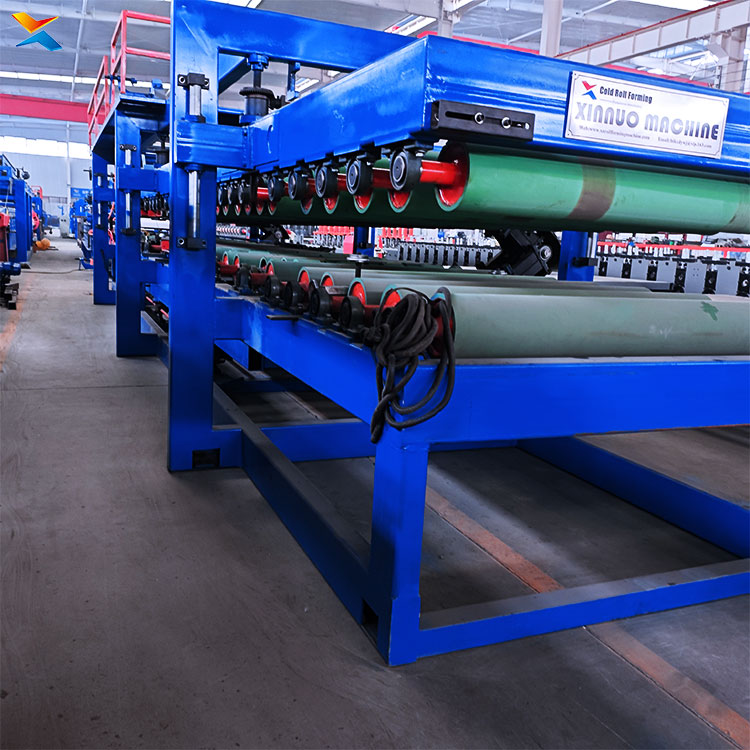
♦ COMPANY PROFILE:
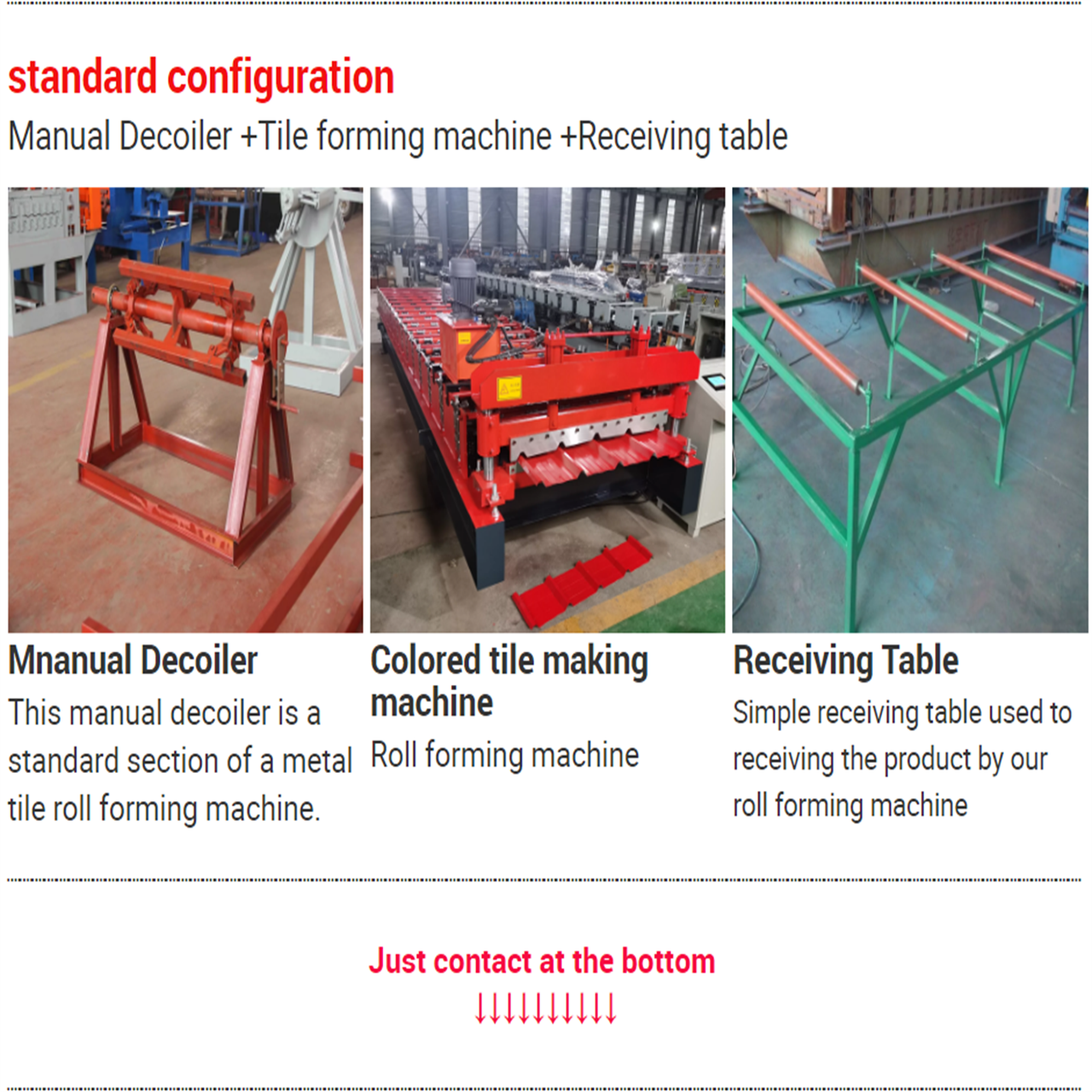
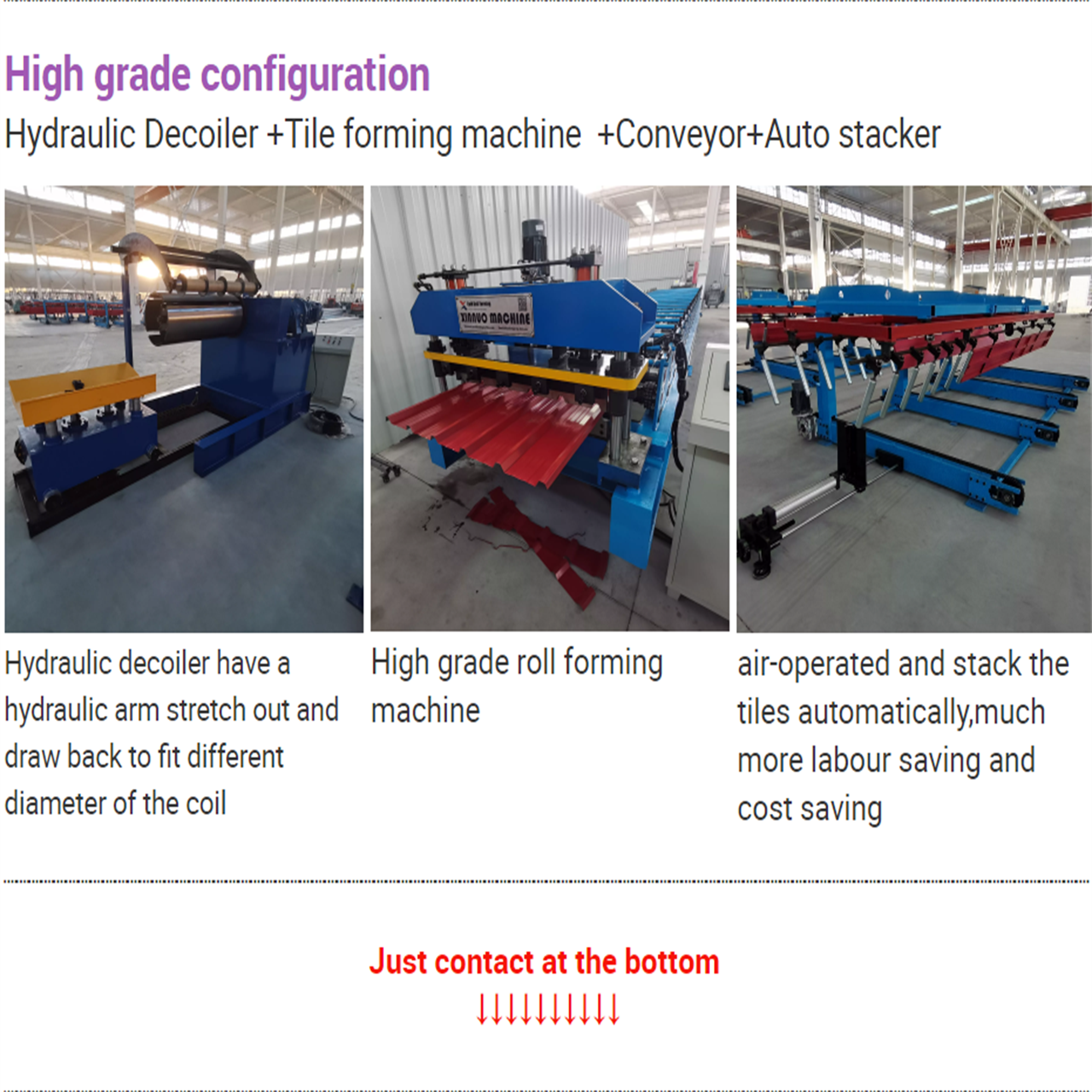
Hebei Xinnuo Roll Forming Machine Co., Ltd., not only produce different types of professional roll forming machines, but also develop intelligent automatic roll forming production lines, C&Z shape purline machines, highway guardrail roll forming machine lines, sandwich panel production lines, decking forming machines, light keel machines, shutter slat door forming machines, downpipe machines, gutter machines, etc.
Advantages of Roll Forming A Metal Part
There are several advantages of using roll forming for your projects:
- The roll forming process allows operations such as punching, notching, and welding to be performed in-line. Labor cost and time for secondary operations are reduced or eliminated, reducing part costs.
- Roll form tooling allows for a high degree of flexibility. A single set of roll form tools will make almost any length of the same cross-section. Multiple sets of tools for varying length parts are not required.
- It can provide better dimensional control than other competing metal forming processes.
- Repeatability is inherent in the process, allowing easier assembly of roll formed parts into your finished product, and minimizing problems due to “standard” tolerance build up.
- Roll forming is typically a higher speed process.
- Roll forming offers customers a superior surface finish. This makes roll forming an excellent option for decorative stainless steel parts or for parts requiring a finish such as anodizing or powder coating. Also, texture or pattern can be rolled into the surface during forming.
- Roll forming utilizes material more efficiently than other competing processes.
- Roll formed shapes can be developed with thinner walls than competing processes
Roll forming is a continuous process which converts sheet metal into an engineered shape using consecutive sets of mated rolls, each of which makes only incremental changes in the form. The sum of these small changes in form is a complex profile.