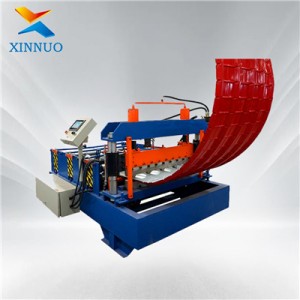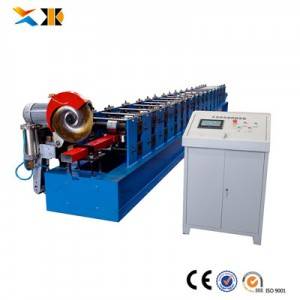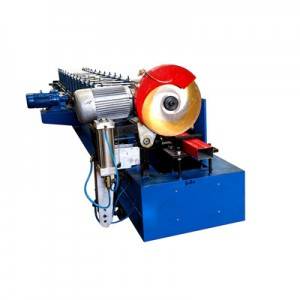


Hebei Xinnuo Downspout Roll Forming Machine – Detailed Specifications & Advantages
Product Overview
Hebei Xinnuo’s downspout roll forming machine is a CNC-integrated, fully automated metal forming system designed exclusively for manufacturing high-quality rainwater downspouts, gutter pipes, and drainage tubes. Engineered for heavy-duty industrial use, it processes a wide range of metal materials to meet the strictest building standards across Europe, Asia, Africa, and the Americas.
Key Advantages for Global Buyers
-
High Precision & Consistency
- Advanced CNC roll forming technology ensures ±0.1mm dimensional accuracy, eliminating product defects and reducing material waste by 95%.
- Adjustable roll sets enable quick switching between pipe sizes/shapes, ideal for small-batch customization and large-scale mass production.
-
Durability & Low Maintenance
- Robust welded steel frame with anti-rust coating withstands 24/7 continuous operation in harsh industrial environments.
- Wear-resistant chromium-plated rolls have a service life of 50,000+ working hours, minimizing replacement costs and downtime.
-
Energy Efficiency & Cost Savings
- Equipped with a variable frequency drive (VFD) system, reducing energy consumption by 20-30% compared to traditional machines.
- Fully automated feeding, forming, cutting, and stacking processes cut labor costs by 60%—no manual intervention required.
-
Compliance with International Standards
- CE, ISO 9001, and SGS certified, meeting safety and quality requirements for the EU, North American, and Middle Eastern markets.
- Customizable to local building codes (e.g., ASTM, BS, DIN standards) for seamless integration into regional production lines.
Full-Service Support from Hebei Xinnuo
- Factory-Direct Pricing: No middlemen—competitive wholesale prices for single units and bulk orders.
- Global On-Site Service: Professional engineers provide free installation, commissioning, and operator training within 7 working days of machine arrival.
- 12-Month Warranty & Spare Parts Supply: Free replacement of defective parts for 1 year; long-term supply of original spare parts at factory prices.
- Customization Solutions: Tailor machine design, speed, and size to match your specific production needs and budget.
Ideal Applications
Metal fabrication factories, construction material suppliers, roofing & drainage system manufacturers, prefabricated building companies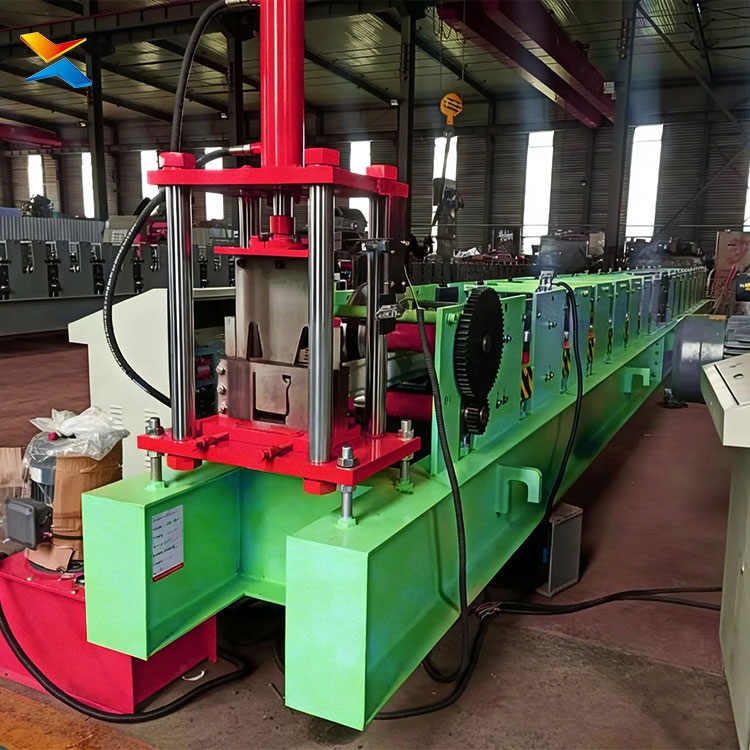



♦ COMPANY PROFILE:
Hebei Xinnuo Roll Forming Machine Co., Ltd., not only produce different types of professional roll forming machines, but also develop intelligent automatic roll forming production lines, C&Z shape purline machines, highway guardrail roll forming machine lines, sandwich panel production lines, decking forming machines, light keel machines, shutter slat door forming machines, downpipe machines, gutter machines, etc.
Advantages of Roll Forming A Metal Part
There are several advantages of using roll forming for your projects:
- The roll forming process allows operations such as punching, notching, and welding to be performed in-line. Labor cost and time for secondary operations are reduced or eliminated, reducing part costs.
- Roll form tooling allows for a high degree of flexibility. A single set of roll form tools will make almost any length of the same cross-section. Multiple sets of tools for varying length parts are not required.
- It can provide better dimensional control than other competing metal forming processes.
- Repeatability is inherent in the process, allowing easier assembly of roll formed parts into your finished product, and minimizing problems due to “standard” tolerance build up.
- Roll forming is typically a higher speed process.
- Roll forming offers customers a superior surface finish. This makes roll forming an excellent option for decorative stainless steel parts or for parts requiring a finish such as anodizing or powder coating. Also, texture or pattern can be rolled into the surface during forming.
- Roll forming utilizes material more efficiently than other competing processes.
- Roll formed shapes can be developed with thinner walls than competing processes
Roll forming is a continuous process which converts sheet metal into an engineered shape using consecutive sets of mated rolls, each of which makes only incremental changes in the form. The sum of these small changes in form is a complex profile.