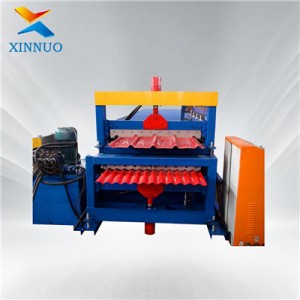


Detailed Description of Double Layer Single Sheet Forming Machine
I. Product Definition and Core Positioning
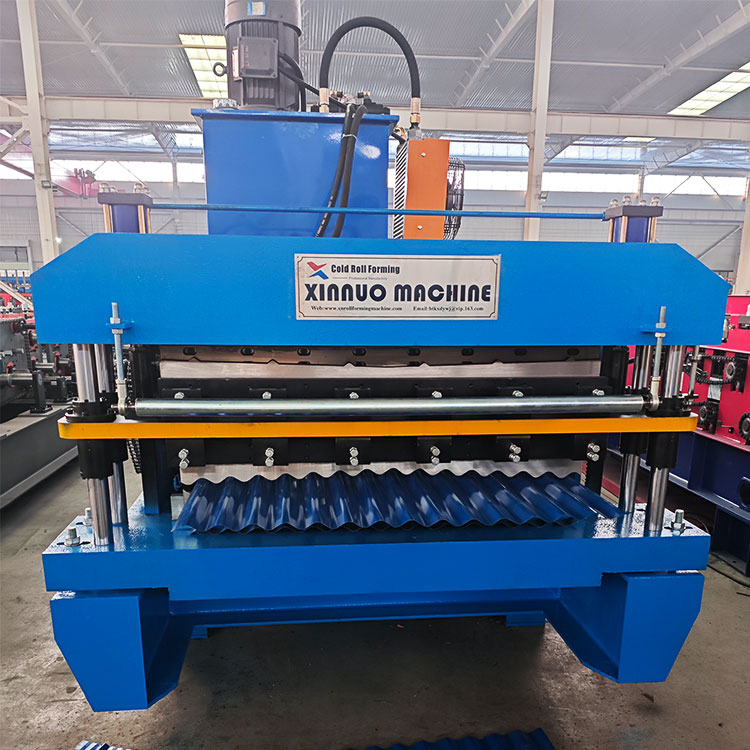
The Double Layer Single Sheet Forming Machine is an efficient and automated equipment designed for metal sheet processing based on cold roll forming technology. Its core feature is the vertical integration of two independent single-sheet forming systems into the same machine frame, enabling alternating production of two metal sheets with different specifications and types. There is no need to purchase additional single machines, making it a core equipment to solve the pain points of “limited space, diverse orders and high costs” in metal building materials production.
The equipment is mainly used for cold roll forming of color-coated steel sheets, galvanized steel sheets, stainless steel sheets, aluminum-magnesium-manganese alloy sheets and other metal sheets. It can produce various commonly used building single sheets such as trapezoidal tiles, corrugated tiles and standing seam tiles. It is widely suitable for the roof, wall decoration and enclosure needs of steel structure workshops, warehouses, prefabricated houses, agricultural greenhouses, public venues and other buildings. It is the core production equipment of metal building materials processing plants, steel structure enterprises and prefabricated component factories.
II. Overall Structure Composition (Detailed Explanation of Core Components)
The equipment adopts a modular design as a whole, consisting of six core parts: machine frame, feeding system, forming system, cutting system, control system and discharging system. All components work together to ensure forming accuracy and production efficiency. The specific details are as follows:
1. Machine Frame
It is integrally welded with 350# H-beam and undergoes aging treatment to eliminate welding stress, ensuring strong rigidity and high stability of the frame. It can effectively avoid frame deformation during long-term high-speed operation and ensure forming accuracy. The surface of the frame is treated with sandblasting derusting + electrostatic spraying, which is corrosion-resistant and wear-resistant, suitable for complex working environments such as humidity and dust in the workshop, and the service life can reach more than 10 years.
The height and width of the frame can be customized according to production needs. The floor area of the conventional model is only 1/2 ~ 1/3 of that of two single machines, which greatly saves workshop space resources and reduces site rental costs.
2. Feeding System
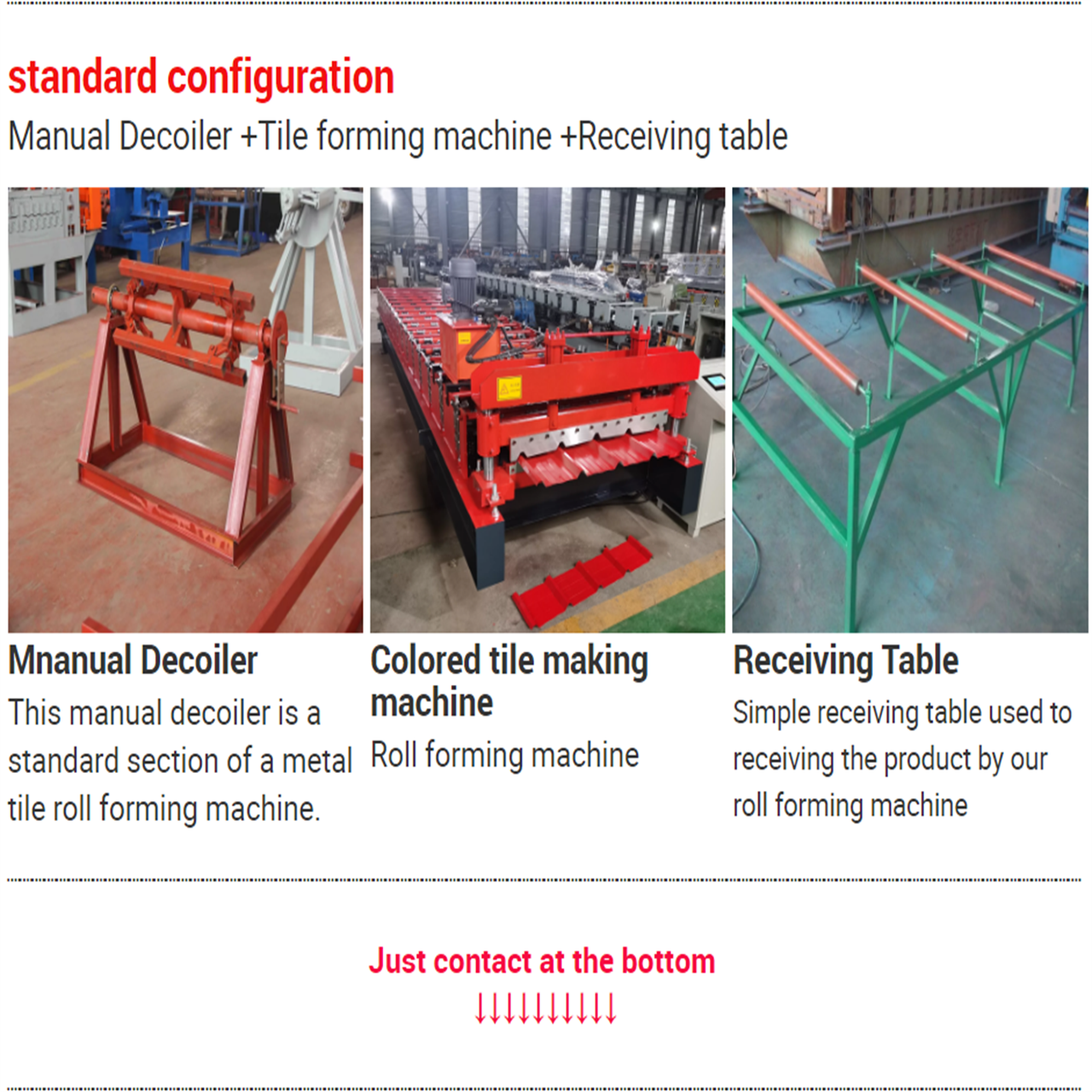
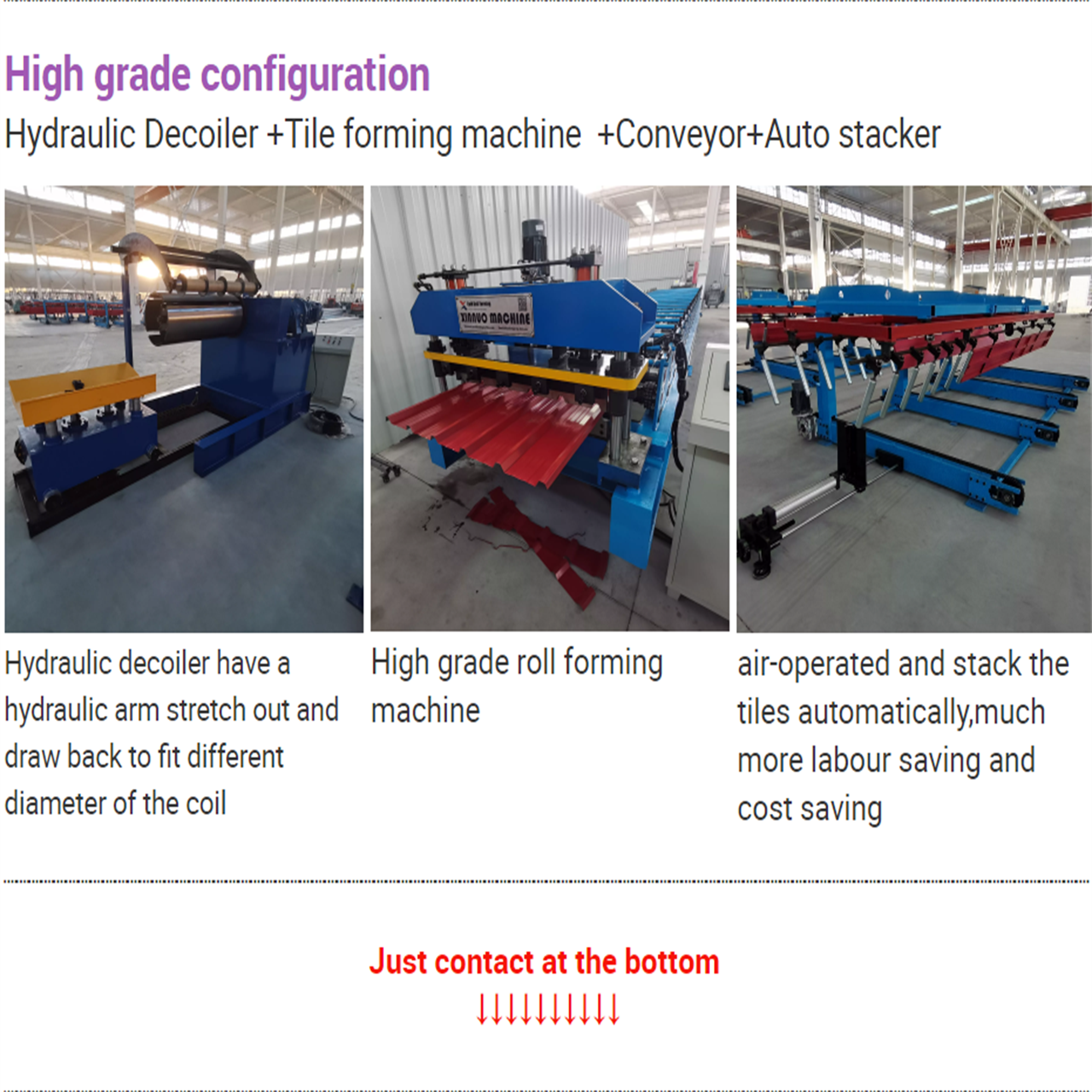
The feeding system is composed of an uncoiler, a leveling machine and a feeding guide device, which is responsible for the stable transportation and preprocessing of metal coils to provide high-quality blanks for subsequent forming:
- Uncoiler: Adopts hydraulic expansion design, suitable for coil inner diameter Φ508mm ~ Φ610mm, outer diameter ≤ Φ1200mm, can bear coil weight ≤ 5000kg, equipped with coil anti-deviation device to avoid coil deviation during feeding and ensure feeding accuracy;
- Leveling machine: Adopts multi-roll leveling structure (conventional 12 ~ 16 rolls), the roller is precision processed with 45# quenched steel and chrome-plated on the surface, which can effectively eliminate the rolling stress of the metal coil, correct the flatness of the sheet, ensure that the formed single sheet has no warpage and no waviness, and the leveling accuracy can reach ±0.1mm/m;
- Feeding guide device: Equipped with adjustable guide rollers, which can be flexibly adjusted according to the width of the sheet, the guide accuracy is ≤ ±0.5mm, avoiding the deviation of the sheet during feeding and ensuring the accuracy of the subsequent forming size.
3. Forming System (Core Component)
The forming system is the core of the equipment, adopting a “double-layer independent design”. Each of the upper and lower layers is equipped with a complete set of forming roller groups, which can be debugged for different types separately to realize rapid switching production. The specific details are as follows:
- Forming roller group: Each layer is equipped with 12 ~ 22 forming stations (adjusted according to the complexity of the type). The roller is made of 45# high-quality carbon steel,经过 quenching and tempering treatment, the hardness can reach HRC55 ~ 60, and the surface is treated with hard chrome plating (thickness 0.05 ~ 0.1mm), which is wear-resistant and corrosion-resistant. It can bear the friction and pressure of high-speed forming for a long time, and the processing accuracy of the roller group is ≤ ±0.02mm;
- Forming drive: Adopts chain drive + frequency conversion speed regulation design. The motor power is 11 ~ 22KW according to the model configuration, and the frequency conversion range is 0 ~ 20m/min. The forming speed can be flexibly adjusted according to the sheet thickness and type complexity, ensuring stable forming process and avoiding scratches, wrinkles and other defects on the sheet;
- Interlayer switching: Equipped with manual/automatic switching device, the switching process is simple and fast, no need to disassemble the roller group, the switching time is ≤ 5 minutes, which can quickly realize the alternating production of two types, adapting to the needs of multi-batch and small-batch orders.
4. Cutting System
Adopts hydraulic cutting design, matched with Cr12MoV high-quality die steel blade, which has high hardness, strong wear resistance, high cutting accuracy and flat incision without burr and deformation. The specific parameters are as follows:
- Cutting method: Hydraulic synchronous cutting, fast cutting speed (single cutting time ≤ 0.5s), which can realize fixed-length cutting in continuous production without shutdown waiting;
- Cutting accuracy: The cutting length tolerance is ≤ ±2mm. According to production needs, the cutting length can be preset through the control system (range 1 ~ 12m), supporting two modes: continuous fixed-length and batch fixed-length;
- Blade maintenance: The blade is detachable and replaceable, with long service life. Daily maintenance only needs regular lubrication and grinding, and the maintenance cost is low.
5. Control System
Adopts PLC programmable control system + color touch screen (HMI), which is simple to operate and highly intelligent, suitable for operators of different operation levels. The core functions are as follows:
- Parameter setting: Digitally set parameters such as forming speed, cutting length, production quantity and interlayer switching. Parameters can be saved and called, adapting to multi-batch repeated production;
- Status monitoring: Real-time display of equipment operation status (such as forming speed, production quantity, fault alarm, etc.). When a fault occurs, it will automatically shut down and prompt the cause of the fault, facilitating quick troubleshooting;
- Safety protection: Equipped with emergency stop button, protective fence and photoelectric protection device, avoiding safety accidents caused by misoperation of operators, and complying with industrial safety standards;
- Optional configuration: Can be upgraded to PLC + touch screen + remote control module, supporting remote debugging and fault troubleshooting, facilitating remote management.
6. Discharging System
Composed of a discharging frame, a supporting roller and a stacking device, it is responsible for the stable output and sorting of the formed single sheets:
- Discharging frame: The length matches the equipment body (conventional 7 ~ 10m), adopts steel structure welding, and the surface is paved with non-slip rubber pads to avoid scratches on the surface of the single sheet;
- Supporting roller: Evenly distributed on the discharging frame, made of polyurethane material, flexible rotation, can stably support the single sheet output, avoiding single sheet deformation;
- Stacking device: Equipped with adjustable stacking baffle, which can be adjusted according to the length and width of the single sheet, realizing automatic alignment and stacking of single sheets, reducing manual sorting workload and improving production efficiency.
III. Working Principle and Operation Process
1. Core Working Principle
The equipment adopts the working mode of “cold roll forming + double-layer alternation”. Using the plasticity of metal sheets, the flat metal sheets are gradually cold-rolled into the preset shape through two independent upper and lower forming roller groups, and then cut to fixed length by the hydraulic cutting device, and finally output qualified metal single sheets. The core feature is that “two types cannot be produced at the same time, but can be switched quickly”, taking into account both production efficiency and type diversity.
2. Complete Operation Process (Fully Automated, Operable by One Person)
- Coil installation: Hoist the metal coil to the uncoiler, fix the coil through the hydraulic expansion device, adjust the position of the coil to ensure no deviation;
- Parameter debugging: Turn on the control system, set the forming speed, cutting length and production quantity according to production needs, select the desired type (upper layer/lower layer), and call the corresponding parameters (such as forming station pressure, guide position, etc.);
- Feeding and leveling: Start the equipment, the uncoiler gradually releases the coil, which is corrected for flatness by the leveling machine, and then guided to the selected forming layer (upper layer/lower layer) by the feeding guide device;
- Cold roll forming: After the sheet enters the forming roller group, it is gradually cold-rolled through multiple stations. The roller group exerts uniform pressure to bend the sheet into the preset trapezoidal, corrugated and other types. During the forming process, the surface quality of the sheet is monitored in real time to avoid scratches and wrinkles;
- Fixed-length cutting: The formed single sheet is continuously transported to the cutting device. When the preset length is reached, the hydraulic cutting device cuts quickly, with a flat incision without burrs;
- Discharging and stacking: The cut single sheet is transported to the stacking device through the discharging frame and automatically aligned and stacked. When the stacking reaches the preset quantity, it is manually transferred to the finished product area;
- Type switching: When it is necessary to produce another type, switch to the corresponding forming layer through the control system, adjust the guide device and parameters, no need to shut down and disassemble parts, and the production can be continued after switching within 5 minutes.
IV. Core Technical Parameters (Standard Model, Customizable)
|
Parameter Name
|
Standard Parameters (840/900 Type)
|
Customizable Range
|
|
Forming Type
|
840 Type (Roof Tile) / 900 Type (Wall Tile)
|
Various trapezoidal, corrugated and standing seam types such as 760, 828 and 860
|
|
Forming Stations
|
18 for upper layer, 12 for lower layer
|
12 ~ 22 (adjusted according to the complexity of the type)
|
|
Applicable Sheets
|
Color-coated steel sheets, galvanized steel sheets, stainless steel sheets, aluminum-magnesium-manganese alloy sheets
|
Various metal sheets (as long as the thickness is suitable)
|
|
Sheet Thickness
|
0.3 ~ 0.8mm
|
0.2 ~ 1.2mm
|
|
Feeding Width
|
1000mm
|
800 ~ 1250mm
|
|
Forming Speed
|
8 ~ 18m/min
|
5 ~ 20m/min (frequency conversion adjustable)
|
|
Cutting Length
|
1 ~ 12m (fixed length adjustable)
|
0.5 ~ 15m
|
|
Cutting Tolerance
|
≤±2mm
|
≤±1mm (high-precision customization)
|
|
Total Power
|
18.5KW
|
11 ~ 22KW
|
|
Machine Size (L×W×H)
|
7300mm×1450mm×1500mm
|
Adjusted according to type and number of stations
|
|
Equipment Weight
|
About 5000kg
|
4000 ~ 8000kg
|
|
Control System
|
PLC + Color Touch Screen
|
Can be upgraded to remote control and PLC linkage control
|
|
Power Supply Requirement
|
380V/50Hz (Three-phase Five-wire System)
|
Can be adapted to 110V/60Hz (export customization)
|
V. Product Advantages (Core Competitiveness)
1. Double Savings in Space and Cost
Integrating two forming systems into one, the floor area is only 1/2 ~ 1/3 of that of two single machines, which greatly saves workshop space resources and reduces site rental costs; at the same time, there is no need to purchase two single machines separately, the initial equipment investment can be reduced by 30% ~ 40%, and the manpower and material costs for equipment installation, commissioning and maintenance are reduced, which is suitable for small and medium-sized processing plants and enterprises with limited budgets.
2. High Efficiency and Flexibility, Adapting to Multi-order Needs
Frequency conversion speed regulation design, the forming speed can be flexibly adjusted, up to 20m/min, the daily output can reach 800 ~ 1500 ㎡, and the production efficiency is far higher than that of traditional single machines; interlayer switching is fast (≤ 5 minutes), which can realize alternating production of two types without stopping the machine to change rollers, adapting to the needs of multi-batch, small-batch and multi-type orders, and effectively improving the order delivery efficiency.
3. High Forming Accuracy and Stable Product Quality
The machine body adopts H-beam welding + aging treatment, with strong rigidity and no deformation; the forming roller group is precision processed and chrome-plated on the surface, with high forming accuracy, the single sheet size tolerance is ≤ ±2mm, and the surface has no scratches, no warpage and no waviness; the leveling system can effectively eliminate the sheet stress, ensure high flatness of the formed single sheet, meet the building construction standards, and improve product competitiveness.
4. Intelligent Operation, Reducing Labor Costs
PLC programmable control system + touch screen, simple and easy to understand operation, no need for professional and technical personnel, one person can complete the whole machine operation (feeding, debugging, monitoring, discharging); parameters can be saved and called, reducing repeated debugging workload; automatic fault alarm, facilitating quick troubleshooting, reducing labor costs and operation difficulty.
5. Strong Durability and Low Maintenance Cost
Core components (forming rollers, blades, motors) are all precision processed with high-quality materials, with wear resistance, corrosion resistance and long service life; the equipment adopts an overall modular design, which is convenient for component replacement and maintenance. Daily maintenance only needs regular lubrication, cleaning and inspection, with low maintenance cost. The annual maintenance cost is only 2% ~ 3% of the total equipment price.
6. Wide Adaptability and High Customization Degree
It can process various metal sheets (color-coated sheets, galvanized sheets, stainless steel sheets, etc.), adapting to sheets of different thicknesses and widths; it can customize equipment of different types, different stations and different powers according to customer needs, and can also upgrade functions such as remote control and automatic stacking, adapting to production needs of different industries and different scenarios.
VI. Applicable Scenarios and Application Fields
The equipment is mainly used for mass production of metal single sheets, adapting to the roof and wall enclosure and decoration of various buildings. The specific application fields are as follows:
- Industrial and commercial buildings: Factory workshops, warehouses, logistics centers, supermarkets, shopping malls, etc., used for roof and wall enclosure, with waterproof, thermal insulation and decorative functions;
- Public facilities: Stadiums, exhibition centers, airport terminals, railway stations, hospitals, schools, etc., used for large-scale roof and wall decoration, beautiful and durable;
- Prefabricated buildings: Container houses, mobile board houses, temporary construction offices, prefabricated residences, etc., used for quickly building roofs and walls, improving construction efficiency;
- Agricultural facilities: Greenhouses, livestock barns, grain storage sheds, etc., used for roof and wall enclosure, corrosion-resistant and wind-resistant;
- Other fields: Steel structure landscapes, enclosures, sound insulation barriers, etc., used for customized metal single sheet production.
VII. Daily Maintenance and Precautions
1. Daily Maintenance (Daily/Weekly/Monthly)
- Daily maintenance: Before starting the machine, check whether the equipment power supply, hydraulic system and transmission system are normal, and whether there is abnormal noise or oil leakage; clean the dust and debris on the equipment surface, feeding guide device and discharging frame; check whether the blade is sharp, and grind it in time if it is worn;
- Weekly maintenance: Lubricate the forming roller group, transmission chain and leveling roller (add lubricating oil); check whether the pressure of the hydraulic expansion device of the uncoiler is normal; check the alignment accuracy of the stacking device and adjust it in time;
- Monthly maintenance: Check the wear of the forming roller group and blade, and replace them in time if they are seriously worn; check whether the machine frame is deformed or loose, and fasten the bolts in time; debug the control system and clean the parameter cache; check the oil quantity and purity of the hydraulic oil, and supplement or replace it in time.
2. Precautions
- Operators must receive professional training, be familiar with the equipment operation process, and are strictly prohibited from misoperation; before starting the machine, must check whether the safety protection devices (protective fence, emergency stop button) are intact, and it is strictly prohibited to start the machine when the protective devices are removed;
- During production, it is strictly prohibited to touch moving parts such as forming roller groups, blades and feed inlets with hands to avoid safety accidents; if it is necessary to adjust parameters or clean debris, must stop the machine and cut off the power first;
- It is strictly prohibited to process sheets beyond the applicable range of the equipment (such as too thick or too wide), so as to avoid damaging core components such as forming roller groups, blades and motors;
- During the operation of the equipment, if abnormal conditions such as abnormal noise, vibration and fault alarm occur, should immediately stop the machine and cut off the power, and restart the machine only after troubleshooting and solving the problem;
- When the equipment is not used for a long time, should clean the dust and debris on the surface and inside of the equipment, apply anti-rust oil, turn off the power and water source, and do a good job in moisture-proof and dust-proof treatment to avoid component rust.
VIII. Quality Assurance and After-sales Service
1. Quality Assurance
All core components of the equipment are made of high-quality materials, and are produced, processed and assembled in strict accordance with national industrial standards; before leaving the factory, each equipment undergoes a 72-hour continuous trouble-free operation test to ensure stable equipment performance and qualified accuracy; the equipment warranty period is 12 months (core components, such as motors, PLC, forming roller groups). During the warranty period, non-artificially damaged components can be replaced and repaired free of charge.
2. After-sales Service
- Installation and commissioning: Provide free on-site installation and commissioning services, and arrange professional and technical personnel to guide operators on-site to be familiar with the equipment operation and maintenance process;
- Technical training: Provide free technical training for customers, including equipment operation, parameter debugging, daily maintenance, fault troubleshooting, etc., to ensure that customer operators can operate the equipment independently;
- Fault maintenance: During the warranty period, if the equipment fails, after receiving the customer’s repair request, respond within 2 hours and provide a solution within 24 hours. If on-site maintenance is needed, arrange technical personnel to go on-site within 48 hours;
- Accessory supply: Provide long-term equipment accessory supply services with preferential accessory prices and timely supply to ensure the normal operation of the equipment;
- Lifetime service: After the equipment warranty period, still provide lifetime technical consultation and maintenance services, and charge reasonable maintenance fees and accessory fees.


♦ COMPANY PROFILE:
Hebei Xinnuo Roll Forming Machine Co., Ltd., not only produce different types of professional roll forming machines, but also develop intelligent automatic roll forming production lines, C&Z shape purline machines, highway guardrail roll forming machine lines, sandwich panel production lines, decking forming machines, light keel machines, shutter slat door forming machines, downpipe machines, gutter machines, etc.
Advantages of Roll Forming A Metal Part
There are several advantages of using roll forming for your projects:
- The roll forming process allows operations such as punching, notching, and welding to be performed in-line. Labor cost and time for secondary operations are reduced or eliminated, reducing part costs.
- Roll form tooling allows for a high degree of flexibility. A single set of roll form tools will make almost any length of the same cross-section. Multiple sets of tools for varying length parts are not required.
- It can provide better dimensional control than other competing metal forming processes.
- Repeatability is inherent in the process, allowing easier assembly of roll formed parts into your finished product, and minimizing problems due to “standard” tolerance build up.
- Roll forming is typically a higher speed process.
- Roll forming offers customers a superior surface finish. This makes roll forming an excellent option for decorative stainless steel parts or for parts requiring a finish such as anodizing or powder coating. Also, texture or pattern can be rolled into the surface during forming.
- Roll forming utilizes material more efficiently than other competing processes.
- Roll formed shapes can be developed with thinner walls than competing processes
Roll forming is a continuous process which converts sheet metal into an engineered shape using consecutive sets of mated rolls, each of which makes only incremental changes in the form. The sum of these small changes in form is a complex profile.