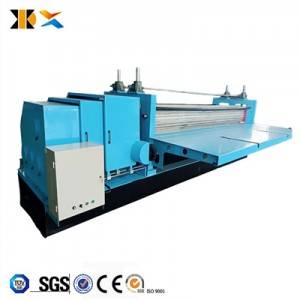


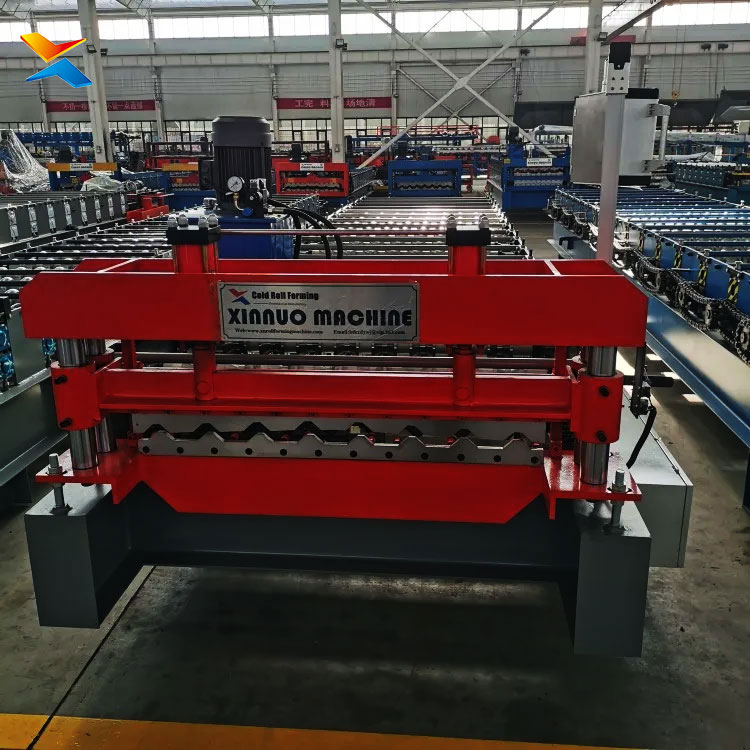
XinNuo Trapezoidal Single Sheet Roll Forming Machine – Product Details
The XinNuo trapezoidal single sheet roll forming machine is a high-performance cold roll forming equipment designed to convert metal coils into trapezoidal profiled sheets through continuous roller pressing. Ideal for steel structure roofing and wall cladding systems, it is compatible with color-coated steel, galvanized steel, aluminized-zinc steel, and aluminum sheets, delivering high efficiency, precision, and automation for global construction projects.
Working Process
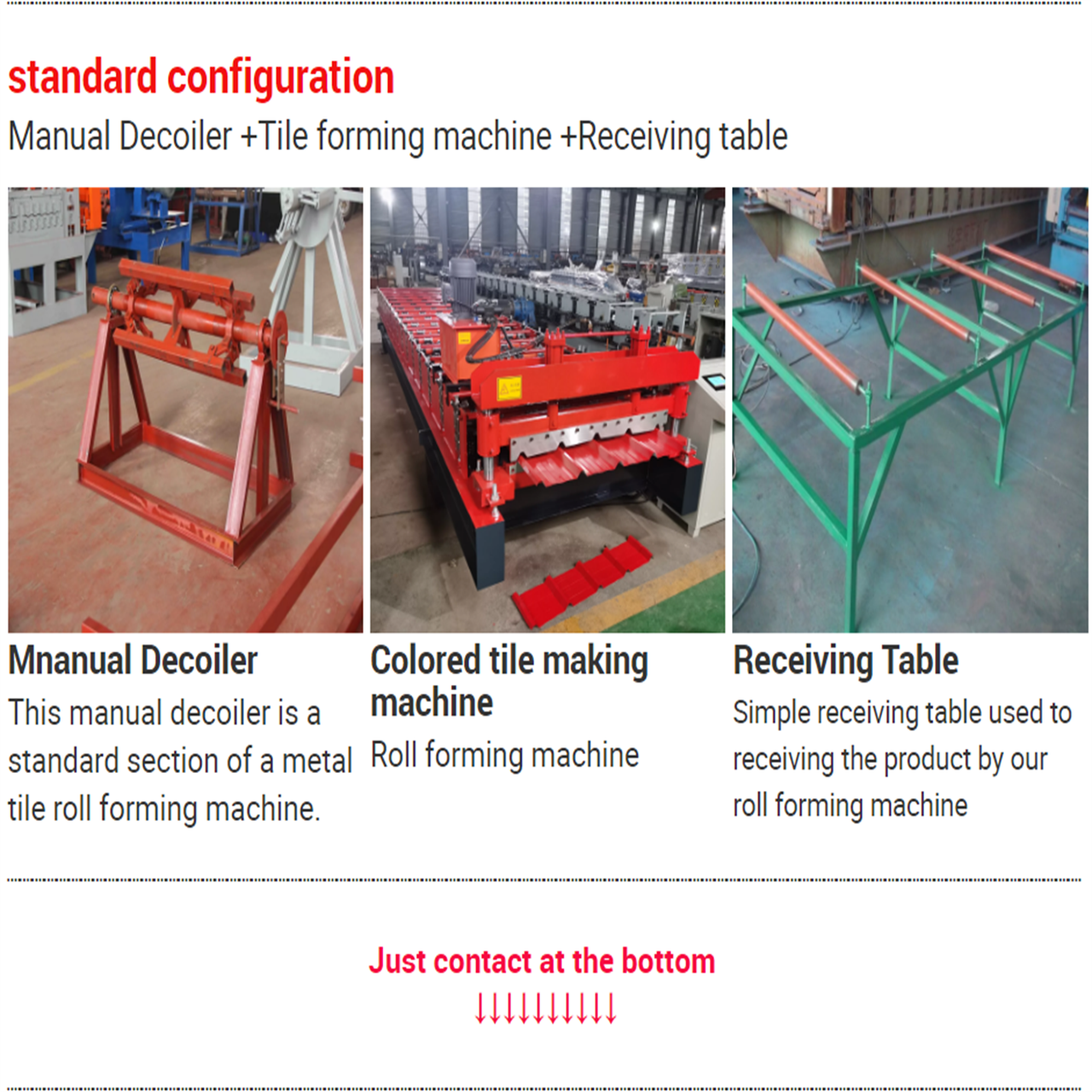
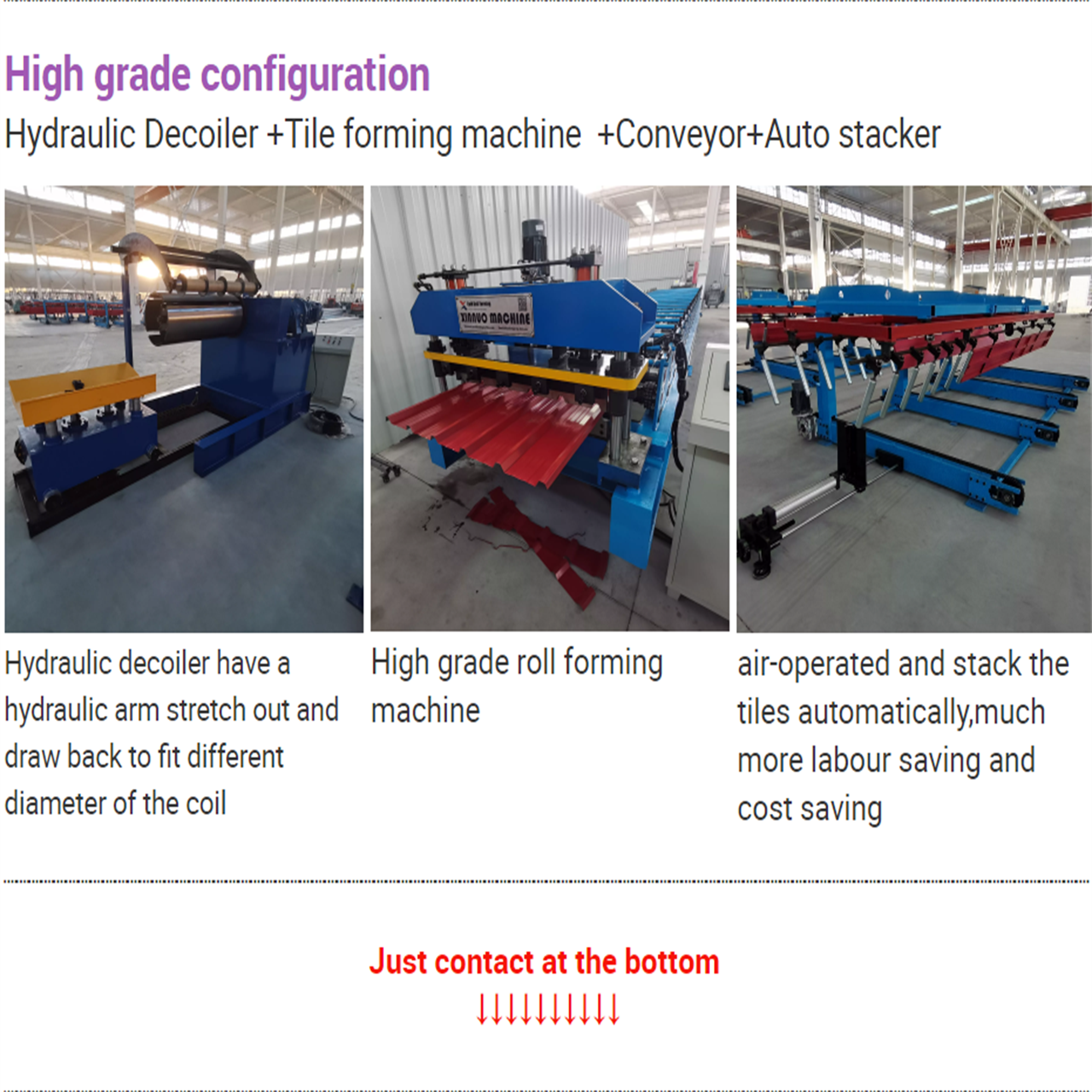
- Uncoiling & Leveling: Metal coils are fed into the uncoiler via the loading trolley, then leveled and guided into the feeding table.
- Continuous Forming: The sheet passes through multi-group forming rollers, which progressively shape it into a trapezoidal cross-section. Roller spacing and angle determine the trapezoid height and slope for customized profiles.
- Precision Cutting: The PLC-controlled cutting system trims the sheet to preset lengths at high speed without stopping production, maximizing output.
- Automatic Stacking: Finished trapezoidal sheets are conveyed to the stacking platform for orderly arrangement, facilitating subsequent transportation and on-site installation.
Core Advantages
- High Efficiency & Large Output: Continuous forming + non-stop cutting enables tens of thousands of meters of daily production, meeting the demands of large-scale factory, warehouse, and logistics center projects.
- Superior Precision & Consistency: Chrome-plated rollers and PLC real-time monitoring ensure uniform trapezoidal profiles with sharp edges. Consistent quality reduces on-site installation errors.
- Flexible Customization: Modular design supports quick profile switching. Customize trapezoid height, flange width, and sheet length to match diverse architectural design requirements.
- Durable & Low Maintenance: 350H steel frame and gear transmission ensure strong structural stability with low noise. The hydraulic/servo system features a long service life, minimizing maintenance costs.
- Wide Material Compatibility: Adapt to various metal materials to produce trapezoidal sheets with excellent waterproof performance and structural strength, suitable for wind-resistant roofing and load-bearing wall applications.
Application Scenarios
- Industrial & Commercial Buildings: Roofing and wall cladding for factories, warehouses, logistics centers, and workshops.
- Public Infrastructure: Large-span roofing systems for exhibition halls, stadiums, airport terminals, and railway stations.
- Agricultural Facilities: Roofing and side walls for greenhouses, livestock farms, and agricultural storage buildings.
- Steel Structure Supporting: Core cladding component for steel structure buildings, enhancing overall corrosion resistance, wind resistance, and durability.
Customization & Selection Guide
- Profile Matching: Choose the corresponding feeding width and forming rollers based on target trapezoidal sheet models (e.g., 840, 900, 914).
- Material Adaptation: Confirm the equipment’s compatibility with your raw material thickness and type to ensure optimal forming results.
- Automation Upgrade: Optional auto-stacking, film coating, and pre-cutting functions to build a fully automated production line.
- International Certification Compliance: Export models meet CE standards, ensuring safety and regulatory compliance for global markets.



♦ COMPANY PROFILE:
Hebei Xinnuo Roll Forming Machine Co., Ltd., not only produce different types of professional roll forming machines, but also develop intelligent automatic roll forming production lines, C&Z shape purline machines, highway guardrail roll forming machine lines, sandwich panel production lines, decking forming machines, light keel machines, shutter slat door forming machines, downpipe machines, gutter machines, etc.
Advantages of Roll Forming A Metal Part
There are several advantages of using roll forming for your projects:
- The roll forming process allows operations such as punching, notching, and welding to be performed in-line. Labor cost and time for secondary operations are reduced or eliminated, reducing part costs.
- Roll form tooling allows for a high degree of flexibility. A single set of roll form tools will make almost any length of the same cross-section. Multiple sets of tools for varying length parts are not required.
- It can provide better dimensional control than other competing metal forming processes.
- Repeatability is inherent in the process, allowing easier assembly of roll formed parts into your finished product, and minimizing problems due to “standard” tolerance build up.
- Roll forming is typically a higher speed process.
- Roll forming offers customers a superior surface finish. This makes roll forming an excellent option for decorative stainless steel parts or for parts requiring a finish such as anodizing or powder coating. Also, texture or pattern can be rolled into the surface during forming.
- Roll forming utilizes material more efficiently than other competing processes.
- Roll formed shapes can be developed with thinner walls than competing processes
Roll forming is a continuous process which converts sheet metal into an engineered shape using consecutive sets of mated rolls, each of which makes only incremental changes in the form. The sum of these small changes in form is a complex profile.